This Is the Asset-Stripping Phase | Simon Dixon on GoldRepublic Global w/ Alexej Jordanov
Jun 25, 2026On June 25, 2026, Simon Dixon participated in an interview for GoldRepublic Global, hosted by Alexej Jordanov. The discussion, titled “This Is the Asset-Stripping Phase,” lasted approximately 1 hour and 56 minutes.
Executive Summary
The central thesis of the discussion is that the global economy has entered a deliberate "asset-stripping phase" orchestrated by a convergence of three power structures: the Financial Industrial Complex (FIC), the Military Industrial Complex (MIC), and the emerging Technical Industrial Complex (TIC). Simon Dixon argues that these entities are transitioning the world from a debt-based slavery model to a technocratic global control grid.
Key takeaways include:
- The Transition of Power: Historical dominance has shifted from the MIC to the FIC (post-1971) and is now moving toward the TIC, which utilizes AI, social credit scores, and programmable money (CBDCs/Stablecoins) for population control.
- Asset Stripping: Nations, particularly in Europe and the UK, are allegedly being systemically stripped of assets through engineered crises, tax policies on unrealized gains, and the reallocation of productive capital into military and energy dependency.
- Bitcoin’s Bifurcation: A sharp divide has emerged between "Sovereign Bitcoin" (self-custody, decentralized nodes) and "Wall Street Bitcoin" (ETFs, corporate treasuries, and captured custodians).
- The Strategic Boycott: Dixon advocates for "sovereignty" through a boycott of the centralized financial system, utilizing self-custodied Bitcoin and physical gold to build wealth outside the FIC's reach.
High-Level Overview
The interview explores the historical evolution of central banking and imperialism, starting from the Dutch Empire to the current "multipolar" world order. The discussion frames current geopolitical events—including the war in Ukraine, civil unrest in the UK, and the rise of AI—not as isolated incidents, but as coordinated mechanisms to concentrate wealth and install a technocratic surveillance state.
Key Arguments Made by Simon Dixon
The Evolution of the "Complex" (FIC, MIC, TIC)
- The FIC Origins: Dixon traces the current system to the Dutch Empire, which established the three pillars of modern subordination: central banking, the private limited liability company, and the government as a "piggy bank" for bondholders.
- The MIC to FIC Shift: In Dixon's opinion, the complete dominance of the FIC occurred around 1971 when the U.S. moved off the gold standard, leading to the financialization and securitization of the global economy.
- The Rise of the TIC: The "Technical Industrial Complex" now seeks to control algorithms, data, and programmable money. Dixon believes this group (including entities like Palantir and XAI) is building a "global control grid."
The Asset-Stripping Phase
- Subordination through Debt: Dixon believes the FIC's goal is to turn individuals and governments into "collateralized debt obligations," where labor is used solely to pay interest.
- Targeting Europe: Europe and the UK are allegedly undergoing systemic asset stripping. Dixon cites tax policies on unrealized gains as a mechanism to force the sale of assets to FIC entities like BlackRock.
- The Ukraine War: Dixon argues the war serves as a money-laundering mechanism to recycle printed currency into the MIC and eventually allow FIC entities to acquire Ukrainian land and resources via debt collateral.
Bitcoin and the Capture Attempt
- Operation Chokepoint 2.0: Dixon claims this was a coordinated effort to destroy independent crypto-servicing banks and replace them with Wall Street institutions (e.g., JPMorgan, BlackRock).
- Wall Street Bitcoin: Dixon believes that Bitcoin ETFs and corporate treasuries (like MicroStrategy) are "subordination vehicles." He characterizes MicroStrategy as an "arbitrage vehicle" designed to centralize Bitcoin for the FIC.
- Sovereign Bitcoin: Dixon defines true Bitcoin as open-source code enforced by 25,000 independent nodes. He maintains that self-custody and running a node is the only way to remain outside the "control grid."
Theories on Satoshi Nakamoto and Infiltration
- Identity Theory: Dixon believes Satoshi Nakamoto was likely Len Sassaman, mentored by David Chaum. He posits that Bitcoin was a "breakaway movement" by a rogue agent from within a project originally intended to create centralized digital currencies.
- Infiltration: Dixon claims to have witnessed numerous attempts by "central intelligence" to infiltrate Bitcoin development since 2011.
Key Arguments Made by Other Participants
Alexej Jordanov (Host)
- Historical Parallels: Cited David Graeber’s Debt: The First 5,000 Years, comparing modern dollar diplomacy to Alexander the Great’s "military-coinage-slavery complex."
- EU Policy Concerns: Highlighted the "Savings and Investments Union" (SIU) as a potential tool to funnel European savings into defense and rearmament (Europe 2030 program).
- Privacy in Bitcoin: Questioned if Bitcoin's pseudo-anonymous nature and the visibility of transactions on-chain make it vulnerable to FIC tracking and "marking" of coins.
Points of Agreement and Disagreement
Points of Agreement
- Systemic Fragility: Both participants agreed that the current financial system is in a "scavenging mode," targeting the "hard-earned money" of citizens to sustain itself.
- Technocratic Threat: There was consensus that digital IDs, CBDCs, and the removal of encryption (as seen in EU proposals) are precursors to a "panopticon" infrastructure.
- Gold’s Value: Both recognized physical gold as a historically proven mechanism for preserving value and autonomy.
Points of Disagreement/Contention
- Bitcoin Privacy: While Dixon argued that Layer 2 (Lightning) and coin joins provide sufficient privacy for the "sovereign," Jordanov remained concerned about the "Hotel California" effect—the difficulty of off-boarding into fiat without total surveillance.
- Satoshi's Identity: While Dixon presented a specific theory regarding Len Sassaman, the host remained neutral, treating it as a speculative but interesting philosophy.
Important Data, Claims, or References Mentioned
Key Entities and Roles
|
Entity |
Role in Analysis |
|
BIS (Bank for International Settlements) |
The jurisdiction for the western central banking system; oversees the "Mbridge" CBDC project. |
|
BlackRock |
Manages $14 trillion; described as the manager of the global "portfolio" of companies and resources. |
|
Palantir |
Described by Dixon as "genocide as a service" and the engine for the pre-crime/surveillance state. |
|
DTCC |
The central clearinghouse that Dixon claims prevents true ownership of public stocks. |
|
MicroStrategy |
Allegedly an arbitrage vehicle used to centralize Bitcoin for the FIC. |
|
S&P 500 |
Described as a tool of subordination used to change corporate behavior via "passive flows." |
Historical and Legislative References
- Operation Chokepoint 2.0: Alleged strategy to remove crypto-friendly banks.
- The Genius Act & Clarity Act: Legislation Dixon believes will give banks the advantage to issue programmable stablecoins using Fed reserves.
- The Balfour Declaration (1917): Cited by Dixon as a move to secure Middle Eastern oil resources.
- 1971 Gold Standard Exit: The turning point for global "financialization."
Notable Quotes or Framing
- On Debt Slavery: "They wanted to create... a collateralized debt obligation where you earn just enough and you work your whole life just to pay the interest... that’s the slavery."
- On Democracy: "There's no such thing as a democracy; democracies are captured. They are politicians that say they work for the people when they work for the lobbies."
- On the End Game: "The endgame here is... you will owe nothing and be happy. How do you achieve that? You will own nothing by inflating the cost of living crisis where anyone that's got assets has to sell them to live."
- On Bitcoin Sovereignty: "If I take that action, am I more subordinate or more sovereign? And who am I subordinate to? ...that’s the job."
- On the TIC: "The next one is the technical industrial complex: the TIC-MIC-FIC... controllers of algorithms, controllers of AI, controllers of social credit scores."
Open Questions or Unresolved Issues
- The "Run" on Custodians: Dixon mentions that "systemic risk" will eventually cause a run on gold and Bitcoin custodians, but the timing and trigger for such an event remain undefined.
- Multipolarity vs. Global Grid: It remains unclear how a "multipolar" world (U.S. vs. China/Russia) reconciles with a "global control grid" that Dixon suggests is being coordinated by the BIS and transnational capital.
- Regulatory Compliance: The tension between being "sovereign" and the necessity of playing within the "confines of the law" (paying taxes, KYC for off-ramps) suggests a limit to total sovereignty that was acknowledged but not fully solved.
Call To Action
- Share this post. Share this blog post to expose the "divide and conquer" trap.
- Subscribe to the Simon Dixon YouTube channel. Get my weekly deep dives into geopolitics, macro, and Bitcoin. Subscribe to my YouTube channel.
- Find me on Rumble. This is my backup channel, safe from censorship. Follow me on Rumble.
- Follow me on X @SimonDixonTwitt. I post real-time updates and analysis on X and am highly active there. Follow me on X.
- Follow me on instagram. Usually short clips are posted here.
- Follow me on TikTok. Usually short clips are posted here.
- SimonDixon.com This is my personal site and an archive of all my content, safe from de-platforming. Join the free membership portal.
Watch on YouTube
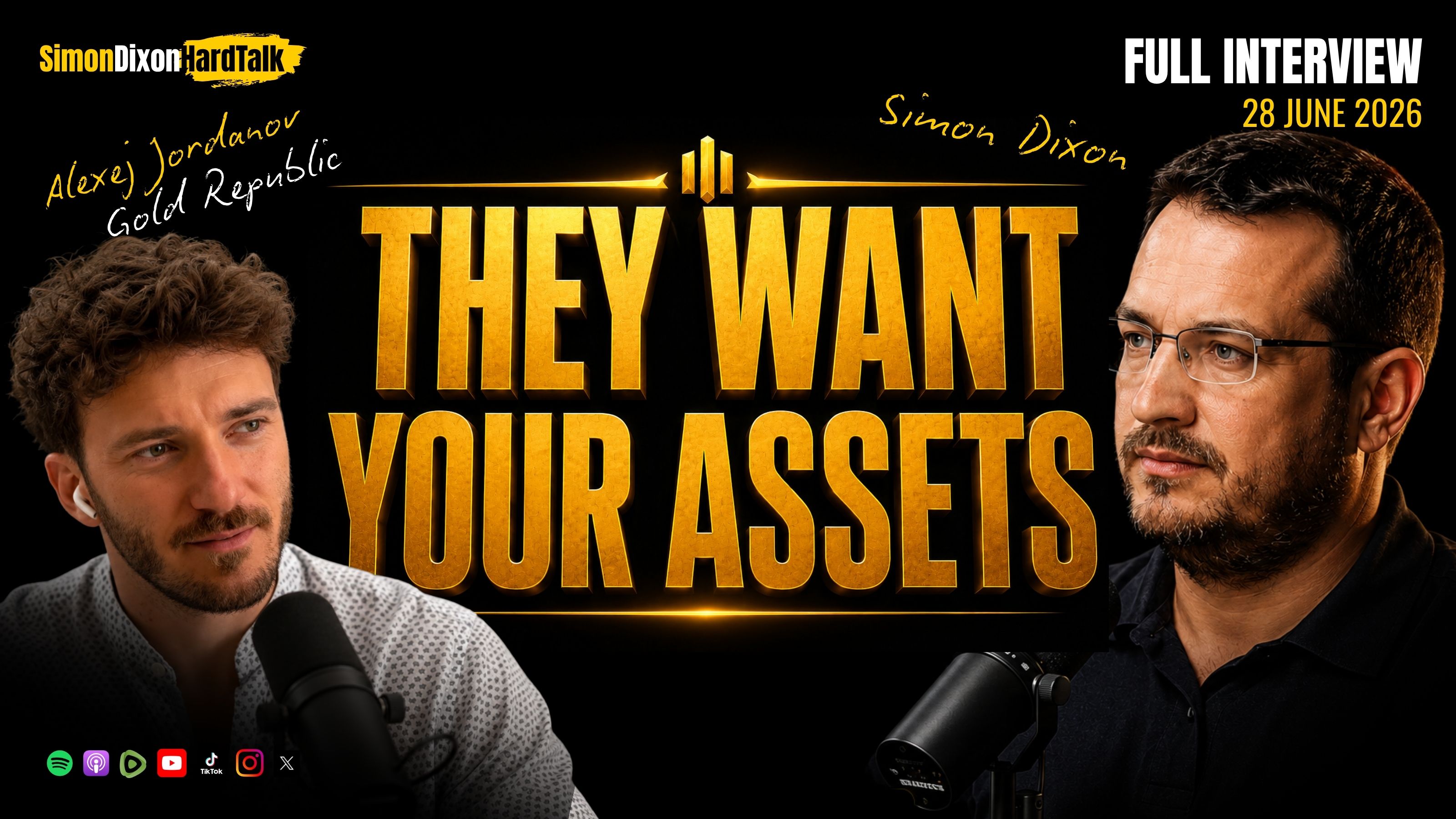
No time for the full video? Watch the AI-generated TL;DR Podcast Style Discussion instead. Or watch the whiteboard explainer — a more visual breakdown of the full discussion.
Prefer To Listen? Available on Spotify & Apple Podcasts

Other Related Blogs
Weaponizing Crisis: The Asset-Stripping Phase | Simon Dixon Hard Talk LIVE (Full Episode)
Immigration, the Lebanon Conflict & the Tech Crash | Simon Dixon Hard Talk LIVE (Part One)

Disclaimers
The views and analysis shared in this interview are provided purely for educational and informational purposes. Simon Dixon shares his macro analysis, models, and commentary with "no sponsorship no uh no business agenda no upsell no monetization" . For complete transparency regarding the companies discussed, particularly MicroStrategy, Dixon is not a shareholder in the company and maintains he never will be, nor does he hold positions in any of its ancillary financial vehicles . Should that position ever change, it will be disclosed publicly .
Legal & Financial Disclaimer
The topics discussed in this episode are "not financial advice" . While the discussion analyzes global capital flows, historical market cycles, and the potential future of sovereign assets like Bitcoin and gold, there is no guarantee that these events will play out exactly as described . All financial and investment decisions carry inherent risks. Viewers must conduct their own independent research and consult with a certified financial professional before making any investment decisions or attempting to build wealth outside of the traditional financial system.