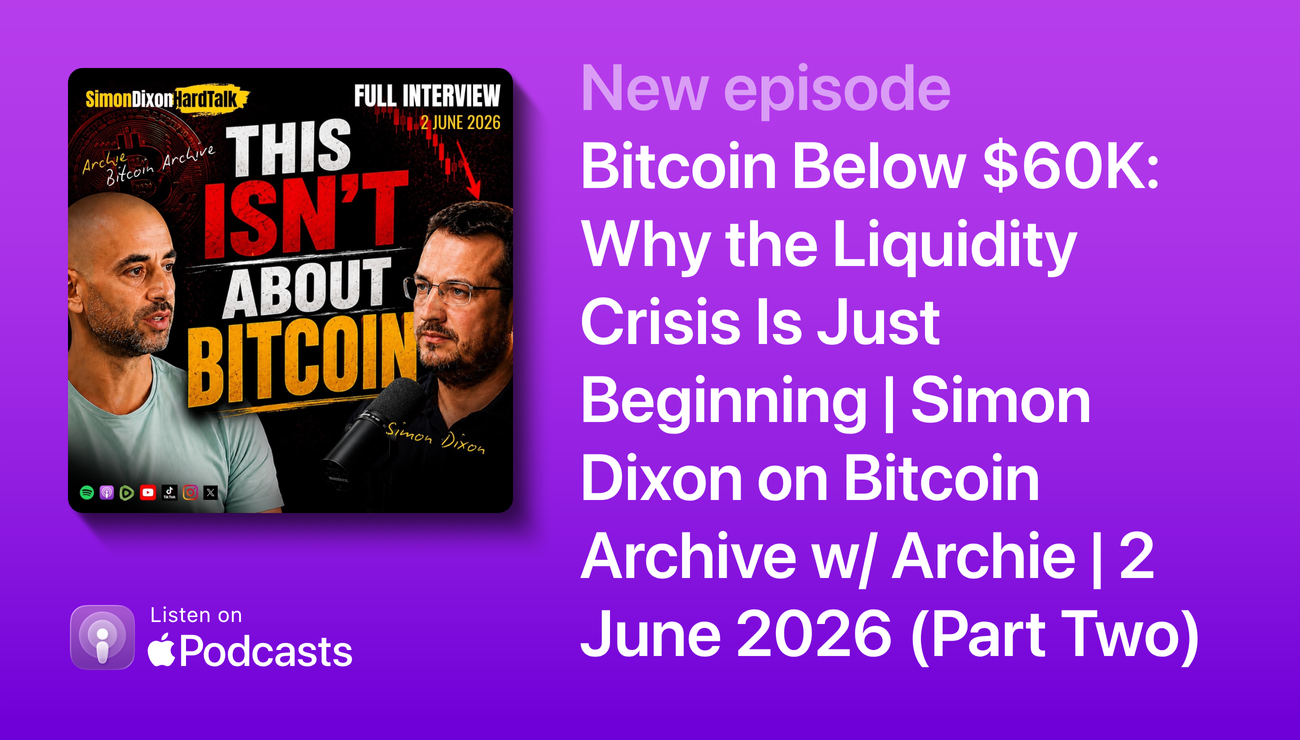
Bitcoin Crashes Below $60K: The Battle for Bitcoin Sovereignty | Simon Dixon on Bitcoin Archive w/ Archie (Part 2)
Jun 02, 2026This briefing document synthesizes the key themes, arguments, and data points from the interview titled "Bitcoin Crashes: How to Protect Yourself", featuring Simon Dixon and host Archie on the show Bitcoin Archive. The interview took place on 2 June 2026 and lasted 1 hour and 12 minutes.
Executive Summary
The interview explores Bitcoin’s transition from a niche digital asset to a critical instrument in global geopolitics and institutional finance. Simon Dixon argues that while Bitcoin has reached a level of "long-term viability" as a top-30 global asset, it is currently facing a sophisticated "centralizing attack" from the Financial Industrial Complex (FIC).
Key takeaways include:
- Sovereign Adoption: Iran is highlighted as the primary example of "adversarial" Bitcoin adoption, allegedly using the network to bypass international sanctions, SWIFT, and legacy insurance markets like Lloyd’s of London.
- The FIC Attack Vector: Simon Dixon believes the FIC (including BlackRock and major banks) is using ETFs and corporate treasury vehicles like MicroStrategy to centralize Bitcoin custody while issuing "paper" IOUs to investors, potentially inflating the perceived supply beyond 21 million.
- AI vs. Bitcoin: A fundamental competition for energy has emerged. Simon Dixon frames AI as the foundation of a "control grid" and Bitcoin as the foundation of a "sovereign grid." The pivot of public miners toward AI processing is viewed as a potential catalyst for the decentralization of the Bitcoin hash rate.
- Market Dynamics: Despite institutional entry, market sentiment remains "jaded" due to a lack of a recent blow-off top and the "sucking out" of liquidity by the AI bubble.
High-Level Overview
The discussion frames Bitcoin as a "permissionless and adversary-proof" settlement layer that is increasingly utilized by sanctioned nation-states and the global financial elite. The interview contrasts two versions of Bitcoin: the "sovereign grid" (self-custody, privacy, and resistance) and the "control grid" (ETFs, centralized custodians, and "paper" Bitcoin contracts). The framing centers on whether institutional involvement is a victory for Bitcoin's price or a strategic subordination of its revolutionary properties.
Key Arguments Made by Simon Dixon
Sovereign Geopolitics and Iran
- Iran as the Leading Case Study: Simon Dixon believes Iran is likely the world's largest sovereign Bitcoin miner. In his opinion, Iran’s adoption is more significant than El Salvador’s because Iran uses Bitcoin to bypass extreme sanctions and the SWIFT system.
- Circumvention of Legacy Rails: Simon Dixon alleges that Iran is developing a bespoke insurance and settlement model using Bitcoin to bypass Lloyd’s of London for maritime trade, particularly in the Strait of Hormuz.
- The "Silent Network": In Simon Dixon’s opinion, a "silent network" of sovereign adoption is being built by countries like Russia (allegedly the second-largest sovereign miner) and the UAE (third-largest) to de-fang Western banking power.
- Nuclear Mining: Simon Dixon points to the "Midnight Hammer" operation as potential evidence that Iran utilizes civilian nuclear energy for Bitcoin mining, noting a correlation between a drop in hash rate and military activity.
The Financial Industrial Complex (FIC) Attack
- Centralization through Custody: Simon Dixon argues that the FIC is executing a coordinated strategy to centralize Bitcoin ownership via ETFs. He believes their goal is to hold the actual asset on their balance sheets while investors hold "paper contracts."
- MicroStrategy as a Subordination Vehicle: While often praised, Simon Dixon views MicroStrategy as a "centralizing attack vector." In his opinion, Michael Saylor’s fiduciary duty to shareholders and bondholders (the FIC) makes the company a vehicle for subordination rather than decentralization.
- Derivative Manipulation: Simon Dixon believes the "derivative complex" allows the FIC to manipulate short-term prices to encourage retail investors to sell or move capital into bubbles like AI, allowing institutions to accumulate the limited supply.
- Paper Bitcoin Supply: Simon Dixon estimates there may already be as many as "28 million paper contracts" for Bitcoin, despite the immutable 21-million-coin limit of the underlying protocol.
Privacy and State Friction
- The War on Privacy: Simon Dixon identifies privacy (coin joins and mixers) as the ultimate friction point with the state. He cites the Samourai Wallet case as an example of "lawfare" used to target developers.
- Elites vs. The Masses: In Simon Dixon’s view, global elites intend to maintain privacy for themselves while forcing the general population onto transparent blockchains and Central Bank Digital Currencies (CBDCs).
Key Arguments Made by Other Participants (Archie)
- MicroStrategy as a Revolutionary Force: Archie argues that Michael Saylor has "cracked the dam wall," creating massive demand for Bitcoin even in bear markets and effectively sucking capital out of Wall Street.
- Market Sentiment: Archie notes that the market feels "jaded" and "frustrated" because Bitcoin has remained stagnant while AI stocks like Nvidia have surged.
- Institutional Demand: Archie suggests that the consistent buying from corporate entities and ETFs (potentially $1–2 billion weekly by MicroStrategy) will eventually overwhelm the market and drive prices higher.
- Iran Liquidations: Archie questioned whether the market weakness in late 2025/early 2026 was caused by Iran liquidating Bitcoin to fund military preparations.
Points of Agreement
- Long-Term Viability: Both agree Bitcoin is now a permanent fixture in the global financial landscape and a "top-30 asset."
- AI and Bitcoin Importance: Both identify AI and Bitcoin as the two most significant technological stories of the era, though they represent opposing forces (control vs. sovereignty).
- Energy Competition: They agree that energy is the new primary commodity and that AI and Bitcoin miners are now in direct competition for power infrastructure.
- The Pivot to AI: Both acknowledge that corporate miners (like Terawulf) are shifting toward AI data processing, which may inadvertently decentralize the Bitcoin hash rate.
Points of Disagreement
- The Role of MicroStrategy: This is the primary area of contention. Simon Dixon views it as a tool for institutional centralization/subordination; Archie views it as an attack on legacy finance that brings liquidity to Bitcoin.
- Market Drivers: Archie believes ETF/corporate demand is the primary driver, whereas Simon Dixon argues the "derivative complex" and paper contracts allow the FIC to control price dynamics.
- Optimism vs. Realism: Archie aligns with "optimists" like Jeff Booth who believe Bitcoin will collapse the fiat system. Simon Dixon identifies as a "skeptical investor" who believes the FIC will manage a transition to keep power.
Important Data, Claims, or References Mentioned
Market Benchmarks
|
Asset / Entity |
Approximate Market Cap / Value |
|
Bond Market |
~$300 Trillion |
|
Real Estate |
~$187 Trillion |
|
Nvidia |
~$5 Trillion (Peaked at $6T) |
|
Bitcoin |
~$1.5 Trillion |
|
Gold |
Simon’s target for Bitcoin is 1/3 of Gold's cap |
Sovereign and Corporate Activity
|
Entity |
Action / Claim |
|
Iran |
Allegedly the largest sovereign miner; accepting Bitcoin for maritime "fees" or "insurance." |
|
Russia |
Allegedly the second-largest sovereign Bitcoin miner. |
|
UAE |
Allegedly the third-largest sovereign miner; building a CBDC network. |
|
Terawulf |
Officially pivoted from "Bitcoin Miner" to "Energy Infrastructure" company for AI. |
|
Coinbase |
Identified as the primary custodian for the FIC and ETFs. |
|
Samourai Wallet |
Developers targeted by DOJ; case cited as the "friction point" for privacy. |
Strategic References
- Operation Choke Point 2.0: A coordinated regulatory attack to decouple the crypto industry from the traditional banking system.
- Operation Midnight Hammer: A B2 bomber operation cited by Simon Dixon in relation to Iranian hash rate fluctuations.
- Lloyd’s of London: The legacy maritime insurance market that Iran is reportedly attempting to circumvent using Bitcoin.
- Strait of Hormuz: The strategic waterway where Iran is allegedly implementing a Bitcoin-based settlement model.
Notable Quotes or Framing
- On the Era: "AI is the foundation of the control grid, and Bitcoin is the foundation of the sovereign grid."
- On Wall Street's Strategy: "Wall Street's model is to create IOU securities so that they can end up with the actual asset on their balance sheet."
- On Sovereignty: "At some point, you either become free or you become subordinate... what Bitcoin represents is sovereign freedom, resistance, leverage, and negotiation."
- On Historical Context: "How you go from a few people in a crackdown [in 2011] to the biggest power structures in the world... discussing how Bitcoin might be a part of this equation is unbelievable."
- On MicroStrategy: Simon Dixon labels it a "subordination vehicle" because its fiduciary duty is to the FIC (shareholders/bondholders), not the Bitcoin protocol.
Open Questions or Unresolved Issues
- The AI Decoupling: Why did Bitcoin fail to follow the "AI trade" upward during the most recent cycle despite acting as a tech-proxy in the past?
- On-Chain Verification: Both participants noted the lack of definitive on-chain profiling of Iranian sovereign wallets.
- Strategic Reserve: Will the U.S. establish a formal Strategic Bitcoin Reserve, or will it continue to "confiscate" Bitcoin through legal proceedings?
- Managed Transition vs. Collapse: Will the shift to a Bitcoin standard be a "managed transition" by the Fed/BIS or a chaotic fiat collapse? Simon Dixon suggests a managed transition is more likely.
Call To Action
- Share this post. Share this blog post to expose the "divide and conquer" trap.
- Subscribe to the Simon Dixon YouTube channel. Get my weekly deep dives into geopolitics, macro, and Bitcoin. Subscribe to my YouTube channel.
- Find me on Rumble. This is my backup channel, safe from censorship. Follow me on Rumble.
- Follow me on X @SimonDixonTwitt. I post real-time updates and analysis on X and am highly active there. Follow me on X.
- Follow me on instagram. Usually short clips are posted here.
- Follow me on TikTok. Usually short clips are posted here.
- SimonDixon.com This is my personal site and an archive of all my content, safe from de-platforming. Join the free membership portal.
Watch on YouTube
No time for the full video? Watch the AI-generated TL;DR Podcast Style Discussion instead. Or watch the whiteboard explainer — a more visual breakdown of the full discussion.
Prefer To Listen? Available on Spotify & Apple Podcasts
Read Other Related Blogs


General & Legal Disclaimer
No Financial or Investment Advice The content of this blog, including any discussions regarding Bitcoin, AI, market liquidity, corporate treasury strategies, or broader macroeconomic trends, is provided for informational and educational purposes only. It does not constitute financial, investment, legal, or tax advice. Simon Dixon’s commentary on market dynamics—including his views on the "Financial Industrial Complex," institutional accumulation, and Bitcoin price targets—represents his personal opinions and analytical interpretations. Readers should conduct their own independent research and consult with certified financial professionals before making any investment decisions.
Strictly an Intellectual Exercise Regarding Sanctions Any geopolitical analysis regarding sovereign nations (such as Iran or Russia) potentially utilizing Bitcoin to bypass the SWIFT system, legacy insurance markets like Lloyd's of London, or international sanctions is strictly an intellectual exercise and theoretical discussion. As Simon Dixon explicitly states, circumventing sanctions is a serious crime. Nothing in this content is intended to endorse, encourage, or provide instructions on how to evade international sanctions or participate in illicit financial activities.
Opinion-Based Macro Analysis The views expressed regarding the transition to the AI era, global regime changes, market manipulation by institutional actors, and the creation of a "sovereign grid" versus a "control grid" are speculative macro-level analyses. These statements reflect Simon Dixon's personal perspective and interpretations as a geopolitical and financial analyst, rather than objective or established facts.
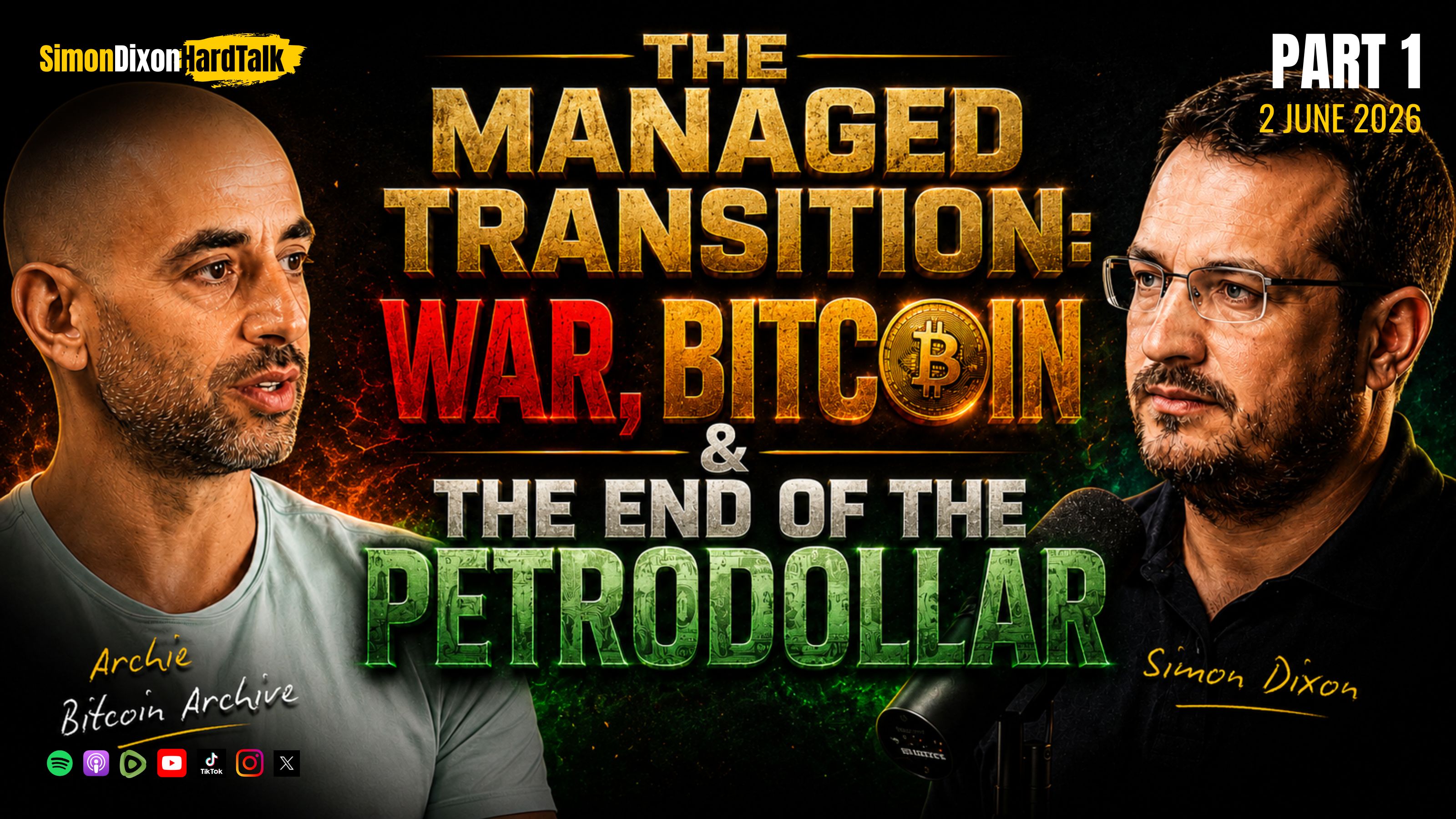
Watch Part 1: The Managed Transition: War, Bitcoin & The End Of The Petrodollar | Part 1 of 2 https://youtu.be/EC7Ovp8ZGTA
Read blog for Part 1: https://www.simondixon.com/blog/the-managed-transition-war-bitcoin-the-end-of-the-petrodollar-simon-dixon-on-bitcoin-archive-w-archie