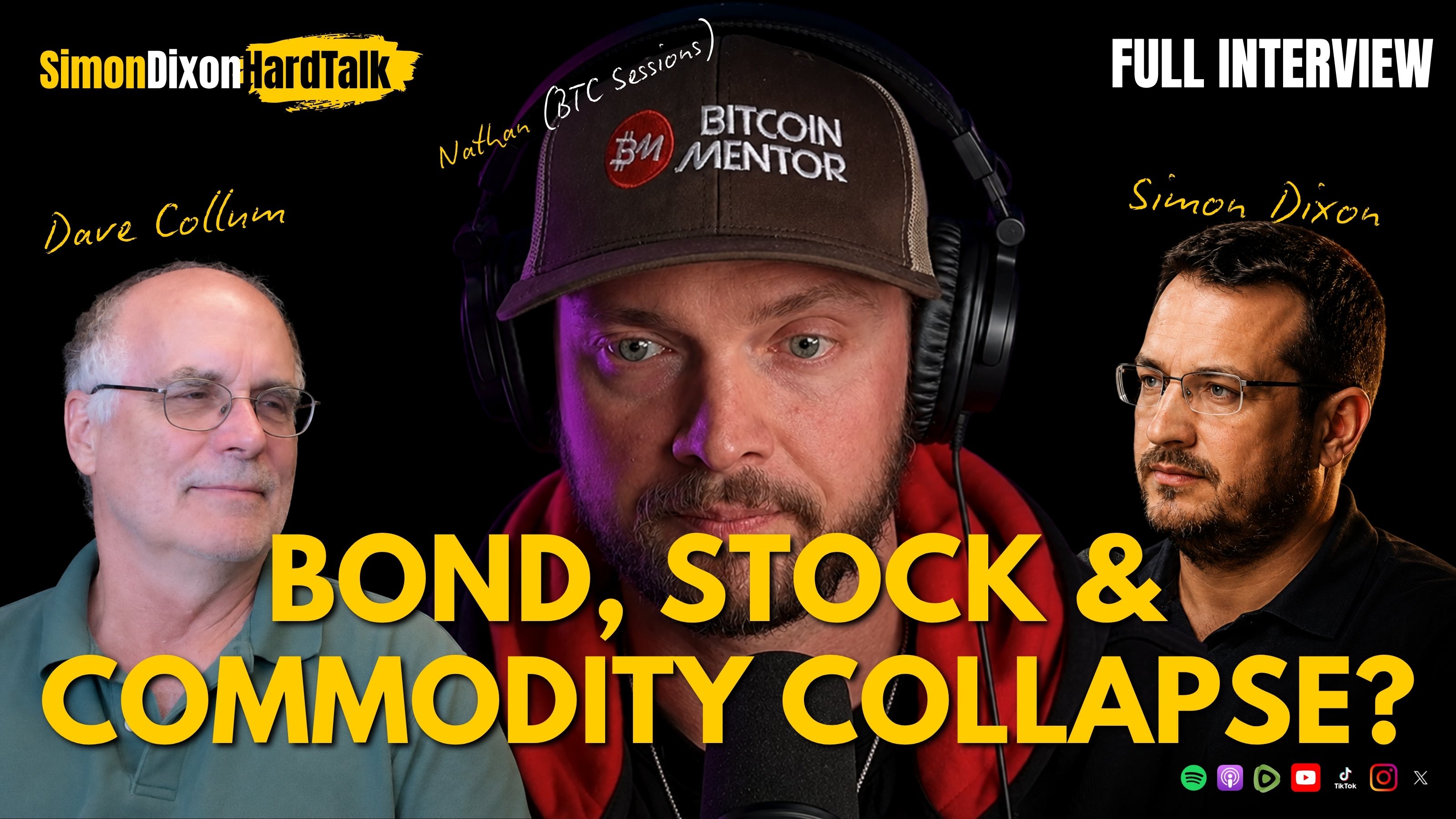
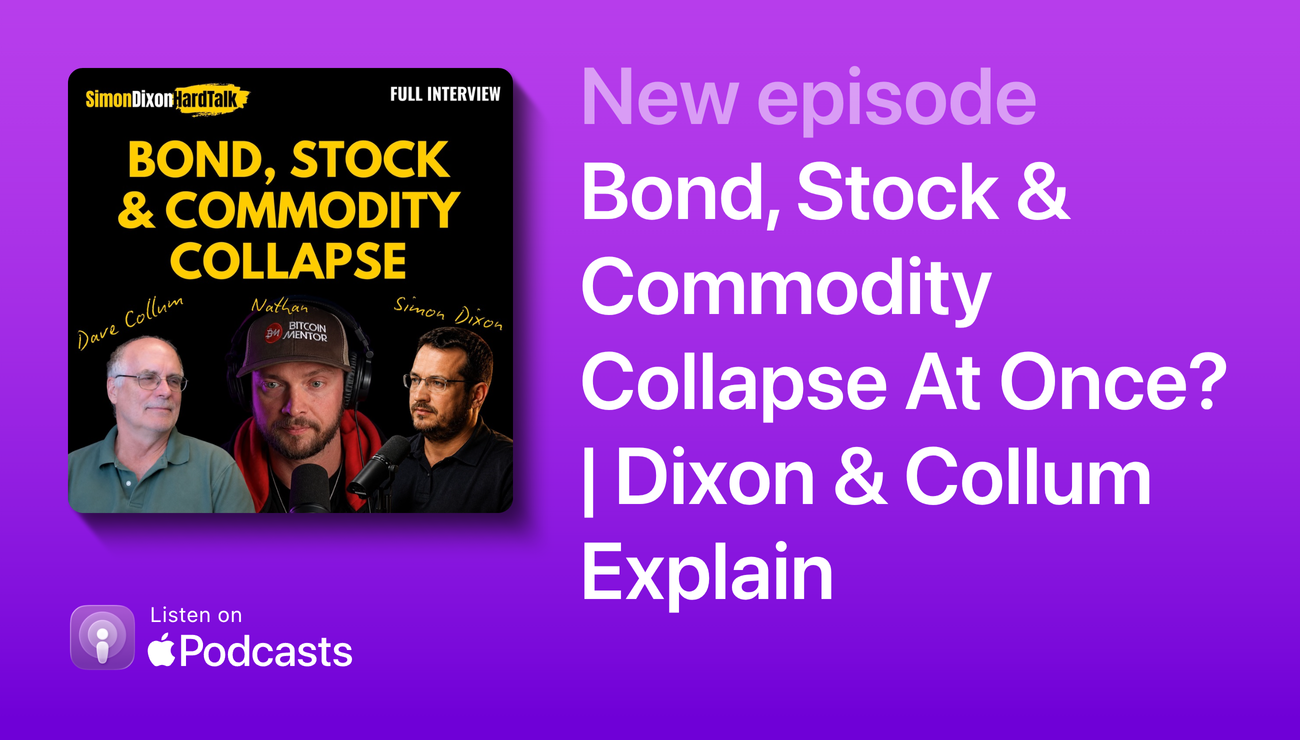
Bond, Stock & Commodity Collapse At Once? | Simon Dixon & Dave Collum Explain | On BTC Sessions w/ Nathan Fitzsimmons
May 29, 2026No time for the full 1h55m video? Watch the AI-generated TL;DR Podcast Style Discussion instead (22m). Or watch the whiteboard explainer — a more visual breakdown of the full discussion (10m).
Executive Summary
This briefing document synthesizes the dialogue between Simon Dixon and Dave Collum regarding the potential risks of a major simultaneous downturn in bond, stock, and commodity markets. In their opinion, the central thesis posits that traditional capitalism is under severe pressure, being replaced by a system of managed liquidity, money printing, and geopolitical narratives. Key takeaways include:
- Geopolitical Narratives: The conflict between the US and Iran, including the closure of the Strait of Hormuz, is characterized as a pre-planned event designed, in their view, to provide political narratives while masking underlying market instability.
- Liquidity Generation: The rush toward AI and SpaceX IPOs is viewed as a mechanism, they argue, to generate liquidity and influence passive investment flows (ETFs) to support the current economic structure.
- Potential Systemic Threats: Potential systemic threats, as they see them, include a bond market downturn (driven by treasury selling), an equity correction (driven by Chinese AI competition like DeepSeek), and a commodity market downturn (related to the London gold derivative complex).
- Multinational Influence: Both participants argue that, in their opinion, the Federal Reserve and political actors serve the interests of multinational financial entities rather than national sovereignty.
High-Level Overview
The discussion frames the current economic climate as a transition into a global system where the United States' role in the Middle East is changing. The overarching theme is the disconnect between economic fundamentals and market valuations, which the speakers suggest are currently sustained by factors like index inclusion manipulation and narrative-driven events. The participants examine the role of major financial entities like BlackRock and the convergence of technology and financial interests in shaping the economy.
Key Arguments Made by Simon Dixon
Simon Dixon presents a view of the world where political events are, in his opinion, aligned with the liquidity needs of major financial players.
- Geopolitical "Exit Off-Ramp" Narratives:
- In his opinion, the US-Iran deal has possibly already been negotiated; the current political actions, he suggests, allow leaders like Trump and the Iranian regime to claim victory for their respective domestic audiences.
- He argues Trump requires a defining political moment to integrate the situation into the Abraham Accords for election optics.
- The State of Capitalism:
- In his view, Capitalism is now substantially defined by debt and money printing.
- He argues the Federal Reserve needs to expand its balance sheet to lower bond yields and prevent a significant banking and real estate downturn.
- The AI/Space Race as National Security Ploy:
- He believes IPOs (OpenAI, Anthropic, SpaceX) are being quickly added to indices to encourage passive investors (like pensioners) to provide liquidity for VC exits (e.g., SoftBank).
- The narrative that certain technologies, like space-based data centers, are necessary to win the AI race against China is, in his opinion, used to justify large-scale money supply expansion.
- Strategic "Rugpulls" by China:
- Bond Market: China and other central banks are reducing their treasury holdings in favor of gold, he suggests, leaving Americans to bear the financial burden.
- Equity Market: China's DeepSeek AI, Dixon claims, can perform near OpenAI’s capacity at a significantly lower cost, potentially leading to a sharp downturn in Western AI valuations.
- Commodities: The West relies on a gold derivative complex that, in his opinion, is highly leveraged compared to physical holdings in Shanghai.
- The Role of BlackRock and Aladdin:
- BlackRock (through its Aladdin technology), Dixon suggests, heavily influences the scenario planning for a large portion of global institutional capital, potentially enabling it to steer market movements.
- ETFs are, in his view, a significant tool for managing global capital flows.
Key Arguments Made by Dave Collum
Dave Collum provides a more "analog" and skeptical critique of current market mechanics, emphasizing a return to equilibrium "the hard way."
- Market Overvaluation:
- Describes the SpaceX IPO valuation as excessive due to its high sales valuation.
- He believes the market is significantly over historical average valuations, predicting a major correction to reach what he considers 'fair value.'
- The Price Momentum Feedback Loop:
- In his opinion, sovereign states or price-insensitive buyers are driving equity markets higher through call option buying, creating a feedback loop that will eventually reverse.
- The Bond/Equity Downturn:
- Fears a simultaneous secular bear market in both bonds and equities, a phenomenon not seen since the 1970s, which he suggests would be devastating for older generations.
- The "Stacking Blocks" Metaphor:
- Markets have become so sensitive that, Collum argues, a minor event could trigger a severe market downturn.
- Critique of GDP and Wealth Creation:
- He argues that GDP is a misleading metric because it includes expenditures, such as healthcare for an aging population and war costs, that he believes do not represent genuine wealth creation.
- Federal Reserve Skepticism:
- In his opinion, the Fed serves multinational financial institutions rather than national sovereignty; he believes its policies for the last 15 years have been seriously misguided by keeping rates too low for too long.
Points of Agreement
- Central Banking Finances: Both agree the system is financially precarious, requiring increasing debt to cover interest on existing debt.
- Institutional Influence: Agreement that, they suggest, the Federal Reserve and major politicians are heavily influenced by multinational financial interests.
- The 2008 Ghost: Recognition that $2 trillion in "toxic" mortgage-backed securities from the 2008 crisis still sits on the Fed's balance sheet.
- AI Investment Cycle: Both view the current AI investment cycle as a "circle jerk" where hyperscalers invest in chipmakers and AI firms, they argue, to boost revenue figures.
- Control via Narrative: Consensus that political and social events (e.g., Epstein files, political polarization) are used, in their view, to distract the public from the concentration of wealth.
Points of Disagreement
- The Future of Capitalism: Collum believes capitalism is severely restricted but expects market price discovery to eventually return. Dixon suggests capitalism has functionally ended and is being replaced by a technocratic, managed system.
- Trump and Politics: Collum expressed past support for Trump but is now uncertain about his recent actions. Dixon views Trump as a functional part of the political structure, whose role, Dixon suggests, is to maintain public engagement in the political process while serving established interests.
- Market Timing: Collum admits to having been pessimistic about market trends in the past and finds the timing of a major downturn difficult to predict; Dixon focuses on what he describes as a 'managed transition' and the specific events (like IPOs, Energy exports & wars) that the system uses, in his opinion, to delay a crisis.
Important Data, Claims, or References Mentioned
|
Category |
Details |
|
Entities |
BlackRock, Goldman Sachs, JP Morgan, SoftBank, OpenAI, Anthropic, SpaceX, DeepSeek. |
|
Key Individuals |
Larry Fink, Kevin Warsh, Thomas Massie, Jimmy Savile, George Bush Sr./Jr., Dick Cheney. |
|
Historical/Literary Refs |
Confessions of an Economic Hitman (John Perkins); Transformation (Kathy O'Brien); A Family of Secrets (Russ Baker); 1989 Nikkei Bubble. |
|
Geopolitical Events |
China Summit; Strait of Hormuz closure; Abraham Accords; Discussions referencing major historical events. |
Notable Quotes or Framing
- Simon Dixon: "Capitalism is debt, in my opinion."
- Simon Dixon: "I believe America is not a fully sovereign state; it is heavily influenced by large organizations."
- Dave Collum: "It strikes me as a system requiring ever-increasing financial input."
- Dave Collum: "The further from equilibrium you are, the more significant the correction will be."
- Dave Collum: "The Fed works for multinational financial interests."
Open Questions or Unresolved Issues
- The "Warsh Effect": Uncertainty remains regarding what Kevin Warsh will actually do at the Fed—whether he will trigger a significant market event to return to a more traditional form of capitalism or continue the managed expansion.
- The Timing of the "Unwind": While both agree a major downturn is probable, the exact trigger remains unknown.
- The Survival of Bitcoin/Self-Custody: Debate persists on whether Bitcoin can truly function as an "exit" if on-ramps/off-ramps are controlled by entities like BlackRock and Coinbase.
- Domestic Unrest: Whether current social and immigration crises in the US and Europe will lead to widespread civil turmoil that political figures are unable to manage.
Call to Action
- Share this post. Share this blog post to expose the "divide and conquer" trap.
- Subscribe to the Simon Dixon YouTube channel. Get my weekly deep dives into geopolitics, macro, and Bitcoin. Subscribe to my YouTube channel.
- Find me on Rumble. This is my backup channel, safe from censorship. Follow me on Rumble.
- Follow me on X @SimonDixonTwitt. I post real-time updates and analysis on X and am highly active there. Follow me on X.
- Follow me on instagram. Usually short clips are posted here.
- Follow me on TikTok. Usually short clips are posted here.
- SimonDixon.com. This is my personal site and an archive of all my content, safe from de-platforming. Join the free membership portal.
Watch on YouTube
Prefer to Listen? Available on Spotify & Apple Podcasts
Read Other Related Blogs
Disclaimer
- Informational & Educational Purposes Only The information contained in this blog post, which synthesizes the dialogue between Simon Dixon and Dave Collum on the BTC Sessions podcast hosted by Nathan Fitzsimmons, is provided strictly for educational and informational purposes.
- Not Financial, Investment, Legal, or Tax Advice The analysis summarized in this document regarding potential systemic threats to the bond, stock, and commodity markets does not constitute financial, investment, legal, or tax advice. Any commentary on the state of traditional capitalism, macroeconomic dynamics, the Federal Reserve, or geopolitical events is strictly for analytical discussion. Explicit mentions of specific assets, financial instruments, digital assets, corporate entities, or sovereign nations—including but not limited to Bitcoin, physical gold, US Treasuries, ETFs, BlackRock, SoftBank, SpaceX, OpenAI, and DeepSeek—are for illustrative purposes only and must not be construed as endorsements, solicitations, or recommendations to buy, sell, hold, or trade.
- Personal Opinions & Speculative Forward-Looking Statements The views and arguments presented by Simon Dixon and Dave Collum represent their personal opinions and individual interpretations of global events, such as the US-Iran geopolitical narratives and the closure of the Strait of Hormuz. Hypotheses regarding artificial liquidity generation, the potential for strategic market "rugpulls" orchestrated by foreign central banks, and the overarching control of multinational financial complexes over national sovereignty are highly speculative. Furthermore, any predictions concerning future market behavior, such as the onset of a synchronized secular bear market in equities and bonds, are forward-looking statements that carry inherent risks and historical uncertainties.
- Market Volatility & Systemic Unpredictability As explicitly noted by the speakers during the referenced interview, financial systems that have been pushed past logical topping points and displaced from equilibrium can experience violent and destructive corrections. Because the exact triggers and timing of potential market downturns or geopolitical escalations remain unknown, the financial climate described is fundamentally precarious.
- Assumption of Risk & Independent Verification Readers are strongly urged to conduct their own independent due diligence and consult with a qualified, licensed financial professional or fiduciary before making any capital allocation decisions. Taking absolute personal responsibility for your financial choices is essential when navigating a market driven by narrative and managed liquidity. The authors, speakers, host, and publishers of this blog post accept no liability for any direct, indirect, or consequential financial losses or damages incurred as a result of acting upon the information, metaphors, or theories provided herein.