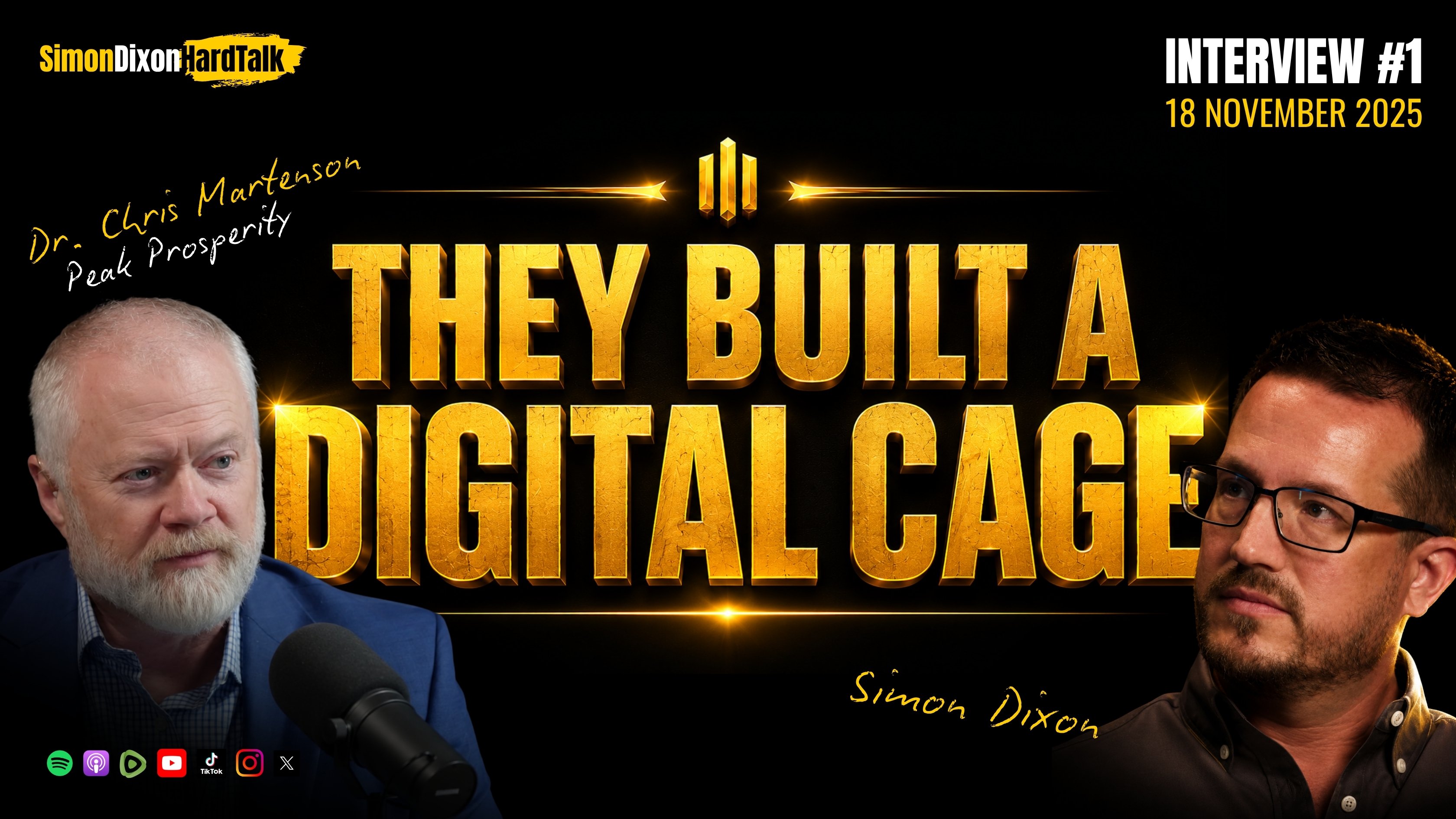
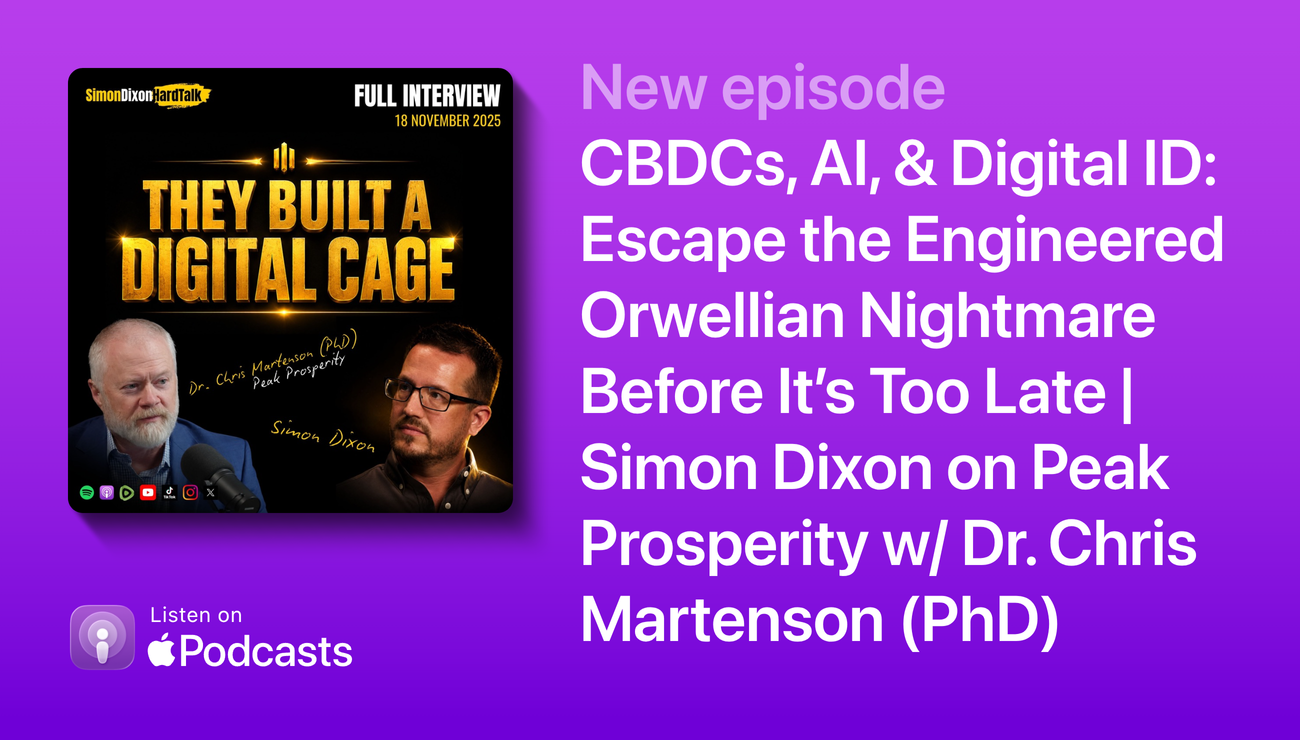
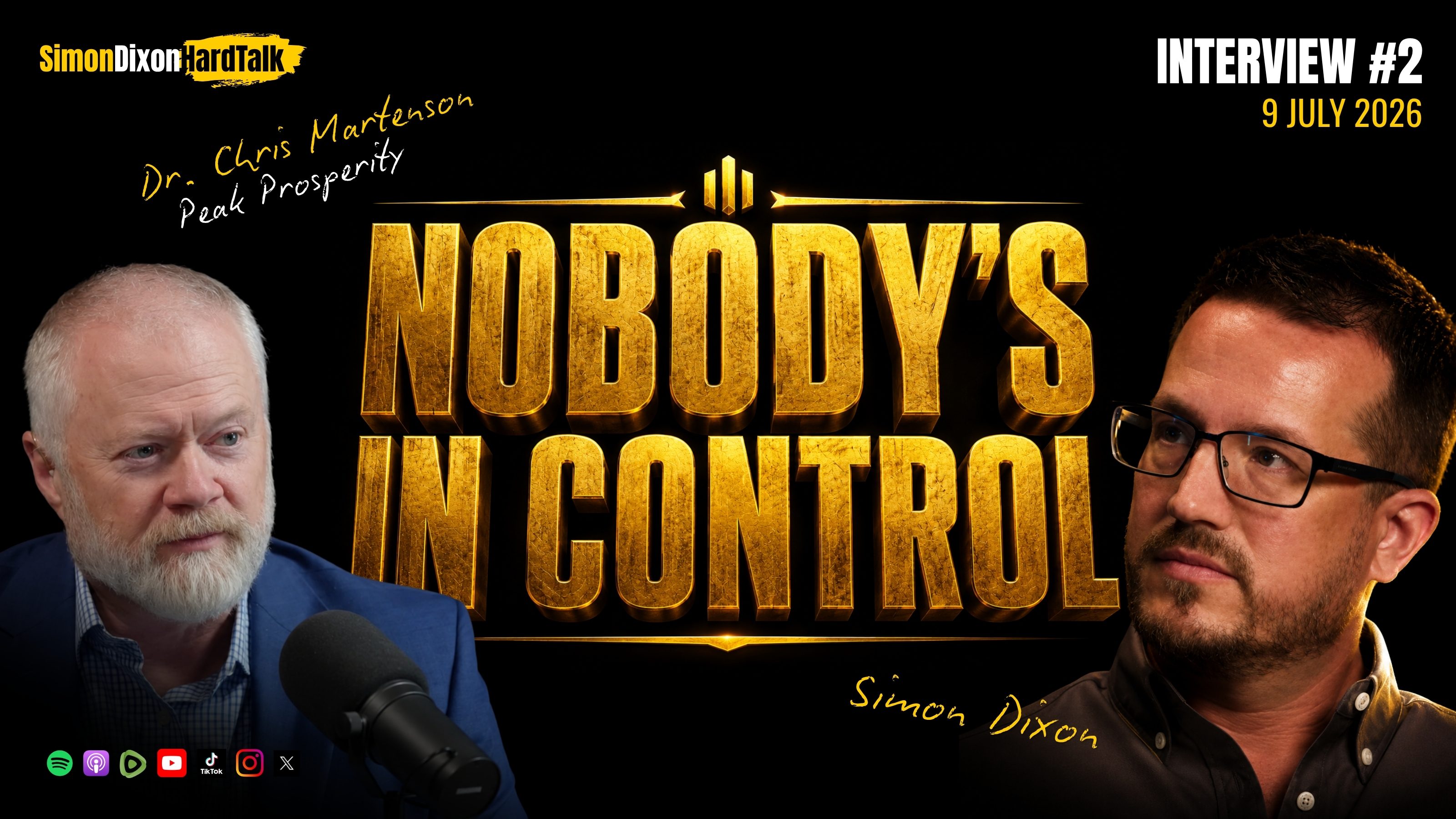
CBDCs, AI, & Digital ID: Escape the Engineered Orwellian Nightmare Before It’s Too Late | Simon Dixon on Peak Prosperity w/ Chris Martenson
Nov 18, 2025Executive Summary
The interview explores the structural transition of the global world order from a US-centric model to a multipolar, corporate-dominated "Proof of Weapons" network. Simon Dixon argues that the legacy financial system is a debt-based Ponzi scheme reaching its mathematical expiry. To manage this collapse, a decentralized yet coordinated network of financial, military, and technological interests (FIC, MIC, and TIC) is engineering a transition toward total digital surveillance via CBDCs, Digital IDs, and AI.
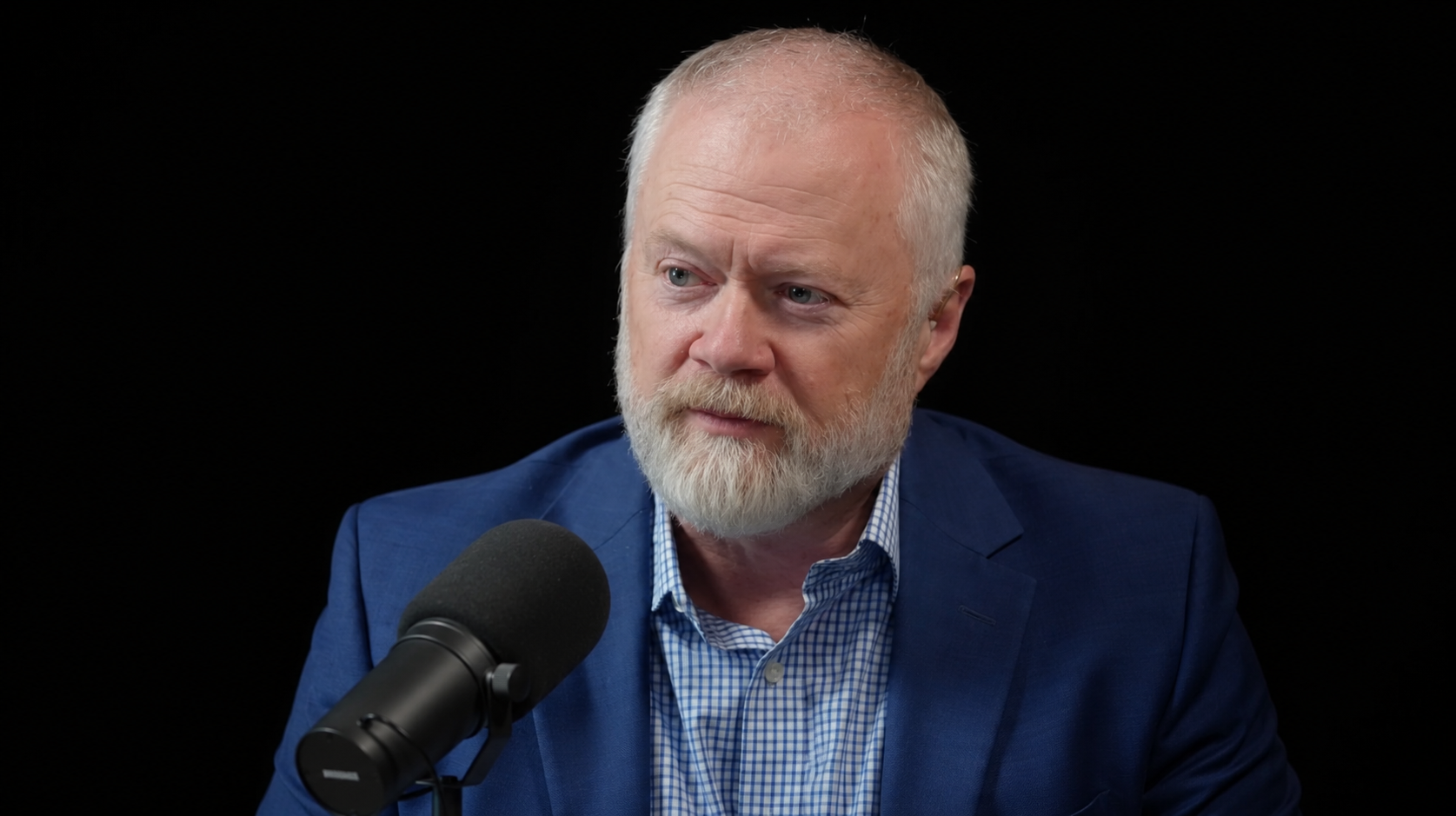
Document Purpose: This briefing document provides a comprehensive synthesis of the interview between host Chris Martenson of Peak Prosperity and guest Simon Dixon, Investor, Geopolitical & Financial Analyst, and Bitcoin OG. The interview, conducted on 18 November 2025, lasted 1 hour and 31 minutes.
Critical Takeaways:
- The Proof of Weapons (POW) Network: Governments are subordinate to a private corporate structure involving the Financial Industrial Complex (FIC), Military Industrial Complex (MIC), and Technical Industrial Complex (TIC).
- Asset Stripping the West: The network is allegedly "vassalizing" the US and Europe, siphoning wealth into scarce assets and relocating strategic growth to the Middle East (GCC) and Asia (China).
- The Role of BlackRock: Through technology like "Aladdin" and massive index fund holdings, BlackRock acts as a primary administrator for the network, influencing both fiscal and monetary policy.
- Digital Enclosure: The implementation of stablecoins (in the US) and CBDCs (in Europe/UK) is viewed as a mechanism to dump devalued government debt onto the public while enforcing social and carbon credit systems.
- Individual Sovereignty: Simon Dixon recommends a five-year window for individuals to achieve sovereignty through "scarce assets" (Bitcoin, Gold), local community building, and emotional/spiritual resilience.
High-Level Overview
The discussion frames the current global state not as a series of random crises, but as an engineered transition. The "old model" of fiat currency, established post-1971, is failing due to a "math problem" where debt interest outpaces economic growth. The interview posits that the power structure is shifting away from nationalistic interests toward a globalized, privatized network that utilizes war, propaganda, and technological control to maintain dominance. The conversation spans from the mechanics of fractional reserve banking to the geopolitical maneuvers in Ukraine, the Middle East, and the burgeoning AI-driven economy.
Key Arguments Made by Simon Dixon
The "Proof of Weapons" (POW) Network
- Subordination of Government: Simon Dixon believes the government is 100% subordinate to a private corporate structure. In his view, the Federal Reserve is owned by private banks that create the dollar, allowing them to determine capital allocation.
- The Trinity of Control:
- Financial Industrial Complex (FIC): Includes central banks, investment banks, and asset managers (BlackRock, Vanguard, State Street) that control capital flows and voting rights in public companies.
- Military Industrial Complex (MIC): Used to agitate wars, justify money printing, and subordinate foreign nations.
- Technical Industrial Complex (TIC): Big tech companies (Nvidia, OpenAI, Palantir) that provide the surveillance and automation infrastructure.
- Lobbying as Control: Simon Dixon claims the government is "for sale," with budgets allocated via lobbying to buy members of Congress and the Senate.
Geopolitics and the Multipolar Transition
- The De-Dollarization Strategy: Simon Dixon believes we are moving to a multipolar world where the "Proof of Weapons" network is co-investing with Gulf Cooperation Council (GCC) sovereign wealth funds and China.
- Vassalization of the West: He argues that the network has "asset stripped" the US and Europe. He characterizes Europe as a "vassal state" and views the destruction of European industry (e.g., Nord Stream) as a deliberate move to subordinate the continent to the network.
- Ukraine as a Financial Operation: In Simon Dixon’s opinion, the conflict in Ukraine serves to siphon funds from the Bank of England, ECB, and Fed back into the MIC, while BlackRock and Russia ultimately acquire the underlying assets.
- The Middle East Pivot: He suggests the network is moving toward regional stability in the Middle East to facilitate the construction of AI data centers and nuclear programs, transitioning away from the "forever war" model.
The Mechanics of the "Digital Prison"
- CBDCs and Stablecoins: Simon Dixon believes Europe and the UK will use CBDCs for control, while the US will use "privatized" stablecoins backed by treasuries to dump government debt on the public.
- Engineered Civil Unrest: He alleges that immigration policies and racial/religious tensions are manufactured to create the civil unrest necessary to justify the implementation of Digital IDs and surveillance states.
- AI and Robotics: These technologies are viewed as the new "manufacturing base" intended to replace a no longer productive or compliant human labor force in the West.
Individual Strategy and Ethics
- Exit Strategies: Simon Dixon advocates for owning scarce assets like Bitcoin and Gold. He emphasizes that if an asset is priced in Bitcoin or Gold, it is currently in a "bear market," illustrating the devaluation of fiat.
- Community and Sovereignty: He advises people to build local communities and "sovereign" networks, operating as if the government will not provide any support (healthcare, UBI, etc.).
- Spiritual Perspective: He believes the current network is "evil" and that a higher power or spiritual connection is necessary to resist the psychological operations (PsyOps) of the algorithms.
Key Arguments Made by Chris Martenson
- The Math Problem: Martenson highlights that since 1971, US debt has compounded at approximately 9% annually, while the economy grows at only 3%. This "math flaw" makes the collapse of the current system inevitable.
- Energy as Primary: He argues that energy is not a subset of the economy, but the foundation. He expresses concern over the "existential emergency" of rising energy demands from AI data centers while shale oil basins are predicted to peak by 2027.
- Complex Systems Critique: As a scientist, Martenson argues that the "control freaks" in power do not understand complex systems. He believes they mistakenly think they can "lock down" and control an economy that can only be "nudged."
- The Incentive Structure: Citing Charlie Munger, Martenson notes that the system is incentivized toward monopolistic oversight and consolidating control, regardless of the long-term "second-order consequences" like de-industrialization.
Points of Agreement
- The Nature of the Banking System: Both agree that fractional reserve banking is an "elegant form of slavery" or a "Ponzi scheme" that creates money out of thin air.
- Propaganda vs. Journalism: Both participants believe that traditional and alternative media are largely used for propaganda to reallocate capital and influence public sentiment.
- Institutional Capture: They agree that large asset managers like BlackRock hold a "board seat on all companies" and effectively manage both fiscal and monetary policy through technology like Aladdin.
- The Target of the System: They align on the idea that the "people do not matter" to the current power structure; citizens are viewed merely as assets or bag-holders for debt.
- Child Welfare as an Indicator: Both agree that the failure to protect children (citing autism rates and child casualties in war) is a primary indicator that the current societal "plot" has been lost.
Points of Disagreement
- Organization of the Power Structure: While Martenson occasionally hints at a more coordinated effort, Simon Dixon clarifies that he views it not as a "monolithic cabal" but as a "decentralized network of power and wealth" that often competes with itself.
- Priority of Decline: Martenson focuses heavily on the physical constraints of energy and resource depletion, whereas Dixon focuses more on the financial and technological mechanisms of control and relocation.
Important Data, Claims, or References Mentioned
The Proof of Weapons Network Hierarchy
|
Component |
Key Entities/Instruments |
Primary Function |
|
FIC (Financial) |
BlackRock, Vanguard, Central Banks, Aladdin |
Capital allocation, index control, debt issuance. |
|
MIC (Military) |
Pentagon, Defense Contractors, NATO |
War agitation, resource acquisition, siphoning tax/debt funds. |
|
TIC (Technical) |
Nvidia, OpenAI, Palantir, X (Social Credit) |
Surveillance, AI data centers, automation of labor. |
|
Deep State |
Intelligence agencies, Blackmail networks (Epstein/Diddy) |
Enforcement, bribery, and judicial control. |
Economic and Geopolitical References
|
Reference |
Context/Data Point |
|
US Debt |
$38 Trillion (mentioned as the result of the MIC/FIC design). |
|
Interest vs. Growth |
Debt grows at ~9% vs. Economy at ~3%. |
|
Layoff Statistics |
150,000 layoffs in October; 1 million over the year (highest since early 90s/2000s). |
|
BlackRock AUM |
Managing approximately $30 Trillion of assets. |
|
GCC Wealth |
Collectively managing approximately $5 Trillion. |
|
Shale Oil Peak |
Projected by the EIA/DOE to begin peaking by 2027. |
|
Petro-Dollar Shift |
Saudi Arabia moved from 100% petro-dollar to 70% dollar / 30% Yuan. |
Notable Quotes or Framing
- On Fiat Currency: "I describe fiat currency as proof of weapons... because Bitcoin is backed by energy (proof of work), but fiat is backed by the ability to enforce debt."
- On the Role of Government: "The government is a piggy bank for corporate interests... Trump is an administrator to fulfill negotiations [with the FIC]."
- On the Current State of the West: "The tactics the West used... on the global south... are coming home. The colored revolutions, the civil unrest... I see all those tactics coming home."
- On Media: "There is no such thing as media or reporting. There's only propaganda."
- On Personal Preparation: "You got 5 years to figure this stuff out because I don't know what the world looks like after 5 years."
Open Questions or Unresolved Issues
- The AI "Wildcard": Simon Dixon notes that while AI is a tool for the power structure, it is an "unpredictable" force that may ultimately "mess them up" as well.
- Success of the Transition: It remains unclear whether the "Proof of Weapons" network can successfully manage the transition to a multipolar world without a catastrophic systemic failure that they cannot control.
- The "Doge" Initiative: Simon Dixon questions whether the Department of Government Efficiency (Doge) is a genuine reform or a "data collection exercise" for future social credit and AI automation.
- The Future of the US Dollar: While the move to a multipolar world is clear, the exact timing and nature of the dollar's replacement (whether by a basket of currencies, gold, or Bitcoin) remains a point of active transition.
Call To Action
- Share this post. Share this blog post to expose the "divide and conquer" trap.
- Subscribe to the Simon Dixon YouTube channel. Get my weekly deep dives into geopolitics, macro, and Bitcoin. Subscribe to my YouTube channel.
- Find me on Rumble. This is my backup channel, safe from censorship. Follow me on Rumble.
- Follow me on X @SimonDixonTwitt. I post real-time updates and analysis on X and am highly active there. Follow me on X.
- Follow me on instagram. Usually short clips are posted here.
- Follow me on TikTok. Usually short clips are posted here.
- SimonDixon.com This is my personal site and an archive of all my content, safe from de-platforming. Join the free membership portal.
About Dr. Chris Martenson (PhD)
Dr. Chris Martenson is an author, educator, and independent researcher focused on the intersection of economics, energy, and the environment. He is the founder of Peak Prosperity, where he publishes analysis on financial markets, macroeconomics, and long-term global trends. Martenson holds a Ph.D. in Pathology from Duke University and an MBA from Cornell University, and is the author of The Crash Course and Prosper!.
Watch on YouTube
Prefer To Listen? Available on Spotify & Apple Podcasts
Read Other Related Blogs

General & Legal Disclaimer
Disclaimer: Educational and Informational Purposes Only
The content of this video/audio/blog is for educational, informational, and entertainment purposes only and should not be construed as financial, investment, legal, tax, or professional advice .
No Investment Advice
Simon Dixon is not a financial adviser, and the views expressed in this programme do not constitute a recommendation or endorsement to buy, sell, or hold any security, digital asset, or financial instrument . The macroeconomic, geopolitical, and financial concepts discussed—including Bitcoin, gold, and legacy banking systems—reflect personal analyses and historical observations .
Financial Disclosures & Conflict of Interest Simon Dixon is the CEO and co-founder of BnkToTheFuture and an active investor in financial technology, blockchain, and digital asset ventures . He holds significant financial interests in various cryptocurrencies, including Bitcoin . Any mention of specific assets, companies, or projects may carry an inherent conflict of interest . Risk Warning & Independent Due Diligence All investments carry risks, and digital assets are subject to extreme volatility and loss of capital . You must perform your own independent research and, where necessary, consult with a qualified, licensed financial professional before making any financial or investment decisions. Past performance is no guarantee of future results.