The AI Bailout, Oil Shock & Wealth Transfer | Simon Dixon on Macroaggressions w/ Charlie Robinson
May 07, 2026High-Level Overview
The discussion examines the current geopolitical and economic landscape through the lens of a "Financial Industrial Complex" (referred to as "the FICK"). The interview frames global events—including Middle Eastern conflicts, the transition to a multipolar world, and the rise of surveillance technology—as coordinated operations designed to facilitate a massive wealth transfer from the middle and lower classes to a transnational shareholder class. The dialogue explores the decline of the American empire, the death of the petrodollar, and the strategic use of energy, debt, and digital assets (Bitcoin) as tools for both control and potential liberation.
Key Arguments Made by Simon Dixon
- The Financial Industrial Complex (FIC): Dixon argues that the world is governed by a transnational network of central banks, investment banks, retail banks, asset managers, and derivative platforms. This complex—the FIC—controls politicians through lobbying and owns the Federal Reserve as shareholders.
- The Legacy of the British Empire: He asserts that modern global finance is a remnant of the British Empire's structures, specifically the British East India Company, which he claims was a front for drug trafficking and money laundering. He cites HSBC as a historical and contemporary example of this legacy.
- Manufactured Global Resets: Events like the COVID-19 pandemic, the 2008 financial crisis, and various wars are framed as "FIC operations." These events justify massive money printing, which socializes losses and privatizes gains for the shareholder class.
- Strategic Choke Points: The closure of the Strait of Hormuz is analyzed not as a genuine war effort, but as a mechanism to influence trade via insurance markets (specifically Lloyds of London) and to manufacture compliance with rising debt and inflation.
- The Multipolar Transition: Dixon describes a shift away from US hegemony. He notes that the US military is now dependent on China for weapons manufacturing, and the petrodollar system is collapsing as oil-producing nations increasingly trade with China and utilize other financial rails.
- Bitcoin vs. "Crypto":
- Crypto as Surveillance/Gambling: Dixon characterizes most "crypto" as Silicon Valley-funded gambling or programmable money (CBDCs and stablecoins) designed for surveillance and control.
- Bitcoin as a Sovereign Asset: He views Bitcoin as an energy-backed asset that allows nations to build insulated economies.
- Capture Efforts: He warns that the FIC is attempting to centralize Bitcoin through Wall Street "wrappers" (ETFs) and corporate vehicles (like MicroStrategy) to create "paper Bitcoin" and prevent individual self-custody.
- The "K-Shaped" Economy: The world is divided into those who own assets that outperform inflation (the elite class) and those who do not (the losing class). He argues that without asset ownership, individuals are destined for financial ruin due to intentional debasement.
- Technological Surveillance State: He highlights the integration of Palantir and AI into government functions (agriculture, police, border control). He claims Gaza and Ukraine serve as "beta tests" for AI-driven warfare and "genocide as a service."
- Upcoming Economic Narrative: Dixon predicts a massive new "print" (estimated at $7 trillion) justified by an energy crisis, a manufactured recession, and the need to "bail out" AI companies to compete with China.
Key Arguments Made by Charlie Robinson
- The Hidden Hand of the City of London: Robinson suggests the City of London and insurance carriers (like Lloyds) are the true power brokers behind the closure of maritime routes, rather than the nations directly involved in the conflict.
- End of the American Empire: He posits that the US is currently in a "Fourth Turning" or the final stages of its imperial lifecycle, marked by the unraveling of the petrodollar.
- Intentional Crippling of Energy: Robinson expresses concern that the disruption of energy and production is an intentional move toward forced global famine to coincide with a Great Reset and depopulation goals.
- Nostalgia as Radicalization: He argues that showing the public clips of a more stable, "analog" past (e.g., the 1960s or 1980s) is a potent radicalizing force because it reminds people that a different world was once possible.
- The Need for False Flags: He suggests that when the public is unenthusiastic about war, governments tend to create "catalyzing events" or false flags (a "new Pearl Harbor") to change public sentiment.
Points of Agreement
- Political Theater: Both participants agree that the current political landscape is "theatrical," with leaders being "installed" and "form prostitutes" for the FIC rather than being democratically chosen.
- Wealth Extraction: They align on the view that the middle class is being intentionally hollowed out through debt, inflation, and the privatization of previously public infrastructure.
- Controlled Narratives: They agree that the media manufactures "boogeymen" (communism, terrorists, pandemics, climate change) to keep the population divided and fearful.
- Inevitability of a Reset: Both see a major structural change to the financial system as imminent and unavoidable.
Points of Disagreement
- Role of the US Military: While Robinson asks if the US military is simply a private army for the remnants of the British Empire, Dixon refines this, suggesting the military is a "rented militia" for transnational capital (public companies owned by the FIC) rather than a specific national interest.
- The Future of Younger Generations: Robinson looks for hope in the younger generation’s adoption of crypto. Dixon is more skeptical, noting that while the youth are tech-savvy, they are being driven toward "crypto gambling" and are experiencing deep resentment and mental fatigue due to algorithmic manipulation. They might want to focus on building Bitcoin wealth instead.
Important Data, Claims, or References Mentioned
|
Category |
Reference / Detail |
|
Financial Institutions |
Lloyds of London, HSBC, BlackRock, State Street, Vanguard, Federal Reserve. |
|
Tech/Surveillance |
Palantir, X (Twitter), AI (Genocide as a service), Social Credit Scores. |
|
Key Figures |
Jerome Powell, Scott Bessent (referred to as Scott Percent), Xi Jinping, Donald Trump, Casim Sulammani, Howard Lutnick (Cantor Fitzgerald). |
|
Historical Events |
1971 (End of Gold Standard), 1973 Oil Embargo, 9/11, Russia-Ukraine War. |
|
Commodities |
Oil ($115 contract vs $170 spot price), LNG, Uranium (sourced from Russia). |
|
Geopolitics |
BRICS Plus, Gulf Cooperation Council (GCC), Somali land (strategic choke point), North Stream pipeline. |
|
Legislation/Acts |
Patriot Act, Genius Act, Clarity Act, Bank Secrecy Act. |
Notable Quotes or Framing
- "The FIC": Dixon’s shorthand for the Financial Industrial Complex.
- "Freedom of speech but not freedom of reach": Used to describe how algorithmic suppression works even when explicit censorship is absent.
- "K-shaped economy": The divergence between those who own assets and those who are collateralized debt obligations.
- "Genocide as a service" / "Occupation as a service": Framing of how Palantir and AI technologies are beta-tested in conflict zones like Gaza and the West Bank.
- "Collateralized Debt Obligations": How Dixon describes the modern American population relative to the financial system.
Open Questions or Unresolved Issues
- The May 14th Meeting: The outcome and impact of the predicted meeting between Xi Jinping and Donald Trump remains to be seen.
- The Scope of the Next "Print": While Dixon predicts a $7 trillion money-printing exercise, the exact timing and the "crisis" used to justify it (AI race vs. energy crisis) remain speculative.
- Effectiveness of Parallel Systems: The discussion touches on building "parallel systems" or communities off the grid, but the feasibility of these surviving a global surveillance state (Palantir/AI) was not fully resolved.
- Internal US Resistance: Whether the "radicalized" population can move beyond resentment to effect real change or if the social profiling will successfully neutralize any unified resistance.
Call to Action
- Share this post. Share this blog post to expose the "divide and conquer" trap.
- Subscribe to the Simon Dixon YouTube channel. Get my weekly deep dives into geopolitics, macro, and Bitcoin. Subscribe to my YouTube channel.
- Find me on Rumble. This is my backup channel, safe from censorship. Follow me on Rumble.
- Follow me on X @SimonDixonTwitt. I post real-time updates and analysis on X and am highly active there. Follow me on X.
- Follow me on instagram. Usually short clips are posted here.
- Follow me on TikTok. Usually short clips are posted here.
- SimonDixon.com. This is my personal site and an archive of all my content, safe from de-platforming. Join the free membership portal.
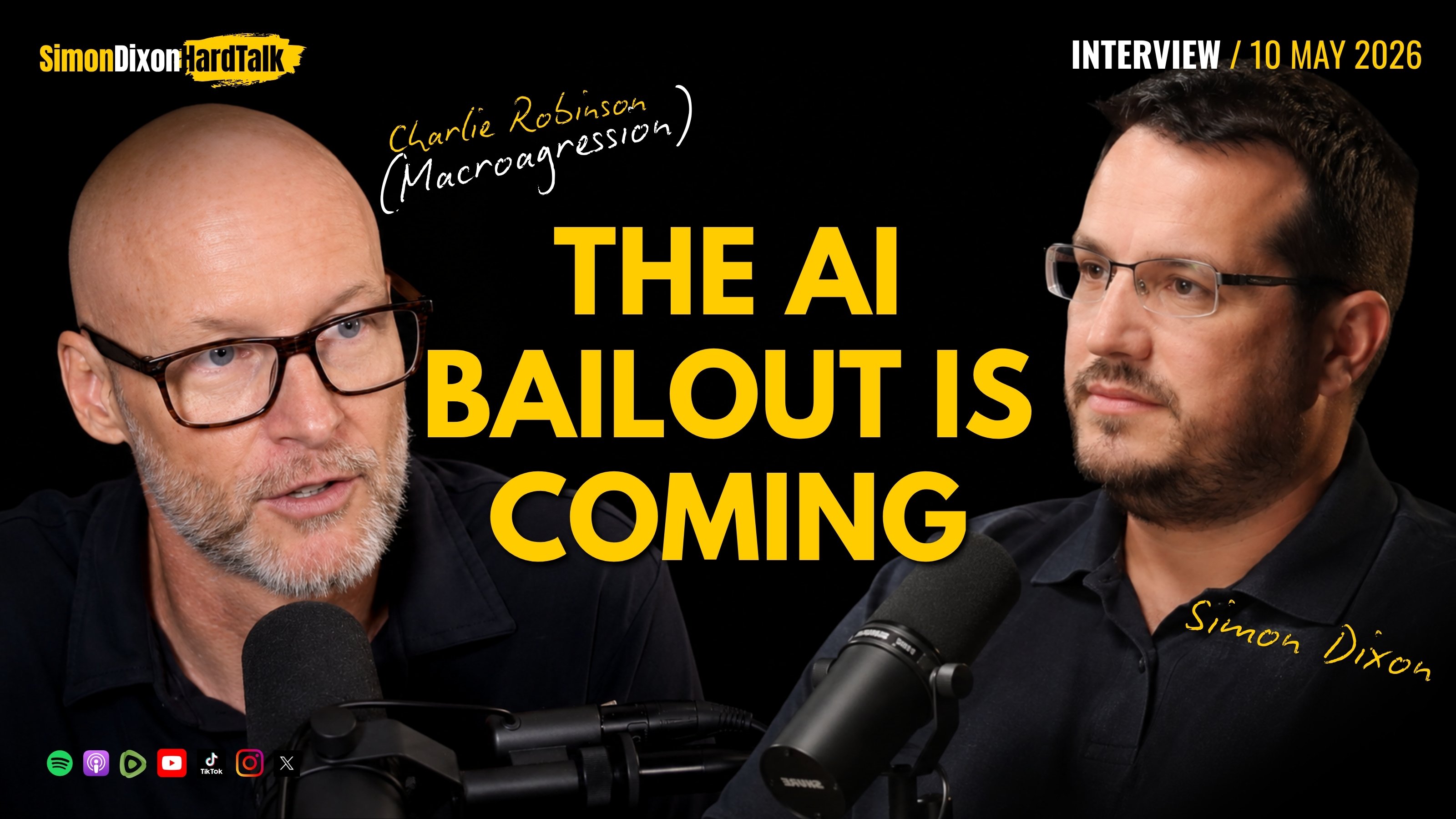
Watch on YouTube
Prefer to Listen? Available on Spotify & Apple Podcasts
About Charlie Robinson
Charlie Robinson is the host of the “Macroaggressions” podcast and YouTube channel, where he discusses topics including geopolitics, finance, media, censorship, and global power structures. He is also the author of The Octopus of Global Control and Hypocrazy, and is known for his commentary on alternative media and current affairs.
DISCLAIMER
Not Financial Advice: The information provided in this blog post, including discussions regarding Bitcoin, the broader cryptocurrency market, inflation, and the "K-shaped economy", is for educational and informational purposes only. It does not constitute financial, investment, legal, or professional advice. Simon Dixon's views on asset ownership, market trends, and his specific economic predictions represent his personal beliefs and estimations. Readers should conduct their own research or consult with a certified financial professional before making any investment decisions.
Opinions and Speculation: This post summarizes a wide-ranging conversation covering complex geopolitics, historical theories, and macroeconomic forecasts. The views, predictions, and theories expressed—including those regarding the "Financial Industrial Complex" (FIC), global resets, surveillance technology, and future geopolitical events—are entirely the personal opinions and speculations of Simon Dixon and Charlie Robinson.
AI-Assisted Summary: As mentioned during the interview, Simon Dixon occasionally utilizes AI tools to help condense lengthy, multi-hour discussions into shorter summaries for his blog. While this document aims to accurately capture the structure and logic of the conversation, it remains a summary. For the complete, nuanced context of these arguments, readers are encouraged to watch the original interview on episode #645 of the Macroaggressions podcast.