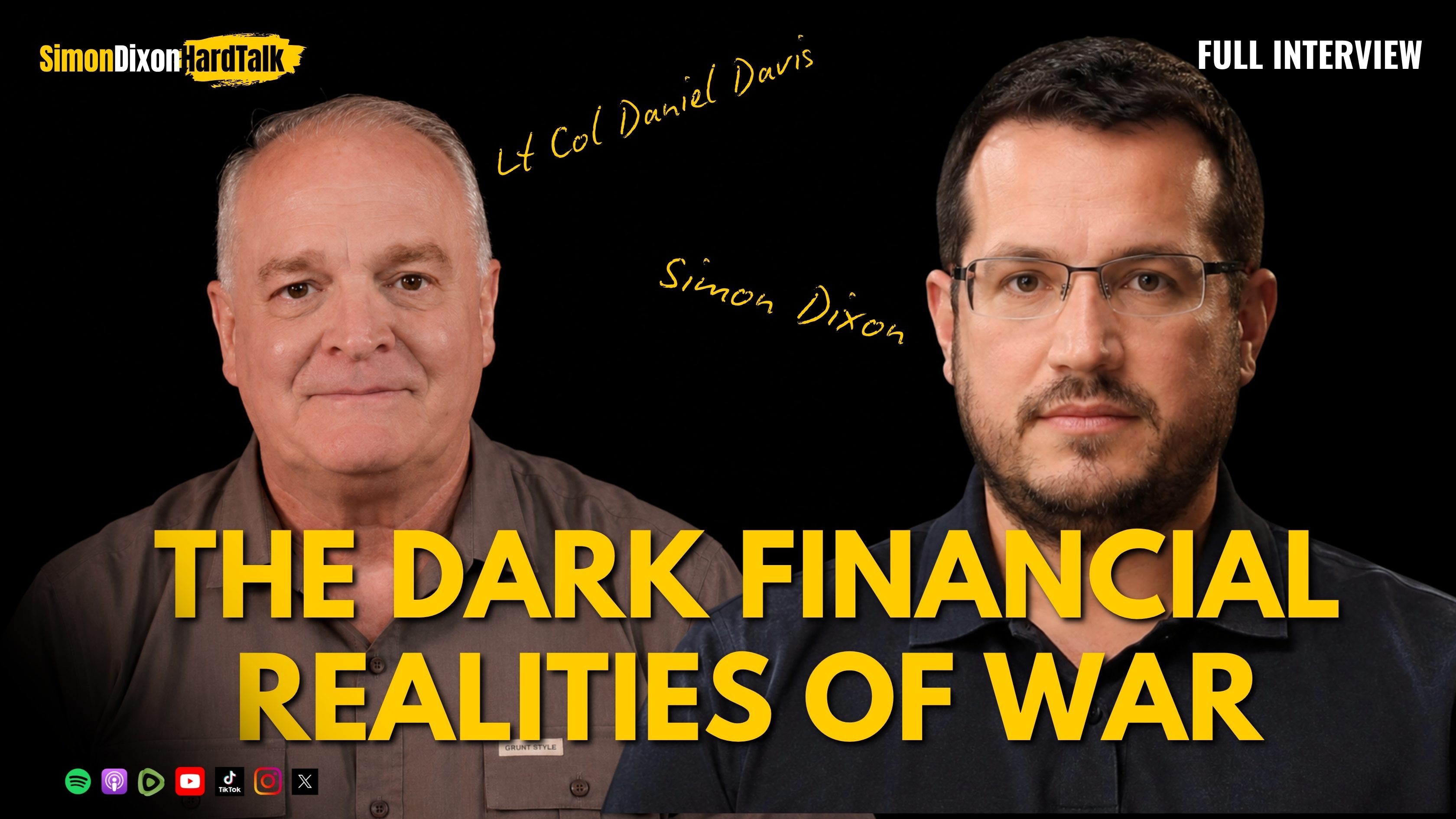
The Dark Financial Realities Behind the Iran War | Lt Col Daniel Davis interviews Simon Dixon
May 14, 2026Executive Summary
This briefing synthesizes the financial and geopolitical analysis provided by Simon Dixon regarding the escalating tensions between the United States, Israel, and Iran. The central thesis is that modern warfare is a well-defined "business model" driven by a "financial-industrial complex" that operates above national interests. The document outlines how transnational capital—represented by major asset managers and sovereign wealth funds—utilizes conflict to consolidate wealth, reset debt cycles, and transition the global economy from a US dollar-dominated system to a multipolar order involving the Petro-yuan and regional stability managed by China. Critical takeaways include the concept of "theatrical" war narratives used to mask resource extraction and the strategic use of "bounded escalation" to renegotiate rebuild contracts.
High-Level Overview
The discussion frames the potential conflict with Iran not as a purely ideological or security-based struggle, but as a calculated financial maneuver.
- Theme of "Theatrical" War: Narratives regarding "bad actors" or nuclear threats are described as scripts designed to gain public tax support and justify inflation.
- The Business of War: Conflict serves to increase Pentagon budgets, issue high-yield bonds, and allow financiers to profit from both the "upside" (success) and "downside" (failure/destruction) of a war.
- The Shift in Power: The interview posits that the era of the "forever war" is transitioning toward a "regional stability" model in the Middle East to facilitate Chinese-led trade and alternative payment rails (CBDCs).
Key Arguments Made by Simon Dixon
The Financial-Industrial Complex
- The Business Model: War is financed by taxpayers and paid for through inflation, but the "yield" is captured by financial institutions.
- Shareholder Alignment: Financiers are the primary shareholders in military-industrial companies; they benefit from the issuance and purchase of bonds necessitated by increased defense spending.
- Resource Extraction: War is used to reset prices and provide opportunities for resource extraction and rebuild contracts.
Transnational Capital vs. National Sovereignty
- Capture of the West: Western nations (US, UK, Israel, Canada, etc.) are effectively captured by corporate interests.
- The "Big Three": BlackRock, State Street, and Vanguard manage approximately $30 trillion in assets and hold 20,000 board seats across all major military, energy, and technology companies.
- Non-National Loyalty: Transnational capital is not "America First"; it partners with global entities like the Norwegian, Gulf, and Chinese sovereign wealth funds to manage portfolios across borders.
The Strategic Use of Israel and Iran
- Israel as a Proxy: Israel is described as a "Palestinian laboratory" and a proxy for Western corporate/military interests, providing "plausible deniability" for crimes or resource seizures.
- Regime Change of Radical Factions: There is a move to "regime change" radical Zionism and specific factions of the IRGC (Iran) that benefit from "strategic tension" to move toward a stability model favored by China.
- October 7th Framing: Dixon suggests such operations can be used to turn assets (like Israel's current administration) into "toxic assets" for "distressed acquisition" and eventual restructuring.
The Role of China and the Petro-Yuan
- Regional Stability: China requires a stable Middle East (West Asia) to secure its energy needs and manufacturing base.
- Alternative Rails: Iran and the UAE are integrating into central bank digital currency (CBDC) networks that circumvent the SWIFT system, facilitating a shift from the Petro-dollar to a Petro-yuan/multi-currency system.
Economic Consolidation Tactics
- Wealth Transfer: Events like COVID-19 and manufactured energy crises concentrate wealth upward by bankrupting small businesses and farmers, who are then acquired by stock-market-floated companies.
- Debt Slavery: The population is moved from entrepreneurship toward "debt slavery" via mortgages and subscription services.
- AI and Robotics: The "new world order" is being built around an AI and data center bubble, requiring massive energy, water, and rare earth minerals—all of which are secured through geopolitical maneuvering.
Key Arguments Made by Other Participants
Senator Kennedy (via clip)
- Theocratic Threat: Characterizes the Iranian government as "Charlie Mansons" and "religious Nazis."
- Global Safety: Argues that the world is "safer today" due to aggressive stances against the Iranian theocracy.
Daniel Davis (Host)
- Skepticism of Control: Questioned whether the "cartel" truly has total control, citing the US withdrawal from Afghanistan as a potential loss for those benefiting from the "forever war."
- Political Motivation: Raised the question of whether leaders like Netanyahu are driven by "messianic obsession" rather than purely financial motives.
Points of Agreement
- Narrative Construction: Both participants acknowledge that the public is presented with a specific narrative (the "theocracy" vs. "security" story) that may not reflect the underlying geopolitical realities.
- Reality of Destruction: While the motivations may be financial/theatrical, both agree the physical deaths and destruction are real and devastating.
Points of Disagreement
- The Afghanistan Withdrawal: Davis suggested the withdrawal might indicate the "money people" lost a battle; Dixon countered that it was a strategic move to close one "portfolio" (forever war) and open another (regional stability/rebuild).
- National vs. Transnational: Davis focused on national leaders and their obsessions; Dixon argued these leaders are "rented" or "puppet" politicians fulfilling the requirements of the four major lobbies (financial, military, Israeli, energy).
Important Data, Claims, or References Mentioned
|
Category |
Item(s) Mentioned |
|
Books |
Confessions of an Economic Hitman (John Perkins), Operation Gladio (Paul Williams) |
|
Financial Entities |
BlackRock, State Street, Vanguard (managing $30T), Goldman Sachs, Citigroup, Saudi Aramco |
|
Intelligence/History |
Safari Club (George Bush/CIA), 1971 Gold Standard default, 1973 Yom Kippur War, Iran-Contra Affair |
|
Geopolitical Concepts |
Bounded Escalation, Jurisdictional Arbitrage, Strategic Tension, Multi-polar World Order |
|
Energy/Economics |
Petro-dollar, Petro-yuan, OPEC, 5% Bond Yield threshold, $120 Oil price cap, "Taco" (capitulation) |
|
Key Companies |
Lockheed Martin, General Dynamics, Raytheon, Chevron, Exxon, Cheniere Energy |
Notable Quotes or Framing
- "Every war needs a good narrative and a good story."
- "The yield is always received by what I call the financial-industrial complex."
- "The deaths are real... but it’s also profitable for somebody."
- "You can rent the US military as a militia in order to go get resources and change the world order."
- "Israel is a Palestinian laboratory... used for jurisdictional arbitrage."
Open Questions or Unresolved Issues
- The Russia-Ukraine Pivot: Dixon estimates the Russia-Ukraine war will continue for another three years to "compensate" the military-industrial complex as the Middle East transitions to stability.
- The 5% Bond Threshold: How long the US can maintain the "theatre" of war before the bond market yields (surpassing 5%) force a "taco" or capitulation to prevent an economic wreck.
- Trump’s True Allegiance: Whether Donald Trump will serve the "America First" narrative or the World Economic Forum (WEF) agenda by allowing the manufacturing of crises to continue.
- The Role of AI: How the transition to an AI-driven economy will specifically dictate the next phase of resource wars and data center buildouts.
About Daniel Davis:
Retired Lt. Col. Daniel L. Davis is a former U.S. Army officer and military analyst with more than 21 years of service, including combat deployments in Iraq and Afghanistan. He is best known for publicly challenging official U.S. assessments of the Afghanistan War in 2012, arguing that military leadership had misrepresented conditions on the ground. Davis is a recipient of the Bronze Star Medal for Valor and the Ridenhour Prize for Truth-Telling. He currently serves as a Senior Fellow at Defense Priorities and hosts the “Daniel Davis Deep Dive” podcast, where he provides analysis on U.S. foreign policy and global conflict.
Call to Action
- Share this post. Share this blog post to expose the "divide and conquer" trap.
- Subscribe to the Simon Dixon YouTube channel. Get my weekly deep dives into geopolitics, macro, and Bitcoin. Subscribe to my YouTube channel.
- Find me on Rumble. This is my backup channel, safe from censorship. Follow me on Rumble.
- Follow me on X @SimonDixonTwitt. I post real-time updates and analysis on X and am highly active there. Follow me on X.
- Follow me on instagram. Usually short clips are posted here.
- Follow me on TikTok. Usually short clips are posted here.
- SimonDixon.com. This is my personal site and an archive of all my content, safe from de-platforming. Join the free membership portal.
Watch on YouTube
Prefer to Listen? Available on Spotify & Apple Podcasts
Disclaimer: The views, thoughts, and opinions expressed in this blog post and the associated interview are solely those of the guest, Simon Dixon, and do not necessarily reflect the views or positions of the host, Daniel Davis. The discussions regarding the "financial-industrial complex," the influence of transnational capital, and the geopolitical business models of war are presented for informational, educational, and analytical purposes only.
The content and analysis provided in this deep dive do not constitute professional financial, investment, legal, or geopolitical advice. Readers and viewers should conduct their own independent research and consult with certified financial professionals before making any investment decisions or acting upon the market theories discussed.