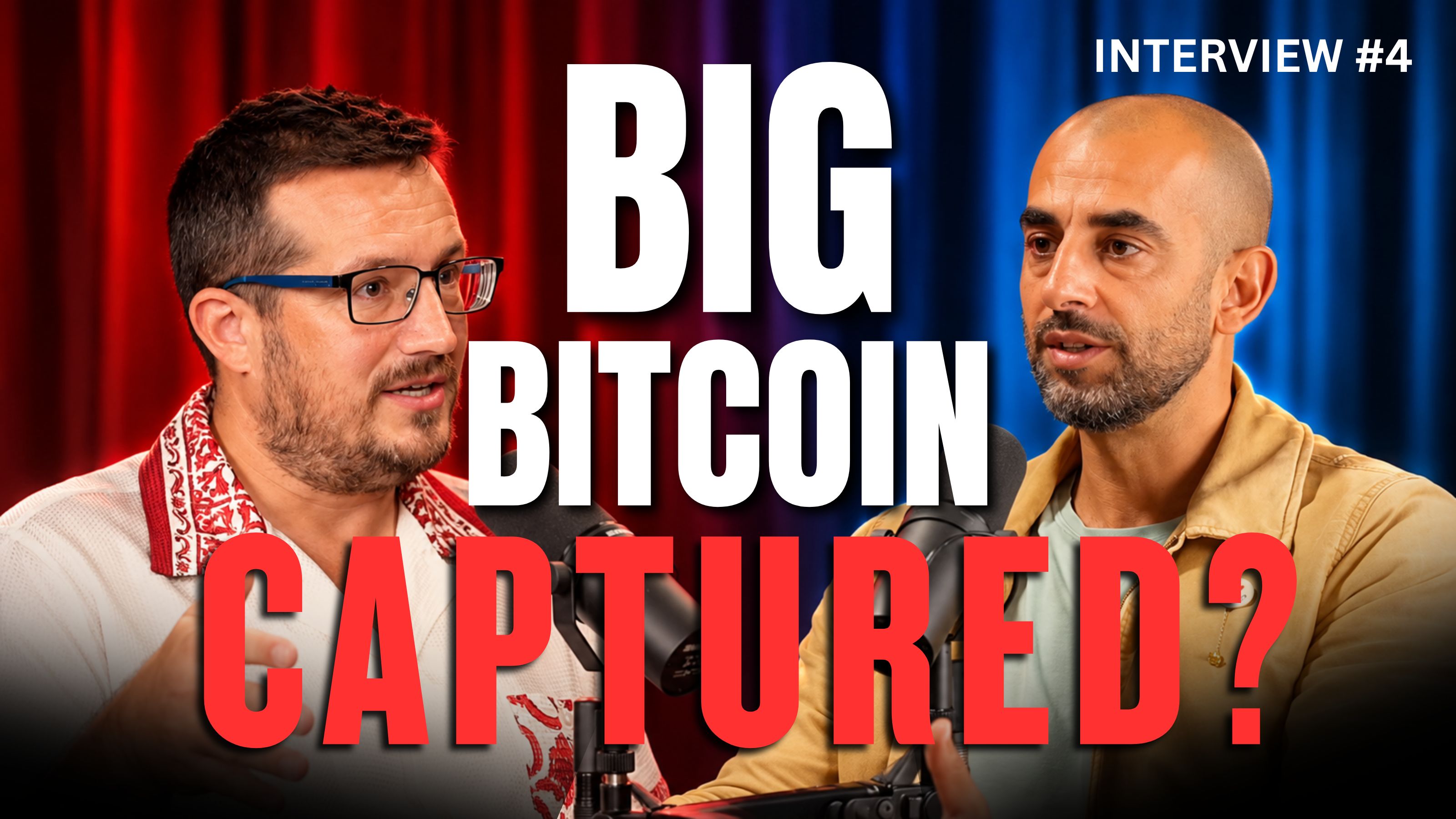
Big Bitcoin, the Financial Industrial Complex & the End of the Petrodollar | Simon Dixon on Bitcoin Archive w/ Archie (Interview #4)
Oct 13, 2026Context & Background This analysis summarizes the two-hour interview titled "Big Bitcoin, the Financial Industrial Complex & the End of the Petrodollar", hosted by Archie on the Bitcoin Archive channel.
The interview took place on 13 October 2026 at Archie’s London studio. This recording marked the fourth face-to-face, in-person interview that Simon Dixon has done for Archie on the channel.
Executive Summary
The discussion covers macroeconomics, global geopolitics, intelligence operations, and the long-term thesis for Bitcoin. The conversation centers on a global trend toward hyper-centralization—driven by artificial intelligence (AI), corporate capital, and state surveillance—and how this impacts self-custody and individual sovereignty.
Key takeaways include:
- The Self-Custody Security Landscape: Recent hardware wallet security breaches (including Cold Card's entropy vulnerability, Ledger supply-chain reseller compromises, and Trezor third-party data leaks) are accelerating a push toward centralized custody, such as Bitcoin ETFs. In Simon Dixon's view, while these events may be opportunistic cyber attacks, they are being weaponized to discourage individual self-custody. Power structures seek self-custody for themselves while restricting it for the public.
- Geopolitical & Economic Realignment: The 1974 Petro-dollar framework is undergoing deconstruction. Global powers are shifting away from U.S. Treasuries, unwinding the Japanese carry trade, and forming new regional trade and financial rails.
- The Interplay of Institutional Power: Power is shifting across three core structures: the Financial Industrial Complex (FIC), the Military Industrial Complex (MIC), and the Technical Industrial Complex (TIC). While the U.S. nation-state incurs high national debt and declining strategic reserves, private corporate capital within the FIC, MIC, and TIC is realizing record profits.
- Evolution of Bitcoin's Role: Bitcoin's original phase of "us versus the banks" has concluded, as traditional financial institutions have integrated the asset to generate revenue. Short-term price action remains driven by liquidity, the Cantillon effect, and Wall Street trading desks. However, the core thesis—peer-to-peer transactions, fixed 21-million supply cap, and self-custody—remains intact.
High-Level Overview
The debate frames the global economy as undergoing a rapid transition toward digitization and peak centralization. Individuals face a choice between submitting data and capital to centralized intermediaries or learning the technical skills required to maintain data and financial sovereignty.
Archie frames current events as a concerted, multi-pronged attack on Bitcoin self-custody, pointing to concurrent hardware wallet vulnerabilities and regulatory pressures in Europe. Simon Dixon frames these developments within broader macroeconomic and intelligence dynamics: AI is currently penetration-testing global digital infrastructure, while the traditional Petro-dollar order is giving way to a multipolar world.
Key Arguments Made by Simon Dixon
Self-Custody, Hardware Wallets, and Intelligence Operations
- Weaponization of Security Failures: Simon Dixon argues that whether hardware wallet breaches are deliberate intelligence operations or opportunistic hacks, the outcome is the same: fear is weaponized to drive retail users away from self-custody and into centralized custodians or Bitcoin ETFs.
- Assessment of Cold Card: In Simon Dixon's opinion, the passphrase entropy vulnerability in Cold Card was a critical failure in a device culturally positioned as the premier wallet for Bitcoin self-custodians. He believes no user should continue using Cold Card.
- Potential Intelligence Integration: Allegedly, the public indifference and communications strategy displayed by the Cold Card corporate X (formerly Twitter) account suggests a degree of protection often associated with intelligence operations. Simon Dixon notes that when compromised entities face catastrophic legal liability, they are frequently leveraged into assets for MIC power.
- Asymmetry of Sovereign Rights: In Simon Dixon's view, power structures do not intend to eliminate cryptography or self-custody entirely because they require those mechanisms for their own operations; rather, they seek to deny self-custody to the general public.
- Evolving Security Standards: To maintain sovereignty against AI-driven hacking, users must move away from generating passphrases via single hardware devices. They should instead adopt multi-signature setups, utilize open-source Bitcoin Core software, or roll physical dice to generate entropy manually.
Geopolitical Models and Governance
- China vs. Western Governance Models: Simon Dixon posits that a sovereign country requires long-term policy continuity. China’s governance model keeps state authority above private corporate capital, preventing finance from dictating national strategy. Conversely, Western neoliberal democracies are subordinate to the FIC, resulting in short-term policy flipping every two to four years.
- Socialism for the Wealthy: In Simon Dixon's opinion, the Western banking system is fundamentally anti-capitalist. Through central bank interventions, it socializes losses for financial institutions while enforcing strict market capitalism on ordinary citizens.
- Propaganda and Education: Simon Dixon asserts that Western educational systems, funded by non-governmental organizations and think tanks, function to download "acceptable operating systems" into the public's minds, conditioning individuals to accept corporate-sponsored narratives.
Petro-Dollar Deconstruction and Global Dynamics
- Unraveling of the Petro-Dollar: The security-for-treasury recycling deal established in 1974 is unwinding. Central banks and foreign entities (such as Japan, China, and Cayman Islands hedge funds) are reducing their intake of U.S. Treasuries, forcing bond yields higher.
- Transition from MIC to FIC in the Middle East: In Simon Dixon's estimation, the Middle East is transitioning from a MIC "forever war" model to an FIC financial control model. As physical military presence is scaled back, financial rails (such as World Bank integration, Visa, Mastercard, and central bank swap lines) move in to capture regional economic infrastructure.
- Oman-Iran Central Banking Axis: Simon Dixon highlights that Oman and Iran have integrated their central banking rails, creating a neutral financial corridor connected to China, bypassing traditional Western sanctions.
- Corporate Profit vs. State Strength: Simon Dixon emphasizes that while the U.S. nation-state grows weaker due to escalating debt and energy costs, private corporate interest within the FIC, MIC, and TIC is realizing record profits through market volatility, AI infrastructure investments, and defense contracts.
The State of Bitcoin and Strategic Outlook
- End of the Institutional War Phase: Simon Dixon believes the initial historical struggle between Bitcoin and the banking system is over. Traditional financial institutions recognized they could not destroy the network, opting instead to capture yields and fee structures by offering custody, treasury products, and ETFs.
- Price Disconnect and Manipulation: Short-term Bitcoin price movements are disconnected from any single economic narrative (e.g., inflation, interest rates, or gold correlation). Price action is heavily influenced by entities benefiting from the Cantillon effect—such as Wall Street hedge funds and trading desks—that access capital and information ahead of the broader market.
- Core Unalterable Value: Despite centralizing forces in mining and development funding, Bitcoin's fundamental value proposition remains intact: peer-to-peer settlement, self-custody capability, and an absolute supply cap of 21 million coins.
Key Arguments Made by Other Participants (Archie)
- Targeted Attack on Self-Custody: Archie raised the concern that recent supply chain attacks and software vulnerabilities are not coincidental, but rather part of a long-planned, sinister campaign to undermine faith in non-custodial Bitcoin ownership.
- Cultural Impact of Cold Card Breach: Archie emphasized that Cold Card was culturally engineered as the primary choice for dedicated Bitcoiners ("plebs"). Its failure represents a profound breach of trust that directly damages the self-custody movement.
- Distinction in Hardware Breaches: Archie pointed out the operational distinction between different security events:
- Cold Card & Ledger: Resulted in direct key exposure/vulnerabilities where funds were swept.
- Trezor: Suffered a third-party supply chain breach (via Mailchimp) exposing user personal data and email addresses, but not the private keys or underlying funds.
- Community Toxicity and Ideological Warfare: Archie argued that online Bitcoin culture has become overly antagonistic and toxic. He expressed sadness that individuals involved in ideological disputes (such as BIP 110) flame out or fork off rather than returning to the core community after losing a debate.
- Military Buildup in the Middle East: Citing analysis from military experts (referencing Professor Pape), Archie noted that the buildup of U.S. military hardware and assets in the Middle East reflects historical patterns that precede major offensive operations, questioning whether a wider conflict with Iran is imminent.
Points of Agreement
- Impact of Wallet Vulnerabilities: Both participants agreed that hardware wallet security breaches actively drive non-technical users away from self-custody and toward centralized custodial alternatives like ETFs.
- Centralization Trends: Both acknowledged that global data, communication, and key storage are centralizing into AI providers and corporate platforms.
- Petro-Dollar Instability: Both agreed that the historical Petro-dollar agreement and U.S. military-backed security model in the Middle East are undergoing structural shifts.
- Social Media Incentives: Both agreed that modern social media algorithms are explicitly structured to incentivize extreme, sensationalist, and divisive behavior to drive user engagement.
Points of Disagreement
- Resolution of Ideological Disputes & Chain Forks:
- Simon Dixon's View: Ideological battles inevitably lead to network forks. Simon Dixon argued that users should maintain an "index" approach by never selling their forked coins, thereby retaining financial exposure to competing technological or political factions.
- Archie's View: Archie argued that factions defeated in technical debates should exhibit emotional intelligence, accept the community consensus, and return to the primary Bitcoin fold rather than remaining isolated on alternative chains.
Important Data, Claims, or References Mentioned
Hardware Wallet Security Incidents & Vulnerabilities
|
Entity |
Breach Type / Target |
Technical Mechanism / Cause |
Direct Result |
|
Cold Card |
Passphrase / Entropy Vulnerability |
Long-dormant software flaw in entropy generation |
Funds swept directly off target wallets; alleged inside involvement. |
|
Ledger |
Reseller Supply Chain Attack |
Hardware modification by middleman resellers; compromised chip insertion |
Private keys scraped via physical chip modification; funds swept. |
|
Trezor |
Third-Party Data Breach |
Email service provider (Mailchimp) compromise |
Customer emails and delivery data exposed; private keys/coins remained safe. |
Historical Monetary & Geopolitical Reference Points
|
Year / Event |
Strategic / Monetary Context |
Historical Outcome |
|
1956 (Levant / Suez Crisis) |
Israeli false-flag operations; British imperial decline |
British financial retreat; shift of Western regional alignment toward the U.S. dollar. |
|
1967 (Six-Day War) |
Regional military conflict |
Israel occupied Gaza, West Bank, Sinai, and Golan Heights. |
|
1971 (Nixon Shock) |
U.S. gold reserve depletion (down from 20,000 to 8,000 tons) |
President Nixon suspended USD convertibility into gold, ending Bretton Woods. |
|
1973 (Yom Kippur War) |
Regional military conflict |
Accelerated U.S. military supply lines and financial integration with Israel. |
|
1974 (Petro-Dollar Agreement) |
U.S. - Saudi Arabia agreement |
Global oil priced exclusively in USD; excess revenues recycled into U.S. Treasuries and military contracts. |
Institutional Power Dynamics & Entities Mentioned
|
Acronym / Entity |
Full Name / Description |
Role in Global Structure |
|
FIC |
Financial Industrial Complex |
Global banking, debt capital markets, Wall Street, bond traders, and central banking networks. |
|
MIC |
Military Industrial Complex |
Defense contractors, state armed forces, and mercenary/militia funding networks. |
|
TIC |
Technical Industrial Complex |
AI providers, surveillance state architecture, and digital identity platforms. |
|
Foundry |
Subsidiary of Digital Currency Group (DCG) |
Operates as a major U.S.-based Bitcoin mining pool; categorized by Simon as an FIC node. |
|
Norwegian Sovereign Wealth Fund |
$2.3 Trillion State Fund |
Diverted/debated investments connected to defense and Israeli military suppliers. |
Notable Quotes or Framing
- On the Nature of Global Centralization:
"The grand trend of the world is hyper-centralization of data, of key storage, of convenience... there's only going to be two types of people really: those that submit and give their data, and those that learn how to store their own data." — Simon Dixon
- On Sovereign Rights and Power Structures:
"Power wants self-custody. It just doesn't want you to self-custody." — Simon Dixon
- On Corporate Capital vs. Western Governments:
"In a country controlled by capital, everything is about alignment with capital to control government. In a country that's controlled by the government, everything's about playing by the rules of the government in order to succeed." — Simon Dixon
- On Western Banking Systems:
"The West is socialism for the banks and capitalism for everyone else." — Simon Dixon
- On the Current Phase of Bitcoin:
"The mission part of Bitcoin is over for me. When it was us versus the banks... that's all done. Now you've got Wall Street kind of trying to have their play. The mission [now] is to try and help as many people securely self-custody, take advantage of Bitcoin... and not fall for the scams, the scops, and get hacked." — Simon Dixon
Open Questions or Unresolved Issues
- Cold Card Intentionality: It remains unproven whether the Cold Card passphrase vulnerability was an unintentional software bug, an inside job, or a long-term covert intelligence operation designed to undermine confidence in self-custody.
- U.S. Military Action in the Middle East: It remains unresolved whether the buildup of U.S. assets in the Middle East will culminate in a direct strike on Iran or if the posturing will yield a broad negotiated settlement involving China, Russia, and the Gulf States.
- Timeline for Palestinian Statehood: Simon Dixon projects that a Palestinian state or recognized administrative reconstruction will occur within five years as a mandatory condition for Saudi-Israeli normalization, whereas Archie views a two-state resolution as highly unlikely given current regional dynamics.
- Bitcoin Short-Term Catalysts: No definitive consensus was reached regarding which specific macro indicator (e.g., interest rate adjustments, energy market stress, or global liquidity expansions) currently serves as the primary driver for Bitcoin's short-term spot price.
Call To Action
- Share this post. Share this blog post to expose the "divide and conquer" trap.
- Subscribe to the Simon Dixon YouTube channel. Get my weekly deep dives into geopolitics, macro, and Bitcoin. Subscribe to my YouTube channel.
- Find me on Rumble. This is my backup channel, safe from censorship. Follow me on Rumble.
- Follow me on X @SimonDixonTwitt. I post real-time updates and analysis on X and am highly active there. Follow me on X.
- Follow me on instagram. Usually short clips are posted here.
- Follow me on TikTok. Usually short clips are posted here.
- Follow me on NOSTR.
- Subscribe to my Substack.
- SimonDixon.com This is my personal site and an archive of all my content, safe from de-platforming. Join the free membership portal.
Watch On YouTube
Prefer to Listen? Available on Apple Podcasts & Spotify
Want the faster version of this article?
If you don’t have time to read or watch the full discussion, you can access the AI Summary and Whiteboard Explainer for this post inside the Simon Dixon Hard Talk Membership Portal.
Already have your complimentary login? Simply sign in to access them.
Not a member yet? The portal is 100% complimentary to join and use.
You can also download a free PDF copy of Simon’s 2011 book and access the full archive of Simon Dixon Hard Talk LIVE episodes, interviews, long-form conversations, AI summaries and explainer videos.
Simon does not ask you to buy anything.
- No membership fees.
- No upsells.
- No sponsors.
- No ad revenue.
- No products being pushed.
The portal exists to build a sovereign community and independent archive that does not depend entirely on YouTube, X or any other social platform to stay connected.
Disclaimer: This blog post is provided solely for educational and informational commentary and reflects personal opinion. It does not constitute financial, investment, legal, or tax advice.