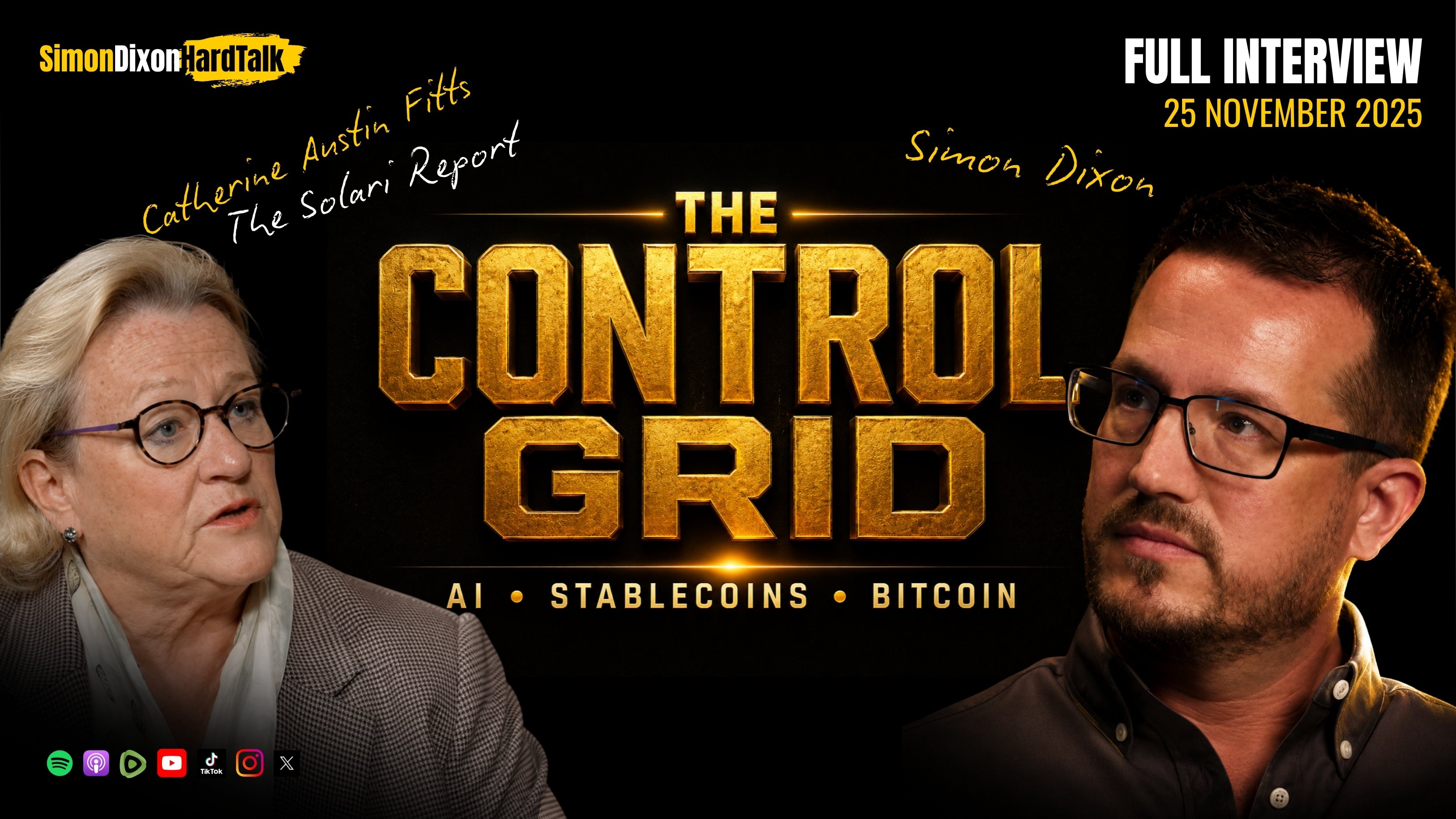
The Financial Reset: AI, CBDCs & Currency Wars | Simon Dixon with Catherine Austin Fitts
Nov 25, 2025Executive Summary
The interview provides an incisive analysis of the current global economic transition, which Simon Dixon characterizes as the "asset-stripping phase" of the collective West. The discussion posits that the global power structure is dominated by the Financial Industrial Complex (FIC), which is currently orchestrating a shift from a unipolar, dollar-centric world to a multipolar regional system. Central to this transition are the Technical Industrial Complex (TIC) and the Military Industrial Complex (MIC), which serve as tools for data extraction, surveillance, and regional destabilization.
Key takeaways include the role of stablecoins as a rollover mechanism for US debt, the use of tokenization to centralize assets under FIC custody, and the framing of Bitcoin as both a tool for personal sovereignty and a target for institutional co-option. The participants agree that political figures, including Donald Trump, act as narrative agents for these underlying financial interests. The ultimate goal, as described, is a technocratic control grid utilizing programmable money, digital IDs, and AI-driven social credit systems.
High-Level Overview
The discussion frames the current geopolitical and financial landscape as a managed reorganization of global power. The central theme is the "asset-stripping" of the Western middle class to facilitate a new digital order. The conversation explores:
- The Transition to Multipolarity: The FIC's move to shrink the US dollar into a regional currency while partnering with the BRICS and Gulf Cooperation Council (GCC) blocs.
- Programmable Money: The evolution of stablecoins and Central Bank Digital Currencies (CBDCs) as tools for fiscal dominance and social control.
- The Role of Technology: How AI, surveillance platforms (like X/Twitter), and data centers are replacing soft power with "hard" technocratic power.
- Sovereignty vs. Centralization: The tension between self-custodied assets (like Bitcoin) and "Wall Street wrappers" (ETFs and tokenized securities) designed to trap liquidity.
Key Arguments Made by Simon Dixon
The Managed Decline of the US Dollar
- Multipolarity Strategy: Simon Dixon believes the FIC has concluded that a "one-world" system is unviable. Instead, they are pushing for a multipolar world where the US manages the Americas, while China, Russia, and the Gulf nations manage other regional blocks.
- Intentional Weakening: In Dixon's opinion, current policies are signaling an intent to weaken the dollar, break currency pegs (such as the Saudi Riyal), and dismantle the petrodollar and Eurodollar systems.
- Regional Currency: The goal, allegedly, is for the dollar to become a regional currency rather than the global hegemon.
Stablecoins and the "Genius Act"
- Debt Rollover: Dixon argues that stablecoins provide a new market for rolling over US debt. As foreign investors downsize Treasury positions, stablecoins turn Treasury bills into a "little currency."
- The Genius Act: This legislation allegedly allows bank reserves at the Fed (approx. $3 trillion) to back stablecoins, essentially leveraging the Fed’s balance sheet to facilitate digital dollar dominance.
- Tether as a Case Study: Dixon notes that Tether became the 18th largest lender to the US government by using the float from digital dollars to buy Treasuries and then using the yield to mine Bitcoin.
Political and Corporate "Vassalization"
- Trump as a Financial Agent: Dixon characterizes Donald Trump as the "financial" choice of the elite, tasked with implementing "fiscal dominance" and the control grid. He believes Trump’s largest backers (Elon Musk, the Mellon family) represent the TIC and FIC.
- Leveraged Entrepreneurs: Dixon claims that billionaires like Elon Musk are "leveraged" into compliance by the FIC, which lends against their stock. This forces them to cooperate with the Gulf countries and provide backdoors to intelligence agencies.
- X (Twitter) as a Honey Trap: Dixon frames X as a surveillance device and "honey trap" that offers "freedom of speech but not freedom of reach," while simultaneously building users' social credit scores via AI.
Bitcoin and Institutional Co-option
- The "Saylor" Narrative: Dixon warns against the Michael Saylor model of borrowing against Bitcoin. He views this as a path to "vassalization," where Bitcoin is centralized in institutional custody.
- Self-Custody as Resistance: Dixon advocates for a "purist" approach: own Bitcoin in self-custody, do not use leverage, and avoid ETFs (which he calls "Wall Street wrappers").
- Bitcoin Strategic Reserve: Dixon notes that the proposed US Bitcoin reserve consists of "seized" coins (e.g., from Silk Road, Bitfinex, and the Prince Group), which he believes rightfully belong to the victims of those crimes/hacks.
Key Arguments Made by Other Participants (Catherine Austin Fitts)
The Legislative Control Grid
- The Clarity Act: Fitts expresses concern that this act is designed to create a regulatory framework for "asset tokens" that remains intentionally vague. She suggests the name "Clarity Act" should be inverted to imply "total confusion."
- Programmable Money vs. Currency: Fitts argues that programmable money (stablecoins/CBDCs) ends "currency" as we know it because it lacks true liquidity and is subject to dynamic, centralized control.
- Fiscal Dominance: She posits that once programmable money and digital IDs are in place, the FIC will control fiscal policy entirely, rendering the executive and legislative branches of government mere "theater."
Historical Patterns of Corruption
- 9/11 and Financial Fraud: Fitts recounts that on September 10, 2001, trillions were announced missing from the Pentagon. On 9/11, offices investigating this fraud were destroyed. Immediately after, the legal and financial focus shifted to Dubai.
- The "Auction" of America: Fitts agrees with the framing of America as an "auction" where presidents act as "bond dealers" selling narratives to ensure the debt can be rolled over.
- Deliberate Poisoning: Fitts observes that US life expectancy is being intentionally lowered and the population "poisoned" as part of a war against the middle class.
Points of Agreement
- FIC Supremacy: Both agree the Financial Industrial Complex (banks, money managers like BlackRock/Vanguard) sits at the top of the global power structure.
- Political Theater: Both believe that major political figures (Trump, Biden, Starmer, Macron) do not work for their people but for the lobbies and corporate interests of the FIC.
- Private Equity as a Trap: They agree that private equity in pension funds is "exit liquidity" for the elite, often involving "mark-to-market" valuations that are manipulated.
- The Surveillance Grid: Both view the combination of digital IDs, AI, and programmable money as a "1984 Orwellian nightmare."
- Community and Localism: Both advocate for moving assets into real things, supporting local farmers/businesses, and building non-digital community ties.
Points of Disagreement
- Bitcoin’s 21 Million Cap: Dixon maintains that the 21 million supply limit is mathematically and socially secure unless the entire ecosystem (developers, miners, nodes) is co-opted. Fitts is more skeptical, believing the FIC’s "physical harassment, surveillance, and dirty tricks" could eventually force a change in the limit through the control of the people who manage the technology.
- The Success of Resistance: While both agree on the severity of the situation, Dixon is slightly more optimistic about the utility of decentralized AI and self-custodied Bitcoin as "friction" against the system, whereas Fitts emphasizes that "hard power" (satellites, invisible weaponry) may make soft-power resistance increasingly difficult.
Important Data, Claims, or References Mentioned
Financial and Regulatory References
|
Entity/Term |
Context/Claim |
|
FIC / MIC / TIC |
Financial Industrial Complex, Military Industrial Complex, Technical Industrial Complex. |
|
Genius Act |
Proposed legislation to allow Fed reserves to back stablecoins. |
|
Clarity Act |
Proposed legislation regarding the regulation of asset tokens and securities (SEC vs. CFTC). |
|
3 Trillion Dollars |
The projected amount of stablecoin issuance by the end of the decade. |
|
10 Trillion Dollars |
The amount of US debt needing to be rolled over by the end of the decade. |
|
325,000 Bitcoin |
The alleged amount of Bitcoin in the US "Strategic Reserve," largely from seizures. |
|
Aladdin |
BlackRock’s data system used by the Treasury and the Fed. |
|
Palantir |
A TIC company (Peter Thiel) contracted for surveillance by the NHS, DoD, and others. |
Historical and Institutional References
- Celsius Bankruptcy: Dixon spent two years analyzing 4,000 documents to maximize recovery for 650,000 victims of this "Ponzi scheme."
- Bitfinex/Tether: The first stablecoin arbitrage mechanism that became the "backbone" of Binance.
- World Liberty Financial: A stablecoin company created by Donald Trump Jr. and Eric Trump, allegedly used to facilitate Gulf investments.
- The Prince Group: A recent seizure of Bitcoin by the US that China argues should be returned to the victims.
- "The Spider’s Web": A documentary recommended by Fitts regarding the British offshore financial system.
Notable Quotes or Framing
- Simon Dixon: "The dollar is debt. You can’t pay down the debt... this is a rollover scheme, not a payoff."
- Simon Dixon: "Freedom of speech, not freedom of reach." (Describing the X/Twitter algorithm).
- Simon Dixon: "Every accusation is a confession." (Regarding political and media narratives).
- Catherine Austin Fitts: "America's become... an auction."
- Simon Dixon: "The US government was paying Tether to hold one of the largest Bitcoin positions."
- Simon Dixon: "You won't out-trade Wall Street, but you can out-invest them."
Open Questions or Unresolved Issues
- The Reality of the 21 Million Cap: Can the state or FIC eventually co-opt the human layer of Bitcoin to increase supply?
- The Ukraine Clearance: Will Russia be successfully "imploded," or is the conflict merely a mechanism for BlackRock and the FIC to acquire Ukrainian grain fields and reconstruction contracts?
- Israel's Status: Will Israel be "privatized" by the FIC and forced into regional stability, or will the MIC continue to use it for destabilization?
- The "Clarity" of the Clarity Act: Will the Senate version of the bill (including "affinity assets") be passed by Thanksgiving 2025, and how will it define the boundary between the SEC and CFTC?
- The Timing of the "Dump": Will the FIC run the price of Bitcoin up to capitalize the system and then "pull the plug," or will it be maintained as a permanent reserve asset?
About Catherine Austin Fitts

Catherine Austin Fitts is an American former investment banker and public official. She served as Managing Director at the Wall Street investment bank Dillon, Read & Co. before being appointed Assistant Secretary for Housing and Federal Housing Commissioner at the U.S. Department of Housing and Urban Development (HUD) during the administration of President George H.W. Bush from 1989 to 1990.
Following her time in government, Fitts founded Hamilton Securities Group and later established Solari, Inc., where she publishes commentary on financial markets, public policy and economic issues. She is also a frequent speaker and author, and has appeared in a range of media interviews discussing finance, government spending and monetary systems, including a widely viewed interview with Tucker Carlson in 2026.
Connect with Catherine Austin Fitts
Call To Action
- Share this post. Share this blog post to expose the "divide and conquer" trap.
- Subscribe to the Simon Dixon YouTube channel. Get my weekly deep dives into geopolitics, macro, and Bitcoin. Subscribe to my YouTube channel.
- Find me on Rumble. This is my backup channel, safe from censorship. Follow me on Rumble.
- Follow me on X @SimonDixonTwitt. I post real-time updates and analysis on X and am highly active there. Follow me on X.
- Follow me on instagram. Usually short clips are posted here.
- Follow me on TikTok. Usually short clips are posted here.
- SimonDixon.com This is my personal site and an archive of all my content, safe from de-platforming. Join the free membership portal.
Watch on YouTube
Prefer To Listen? Available on Spotify & Apple Podcasts
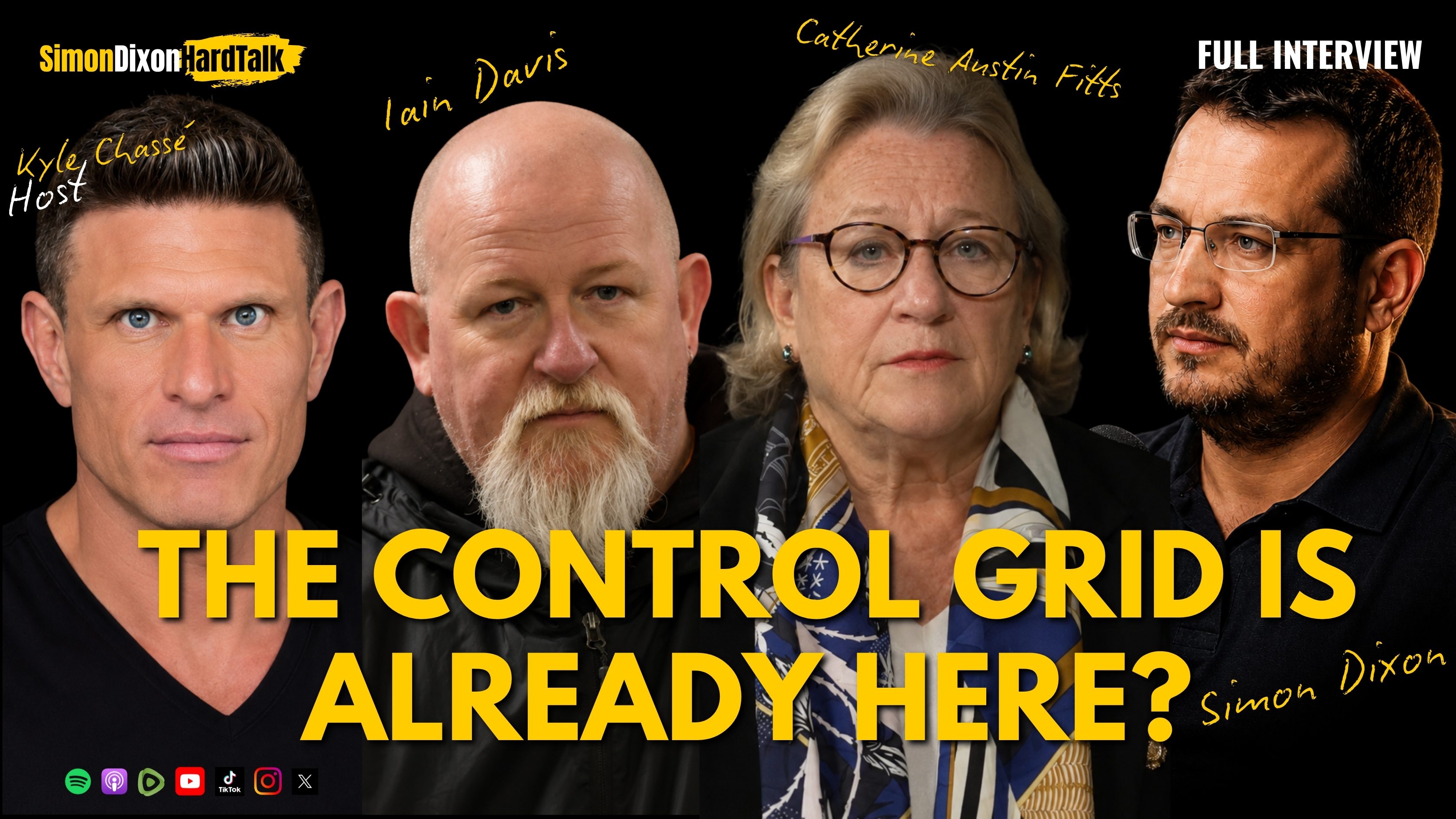
Other Related Blogs

General & Legal Disclaimer
Last Updated: July 2026
The information, opinions, and views expressed on SimonDixon.com, including but not limited to blog posts, videos, podcasts, newsletters, and associated social media content (collectively, the "Content"), are provided for general informational, educational, and entertainment purposes only.
By accessing and using this Content, you acknowledge and agree to the following terms:
1. No Financial, Investment, or Professional Advice
The Content does not constitute financial, investment, legal, tax, or other professional advice, nor does it form any solicitor-client or fiduciary relationship. Simon Dixon is an investor and author, not your personal financial adviser. None of the Content should be construed as a recommendation or solicitation to buy, sell, or hold any security, cryptocurrency, digital asset, or financial instrument, or to engage in any specific investment strategy.
2. High Risk and Volatility of Digital Assets
Cryptocurrencies, Bitcoin, stablecoins, and other digital assets are highly speculative, extremely volatile, and carry a high level of risk. You can lose some or all of your principal investment. Past performance is not indicative of future results. You should never invest money that you cannot afford to lose.
3. Personal Responsibility and "Do Your Own Research" (DYOR)
You are solely responsible for your own financial decisions. Before making any investment or financial decisions, you should conduct your own thorough research, perform due diligence, and consult with a qualified, licensed financial adviser, legal professional, or tax specialist in your relevant jurisdiction.
4. Accuracy and Completeness of Information
While we strive to provide accurate, up-to-date, and reliable information, the Content is provided on an "as is" and "as available" basis without any warranties of any kind, express or implied. Information may become outdated, and we assume no obligation to update any of the information contained herein. We accept no liability for any loss or damage arising directly or indirectly from your reliance on the Content.
5. Third-Party Links, References, and Guests
The Content may feature interviews with guests (such as Catherine Austin Fitts) or refer to third-party platforms, services, books, products, or websites. The views expressed by guests are entirely their own and do not necessarily reflect the official policy, position, or endorsement of Simon Dixon, his companies, or partners. References to third-party entities are for informational purposes only and do not constitute an endorsement, recommendation, or warranty of their safety, legality, or performance.
6. Jurisdiction-Specific Restrictions
The financial products, assets, or services discussed in the Content may not be legal, regulated, or available in your specific country, state, or jurisdiction. It is your sole responsibility to ensure that any financial actions you take comply with all local laws and regulations applicable to you.
For educational resources on self-custody and sovereign finance, visit SimonDixon.com.