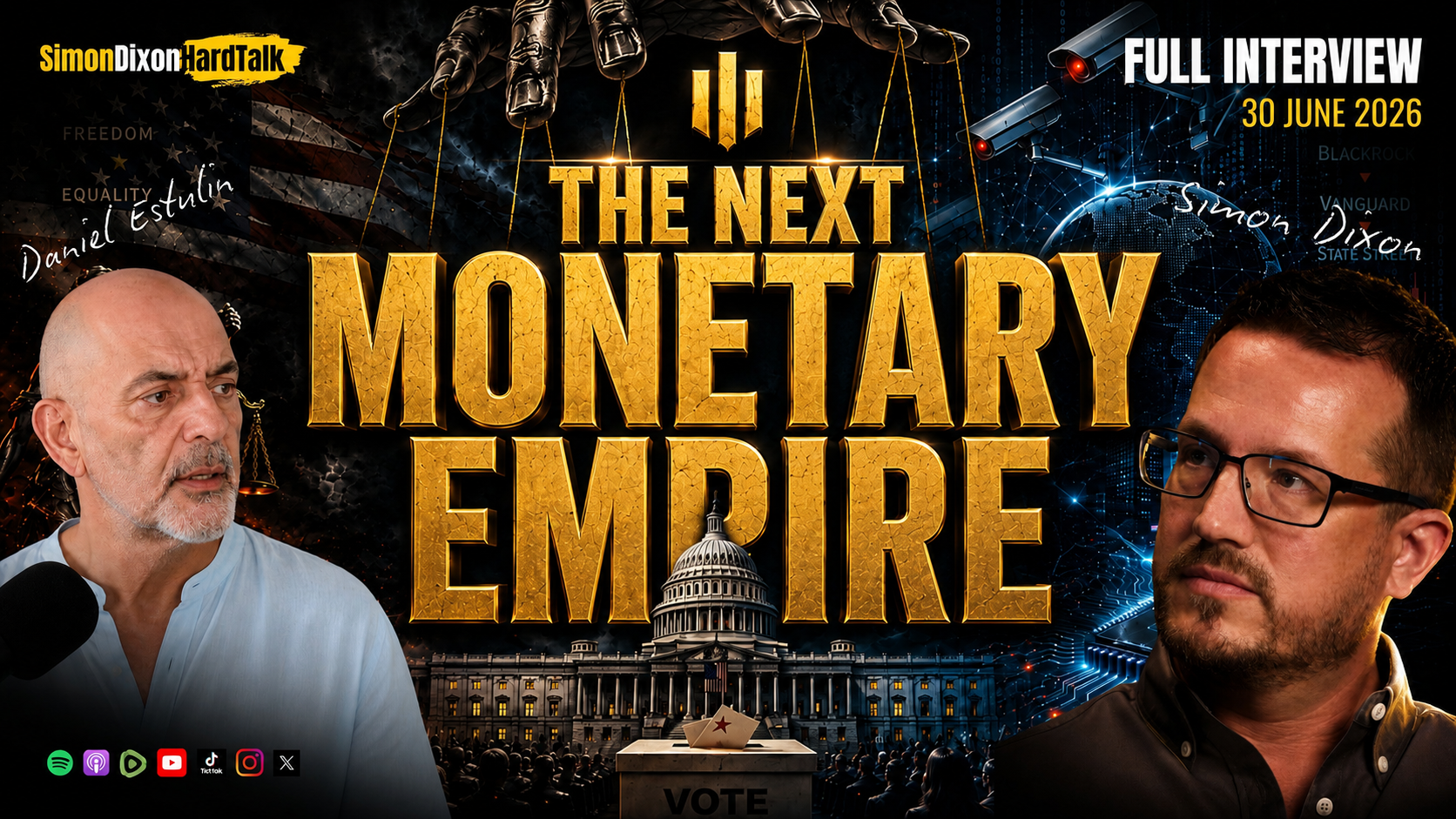
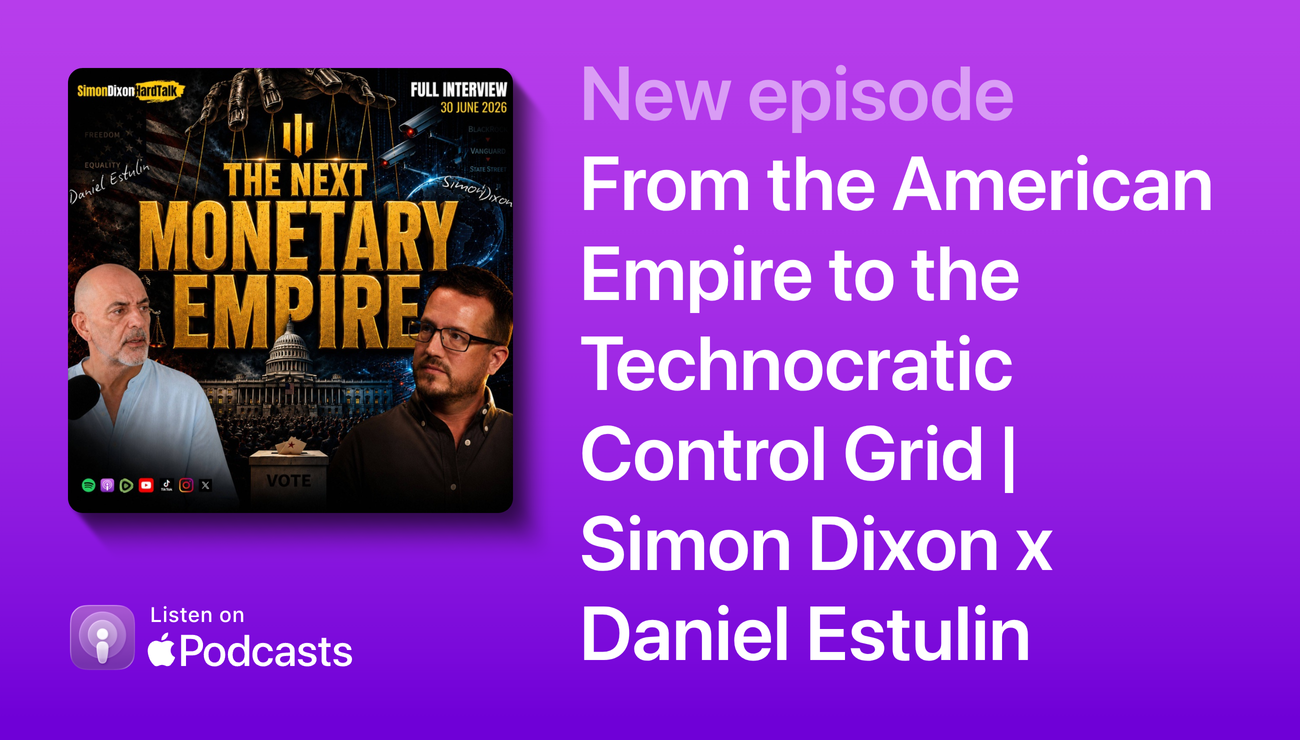
From the American Empire to Technocratic Control | Simon Dixon on Daniel Estulin
Jun 30, 2026On June 30, 2026, Simon Dixon participated in his first-ever interview with host Daniel Estulin. The 55-minute discussion explores the transition of global power from traditional nation-states to a transnational technocratic control grid. This briefing document synthesizes the core themes, historical frameworks, and geopolitical predictions discussed during the interview to assist in the preparation of strategic notes and future presentations.
Executive Summary
The interview posits that the world is undergoing a profound transition from a post-1945 international order toward a multipolar, technocratic system controlled by a partnership between transnational capital and technological interests. Simon Dixon argues that the historical progression of empires—Dutch, British, and American—has reached a terminal phase of "asset stripping" in the West. He asserts that modern democracies function as "regimes" where politicians are selected by lobbies rather than elected by people. The central thesis suggests that while the American Empire is being hollowed out, a new global architecture is emerging, defined by AI, robotics, and a "technocratic control grid" that integrates Western financial power with Eastern sovereign wealth and Chinese-style authoritarian governance.
High-Level Overview
The discussion frames the current global state not as a series of random crises, but as a systematic restructuring of the international system. Key themes include:
- The Evolution of Empire: The movement of financial and naval power from the Dutch to the British, then to the American Empire, and finally toward a multipolar technocratic order.
- The "Complexes" of Power: The interaction between the Financial Industrial Complex (FIC), the Technical Industrial Complex (TIC), and the Military Industrial Complex (MIC).
- Controlled Demolition of Europe: The systematic hollowing out of European sovereign power and its subordination to transnational debt markets.
- Technocracy vs. Ideology: The belief that ideology is a tool for mass manipulation, while the true drivers of history are capital flows and technological control.
Key Arguments Made by Simon Dixon
The Framework of Empire and Debt
- Historical Replication: Simon Dixon outlines how the British Empire replicated the Dutch model (central bank, government debt, private limited company) to socialize losses and privatize gains. He believes the American Empire is currently in the final stages of this cycle.
- The Asset Stripping Phase: Simon Dixon argues that the West is in a "heightened asset stripping phase." This involves loading governments with debt until they require restructuring, implemented through mechanisms like unrealized capital gains taxes and high interest rates that force the sale of assets to private equity.
- Subordination via Debt: In Simon Dixon’s opinion, sovereign debt has replaced democratic politics. Bondholders and "bond vigilantes" dictate government policy by threatening currency stability or lobbying to buy political influence.
The Nature of Modern "Regimes"
- Selected, Not Elected: Simon Dixon claims that Western democracies are "fake" and that politicians are "selected" based on their utility to various lobbies (Big Pharma, MIC, FIC).
- The UK as a Testing Ground: He identifies the UK as a primary site for "regime changes" (changing Prime Ministers) to serve specific agendas:
- Boris Johnson: Allegedly used to implement lockdowns and prevent peace in Ukraine.
- Rishi Sunak: Allegedly served interests related to vaccine investments.
- Keir Starmer: Allegedly tasked with laundering money through Ukraine to the MIC (Lockheed Martin, BAE Systems, etc.) while testing AI-integrated weaponry.
Technocratic and Civilizational Shifts
- The Weaponization of Religion: Simon Dixon believes that faith and immigration are weaponized through "psychological operations" (psyops) to divide populations and justify the creation of a "police and surveillance state."
- The Multipolar Control Grid: He suggests that the ultimate goal is a global AI technocratic control grid—a "privatized partnership" involving the FIC, TIC, and the Chinese Communist Party (CCP)—to manage a multipolar world.
- Capital as the Only Religion: Simon Dixon asserts that the FIC has no ideology other than profit and capital flow; it will fund opposing sides (e.g., Communism vs. Fascism) to maintain control over the underlying financial architecture.
Key Arguments Made by Daniel Estulin
- The Visibility of Power: Estulin argues that daily political events are merely the "visible surface" of a deeper transformation reshaping the foundations of the international system.
- The Decline of the West: He characterizes Europe's current state as a "managed decline" or "controlled dismantling" rather than a natural collapse.
- The Return of Civilizational Identity: Estulin suggests that while the West believed globalization would dissolve ancient identities, the world is moving back to an age of civilizations (China, Russia, India, the Islamic world).
- The Role of the British Monarchy: He questions whether the British aristocracy is strategically embracing Islam as a preparation for a changing geopolitical landscape where the Middle East becomes a central financial hub.
Points of Agreement
- Sovereignty: Both participants agree that national sovereignty in the West has been quietly transferred to transnational entities and debt markets.
- Democratic Facade: They agree that traditional elections no longer determine the actual trajectory of state policy.
- Europe's Future: Both see Europe as a declining entity being "hollowed out" for the benefit of transnational capital.
- Technological Shift: They agree that AI and robotics are becoming the primary strategic assets, potentially surpassing traditional military power.
Points of Disagreement
- The Power of Israel: While Estulin suggests the British establishment might be looking to the Islamic world for future leverage, Simon Dixon believes Israel is being "privatized" and acquired by transnational capital and Gulf interests, suggesting its perceived power is partially an illusion for "plausible deniability."
- The Role of the Monarchy: There is a nuanced tension regarding whether the British Monarchy is at the top of the power chain or if it has been subordinate to the FIC via offshore trust structures.
Important Data, Claims, or References Mentioned
|
Category |
Specific Reference / Claim |
|
Financial Statistics |
Simon Dixon states that 92% of stock market value is held by the top 10% of institutions and wealthy individuals. |
|
Historical Markers |
1917: The Balfour Declaration and the Bolshevik Revolution (claimed to be funded by the same financial interests). |
|
Corporate Entities |
The FIC includes BlackRock, State Street, Vanguard, and major investment banks. |
|
Military Contractors |
Lockheed Martin, General Dynamics, Raytheon, BAE Systems, and Palantir (cited as beneficiaries of the Ukraine conflict). |
|
Geopolitical Nodes |
The City of London, the Vatican, and the Bank for International Settlements (BIS) are described as independent jurisdictions. |
|
Historical Entities |
The Dutch East India Company and the British East India Company (used as models for current corporate-state structures). |
Notable Quotes or Framing
- On Capitalism: "When you have a central bank that determines the price of capital, then you don't have capitalism... what you end up with is socialism for the wealthy... and capitalism for the poor."
- On Political Figures: "Politicians are just a battering ram for the public... they are paid like rent prostitutes for financial power."
- On Global Strategy: "Capital has no ideology, but they have useful idiots everywhere."
- On Innovation: "Every single piece of [America's] technology was innovated originally by Pentagon budgets for killing people, and then they privatize it through a private-public partnership."
Open Questions or Unresolved Issues
- The Future of the US Dollar: Simon Dixon predicts the dollar will be weaker than Gold and Bitcoin in 10 years, but its exact status relative to a "multipolar" basket remains a point of speculation.
- The "Next Empire": While China is identified as the rising power, the degree to which it is truly independent of the FIC vs. being a partner in the technocratic control grid is a complex, unresolved theme.
- Israel and Palestine: Simon Dixon’s prediction of an "Arab majority" and the acquisition of Israel by Gulf countries remains a highly speculative geopolitical projection.
- AI and Quantum Computing: The specific timeline for the transition to a "one world government" controlled by quantum computing and AI was mentioned as a looming development without a fixed date.
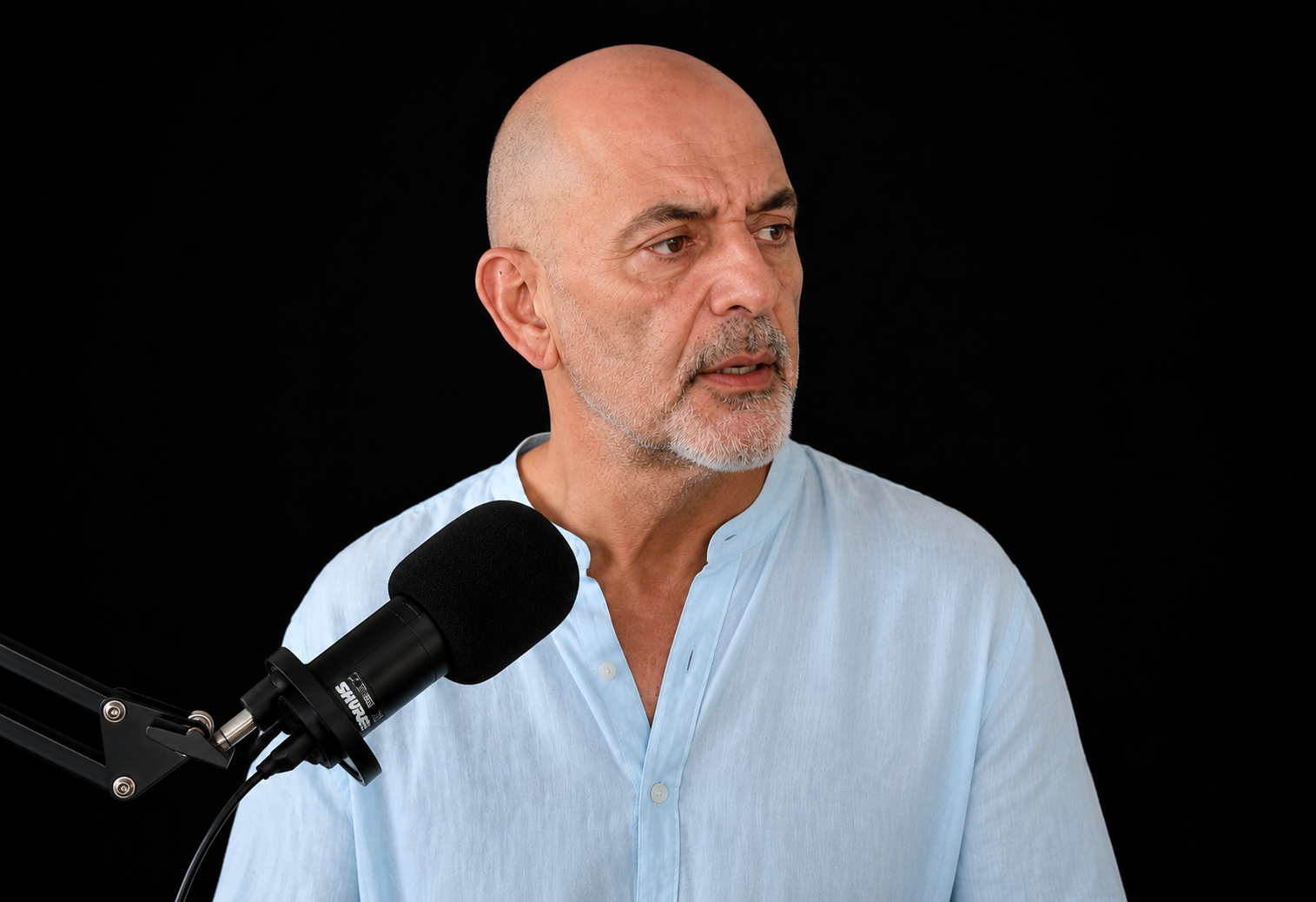
About the host: Daniel Estulin
Daniel Estulin is an author and commentator known for his work on geopolitics and international affairs. He has written several books, including The True Story of the Bilderberg Group, Shadow Masters and Tavistock Institute: Social Engineering the Masses.
Call To Action
- Share this post. Share this blog post to expose the "divide and conquer" trap.
- Subscribe to the Simon Dixon YouTube channel. Get my weekly deep dives into geopolitics, macro, and Bitcoin. Subscribe to my YouTube channel.
- Find me on Rumble. This is my backup channel, safe from censorship. Follow me on Rumble.
- Follow me on X @SimonDixonTwitt. I post real-time updates and analysis on X and am highly active there. Follow me on X.
- Follow me on instagram. Usually short clips are posted here.
- Follow me on TikTok. Usually short clips are posted here.
- SimonDixon.com This is my personal site and an archive of all my content, safe from de-platforming. Join the free membership portal.
Watch On YouTube
Prefer to Listen? Available on Apple Podcasts & Spotify
Read Other Related Blogs
The Week Bitcoin & Global Markets Collide | Simon Dixon Hard Talk LIVE
Japan, Bitcoin & the New Currency War | What Changed This Week? (Part One)