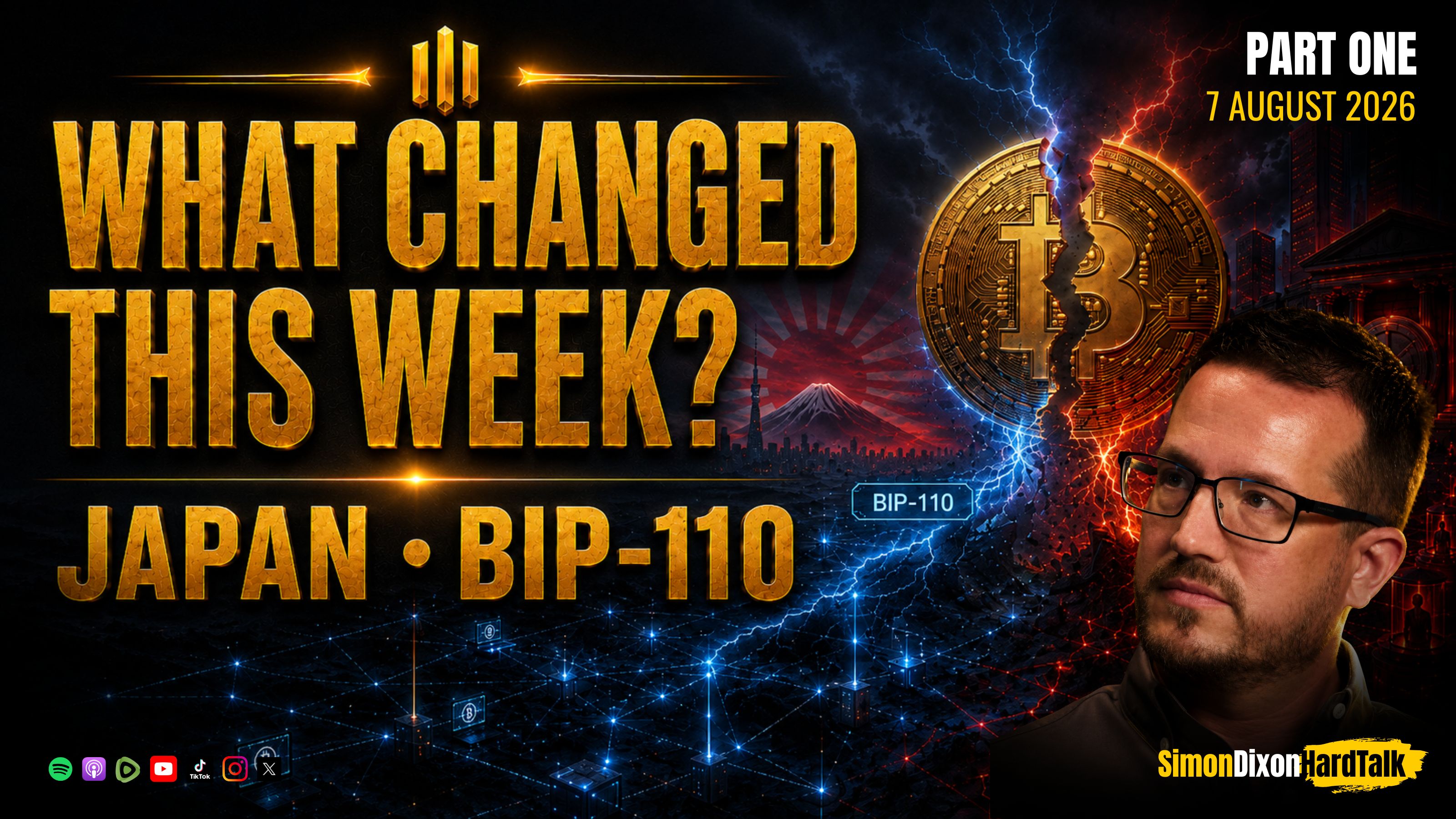
Japan, Bitcoin & the New Currency War | What Changed This Week?
Aug 07, 2026Introduction: The Week Bitcoin and Global Markets Collided
Hey hey sovereign wealth builders, Simon Dixon here.
We are currently witnessing what I describe as a "managed transition" of the global financial order—a period where the old guards of the Financial Industrial Complex are navigating a shift toward multipolarity. This week was a watershed moment where Bitcoin and global macro markets collided in ways that most investors are completely missing. In this post, I’m diving deep into the analysis from my recent session, The Week Bitcoin & Global Markets Collide | Simon Dixon Hard Talk LIVE, specifically the segment Japan, Bitcoin & the New Currency War | What Changed This Week?
To navigate this "Game of Money," you must understand the three primary forces at play:
- Financial Industrial Complex (FIC): The network of central banks and global financial institutions managing the debt-based Ponzi scheme.
- Technical Industrial Complex (TIC): The forces building the technocratic control grid and programmable money.
- Military Industrial Complex (MIC): The operational arm used to secure resources and enforce the FIC's geopolitical alignments.
As these complexes attempt to manage the transition, the first cracks are appearing in the very foundation of the legacy system: the US Treasury market.
The US Treasury Loop and the Reality of Fiscal Dominance
To understand the health of the global economy, you must ignore the headlines and watch the bond yields. The 10-year US Treasury is the single most critical metric in existence; it sets the price of money globally. We have now officially entered "danger territory." My analysis consistently identifies 4.5% as the threshold for extreme economic stress. Currently, the 10-year yield sits at 4.67%, while the 30-year bond has climbed to 5.24%.
This is "desperation territory" for a government that must constantly roll over its debt to keep the Ponzi scheme alive. We are now in a state of Fiscal Dominance, where the central bank is forced to subordinate inflation-fighting to the necessity of funding the government. This has created a "rug-pull in the making" for the average person:
- The K-Shaped Economy: While the poor are crushed by high interest rates, the S&P 500 has ripped to near all-time highs of 7,710. Printed money flows directly into assets owned by the FIC.
- Inflation Hedges: As the Fed remains hawkish but unable to stop the debt rollover, capital is fleeing into gold to escape currency debasement.
- The Debt Trap: The Fed cannot cut rates without fueling more inflation, but it cannot keep rates high without blowing up the government's budget.
This instability is now forcing a coordinated response from America’s largest creditor, the Bank of Japan, to prevent a chaotic collapse.
Breaking the Japan Carry Trade: A Coordinated Unwind
The "Japan Carry Trade" has been a primary liquidity provider for US markets. For years, hedge funds borrowed Yen at 0% interest rates to buy higher-yielding US assets. As Japan begins raising interest rates to manage its own inflation, this "free money" trade is breaking. If Japan were to suddenly dump its US Treasuries to protect the Yen, US yields would spike, causing the debt loop to accelerate into a catastrophe.
To prevent this, we saw an "unusual intervention" this week. Rather than selling Dollars to buy Yen (which would weaken the Dollar and hurt the Treasury market), authorities reportedly sold Euros to buy Yen.
In my view, this is a calculated move to protect the US debt rollover while allowing Japan to slowly decouple. This coordination is overseen by the Bank for International Settlements (BIS). Make no mistake: the BIS is the "Central Bank for Central Banks," an entity with its own jurisdiction, army, and police. It acts as the apex coordinator for the FIC, ensuring the transition to a multipolar world remains managed and that the "protection racket" of global debt stays intact.
The Quiet Demolition of the Petrodollar
The bedrock of American hegemony—the Petrodollar—is being quietly dismantled to make way for new financial rails. This week’s announcement of a Saudi maritime defense coalition consisting of 43 countries is a clear signal that the Middle East is preparing for a post-US world. This coalition allows the US to retreat to a regional power while the FIC facilitates new alliances.
Key developments in this shift include:
- Pricing vs. Settlement: Iran has released draft proposals to settle oil in Yuan or Bitcoin. While "pricing" may stay in Dollars to maintain the illusion of stability, the "settlement"—the actual movement of value—is moving to alternative rails like MBridge.
- Tether as a FIC Node: Tether has emerged as a "too big to fail" node. By holding massive amounts of US debt via Cantor Fitzgerald, Tether has been co-opted. Cantor Fitzgerald holds a 5% convertible bond in Tether; if converted, an asset becomes a 25 billion asset for the FIC-aligned firm.
- Gold Accumulation: Central banks continue to hoard gold as the number one reserve asset, positioning themselves for a world where US Treasuries are no longer the primary collateral.
BIP 110 and the Frontline of Node Resistance
As the macro transition unfolds, a parallel war is being fought for the soul of the Bitcoin network.
The August 7th/8th signaling window is critical. The principle of the User Activated Soft Fork (UASF) is simple: One Node, One Vote. This counters the influence of massive hash power. Currently, there is a stark divide:
- Miners: Only 2.6% are signaling for BIP 110, far below the 55% threshold required for an uninterrupted activation.
- Nodes: There is a rapid increase in "Knots" nodes (an alternative implementation to Bitcoin Core) signaling for BIP 110, indicating grassroots resistance against the "Big Bitcoin" corporate agenda.
If miners refuse to signal and the nodes move forward, we enter "Scenario 2": a potential civil war or chain split. This carries risks of exchange pauses and replay attacks.
The Cold Card Exploit and the Institutional Custody Trap
The timing of technical failures is rarely accidental. The recent "entropy bug" discovered in Cold Card hardware wallets, affecting approximately 5,000 users, is being weaponized by the FIC. The narrative is clear: "Self-custody is dangerous; put your Bitcoin in an IOU like the BlackRock ETF or a Coinbase account."
This is a trap designed to drive users toward the Genius Act and Clarity Act frameworks—the TIC’s plan to tokenize everything and implement a technocratic control grid. To understand the circles involved, look at the board of MicroStrategy, the largest corporate Bitcoin holder:
- Karen Shiffa: 26 years with the CIA, Director of Intelligence Programs.
- Tom Aikin: Former acting assistant secretary of defense for Homeland Security.
MicroStrategy is no longer just a software company; it is an arbitrage vehicle for the FIC. Michael Saylor has spoken about using AI to guide the creation of debt instruments like STRC. This AI-driven loop leads to commitments in dividends that may eventually force the selling of Bitcoin to pay the FIC, effectively creating a "managed" Bitcoin treasury that is subordinate to the legacy system. This follows the pattern of Operation Chokepoint 2.0, where the system removes independent players to replace them with FIC-approved entities.
Conclusion: Your Strategy for Sovereignty
We are living through five simultaneous transitions: the Petrodollar, the Eurodollar, the Japan Carry Trade, the rise of Gold, and the battle for Bitcoin governance. The FIC is not trying to stop these changes; it is trying to manage them so you remain a debt slave in the new order.
For the Sovereign Wealth Builder, the strategy remains the same:
- Secure True Self-Custody: If you are one of the 5,000 users exposed to the Cold Card entropy bug, move your funds to a new, secure environment immediately.
- Run a Node: This is your self-custody defence. Do not let Coinbase or BlackRock decide the rules of the network for you if you self-custody.
- Opt Out of IOUs where you can: Institutional Bitcoin (ETFs) is "fake" Bitcoin. It allows the FIC to socialise losses while they privatise the gains of the underlying asset.
The world is shifting to multipolarity, but your role is to remain sovereign through mathematics and code. Follow the money, watch the bond yields, and never forget that in the "Game of Money," the only way to win is to not be subordinate.
Call To Action
- Share this post. Share this blog post to expose the "divide and conquer" trap.
- Subscribe to the Simon Dixon YouTube channel. Get my weekly deep dives into geopolitics, macro, and Bitcoin. Subscribe to my YouTube channel.
- Find me on Rumble. This is my backup channel, safe from censorship. Follow me on Rumble.
- Follow me on X @SimonDixonTwitt. I post real-time updates and analysis on X and am highly active there. Follow me on X.
- Follow me on instagram. Usually short clips are posted here.
- Follow me on TikTok. Usually short clips are posted here.
- SimonDixon.com This is my personal site and an archive of all my content, safe from de-platforming. Join the free membership portal.
Watch On YouTube
Prefer to Listen? Available on Apple Podcasts & Spotify.
Read Other Related Blogs
The Week Bitcoin & Global Markets Collide | Simon Dixon Hard Talk LIVE
From the American Empire to the Technocratic Control Grid | Simon Dixon x Daniel Estulin (Part Two)
Disclaimer
This document is provided for educational and informational purposes only. The analysis herein is based on global macro trends, Bitcoin game theory, and the author's 15+ years of experience in the sector. The author is an active investor in the financial and Bitcoin spaces. Readers must perform their own due diligence, particularly regarding technical operations such as self-custody and running Bitcoin nodes. This is not financial advice.