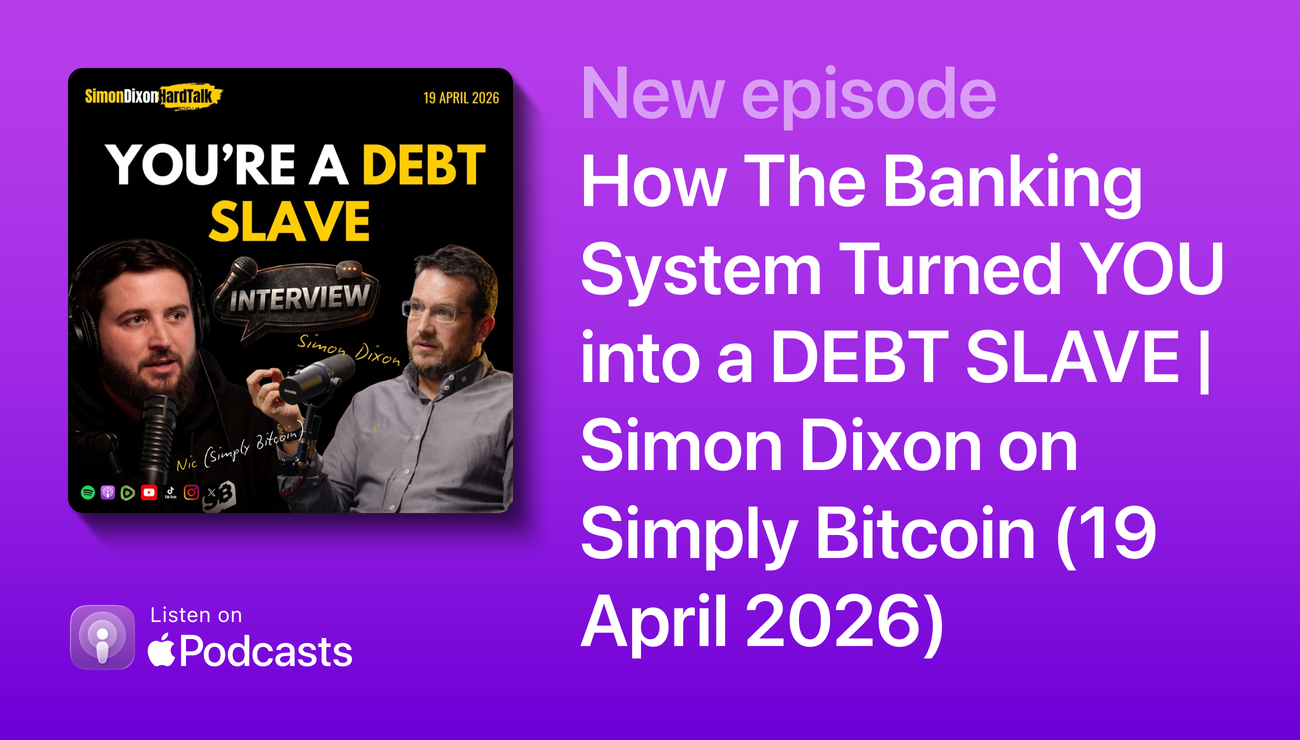
How The Banking System Turned YOU into a DEBT SLAVE | Simon Dixon on Simply Bitcoin
Apr 24, 2026No time for the full 1h8m video? Watch the AI-generated TL;DR Podcast Style Discussion instead (23 mins). Or watch the whiteboard explainer — a more visual breakdown of the full discussion (6 mins).
Executive Summary
This briefing synthesizes an in-depth discussion between Nico (host of Simply Bitcoin) and Simon Dixon regarding the structural mechanics of the global financial system, termed the Financial Industrial Complex (FIC). The central thesis is that the modern banking system is designed to transform individuals, corporations, and governments into "debt slaves" to facilitate a continuous transfer of wealth to a transnational elite.
The discussion outlines a managed transition currently underway: the deconstruction of the American Empire and the US dollar’s status as the world reserve currency in favor of a multipolar world order. Dixon argues that political elections are largely inconsequential as governments function primarily as "piggy banks" and "battering rams" for the FIC. The primary solution presented is the strategic use of Bitcoin—not merely as an investment, but as a tool for "opting out" and boycotting the centralized financial and surveillance structures.
High-Level Overview
The conversation frames the global economy not as a series of independent markets, but as a captured ecosystem controlled by the FIC. This complex integrates commercial banks, central banks, the military-industrial complex (MIC), and the technical-industrial complex (TIC). The overarching narrative suggests that we are in a "Fourth Turning" style regime change where the "Petrodollar" and previous debt-leveraging mechanisms are being systematically dismantled to make way for a new, more technocratic global structure.
Key Arguments Made by Simon Dixon
The Mechanics of the Financial Industrial Complex (FIC)
- The Debt Cycle: Commercial banks create currency whenever they issue loans. Their primary goal is to turn individuals into "collateralized debt obligations" by inducing addiction to mortgages, credit cards, and student loans.
- Corporate Subordination: Companies are funneled through a cycle—from Venture Capital to Private Equity to Wall Street. Once public, they are loaded with corporate debt and junk bonds, making their boards and governance subordinate to index funds (like BlackRock and Vanguard) and the bond market.
- Socialized Losses, Privatized Gains: Central banks guarantee the system by socializing losses across the citizenry while allowing the FIC to privatize the profits.
The Role of Government and Politics
- The Three Functions of Government:
- Piggy Bank: Directing money from the printer/bond market to the corporate sector via social programs or deregulation.
- Inflation Damper: Using taxes not to balance budgets, but to remove money from the system to curb inflation.
- Narrative Creator/Battering Ram: Creating the illusion of choice through "left vs. right" political theater to distract the public while the "Deep State" remains in control.
- Lobbyist Control: Politicians are viewed as competent actors who work for their funders, not the electorate. Trump is characterized as an agent who successfully facilitated FIC goals (e.g., transitioning to a multipolar world, implementing surveillance tech through the "Department of Government Efficiency") while maintaining a "populist" narrative.
The Managed Transition to Multipolarity
- Breaking the Dollar: The FIC is currently deconstructing the pillars of the US dollar, including the Japan carry trade, the Euro-dollar (by breaking Germany’s manufacturing base), and the Petrodollar.
- The China Pivot: America is being framed as a destabilizing force while China is positioned as a beacon of stability. This transition involves renegotiating global relationships through tariffs and creating "strategic tension" via regional wars.
- The Global Reset: Events like the closure of the Strait of Hormuz and the release of the Epstein files serve to destabilize the old empire’s morality and economic dominance to usher in a new world order.
Bitcoin as the Exit Strategy
- Anti-Capture Technology: Bitcoin was designed to exist outside the system. It allows individuals to compete with central banks (mining), custodians (self-custody), and the Fed (owning the asset).
- The "Elite" Shift: Bitcoin will not necessarily "fix" the world for everyone; instead, it will create a new class of sovereign elites who understand private keys and self-reliance.
- Boycott Power: True victory comes from boycotting FIC constructs—holding Bitcoin in self-custody rather than ETFs, using decentralized social media, and building parallel local supply chains.
Key Arguments Made by Other Participants (Nic from Simply Bitcoin)
- The Overton Window: Noted that political discourse has shifted, citing Trump’s 2016 critiques of the Iraq War, yet observed that policy often remains stagnant regardless of the leader.
- Disintermediation: Argued that the rise of social media and Bitcoin represent the two most pivotal shifts in human history: the disintermediation of information and the disintermediation of money.
- Financialization Concerns: Expressed concern that the current Bitcoin cycle has become too focused on "paper Bitcoin" (ETFs and treasury companies) rather than the original revolutionary zeal of self-custody.
Points of Agreement
- Inefficacy of Elections: Both participants agree that the "left vs. right" dynamic is a tool used by legacy media to divide and conquer the population.
- Sovereignty via Self-Custody: They align on the fact that "Bitcoin or slavery" is the ultimate choice; self-custody is the only way to truly "vote" against the system.
- The Impending Storm: Both see a "rough time" ahead characterized by the deconstruction of federal structures and increased surveillance.
Points of Disagreement
- The Scope of Bitcoin’s Impact: While Nico suggests Bitcoin might "fix the world," Dixon is more skeptical, arguing it will likely just create a new cycle of elites while the FIC attempts to co-opt the technology to make itself more powerful.
Important Data, Claims, or References Mentioned
|
Category |
Specific References |
|
Entities/Orgs |
BlackRock, Vanguard, State Street, IMF, World Bank, Bank for International Settlements (BIS), Federal Reserve, CIA, National Endowment for Democracy. |
|
Historical Events |
1971 Gold Standard abandonment, 1973 Oil Embargo, 9/11 and the Patriot Act, 2008 Financial Crisis, World War I & II (as empire transitions). |
|
Current/Future Events |
May 15, 2024 (Trump/Xi Jinping meeting), Operation Warp Speed 2.0, Closure of the Strait of Hormuz, Epstein Files. |
|
Key Figures |
Elon Musk (TIC node), Miriam Adelson (MIC connection), The Mellon Family, The Rothschilds, The Warburgs, King Faisal, Satoshi Nakamoto. |
|
Financial Terms |
Japan Carry Trade, Euro-dollar, Petro-dollar, Dollar Milkshake Theory, Collateralized Debt Obligation (CDO). |
Notable Quotes or Framing
- On the System: "They socialize the losses across all the individuals of a nation and they privatize the gains."
- On Political Futility: "It’s a big club and you’re not invited... we’re not in it."
- On the "FIC": "The government is a piggy bank for the financial industrial complex."
- On Bitcoin's Purpose: "You can boycott the Fed by owning Bitcoin. You can boycott BlackRock by holding it in self-custody... You can boycott the banks by not borrowing against it."
- The Binary Choice: "It’s Bitcoin or slavery."
Open Questions or Unresolved Issues
- The Percentage of "Elites": How much Bitcoin is actually required to enter the new "sovereign elite" class remains subjective and dependent on individual geography and lifestyle.
- The Role of China: While China is rising as the US empire declines, the discussion leaves open how "sovereign individuals" will fare under a CCP-influenced global stability model.
- Infiltration of Developers: The extent to which the FIC has successfully infiltrated Bitcoin's open-source development through corporate funding remains a point of ongoing vigilance.
Call to Action
- Share this post. Share this blog post to expose the "divide and conquer" trap.
- Subscribe to the Simon Dixon YouTube channel. Get my weekly deep dives into geopolitics, macro, and Bitcoin. Subscribe to my YouTube channel.
- Find me on Rumble. This is my backup channel, safe from censorship. Follow me on Rumble.
- Follow me on X @SimonDixonTwitt. I post real-time updates and analysis on X and am highly active there. Follow me on X.
- Follow me on instagram. Usually short clips are posted here.
- Follow me on TikTok. Usually short clips are posted here.
- SimonDixon.com. This is my personal site and an archive of all my content, safe from de-platforming. Join the free membership portal.
Watch on YouTube
Prefer to Listen? Available on Spotify & Apple Podcasts
Read other related blogs
Disclaimer
The content provided on this blog is based purely on Simon Dixon's personal experiences, independent research, and macro analysis. It does not constitute financial or legal advice. Any discussions regarding investment strategies, Bitcoin, handling debt, or global geopolitics are shared for informational purposes only.
Please note that everything presented on this blog reflects Simon Dixon's own interpretations and perspectives. Even where certain statements regarding the financial system, historical events, or the "Financial Industrial Complex" are stated as absolute fact, they represent Simon's personal opinions and macro analysis. Readers should not treat this content as 100% factual and are strongly encouraged to conduct their own independent research before making any decisions.
Personal financial decisions—such as acquiring assets, choosing to default on debt, or engaging in jurisdictional arbitrage—carry significant real-world consequences, including severe impacts on your credit score and future ability to access financial services. You must fully understand what you are doing and the legal implications of your actions. Finally, this blog operates with no sponsorship, no monetization, no business model, and no products for sale. The information is published solely to help people understand the current financial system and prepare for upcoming macroeconomic changes based on Simon's perspective.