I Lived Through Operation ChokePoint 2.0. Here’s What Really Happened | Simon Dixon on What Bitcoin Did w/ Danny Knowles
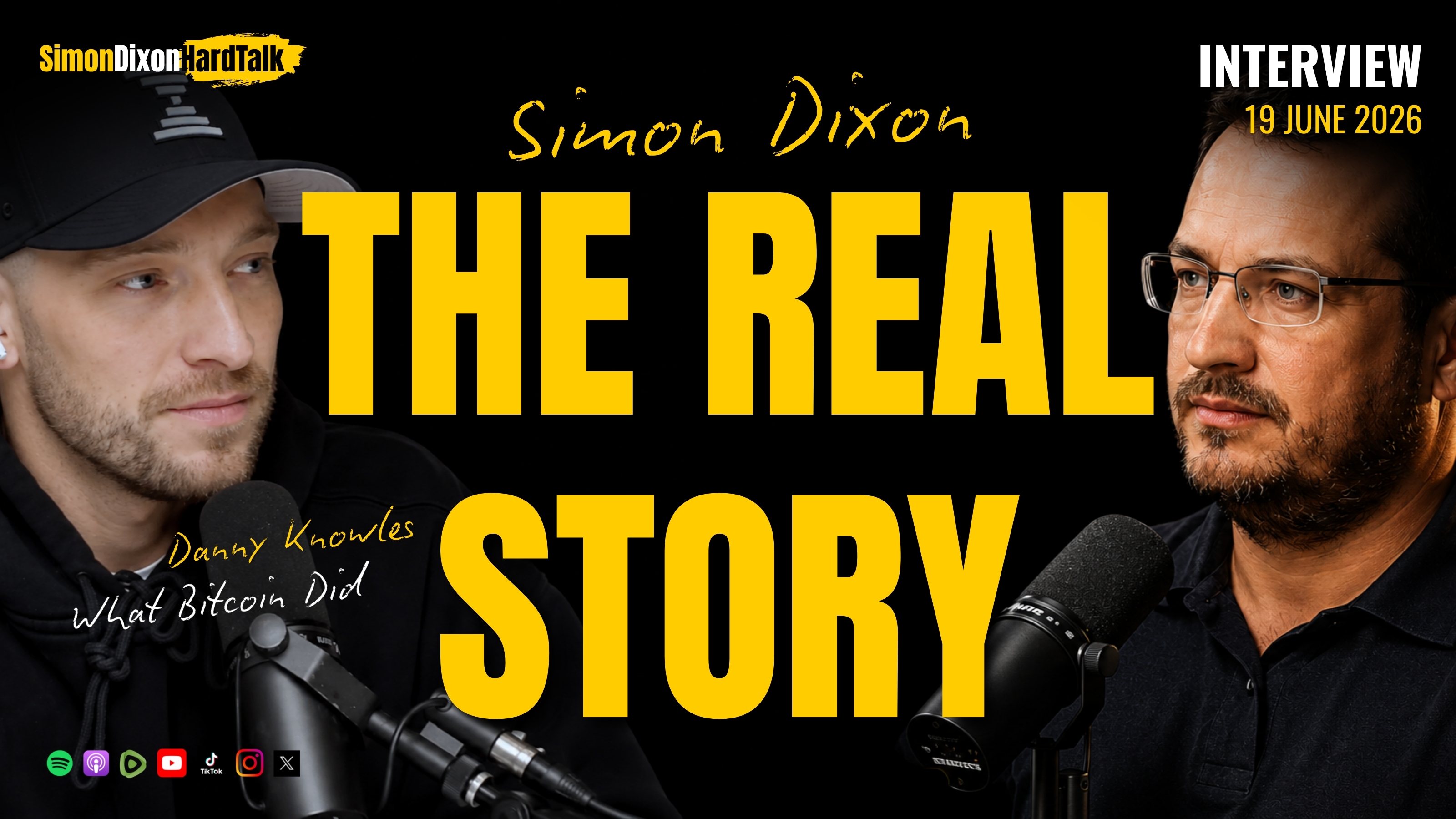
Jun 23, 2026This briefing document synthesizes the key insights, arguments, and data points from an interview conducted on the show What Bitcoin Did, hosted by Danny Knowles. The interview, titled "How Global Power Actually Works," was recorded on 19 June 2026 and lasted 2 hours and 15 minutes.
Executive Summary / High-Level Overview
This discussion outlines a paradigm shift in global power, structured uniquely by first building a foundational understanding of how transnational capital utilizes covert operations, which then culminates in a detailed systemic analysis of Operation Chokepoint 2.0.
Simon Dixon argues that the nation-state is largely an illusion; instead, he believes true power resides in three primary pillars: the Financial Industrial Complex (FIC), the Military-Industrial Complex (MIC), and the Technical Industrial Complex (TIC).
To understand the motives behind the recent financial attacks on the cryptocurrency space, Dixon first establishes the history of global covert operations. He explains how these transnational factions allegedly engineer geopolitical conflicts to intentionally manage the decline of the US empire and transition the world away from the petro-dollar toward a multipolar system.
In Simon Dixon's opinion, the United States is no longer projecting true strength but is merely demonstrating it while being actively "asset-stripped" by these transnational interests. The overarching theme of this managed transition is the deliberate move toward a global technocratic surveillance state powered by AI and robotics, wherein the West is allegedly transitioned to a Universal Basic Income (UBI) model, while future economic growth is shifted toward emerging markets in "West Asia," Africa, and Southeast Asia.
By tying this massive macroeconomic and geopolitical background together, Dixon frames Operation Chokepoint 2.0 not as an isolated regulatory event, but as a coordinated covert operation orchestrated by the FIC to capture the cryptocurrency industry. In his opinion, this operation was specifically designed to allegedly wipe out crypto-friendly banks, engineer rug-pulls on stablecoin networks, and discredit early industry players. This strategic dismantling allegedly cleared the path for traditional Wall Street entities to step in and centralize as. Much Bitcoin as possible through custody services, ETFs, and "Bitcoin treasury" arbitrage vehicles.
Ultimately, Dixon believes the goal of these financial operations is to subordinate everyday users into collateralized debt obligations, attempting to capture and neutralize Bitcoin in the exact same way the traditional financial system captured gold. He emphasizes that individual sovereignty can only be maintained by understanding these systemic covert operations and actively resisting them through the unapologetic self-custody of Bitcoin, the pursuit of decentralized AI, and the building of parallel community infrastructures.
Key Arguments Made by Simon Dixon
Geopolitics and the "Three Pillars" of Power
- Transnational Factions: Dixon believes that global power is held by transnational factions (FIC, MIC, TIC) that cooperate across borders, rendering the concept of the sovereign nation-state obsolete.
- The Three Complexes:
- FIC (Financial Industrial Complex): The dominant force, controlling capital flows through the private central banking system and the Bank for International Settlements (BIS).
- MIC (Military-Industrial Complex): Functions as a "for-rent militia" for transnational capital to secure resources (e.g., Venezuelan oil).
- TIC (Technical Industrial Complex): Provides the surveillance and AI infrastructure (e.g., SpaceX, Palantir, XAI) for the new global control grid.
- The Managed Decline of the US & EU: In Dixon’s opinion, the US & EU is being intentionally hollowed out. Politics is described as an "extraction game" where politicians serve two-to-four-year cycles to benefit their private lobbies.
- Multipolarity as an Alternative to World War III: Dixon argues that the shift to multipolarity (splitting the world into regional spheres of influence) is a strategy to avoid a total nuclear conflict while allowing elites to profit from the transition.
The Petro-Dollar and Financial Systems
- Death of the Petro-Dollar: Dixon claims transnational capital has decided to kill the petro-dollar, which was based on the 1973 agreement requiring Saudi Arabia to price oil in dollars and reinvest in US Treasuries.
- The Ponzi Scheme: He describes the fiat currency system as a "debt-based Ponzi scheme" where the belief in US Treasury liquidity is the only thing propping up the financial system.
- The Role of the BIS: The Bank for International Settlements (BIS) is allegedly the "top of the pyramid," forcing every conquered nation to install a debt-based central bank.
The Role of Donald Trump and Contemporary Policies
- Trump as a Dealmaker: Dixon distinguishes Trump from "neocon Zionists" like Biden, framing Trump as a representative of the FIC and a "front man" for transnational capital and Gulf sovereign wealth funds.
- D.O.G.E. and Surveillance: The Department of Government Efficiency (D.O.G.E.) is viewed by Dixon not as a tool for debt reduction, but as a way to hand over national data to TIC companies like Palantir and XAI to build a surveillance state.
- Tariffs: Dixon argues that tariffs serve to bankrupt American small businesses while allowing large multinationals to negotiate exemptions, further concentrating wealth and to push countries to China.
Bitcoin and the "Bitcoin Industrial Complex"
- Operation Chokepoint 2.0: Dixon believes this was a coordinated effort to destroy "crypto-friendly" banks (Silvergate, Silicon Valley Bank) and discredit the industry to allow Wall Street (BlackRock, Fidelity) to take over.
- Centralization Tactics: He views "Bitcoin treasury" companies and ETFs as "subordination vehicles" designed to get Bitcoin into the custody of the FIC so it can be used as leverage in global negotiations.
- The Origin of Bitcoin: Dixon supports the theory that Satoshi Nakamoto was Len Sassaman and Hal Finney, suggesting the white paper was a "resistance movement" against the digital surveillance currencies (CBDCs) being developed by intelligence-connected cryptographers.
Key Arguments Made by Other Participants (Danny Knowles)
- Rationale for US Decline: Knowles questioned why the US would willingly give up its hegemonic status. He pondered if the burden of debt has reached a point where being the hegemon is no longer a "gift" but a liability.
- The Risks of the New World Order: Knowles observed that the multipolar world described by Dixon sounds like an "AI surveillance panopticon" and asked if this was simply the "lesser of two evils" compared to nuclear war.
- Insurance and Geopolitics: Regarding the closure of the Strait of Hormuz, Knowles questioned whether Lloyds of London’s refusal to insure ships was a nefarious act or a standard response to high-level risk.
Points of Agreement
- The Unviability of the Status Quo: Both participants agreed that the current US debt levels and political polarization are unsustainable.
- The Influence of Corporate Power: There was a consensus that major financial entities like BlackRock and the "PayPal Mafia" (Thiel, Musk, Sacks) hold more functional power than individual voters or traditional political structures.
- Bitcoin as a Solution: Both Dixon and Knowles framed self-custody Bitcoin as a primary tool for individuals to opt out of the described "extraction game."
Points of Disagreement
- The Nature of Conflicts: While the host leaned toward viewing global conflicts through traditional geopolitical lenses (e.g., US vs. Iran), Dixon consistently reframed them as "theatrical" operations managed by the same underlying financial interests.
- Intentionality vs. Incompetence: Knowles’ questions often explored the possibility of systemic failure or high risk, whereas Dixon argued for a high degree of "managed" intentionality behind market crashes and geopolitical resets.
Important Data, Claims, or References Mentioned
Financial and Corporate Data
|
Entity / Concept |
Data Point / Claim |
|
US Assets |
Dixon claims $70 trillion of American assets are foreign-owned. |
|
BlackRock |
AUM allegedly grew from $12 trillion to $14 trillion during recent global conflicts. |
|
US Consumption |
The top 10% of Americans are reportedly responsible for 50% of consumption. |
|
China's Reserves |
China allegedly built 1.6 billion barrels of oil reserves before the Venezuela operation. |
|
Iran Mining |
Dixon believes Iran is the largest sovereign, nuclear-powered Bitcoin miner in the world. |
Historical and Institutional References
- Safari Club: Described as a covert operation involving the Bush family and Gulf intelligence to groom assets like Osama bin Laden.
- 1956 Suez Canal Moment: Used as a historical parallel to describe the US's loss of control over the Strait of Hormuz.
- 1973 Oil Crisis: The anniversary of which (2023) Dixon links to a "multi-decade coordination" to reset the world order.
- Aladdin: BlackRock’s AI technology, which Dixon says manages $25 trillion of capital and performs "scenario planning" for global resets.
Notable Quotes or Framing
- On Personal Strategy: "Own more Bitcoin this month than the last month... self-custody it, run a node, and invest in community infrastructures."
- On Politics: "Politics is just corruption... an extraction game."
- On the US Military: "A for-rent militia army called the US military was rented by transnational capital."
- On Global Transitions: "This is what I call cooperation as an alternative to World War III."
- On Sovereignty: "You're a trillionaire when you can send a trillion dollars of Bitcoin... without needing any shipment or port or government to do it."
Open Questions or Unresolved Issues
- The True Identity of Satoshi: While Dixon favors the Sassaman/Finney theory, it remains a point of speculation within the broader community.
- The Stability of the "Managed Transition": It is unclear whether transnational capital can successfully manage a "rug-pull" of the global system without triggering the very chaos or uprisings (socialist/communist) they seek to avoid.
- The Level of Internal Resistance: The discussion touched on "breakaways" within the elite, but the extent to which these factions might sabotage the transition to a multipolar world is unresolved.
- Effectiveness of "Decentralized AI": While Dixon advocates for decentralized LLMs and community nodes, the technical feasibility of competing with centralized, chip-heavy TIC entities remains a significant challenge.
Call To Action
- Share this post. Share this blog post to expose the "divide and conquer" trap.
- Subscribe to the Simon Dixon YouTube channel. Get my weekly deep dives into geopolitics, macro, and Bitcoin. Subscribe to my YouTube channel.
- Find me on Rumble. This is my backup channel, safe from censorship. Follow me on Rumble.
- Follow me on X @SimonDixonTwitt. I post real-time updates and analysis on X and am highly active there. Follow me on X.
- Follow me on instagram. Usually short clips are posted here.
- Follow me on TikTok. Usually short clips are posted here.
- SimonDixon.com This is my personal site and an archive of all my content, safe from de-platforming. Join the free membership portal.
Watch on YouTube
No time for the full video? Watch the AI-generated TL;DR Podcast Style Discussion instead. Or watch the whiteboard explainer — a more visual breakdown of the full discussion.

Prefer To Listen? Available on Spotify & Apple Podcasts
General and Legal Disclaimer
Not Financial, Legal, or Investment Advice The themes, macroeconomic analyses, and wealth preservation strategies discussed in this content are provided solely for informational and educational purposes. While Simon Dixon advocates for a 10-year plan of accumulating Bitcoin, practicing self-custody, and running sovereign nodes , these statements do not constitute personalized financial, investment, or legal advice. Viewers should independently assess their own financial situation before engaging with digital assets or opting out of the traditional banking system.
Views, Opinions, and Speculation The views expressed regarding global power structures, the deliberate transition away from the petrodollar, and the geopolitical maneuvering of the Financial, Military, and Technical Industrial Complexes represent Simon Dixon's personal theories and frameworks. Dixon explicitly states that some of his conclusions regarding global leaders and market events are a "speculative bet" . Furthermore, when discussing complex historical events and the origins of digital currencies, he notes that he is "not making any accusations" against specific individuals .
No Endorsement or Malice Mentions of specific companies, financial institutions, political figures, or cryptocurrency platforms—such as BlackRock, Tether, Celsius, or public exchanges—are utilized strictly for systemic analysis . Dixon clarifies his intent regarding the individuals involved in these systems, stating, "I'm not saying these people are bad people," but rather pointing out how the financial industrial complex creates tools designed to subordinate people to its incentives . Assumption of Risk Any actions taken based on this commentary, including the use of Bitcoin-backed loans, engaging with cryptocurrency exchanges, or avoiding Wall Street arbitrage vehicles, carry inherent risks . Viewers are solely responsible for conducting their own due diligence and understanding the friction and risks associated with maintaining varying "degrees of sovereignty" in the modern financial system.