BIP-110, the Spam War, and the Battle Nobody Wants to Name: Where I Stand
Jul 24, 2026This is a long read. It is my honest attempt to answer a question a lot of you have been asking me: where do I actually stand on BIP-110, the “spam war,” and the fight over Bitcoin Core? I am going to give you the game theory, follow the money on all sides, walk through exactly what happens over the next year, and then tell you what I am doing and why. I am not going to tell you I know how this ends. Anyone who tells you they know how this ends is selling you something.
Where I stand, in one breath
I already run a Bitcoin Knots node. That was a choice about which implementation I trust, and I made it before this latest fight came to a head.
What people are actually asking me now is different: where I stand on BIP-110 — the soft-fork proposal that has revived the old activation war and forced the question of who really sets Bitcoin’s rules. So let me answer directly, then earn the answer over the rest of this piece.
Ideologically, I am aligned with what BIP-110 represents: node operators demonstrating that corporate capture of Bitcoin can be resisted, the way we demonstrated it in 2017. I have concerns about BIP-110 as a specific mechanism. I have far graver concerns about the current state of Bitcoin Core. And I have concerns about the actors circling both camps. I am not tribal about this, and by the end I hope you will see why refusing to be tribal is the whole point — and why, in the end, I think Bitcoin needs to go through this to come out stronger.
One thing I want clear from the very first line, though, so the rest reads correctly: my conviction in Bitcoin itself is total, and has been since 2011 — that is not what is in question here. Let me be precise about what “total” means, because I am not a blind loyalist: I am with Bitcoin unless it is actually captured by the Financial Industrial Complex and stops being money that individuals control. That is not something I expect to happen, and I think we are a long way from it even though they are clearly trying. But my loyalty is to Bitcoin-as-sovereign-money, not to a ticker — if the thing were ever truly captured, the commitment would be to the properties, not the brand. What I am actively deciding in this piece is narrower and more specific: my conviction in BIP-110 as a mechanism for pushing back against the capture of Bitcoin Core. That is the vote I am casting. The caution in this piece is about how this particular fight resolves tactically — never about whether I stand with Bitcoin, and never about whether the community should push back. I do, and it should.
1. The frame: this is a strategy of tension
Before the technical weeds, the lens I look through, because without it my “concerns about both sides” will sound like fence-sitting.
I do not believe the most important thing happening in Bitcoin is a disagreement about data in blocks. I believe it is a strategy of tension — the pattern the historians of the Cold War called Operation Gladio. The essence of a strategy of tension is not that you back one side and beat the other. It is that you quietly involve yourself on both sides of a conflict, let the conflict itself do the damage, and position yourself to benefit from — and steer — whatever outcome emerges. The division is not a side effect. The division is the operation.
Let me be careful and precise, because this is exactly the kind of claim that makes people stop reading. I am not asserting that a single named person runs a control room. I am describing a structural pattern, and I am telling you honestly that it is my reading of it, not something I can place before a court. Where I name people and money below, I show you what is documented, mark clearly what is my interpretation, and carry the denials. Hold me to that.
Once you see Bitcoin’s civil wars through this lens, the question changes. It stops being “which side is right?” and becomes “who benefits from the war itself, and who benefits from each possible ending?” That is what this article is really about.
2. I have seen this movie before: Hong Kong, New York, and 2017
I am not analysing this from the outside. I lived it.
In February 2016, a group of Bitcoin Core developers and the major miners met in Hong Kong and signed the Hong Kong Agreement — a roadmap to activate Segregated Witness as a soft fork and then follow it with a 2MB hard fork. I was at the Hong Kong event. It was, for all its flaws, a genuine attempt at consensus between developers and miners.
It fell apart. Which side reneged is still contested — the big-block camp says Core never delivered the promised hard fork; the Core developers argued they had only agreed to propose one, not force it, because they do not control the network. I will not pretend I can cleanly assign blame. Hold that ambiguity; it matters.
Then, in May 2017, a different configuration emerged: the New York Agreement, also known as SegWit2x. This one was driven by Barry Silbert, the head of Digital Currency Group, and gathered a large group of corporations and miners behind a plan to force a block-size increase. I was not at the New York Agreement — but I was a shareholder in many of the companies that signed it, so I watched it unfold from inside the businesses that were party to it. Unlike Hong Kong, essentially no Bitcoin Core developers signed it. Observers at the time — not just me in hindsight — described SegWit2x as a corporate takeover attempt, agreed behind closed doors among a Bitcoin investment conglomerate and a group of large companies, designed to divide the community.
I did not watch that war from the sidelines. I covered the entire block-size war in real time, week after week, on Tone Vay’s YouTube channel — and at one point I sold some of my Bitcoin Cash live on that show, executed through Kraken. I was giving a presentation in Shanghai the day SegWit actually activated. So let me be precise about the shape of it, because it is the shape that repeats: most of the large corporations wanted bigger blocks and SegWit2x — that was the corporate side. The users, running their own nodes, were the resistance. SegWit itself was genuinely contested; Taproot, later, was far less so. The block-size war was the contested one, and it is the one that rhymes with today.
And it was defeated. It was defeated by node operators — ordinary users running their own nodes, through a user-activated soft fork, making clear they would enforce the rules they chose regardless of how much hashpower or how many corporate logos lined up against them. The miners and corporations backed down because a chain the economy refuses to honour is worthless.
That is the precedent under everything that follows. In 2017 the community discovered that corporate capture could be resisted — but only because enough people understood the game theory and were willing to run the experiment to the edge. The key corporate figure that round was Silbert and DCG. Keep that pattern in mind, because it did not go away. It changed clothes.
And I want to name the newest set of clothes directly, because I put it in a post this week:
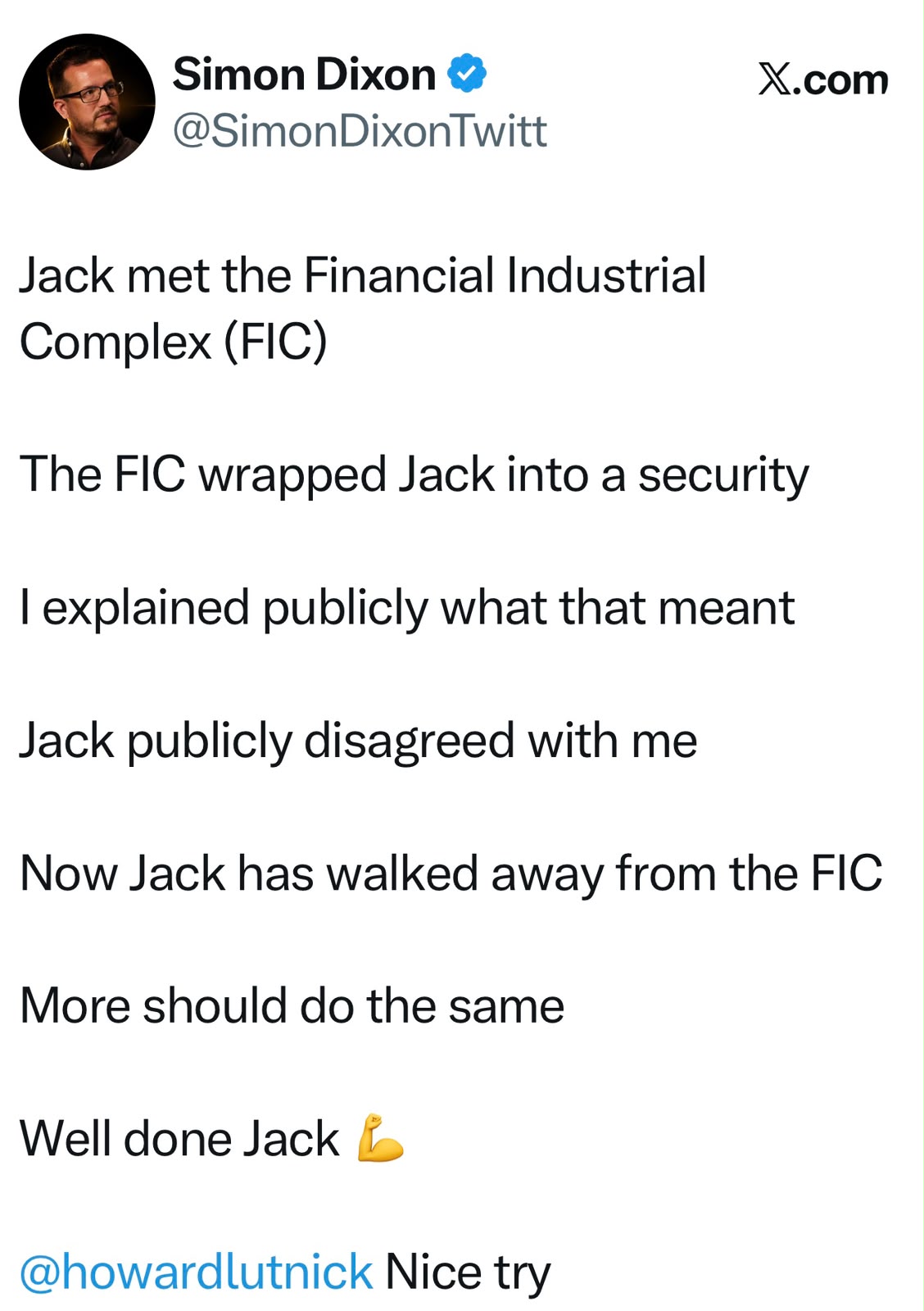
This is not history — it happened this week. As I write, Strategy has just announced the Bitcoin Security Consortium: nine founding members — Anchorage, ARK Invest, BlackRock, Block, Blockstream, Coinbase, Fidelity Digital Assets, Galaxy, and Strategy — with $15 million pledged over three years. The consortium says it does not develop Bitcoin, propose protocol changes, or represent developers, and that its funding is decentralised.
I want to be honest about how I read statements like that, because it is the method behind this entire piece: I do not take people or institutions at their stated intent. I follow the money, and I follow the incentives. And the incentive, always, is to gain more control — in order to steer Bitcoin in the direction the controller believes serves its interests. That is not an accusation against any individual; it is what concentrated capital does, by its nature. So my concern here is structural and it does not depend on parsing a press release: when the largest concentrations of capital in the world convene around Bitcoin, the 2017 lesson is the one that matters — the protocol does not belong to the consortium of the moment, whichever consortium it is, and whatever it says its intentions are. One detail sharpens the point: the consortium’s day-to-day coordinator is Mike Schmidt, Executive Director of Brink — the nonprofit that funds much of Bitcoin Core development. Hold that name; it comes back.
3. What BIP-110 and the “spam war” actually are
The technical ground, as plainly as I can lay it out. If you know this, skip ahead.
The setup. Bitcoin transactions can carry small amounts of arbitrary, non-financial data. For years there was a modest limit on one field (OP_RETURN) and a node-operator setting (-datacarriersize) to limit how much such data your node would relay. The intent, going back to 2014–2015, was to keep Bitcoin a monetary network and discourage using the chain as a data dump.
What changed. Two upgrades the community broadly wanted — SegWit (2017) and Taproot (2021) — created new places to put data the old limit was never written to cover. In January 2023 the Ordinals “inscriptions” protocol began using Taproot’s script path to embed images and files at scale. I want to be careful not to repeat the myth that this “took everyone by surprise.” It didn’t. There was strong resistance from the start, and Luke Dashjr in particular fought it hard and early — he publicly called inscriptions an exploit of a bug, built a fix, and pushed to close the gap while others argued it should be left alone. The old filter didn’t reach the new venues, and the fight over whether to make it reach them is exactly the fight we are still having. This is the “spam” — either a harmless use of blockspace people pay for, or the pollution of a monetary network with jpegs, depending on who you ask.
The fight, in four moves. Every step here is on the public record — GitHub, mailing lists, the Bitcoin Core IRC logs, all timestamped:
- The documentation change (June 2023). A six-line edit narrowed the described scope of -datacarriersize. The developer who made it says it merely documented what the code already did since 2015. Others argue it quietly locked in narrower language exactly as the debate over the new data venues heated up.
- Luke Dashjr’s filter patch (Sept 2023 – Jan 2024). Luke — the longest-serving BIP editor and a driving force behind the 2017 UASF — proposed restoring the filter to cover the fields inscriptions were using. It was rejected. He shipped the fix in Bitcoin Knots instead and obtained a formal CVE (a security-vulnerability designation) for the bypass.
- The commissioned uncap (April 2025). A pull request to remove the OP_RETURN size limit entirely was filed by Peter Todd, who stated openly he had been “asked to open it by an active Core dev.” Community reaction ran roughly four-to-one against.
- The institutional uncap (May–June 2025). After opposition piled up, a second, maximal version was filed by another developer and merged on 9 June 2025 by maintainer Gloria Zhao — removing the size cap and the output-count limit. Three days before the merge, a letter signed by 31 Core contributors framed the existing limit as an attack on Bitcoin’s censorship resistance.
The revolt. Node operators responded. Bitcoin Knots — the alternative node software that kept the filter — went from around 2% of the network to more than 20% in a matter of months. Thousands of people switched. That is the system working: when a contested change goes in over strong objection, the people who disagree run different software and withdraw their economic weight from the outcome they reject. It is the same lever that won in 2017.
Now BIP-110 itself — the concrete parameters. BIP-110, the “Reduced Data Temporary Softfork,” was authored pseudonymously (“Dathon Ohm”), with Luke Dashjr credited for the original draft, and merged into Bitcoin Knots. It is worth being precise: it is a draft BIP, not a finalized standard — the BIP editor who assigned it the number (“Murch”) described it as a misguided and unusually careless proposal, and Bitcoin Core has not adopted it and will not. It lives in Knots. The mechanics, from the proposal itself:
- It uses version bit 4 and a 55% miner-signalling threshold (1,109 of 2,016 blocks in a retarget period) for early lock-in — deliberately lower than the traditional 95%.
- If miners don’t fast-track it, there is a mandatory-signalling / flag-day window at block ~961,632, projected around 7 August 2026, at which BIP-110-enforcing nodes begin rejecting any block that fails to signal. Lock-in follows, with activation projected around block 965,664, roughly 1 September 2026.
- It is temporary by design — the restrictions enforce for about a year and then expire automatically, and coins that already exist before activation are grandfathered (with one narrow theoretical exception I cover below).
What it actually does — because this matters, and most coverage gets it wrong. People describe BIP-110 as “the OP_RETURN filter,” but that undersells it. The draft spec imposes seven distinct rules, not one. Yes, it restores the old 83-byte limit on OP_RETURN outputs — but it also caps most new output scripts at 34 bytes, limits data pushes and witness items to 256 bytes, and, importantly, restricts several Taproot features: it caps Taproot control blocks at 257 bytes (which limits script trees to 128 leaves), disallows the OP_SUCCESS and OP_IF/OP_NOTIF opcodes in Tapscript, and invalidates the Taproot annex and undefined witness versions. In plain terms: it is not purely an anti-spam patch. It reaches into Bitcoin’s scripting capabilities. And that is where the two strongest technical criticisms live — I am going to give you both, fairly, with the answer each side makes.
Criticism one: it could impede advanced contracting, like BitVM. The 257-byte control-block cap constrains large Taproot script trees, and critics — Jameson Lopp foremost — argue this suppresses innovation like BitVM and complex covenants. The BIP-110 side’s answer: BitVM has zero mainnet transactions today — it is a research project with no deployed contracts and no users — the restriction is temporary and expires in a year, developers can keep building on testnet and sidechains in the meantime, and 128 scripts per tree is ample for real transactions (the old limit allowed an absurd number nobody needs). Blocking action on millions of live spam transactions to protect a project with no real usage, they argue, is “using vaporware as a human shield.” Criticism two: it could freeze funds. The spec itself concedes a narrow edge case where a pre-signed Taproot transaction using OP_IF or a very deep script tree could, in theory, lock funds. The BIP-110 side’s answer: pre-activation coins are permanently exempt with no deadline to move them, there is a two-week grace period between lock-in and activation for wallets to update, and the affected pattern is a fraction of a percent of usage — the overwhelming majority of Taproot spends never touch the script tree. And on the broader “it’s too aggressive, it risks a chain split” charge, Luke Dashjr’s answer is that upgraded nodes face no reorg risk once it locks in, and that this is the very same user-activated mechanism that safely delivered SegWit in 2017. I am not going to adjudicate that for you — I am showing you that both the criticism and the counter are real, and serious people hold each.
Here is why the technical detail matters to my argument, though, and it is the part almost no one connects. Notice which capabilities BIP-110 restricts: the Taproot scripting that Bitcoin rollups and BitVM-style projects depend on. Those are precisely the projects the concentration-friendly capital is invested in — Citrea, led by Thiel’s Founders Fund, and the rollup cohort in UTXO Management’s portfolio. So the “spam war” is, underneath, also a fight over whether Bitcoin’s base layer will host the rollup infrastructure that layer of capital is betting on. I am not alleging anyone designed BIP-110 to hurt those investments; I am pointing out, factually, that the technical fault line and the money fault line fall in the same place. That is not a coincidence you have to believe in — it is just what the seven rules do. And notice, too, the shape of the strongest argument against acting: “it’s messy, it’s risky, do nothing.” In a strategy of tension, “do nothing” is exactly the outcome that serves whoever benefits from the status quo. Even the technical debate has the frame’s fingerprints on it.
Where does support actually stand, and how should you read it? Two very different numbers, and the gap between them is the whole story. On the node side, Bitcoin Knots is running on north of 20% of the network — up from around 2% in a matter of months. That is not a fringe movement; it is one of the fastest-growing shifts in node software Bitcoin has seen, and it represents real conviction at the user and economic layer. On the miner side, signalling so far is low — under 1% at the time of writing, mostly from Ocean, the pool Luke co-founded — and no major pool (Foundry, AntPool, F2Pool) has committed, with F2Pool openly opposed.
Now read those two numbers correctly, because this is where people jump to the wrong conclusion. Low miner signalling today does not mean the proposal is dead. It means the miners have not shown their hand — which is exactly what you would expect, because miners are economically incentivised to decide at the last possible moment. Signalling early costs them optionality and paints a target; signalling late protects their revenue while keeping every option open. This is precisely what happened in 2017: signalling sat far below the threshold for months, and then miners moved fast right at the deadline. So the honest reading is not “dead in the water” — it is “strong and fast-growing conviction among nodes and users, while the miners keep their powder dry and wait to see whether the economic weight behind this is real.” That asymmetry — users out ahead, miners watching — is the 2017 setup almost exactly. Saylor has published a long case against BIP-110; Adam Back and Jameson Lopp warn it risks a chain split. Hold all of it — it decides everything in the next two sections.
4. Follow the money — on all sides
The section I have been asked for most, and the one where I must be most careful, because it involves named, living people and real institutions. Everything I state as fact is documented and sourced. Everything I offer as interpretation, I mark as mine. Where people have denied things or offered innocent explanations, I carry the denial.
The point of following the money is not to prove any individual is a villain. It is to show you the incentive structure — because a system does not need a conspiracy to produce a captured outcome. It only needs enough powerful actors whose incentives all point the same way. Selection, not conspiracy. That is the thesis of everything I write.
The side pushing the uncap
The change that removed the limit was, by the filer’s own public statement, commissioned by an active Core developer, and the motivating use-case named repeatedly in the record was a project called Citrea — a Bitcoin “rollup” needing to embed proof data.
Here is the documented trail. Citrea’s Series A, announced October 2024, was led by Peter Thiel’s Founders Fund — the fund’s partner called it “the first investment we’ve made in the Bitcoin ecosystem.” Jameson Lopp is named among the participating investors in Citrea’s own announcement. Lopp publicly supported the uncap and endorsed the pull request. When another participant asked him to disclose the Citrea connection on the PR itself, that disclosure request was hidden as “abuse.”
The counter-account belongs right here, because it exists and it is on the record. Antoine Poinsot — the Core developer who launched the campaign — has stated he never discussed Citrea with Todd, that “Citrea did not need the change,” and that “the person that asked Peter… is me.” Lopp has stated publicly that his Citrea investment created no conflict of interest. Those denials sit next to the facts; weigh them yourself.
My reading — and it is a reading — is this: capital connected to the largest concentration-friendly players in the industry sat on the pro-uncap side of a fight about whether Bitcoin’s base layer should accommodate large-scale non-monetary data. That is a structural observation, and it is enough to warrant concern without proving anyone acted in bad faith.
The side that also deserves scrutiny — and why the money runs both ways
Here is the part that most commentary misses, and it is the whole point of the Gladio frame: the money is on both sides. A strategy of tension does not pick a team. It funds the fight.
On the “resist” side, follow it just as carefully. Ocean, the mining pool at the centre of BIP-110 signalling, is Luke Dashjr’s company — and it took a $6.2 million seed investment led by Jack Dorsey. Note what Dorsey is: the executive of public companies (Block, formerly Square), whose Bitcoin-development arm, Spiral, funds Bitcoin Core. A public-company executive is, by definition, subordinate to the Financial Industrial Complex — answerable to shareholders, securities law, and a board — and here he is funding the mining pool at the heart of the resistance. That does not make Ocean compromised. It makes the point that the money on the “resist” side traces back to the same kind of institutional actor as the money on the other side.
And the Thiel connection does not sit only on the uncap side. Two of the most prominent public voices for BIP-110 are Matthew Kratter, who runs the Bitcoin University channel, and the pseudonymous Bitcoin Mechanic, who functions as one of Ocean’s public voices. Kratter is a former portfolio manager at Peter Thiel’s hedge fund, Clarium — a connection he discloses openly himself. Now, note which way this cuts: Kratter is arguing for BIP-110, which is the opposite of what Thiel’s Founders Fund capital, sitting in Citrea on the uncap side, would want. So this is not evidence that Thiel is quietly steering the resistance. It is something subtler and, to me, more telling: Thiel-world fingerprints turn up on both sides of the same fight — the capital on one side, a prominent advocate on the other. I am not going to tell you what to make of that. I am telling you it is there, on the record, and that a strategy of tension does not require a single hand on both levers — only proximity to both.
And here the history folds back on itself in a way worth pausing on. Luke Dashjr — the man now leading the resistance through Ocean and BIP-110 — was an early contributor to Blockstream. By his own account he was promised co-founder status by Adam Back and then, in his words, cut out. Years later, after the Epstein files were released, Luke publicly called for Back to resign, saying the revelations “shed light on some of Adam’s hostility toward me and his recent pro-spam gaslighting.”
That brings us to Adam Back, who is arguably the single most important character to understand here, because he sits at three points on the board at once. He is the CEO of Blockstream — the company that has historically funded a great deal of Bitcoin Core development and was instrumental on the SegWit side of the 2017 war. He is the founder of BSTR, a Bitcoin treasury vehicle (more on its troubles below). And he sits inside the documented Epstein-era funding web: Epstein corresponded with Blockstream’s founders in the 2014 period, and the files indicate money moved through that early network, including indirectly via MIT-related funds. Back has denied any direct or indirect financial relationship with Epstein. I hold all of that at exactly the level the evidence supports — documented correspondence and funding are facts; the harder characterisations are contested and denied — and my fuller treatment is in the Epstein piece listed at the end, with the deepest version a chapter in the book I’m writing. The point is not to convict Adam Back of anything. The point is that one man sits at the intersection of Bitcoin development funding, a treasury company, and a compromised early-funding network — which is exactly the kind of concentration the whole piece is about.
I am not saying the resist side is the villain and the uncap side the victim, or vice versa. I am saying the opposite: the loudest advocates on either side are not automatically right because their opponents are compromised, and concentration of power is the risk wherever it appears — including among people I largely agree with. If I only followed the money on one side, I would be doing the very tribal thing I am warning against. That is what a strategy of tension looks like from the inside: not a tidy “good side versus bought side,” but overlapping funding, personal betrayals, and compromise threads running through both camps at once. The Financial Industrial Complex is circling this in every direction.
The developer layer
Underneath the specific fight sits a structural fact that should concern everyone regardless of their view on inscriptions: Bitcoin Core development is concentrated. Independent, primary-sourced reporting puts total funding of Core development in 2025 at roughly $10–14 million, flowing through a small set of institutions — Chaincode Labs, Brink (yes, the same Brink now coordinating the Bitcoin Security Consortium), Block’s Spiral arm (funded by Jack Dorsey), MIT’s Digital Currency Initiative, and others. By these accounts a single funded engineer merged the majority of all changes to Bitcoin Core in 2025.
I am not saying these developers are bad actors or that this funding is a plot. Most, I have no doubt, are sincere and skilled. I am saying that when the people who write, review, and merge the code running a trillion-dollar monetary network are funded by a handful of aligned institutions, you have a concentration of influence worth naming out loud — and resisting structurally — no matter how good the individuals are. That is the whole point of building systems that do not require trust.
The treasury companies
Watch the custody layer, because this is where the concentration is loudest, and where a pattern I have been warning about for years came together this year. A cluster of Bitcoin treasury companies now shapes the corporate-holder landscape:
- Strategy (Michael Saylor) — the template and the largest corporate holder. (Cantor covers the stock as an analyst but is not, as far as I can find, behind its financing.)
- Twenty One Capital (XXI) — co-founded by Jack Mallers and Tether, taken public via a Cantor Equity Partners SPAC in December 2025, backed by Tether, SoftBank, and Bitfinex; one of the largest corporate holders at ~43,500 BTC.
- Bitcoin Standard Treasury (BSTR) — Adam Back’s vehicle, which planned to go public through a Cantor Equity Partners I SPAC (chaired by Brandon Lutnick, son of Howard Lutnick) holding around 30,000 BTC. It is important to be precise here: BSTR has not actually launched. The shareholder vote was postponed repeatedly through mid-2026 and the original merger terms were then scrapped when the financing fell apart. It would be one of the largest public treasury vehicles if it lists — but as of now it hasn’t, and its stumble is itself part of the story: the treasury model straining to get off the ground.
- Nakamoto (NAKA) — David Bailey’s vehicle, merged with KindlyMD (its bank was Cohen & Company, not Cantor).
The Cantor thread is worth naming plainly: both Twenty One and BSTR ran through the Lutnicks’ Cantor Fitzgerald — the same Cantor that custodies Tether — with BSTR’s SPAC chaired by Howard Lutnick’s son directly. Not every treasury company is a Cantor vehicle, but Cantor sits behind two of the most prominent and the largest stablecoin, tying the custody layer and the money layer together in the same hands.
And here is the sentence I most want you to hold: these treasury companies and the Bitcoin ETFs are wrapped in the same securities that BlackRock wants to tokenize. BlackRock has made no secret of its mission to tokenize everything — every asset, on-chain, under management. That is the top of the chain. When your Bitcoin sits inside a public treasury company or an ETF, it has become a security in a stack that the largest asset manager on earth intends to render as a token it administers. The custody layer and the tokenization agenda are the same project seen from two ends.
Nakamoto deserves its own note, because it is not just a treasury play — it is a media capture, and we have seen this exact move before. Bailey folded Bitcoin Magazine and the global Bitcoin Conferences (through BTC Inc, now a Nakamoto subsidiary) and his investment fund, UTXO Management, into the treasury vehicle. Media, conferences, a fund, and a Bitcoin balance sheet under one public roof. The parallel is precise: in the previous cycle, Digital Currency Group — Barry Silbert again — acquired CoinDesk, the main media outlet of that era. Capture the balance sheet, and capture the story told about it. UTXO Management, for its part, describes its own strategy as “alpha generation through Bitcoin Treasury Companies,” and it is invested across the Bitcoin rollup ecosystem — the same category of projects that benefit from the base-layer data change at the centre of this fight.
The Thiel thread, and the harder material
Peter Thiel’s name recurs across this landscape — through Founders Fund’s lead position in Citrea now, just as the recurring corporate power-broker in the 2017 takeover attempt was Barry Silbert of DCG. Different names, different fronts, the same pattern of concentrated capital positioning itself around the protocol.
I am going to say something plainly, and I want to be equally plain that it is my opinion, not a claim I can put before a court: I believe Peter Thiel functions as an infiltrator in this space. That is my read of the pattern, stated as opinion. Here is the documented fact that shapes it, and I think it is more revealing than any allegation I could make. In July 2014 — from the files released by the Department of Justice — Thiel and Jeffrey Epstein were emailing each other about Bitcoin. Thiel asked whether the state was ratcheting up its posture: “Do you think this is the first step in upping the anti-BTC pressure?” Epstein replied: “There is little agreement on what Bitcoin is. Store of or intrinsic value, (if any) currency, property, architecture, payment system. Etc.”
Sit with what that exchange actually is. In 2014 — years before the block-size war, years before OP_RETURN — these two men were already circling the exact fault line that every subsequent Bitcoin war has been fought along: is Bitcoin a store of value or a medium of exchange? Currency, or property, or payment system? That definitional question is not academic. It is the whole battle. What “wins” that definition determines whether Bitcoin becomes money the world transacts in, or a reserve asset safely locked in custody while the transacting is done on someone else’s rails. And here is a man whose entire documented method was inserting himself into elite networks to acquire leverage, tracking that precise question, in correspondence with Thiel, a decade before it played out in public. I am not alleging a coordinated operation from those two emails, and I want to be careful: inclusion in the released files is not evidence of a crime, and Thiel has not been charged with anything. But the fact that this conversation was happening at all, that early, between those two people is, to me, the genuinely sinister thing — evidence that the pattern I keep describing, powerful and compromised networks circling the definition of money, was in motion from close to the very beginning.
I am not going to go deeper than that here, because I have gone very deep on it elsewhere — the full follow-the-money analysis of the infiltration attempts is a chapter in the book I’m writing. That chapter is where I lay out the whole map: Peter Thiel and Founders Fund; Brock Pierce and Blockchain Capital; Digital Currency Group via Barry Silbert; the funding webs on every side. My fuller treatment of the Epstein-and-Bitcoin material specifically is in one of the posts listed at the end of this piece, written carefully to state what the evidence does and does not support. The principle throughout is the same one that governs this whole piece: I am not calling named individuals criminals. I am following capital and incentives, because that is what actually explains the outcomes. Compromised or not, the incentive structure points the same way — toward control — and the Financial Industrial Complex is circling this in every direction, through cover after cover.
So who are the biggest players, in my reading? At the top: Cantor Fitzgerald and Peter Thiel. Then a supporting cast whose names keep recurring across these fronts — Brock Pierce, Barry Silbert, Adam Back, Michael Saylor. Incentives, not indictments. But the incentives are the story.
The real battlefront: centralization versus decentralization
Now step back, because this is what I most want you to take away. BIP-110 is not really about jpegs. It is one front in a much larger campaign, run across every layer of Bitcoin at once:
- The money layer — stablecoins and CBDCs. The endgame. Tether, custodied by Cantor Fitzgerald, and the emerging stablecoin legislative framework in the US are re-entrenching the dollar on programmable, surveillable rails. The goal: make the digital dollar the medium of exchange, and turn Bitcoin into a reserve asset safely locked in custody.
- The custody layer — get as much Bitcoin as possible into ETFs and corporate treasuries.
- The mining layer — capture as much hashrate as possible.
- The economic-node layer — capture the economic weight that actually decides which chain the world honours. (Next section — it is the least understood and the most important.)
- The developer layer — centralize the people who write and merge the code.
Everything above — the uncap fight, the treasury boom, Cantor and Tether, the Core funding concentration, the consortium — is the same operation attacking different layers. And here is the thing to sit with: it all came to a head this same week, right ahead of the BIP-110 flag day. Look at what landed in a matter of days. Strategy announced the Bitcoin Security Consortium — the largest institutions pooling their “security” budgets around Bitcoin. The Trump administration’s Clarity Act reached its final working draft in the Senate, the market-structure bill that, alongside the stablecoin framework, sets the terms on which the dollar re-entrenches itself on digital rails, with a deadline landing in the very same early-August window as the fork. And the treasury-company model visibly began to strain: Jack Mallers stepped down as CEO of Twenty One Capital — the Tether-majority-owned, Cantor-SPAC vehicle he co-founded — as Tether’s plan to merge it with his payments company Strike collapsed, and he kept Strike independent, without the full story of what happened inside that boardroom yet clear. Founders are already exiting these structures.
That is the point about the treasury companies and the ETFs generally: they are public companies, and public companies are structurally subordinate to the Financial Industrial Complex — wrapped in securities law, SPAC sponsors, custodians, and shareholder obligations that a sovereign individual holding their own keys simply does not carry. When you put your Bitcoin inside one of these vehicles, you are handing your economic weight to an entity that answers to the machine. Some people are starting to walk back out. Good. The capture is real, but it is not destiny.
So look at the week as a whole: security budgets pooled, market-structure law pushed, treasury vehicles wobbling, and a protocol fork’s flag day — all at once, all pointing the same direction. BIP-110 is not a standalone spat about jpegs. It is one front among several that happened to crest together. We resist across all of them, or we do not really resist at all. And I will be honest: the resistance is messy. It does not resolve into a slogan. Anyone offering you a tidy answer here is either not paying attention or selling you their side.
5. The economic node: the thing we most need to understand — and its limit
If you take one concept away from this article, make it this one, because it is the hinge the whole game turns on and almost nobody explains it honestly.
People think a node protects Bitcoin by “voting.” It does not vote. There is no tally, no stake-weighting, no shares. A node simply enforces the rules its operator chooses by rejecting anything that breaks them. Every node is equal in this: a node with 10,000 bitcoin behind it and a node with none are identical in the eyes of the protocol. This is the opposite of proof-of-stake, and it is one of the most important things about Bitcoin. If you run a node, nobody on earth can pay you in bitcoin that violates your rules — that protects you, personally and completely, no matter what anyone else does or how much they hold. That is the individual-sovereignty floor, and it never moves. It is exactly why I have spent years telling people to run their own node and hold their own keys.
So if nodes are all equal, what does “economic node” even mean — and why does it matter who holds what? Here is the distinction, and it is subtle but decisive. It has nothing to do with one node out-voting another. It is about which chain you can actually spend your coins on after a split. A coin is only worth anything if someone will accept it from you. So when the network splits into two rule-sets, the question that settles which chain “is Bitcoin” is not a vote — it is: where does the economic activity go? Where can people actually pay, get paid, and cash out?
That is where nodes stop being equal — not in protocol weight, but in economic gravity. A node run by a major exchange is not “worth more” because the exchange holds more coins. It is decisive because millions of people can only reach Bitcoin through that exchange. When its node enforces a rule, it is not casting a bigger vote — it is determining which chain all of those users are able to touch at all. The exchange, the stablecoin issuer, the ETF custodian, the payment processor: each is a chokepoint, a door through which ordinary people reach the network. When a chokepoint picks a chain, everyone who depends on that door is carried onto it — not by force of votes, but because they have no other way in. That is precisely how the 2017 user revolt beat an 85%-hashpower corporate agreement: the economic chokepoints signalled they would honour the users’ chain, and a chain the economy won’t transact on is worthless, whatever its hashpower.
Now the honest limit — and this is the deepest point in the piece. The danger of financialization is not that custodians get more votes; they don’t, and they can’t. The danger is that more and more people’s only access to Bitcoin runs through a shrinking number of custodial doors. If the public can only touch Bitcoin through a handful of ETFs, exchanges, and custodians, then those few doors effectively decide which chain the public ends up on — not by out-voting anyone, but by being the only route in. And those doors will almost certainly not walk their users onto an experimental enforcing fork: the largest corporate holder’s own chairman has already published a case against BIP-110. The person who self-custodies and runs their own node has their own door and cannot be carried anywhere against their will. The person whose Bitcoin sits in an ETF goes wherever the custodian goes. That is the whole argument for self-custody, stated at the level of consensus rather than personal safety — and it is why the fight is not about how many coins anyone holds, but about how many people still have their own door.
6. What actually happens next: the escalation ladder
This is the part almost nobody walks through honestly, and it is where your own position has to get specific. BIP-110 is not one decision. It is a ladder, and each rung has different risks and a different answer to “who decides.”
Rung 1 — Miner fast-track (now → early August). Miners signal bit 4, or they don’t. Signalling is low today, but do not misread that as the fight being over: miners are incentivised to move at the last moment, and in 2017 they did exactly that, swinging hard right at the deadline. This rung stays live right up until the flag day. No split risk on this rung: a soft fork’s blocks are valid to everyone.
Rung 2 — The UASF flag day (block ~961,632, projected early August). Enforcing nodes begin rejecting non-signalling blocks. This is still a soft fork. As long as it doesn’t split, enforcing and non-enforcing nodes stay on one chain and the pressure is on miners to signal. This is where running Knots with BIP-110 enforcement is a real, low-risk move — you are tightening the rules your own node accepts, not leaving the network. This is “running the experiment.”
Rung 3 — The split point. If miners refuse to signal and enforcing nodes hold the line, the enforcing chain diverges from the miner-majority chain. Here the game theory gets genuinely subtle, and I want to be accurate rather than tidy:
- Because BIP-110 is a soft fork (a tightening of rules), the outcome depends on where the hashpower lands, not on anyone’s intentions. If a majority of hashpower ends up enforcing, any split is temporary — non-compliant blocks get orphaned and everyone converges on the BIP-110 chain. If only a minority of hashpower enforces, the enforcing nodes are on a minority chain and the looser chain keeps going.
- There is a dangerous asymmetry unique to soft-fork splits: because BIP-110 blocks are valid to everyone but non-BIP-110 blocks are invalid only to enforcing nodes, the stricter chain can, if it ever gains more accumulated work, cause a reorg that wipes out recent history on the looser chain. This is not two clean parallel coins. It is two chains where one can retroactively swallow the other.
- And critically for user safety, this is where the replay-protection question comes in — and the real history is more instructive than the tidy version. When a chain splits, replay protection is what lets the two chains be used safely and independently. What actually happened in the 2017–2018 forks is telling: the breakaway camps did not want a clean separation at first, because they were claiming to be the real Bitcoin — Roger Ver’s camp initially pushed Bitcoin Cash as the true Bitcoin, and in the later Bitcoin SV split both sides withheld replay protection while they fought a hashwar over the name. Only when the game theory forced their hand — exchanges, wallets, and the economic majority refusing to tolerate the chaos and naming the chains — were they compelled to implement replay protection and accept life as a separate coin. A minority UASF split like BIP-110 could face the same dynamic: no replay protection by default, transactions valid on both chains, real double-spend and replay risk for ordinary users during the chaos, until the economic weight forces a resolution. (Jameson Lopp, on the anti-BIP-110 side, has made this point sharply from his own 2017 experience preparing exchange infrastructure; the mechanic is correct regardless of who makes it.)
Rung 4 — Hard fork / URSF. If the other side escalates — if big Bitcoin actively rejects BIP-110 rather than ignoring it, running a “user-rejected soft fork” that hard-forks away — you get a genuine, permanent two-coin split. This is the scenario Back and Lopp warn about, and it is the top of the ladder.
So who actually decides which chain is Bitcoin? Not “the exchange,” as a clean rule — but close to it, and worth being precise about. What ultimately decides is which chain the economic actors choose to honour: users, exchanges, payment processors, custodians. Miners chase that, because coins on a chain the economy won’t accept are hard to sell — so economic weight pulls hashpower. The exchanges and futures markets don’t rule by fiat; they reveal and coordinate where the economic majority already is. In 2017, Bitfinex — an exchange in which I am a shareholder — issued chain-split tokens, BT1 for the original chain and BT2 for the SegWit2x chain, trading against dollars and BTC. The market priced them, and when SegWit2x was called off, BT2 collapsed to about 1% of BT1 within hours. The economic weight had declared which chain was Bitcoin — and the tickers simply announced the verdict.
That is the real risk you have to hold honestly: in a split, the chokepoints most people depend on effectively get to name Bitcoin — and in 2026 those chokepoints are increasingly the concentrated custodians the whole capture campaign has been building. A chain split could become the very moment those custodial doors walk the public onto whichever chain they choose. Which is why, paradoxically, a quiet fizzle — no split at all — may be the healthiest near-term outcome: the community demonstrates the resistance without handing the concentrated custodians that power.
7. Where I stand — my stop-point, and why I want to go through it anyway
Here, finally, is my actual position, stated with the specificity the game theory demands.
Let me say the most important thing first, plainly, so no one can reach the end of this and mistake my caution for fence-sitting. My conviction in Bitcoin is absolute and it is not the thing in question. What I am casting a vote for, here and now, is narrower and deliberate: BIP-110 as a mechanism to push back against the capture of Bitcoin Core. That is the ideological vote, and I am casting it — not “going along,” not “waiting to see.” I believe Bitcoin must remain money that individuals control through their own nodes and their own keys, I believe the community must be willing to demonstrate that Core can be resisted, and I will act on that for as long as it takes. Everything below — the stop-point, the caveats, the refusal to predict the miners — sits underneath that commitment, not in place of it. The caution is about tactics and outcomes. The commitment is not.
My committed move, on the low rungs: I run Knots with BIP-110 enforcement. On rungs 1 and 2 this costs nothing and risks nothing — it is a soft fork, my node simply enforces tighter rules, and it demonstrates that the resistance is real. This is the experiment, and I want to run it.
My stop-point, at the split: I will not ride a stranded minority enforcing chain — one that lacks both majority hashpower and economic-weight backing — off a cliff. That is not sovereignty; it is a losing bet with wipe-out and replay risk, and it would contradict the very economic-node logic this whole argument rests on. If the enforcing chain carries the economic weight and the hashpower follows, then it is Bitcoin and I stay on it without hesitation. If it strands as a minority chain the economy does not honour, I follow the economic majority — because the economic-node principle cuts both ways: it is how you resist capture, and how you identify the real chain if resistance fractures the network.
I want to be honest that this makes me a participant, not a martyr. Let me be exact about my own position, because it is the thesis of this piece lived out. I have never held my Bitcoin through a company — I have always been a self-custody advocate, and my Bitcoin is my own. What I hold in companies is shares: I have been a shareholder in over 100 Bitcoin companies. I am now deliberately diversifying out of those shares — down to fewer than 50 — and I am doing it for a specific reason: these companies are getting more and more deeply integrated into the Financial Industrial Complex, and I would rather convert those shareholdings, as liquidity comes available through public listings, acquisitions, or otherwise, into Bitcoin held in my own self-custody — Bitcoin the way it was designed to be held. This is not a retreat from Bitcoin; it is the opposite. It is moving my own weight from the corporate, FIC-integrated layer to the sovereign layer — exactly what I am urging everyone else to do. My remaining shareholdings include Bitfinex and Kraken, among companies that have not yet had a public listing or a liquidation event. I write as someone with real skin in the game, actively moving to the sovereign layer, not as a neutral observer who can costlessly follow an experimental chain into oblivion. My stop-point is principled, but it is not suicidal.
And yet — I want Bitcoin to go through this. Here is the resolution, and it is the low-time-preference, long-term view that everything else in my life around Bitcoin has been building toward. If this attack vector is real, then it is better to go through it now, deliberately, from within the community, and learn exactly what it can and cannot do — than to have a more sophisticated version of it used against us later, when we are less prepared and the economic weight is even more concentrated. If it is going to happen, let it happen. Bitcoin will be stronger on the other side, and we will know more.
This is why I have been anti-Bitcoin-treasury-company, anti-ETF, and relentlessly pro-self-custody and pro-node-running for years. Those were never separate opinions. They were preparation for exactly this moment: every person who holds their own keys and runs their own node is one more door the custodians cannot close, one more route to Bitcoin that cannot be walked onto the wrong chain. That is the game, and it is a low-time-preference one — you win it by preparing before the test arrives, not during it.
8. What I refuse to do — and where that leaves us
The one thing I will not do is predict the outcome. The miners are incentivised to decide at the last minute, signalling whichever way protects their revenue at the moment of decision — so anyone claiming to know the August result today is guessing. The point of this article is to give you the game theory, the tech, the money, and the frame, so that you can reason about it — not to hand you a prophecy.
Because here is what the strategy of tension actually wants: it wants us tribal. It wants the community exhausting itself in a two-sided war while the real campaign — stablecoins, CBDCs, custody, hashrate, developers, economic nodes, all centralizing at once — proceeds above the noise. The most radical thing we can do is refuse the tribalism, understand the whole board, and resist concentration wherever it appears, on either side.
So do not mistake the honesty of my uncertainty for weakness of conviction. I do not know how the August game theory resolves — but I know which side I am on, I know I will run my node and hold my keys through whatever comes, and I know I will see this through. If it is going to happen, let it happen: Bitcoin comes out stronger, and we know more. That is where I stand. Not a clean answer. The committed one.
Nice try, Financial Industrial Complex.
— Simon Dixon
Disclosure: I have been a Bitcoin investor and Bitcoin company owner since 2011. I have always held my own Bitcoin in self-custody, never through a company. Separately, I have been a shareholder in over 100 Bitcoin companies, and I am deliberately diversifying out of those shareholdings — now fewer than 50 — as liquidity events occur (public listings, acquisitions, and failures), because these companies are increasingly integrated into the Financial Industrial Complex and I would rather convert those holdings into Bitcoin held in my own self-custody. My remaining shareholdings include Bitfinex and Kraken, among companies that have not yet had a public listing or liquidation event. I attended the 2016 Hong Kong meeting, and I was a shareholder in many of the companies that signed the 2017 New York Agreement, though I was not a party to that agreement myself. Where this article discusses specific companies or holdings, understand that I write as a participant with skin in the game, not a neutral observer. This piece states documented facts with sources; where I offer interpretation of motive or pattern, I mark it as my own reading, and I carry the denials and innocent explanations of those named. Nothing here is financial, legal, or investment advice. Do your own research, and — the oldest rule in Bitcoin — don’t trust, verify.
Further reading
For those who want to go deeper on the threads I’ve only touched on here, these are pieces I’ve written previously. I’ll link them alongside this post:
- The Truth About Jeffrey Epstein and Bitcoin
- Who Is Satoshi Nakamoto? The Origin Story
- Did the CIA Create Bitcoin?
- Jane Street’s Attack on Bitcoin and the Bitcoin Price
- Hijacking Bitcoin
- Knots vs Core
And the full follow-the-money analysis of the infiltration attempts — Peter Thiel and Founders Fund, Brock Pierce and Blockchain Capital, Digital Currency Group via Barry Silbert, and the funding webs on every side — is a dedicated chapter in the book I’m writing.
Please note: This blog has also been published on X and LinkedIn.
Watch on YouTube

Prefer To Listen? Available on Spotify & Apple Podcasts
Read Other Related Blogs