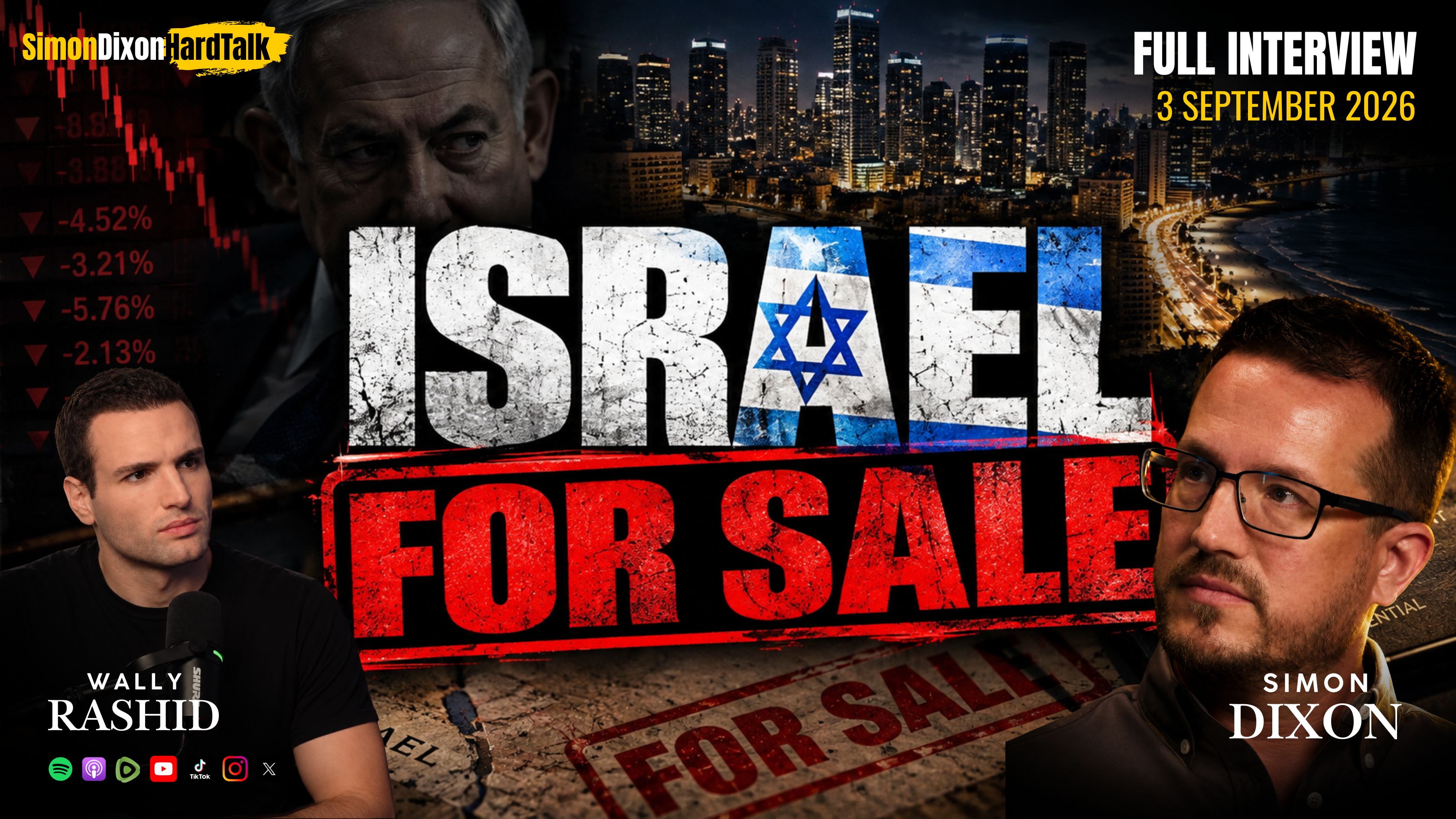
🇮🇱Israel Is Being Privatized — And Netanyahu Is Being Left Behind | Simon Dixon x Wally Rashid
Sep 04, 2026Executive Summary
This briefing document synthesizes the key insights from an interview conducted on September 3, 2026, between host Wally Rashid and guest Simon Dixon. The discussion outlines a profound shift in global power dynamics, characterized by the managed decline of United States hegemony and the transition toward a multipolar world order.
Simon Dixon argues that current Middle Eastern conflicts, specifically involving Iran and Israel, are not merely wars between nations but are "bounded escalations" serving as military negotiations for a new regional order. Central to this thesis is the belief that Israel is being privatized and asset-stripped, transforming from a sovereign state into a node of the Military-Industrial Complex (MIC). Simultaneously, the Financial-Industrial Complex (FIC) is facilitating a transition where China becomes the primary strategic partner in the Middle East, while the West shifts toward a surveillance-heavy Technical-Industrial Complex (TIC).
Key takeaways include the impending regime change of Benjamin Netanyahu, the significance of the "Mecca Agreement" between Turkey, Saudi Arabia, and Pakistan, and the decoupling of financial markets from real economies, leading to a "K-shaped" global transfer where asset owners thrive while debt-holders are subordinated to a burgeoning police state.
High-Level Overview
On September 3, 2026, investor and geo-financial analyst Simon Dixon appeared for the first time on Wally Rashid’s channel to discuss the escalating tensions in the Middle East and the broader "geo-financial" implications for the global order.
The interview frames the current geopolitical climate as a "change of empire." Dixon posits that we are witnessing the end of the US dollar hegemony and a transition toward multipolarity. This shift involves the strategic realignment of energy flows, the control of maritime choke points (such as the Strait of Hormuz), and the privatization of state functions. The discussion moves beyond traditional political analysis to examine how three primary power structures—the Financial-Industrial Complex (FIC), the Military-Industrial Complex (MIC), and the Technical-Industrial Complex (TIC)—are reorganizing global assets and governance.
Key Arguments Made by Simon Dixon
The Realignment of Power Dynamics
- Bounded Escalation: Simon Dixon believes the Iran conflict is a "bounded escalation," meaning it is a controlled military negotiation rather than a precursor to World War III.
- Factions in Iran: He distinguishes between the IRGC (the military arm) and the Iranian government (a pragmatic, China-aligned faction), suggesting they play a "good cop, bad cop" role in negotiations with the West.
- US Managed Decline: In Simon Dixon's opinion, the US is transitioning from a global hegemon to a regional power. He compares this to the British Empire’s decline post-World War II, specifically the "Suez Canal moment."
- Asset Stripping: He argues that the US is currently undergoing a process of "slow asset stripping" where value is shifted from the general economy into the financial markets to manage massive debt obligations.
The Privatization and Role of Israel
- Israel as an MIC Node: Simon Dixon characterizes Israel not as a sovereign country in the traditional sense, but as a "node" of the Military-Industrial Complex. He believes Israel serves as a mechanism for laundering US debt into military profits.
- Netanyahu’s Status: He describes Benjamin Netanyahu as a "puppet" and "bait porn" within the power structure, serving the interests of major defense contractors like Lockheed Martin and Raytheon.
- Privatization of Defense: Allegedly, Israel is loading up on corporate debt and privatizing state assets. Dixon cites upcoming IPOs for state defense companies (e.g., Alba Systems) as evidence that ownership is shifting to global funds and Gulf interests.
- Testing Ground for TIC: Simon Dixon claims that Israel and Palestine are used as testing grounds for "genocide as a service" and "occupation as a service" by technology companies like Palantir to refine drone integration and surveillance tools.
The "Mecca Agreement" and Post-US Middle East
- A New Order: Dixon identifies the "Mecca Agreement" between Turkey, Saudi Arabia, and Pakistan as the most significant geopolitical change of our lifetime. He believes it represents a genuine defense unification that will eventually include Syria and Iran.
- China’s Role: In Simon Dixon’s view, China is becoming the most important strategic partner in the Middle East, facilitating normalization between historical rivals (e.g., Iran and the GCC).
- Expulsion of the US: He suggests that Gulf countries covertly desire the removal of US bases, leading to a "West Asia" regional stability that excludes American dominance.
The Rise of the Technical-Industrial Complex (TIC) in the West
- Domestic Surveillance: As the MIC "returns home" from the Middle East, Dixon expects it to pivot toward domestic terrorism narratives and the implementation of a police state in the West.
- Control Grid: He warns of an emerging control grid involving Central Bank Digital Currencies (CBDCs), social credit scores, and AI-driven surveillance, facilitated by the TIC.
- Wealth Inequality: He predicts "K-shaped" economies where the top 10% own 92% of the stock market, while the remainder of the population is pushed toward Universal Basic Income (UBI) and programmable money.
Key Arguments Made by Other Participants (Wally Rashid)
- Zionist Ideology: Wally Rashid questioned whether the ideological commitments of Zionist investors might override rational financial interests. (Dixon countered that capital uses ideology as a weapon but is ultimately ruthless and pragmatic).
- Destabilization: Rashid argued that Israel remains a primary "destabilizing force" in the Middle East, questioning how a stable regional settlement can be reached without resolving the Israel-Palestine conflict.
- US Empire Strength: Rashid noted the visible weakening of the US empire but pressed for a more specific timeline on when the dollar would lose its status as the global reserve currency.
Points of Agreement
- Weakening of Hegemony: Both participants agree that the United States’ global influence is in a state of decline.
- The Power of Lobbies: They acknowledge that lobby powers, specifically AIPAC, often hold more sway over US policy than the voting public.
- Impact of Technology: Both see AI and technology as double-edged swords that are currently being utilized for centralization and surveillance.
Points of Disagreement
- Ideology vs. Capital: While Rashid suggested Zionism might be a primary driver for certain global actors, Dixon maintained that at the highest levels of power, ideology is merely a recruitment and "divide and conquer" tool, subordinated to capital.
- Timing: Dixon admitted that his previous predictions regarding the speed of the Iran-Israel "theatrical war" were incorrect, noting that the process is moving slower than he originally anticipated.
Important Data, Claims, or References Mentioned
Economic and Financial Data
|
Data Point |
Description |
|
$300 Billion |
The size of a potential investment/MOU agreement regarding Iran's reconstruction and reintegration. |
|
4.75% |
Current yield on US government debt mentioned as a "problem level." |
|
5.25% |
Yield on 30-year US debt, described as a "blowout phase." |
|
92% |
The percentage of the stock market owned by the top 10% of institutions and wealthy individuals. |
|
30% - 40% |
The concentration of the "Magnificent Seven" tech companies within the S&P 500 index. |
|
25% |
The percentage of military production Greece is allegedly receiving in a deal with Israel. |
Significant Entities and Agreements
- FIC: Financial-Industrial Complex (associated with global finance and Trump-aligned power).
- MIC: Military-Industrial Complex (associated with defense contractors and Netanyahu-aligned power).
- TIC: Technical-Industrial Complex (associated with surveillance, AI, and companies like Palantir).
- Mecca Agreement: A defense and manufacturing alliance between Turkey, Saudi Arabia, and Pakistan.
- Companies Mentioned: Palantir, Lockheed Martin, General Dynamics, BAE Systems, Alba Systems, CoreCivic, Geo Group.
Notable Quotes or Framing
- "Israel is a node of the military-industrial complex... Netanyahu is bait porn in that power structure."
- "War is a mechanism for acquiring resources... and subordinating a country to private corporate power."
- "When Zionism is profitable, they'll use it. When Zionism is no longer profitable, they'll dump it."
- "The US has been expelled from the region [Middle East]... this is the empire's worst nightmare."
- "Everything your screen wants you to do is probably the opposite of what you should be doing."
- "The house is AI... you need a digital resistance against the centralizing AI right now."
Open Questions or Unresolved Issues
- The Specific Timeline of the "Next Order": While Dixon expects regional stability in the Middle East over the next five years, the exact timing of the US dollar's total loss of reserve status remains a "slow transition."
- The Integration of Militias: How the IRGC and various regional militias (Hezbollah, Houthis) will be successfully integrated into "country state politics" remains a complex, unresolved process.
- The Nature of the "Mecca" Iran Inclusion: It is unclear exactly when or how Iran will officially sign on to the Mecca Agreement given current tensions.
- The Palestinian State: While Dixon believes a Palestinian state is "inevitable" through financial pressure, the specific borders and level of sovereignty remain undefined.
Call To Action
- Share this post. Share this blog post to expose the "divide and conquer" trap.
- Subscribe to the Simon Dixon YouTube channel. Get my weekly deep dives into geopolitics, macro, and Bitcoin. Subscribe to my YouTube channel.
- Find me on Rumble. This is my backup channel, safe from censorship. Follow me on Rumble.
- Follow me on X @SimonDixonTwitt. I post real-time updates and analysis on X and am highly active there. Follow me on X.
- Follow me on instagram. Usually short clips are posted here.
- Follow me on TikTok. Usually short clips are posted here.
- Follow me on NOSTR.
- SimonDixon.com This is my personal site and an archive of all my content, safe from de-platforming. Join the free membership portal.
Watch On YouTube
Prefer to Listen? Available on Apple Podcasts & Spotify
Read Other Related Blogs
Want the faster version of this article?
If you don’t have time to read or watch the full discussion, you can access the AI Summary and Whiteboard Explainer for this post inside the Simon Dixon Hard Talk Membership Portal.
Already have your complimentary login? Simply sign in to access them.
Not a member yet? The portal is 100% complimentary to join and use.
You can also download a free PDF copy of Simon’s 2011 book and access the full archive of Simon Dixon Hard Talk LIVE episodes, interviews, long-form conversations, AI summaries and explainer videos.
Simon does not ask you to buy anything.
- No membership fees.
- No upsells.
- No sponsors.
- No ad revenue.
- No products being pushed.
The portal exists to build a sovereign community and independent archive that does not depend entirely on YouTube, X or any other social platform to stay connected.