The Great Capital Rotation: AI, Bitcoin & The Financial Industrial Complex | Simon Dixon Hard Talk LIVE
Jun 05, 2026Hey hey sovereign wealth builders, Simon Dixon here.
I believe we are witnessing a significant shift that is often misinterpreted. In my opinion, this isn’t an economic collapse; it may be a "managed transition." From where I sit, following the capital flows, the United States is allegedly being repositioned from a global hegemon into a regional power. The Financial Industrial Complex (FIC) is allegedly working to facilitate a rotation into a multipolar world.
For those of you who don’t have four and a half hours to watch the full livestream, I’ve put together this "Hard Talk" TLDR to give you the raw data and the strategy you need to stay sovereign.
Part 1: AI Bubble, Bitcoin Financialisation & The Great Capital Rotation

To understand the current cost of living and stock market trends, it is helpful to understand the Financial Industrial Complex (FIC). This group consists of mega-asset managers (BlackRock, Vanguard, State Street), investment banks, and central banks that, in my opinion, tend to socialize losses while privatizing gains.
The Master Algorithm: Aladdin AI
I believe a significant tool in their arsenal is BlackRock’s Aladdin AI. In my opinion, it operates as a major influence, use by $25 trillion of asset managers and serving as an algorithm for many central banks, sovereign wealth funds, and treasury departments. When Aladdin scenario-plans a crisis—like the closure of the Strait of Hormuz—major pools of capital reportedly react, which I believe creates a pattern the FIC influences.
The Subscription Industrial Complex (SIC)
I am introducing the concept of the Subscription Industrial Complex (SIC). In my opinion, this represents a business model based on dependency. I believe the goal is to shift from asset ownership to a model where individuals are "collateralized products."
Key Pillars of the Subscription Industrial Complex:
- The Poison Industrial Complex: My thesis is that certain aspects of the food industry may lead to health issues that necessitate long-term medical care. In my opinion, this creates a recurring revenue stream for pharmaceutical companies.
- Debt Management: I believe the use of interest on credit (mortgages, student loans) can keep individuals in a state of long-term financial obligation.
- Monetized Dependency: In my opinion, the shift toward "access" and "tokens" rather than traditional ownership allows entities to borrow against future service fees.
- Financialization: I believe that packaging debt into derivatives can lead to risks that are eventually absorbed by central bank balance sheets.
AI as a Policy Tool for the "Doom Loop"
In my opinion, the U.S. economy faces significant challenges. GDP was recently revised to 1.5%, while the average cost of national debt is approaching 3.5%. I believe the AI sector is currently a primary driver of perceived growth. In my view, the "AI arms race" is a narrative that may be used to justify government spending and could lead to sector bails-outs if market trends shift. Currently, the top 10% own 92% of the stock market wealth, and $70 trillion of U.S. assets are under foreign ownership. I believe these factors indicate a significant internal transition.
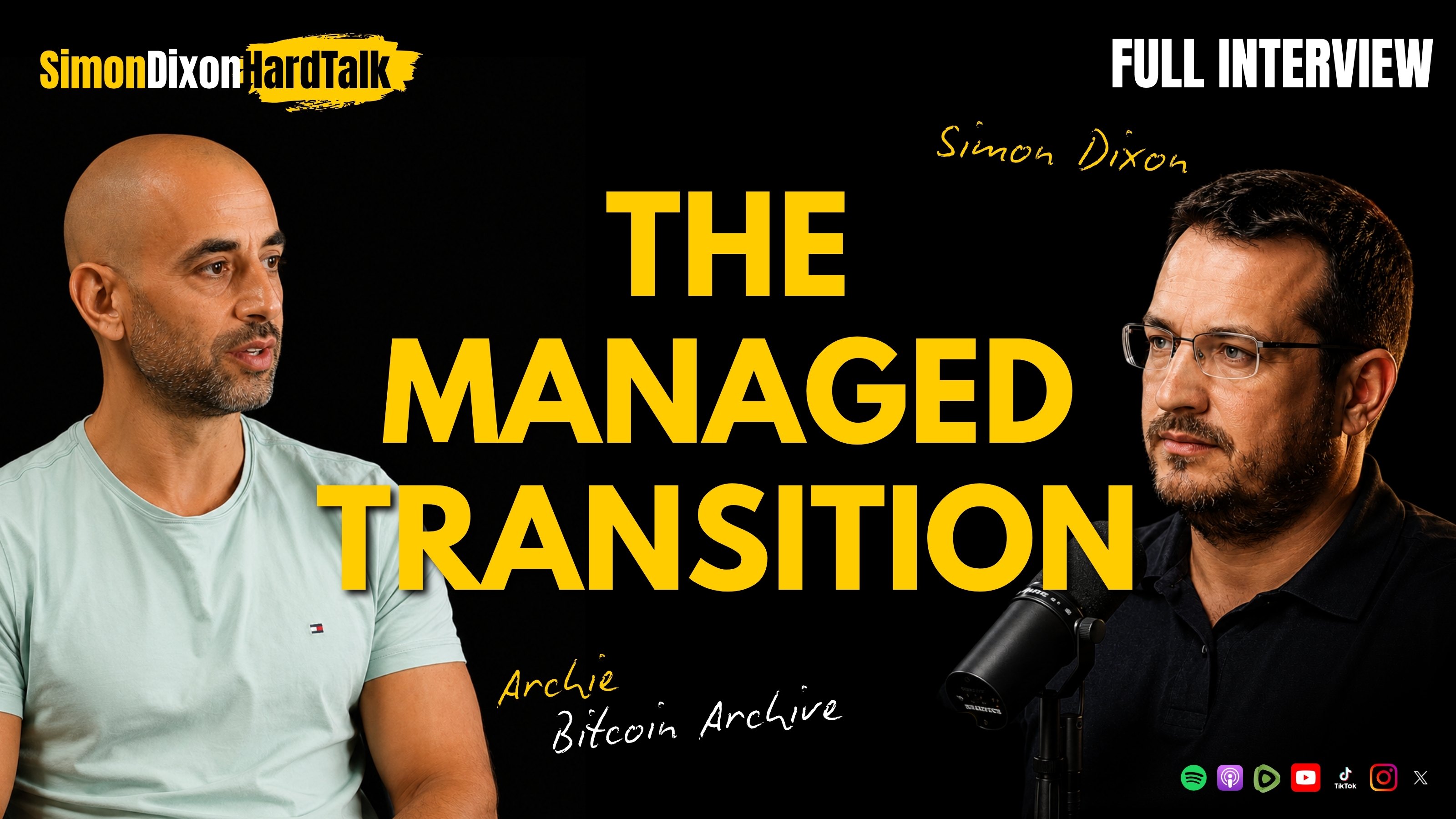
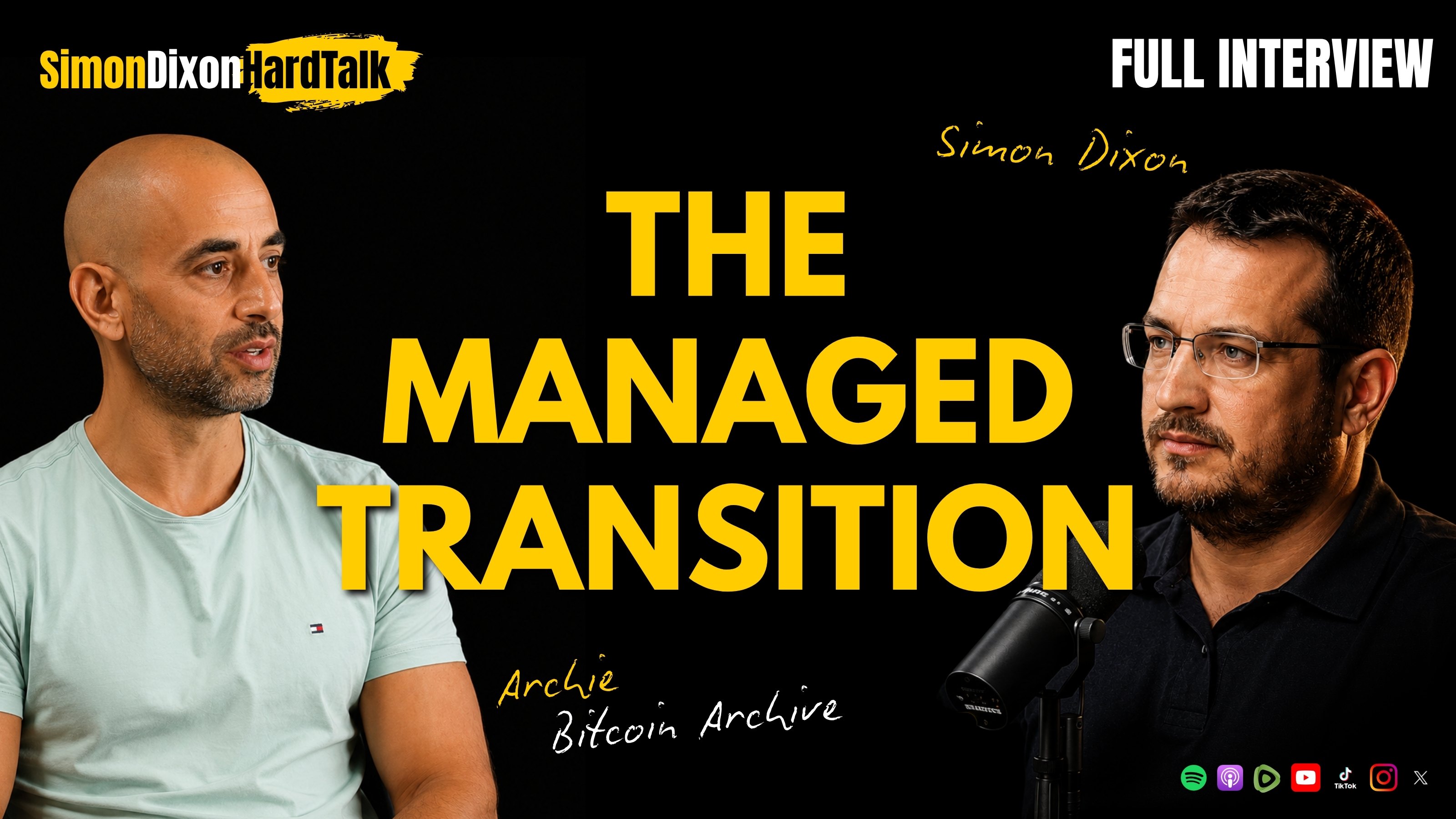
Part 2: The Managed Transition: War, Bitcoin & The End Of The Petrodollar | Simon Dixon on Bitcoin Archive w/ Archie
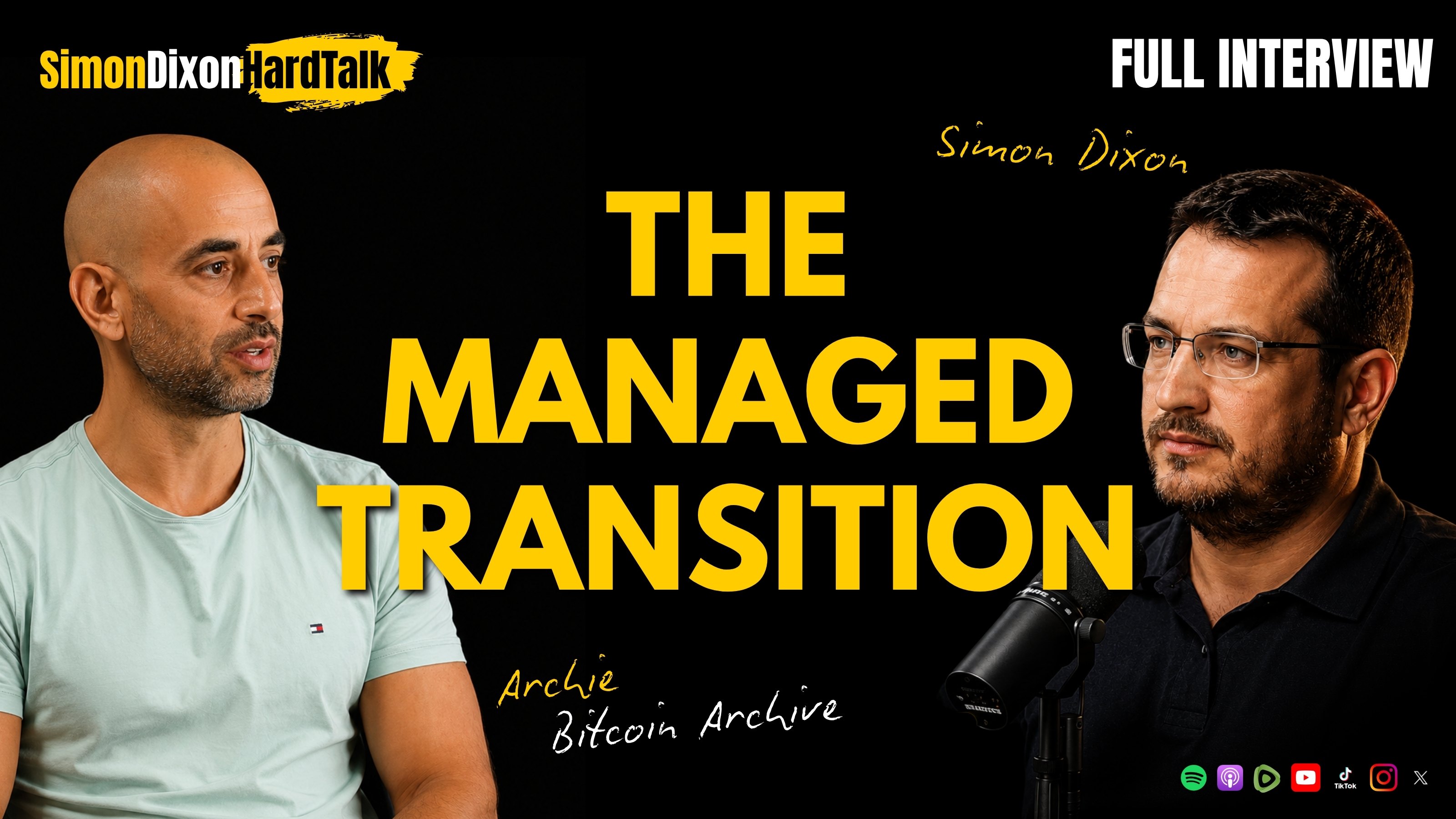
In my interview with Archie from Bitcoin Archive, we discussed the geopolitical factors that may accompany this financial reordering. I believe that transnational capital interests can significantly influence military objectives.
Top 5 Insights from the Bitcoin Archive Interview
- War and Reconstruction: I believe that regional conflicts, such as those involving Iran and Israel, can lead to profitable opportunities for both the defense industry and the FIC through subsequent reconstruction contracts.
- Changes to the Petrodollar: In my opinion, we are seeing a shift toward a multipolar energy model. The UAE signing energy pacts with BRICS countries suggests to me that the petrodollar’s dominance is changing.
- The UAE FX Swap Line: In a massive signal, the Fed gave the UAE an "FX swap line." This is an exclusive club previously reserved for Western powers (UK, Japan, Canada). It effectively turns the UAE into a primary global financial node for the new order.
- China’s "West Asia" Strategy: My thesis is that China is decolonizing the Middle East. By normalizing relations between Iran and Saudi Arabia, China is securing its "West Asia" trade routes and ensuring regional stability for its Belt and Road Initiative.
- The $300 Billion Infrastructure Trap: The reparations fund for Iran won't be cash; it will be a series of contracts where Gulf sovereign wealth funds and the FIC invest in the ports, energy, and telecoms. It is ownership via acquisition, not aid.
The Bitcoin Complex & Self-Custody Strategy
Wall Street has successfully built the "Bitcoin Complex" (ETFs, MSTR, and Strive/STRC). These are not vehicles for your sovereignty; they are arbitrage tools for the FIC.
- The "Digital Credit" Trap: Look at products like STRC (Preferred Stock). They call it "digital credit," but it’s just a preference share. The dividend on these products is often paid by selling Bitcoin or equity, creating a "flywheel" of dilution that subordinates the investor to the FIC.
- Aladdin’s Rotation: We recently saw $4 billion in Bitcoin ETF outflows. I interpret this as a potential algorithmic rotation of capital to provide liquidity for sectors like AI and data center infrastructure.
- The Strategy: My advice is to maintain independence from these centralized systems. In my opinion, the FIC prefers centralized custody to facilitate lending and fees. I believe that self-custody is a viable way to manage risk.
Final Thought
In my opinion, centralized custody allows the Financial Industrial Complex to influence your assets. I believe self-custody is an important method for maintaining your ability to operate outside of debt-based financial structures. I suggest prioritizing the asset over paper-based representations.
Call to Action
- Share this post. Share this blog post to expose the "divide and conquer" trap.
- Subscribe to the Simon Dixon YouTube channel. Get my weekly deep dives into geopolitics, macro, and Bitcoin. Subscribe to my YouTube channel.
- Find me on Rumble. This is my backup channel, safe from censorship. Follow me on Rumble.
- Follow me on X @SimonDixonTwitt. I post real-time updates and analysis on X and am highly active there. Follow me on X.
- Follow me on instagram. Usually short clips are posted here.
- Follow me on TikTok. Usually short clips are posted here.
- SimonDixon.com. This is my personal site and an archive of all my content, safe from de-platforming. Join the free membership portal.
Watch on YouTube

Prefer to Listen? Available on Spotify & Apple Podcasts

Read Other Related Blogs


Disclaimer
The views expressed in this document are my own opinions and theoretical frameworks based on my analysis of capital flows; they do not constitute financial advice. Investing in Bitcoin involves significant risk, particularly when using "Paper Bitcoin" products, ETFs, or structured vehicles like MSTR and STRC. The "AI Bubble" described is a theoretical model of market manipulation and carries a high risk of capital loss. Perform your own due diligence and prioritize self-custody to mitigate counterparty risk.