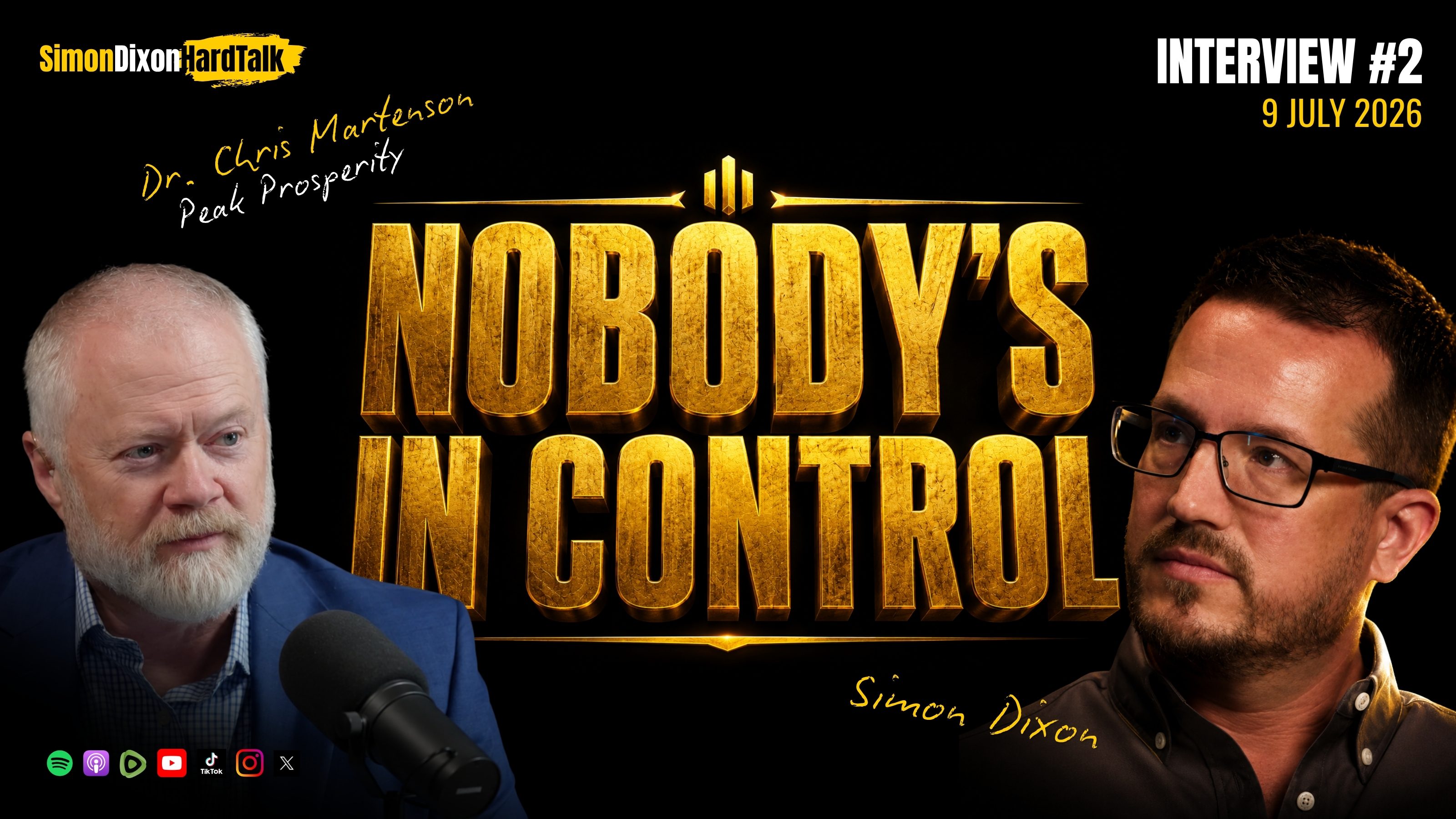
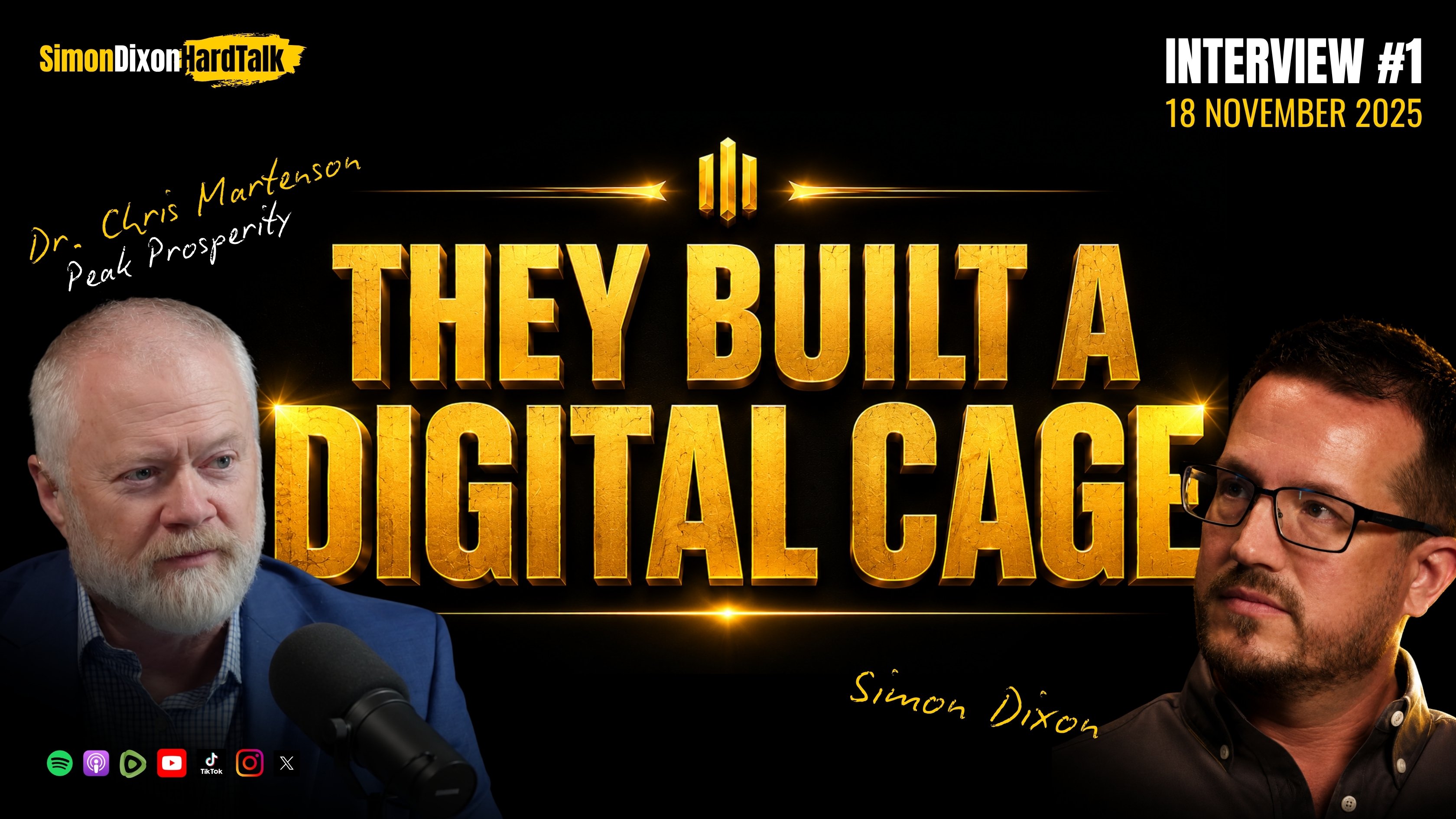
The Government Isn't Out of Control, It's NOT in Control | Simon Dixon on Peak Prosperity w/ Chris Martenson (INTERVIEW #2)
Jul 09, 2026Executive Summary
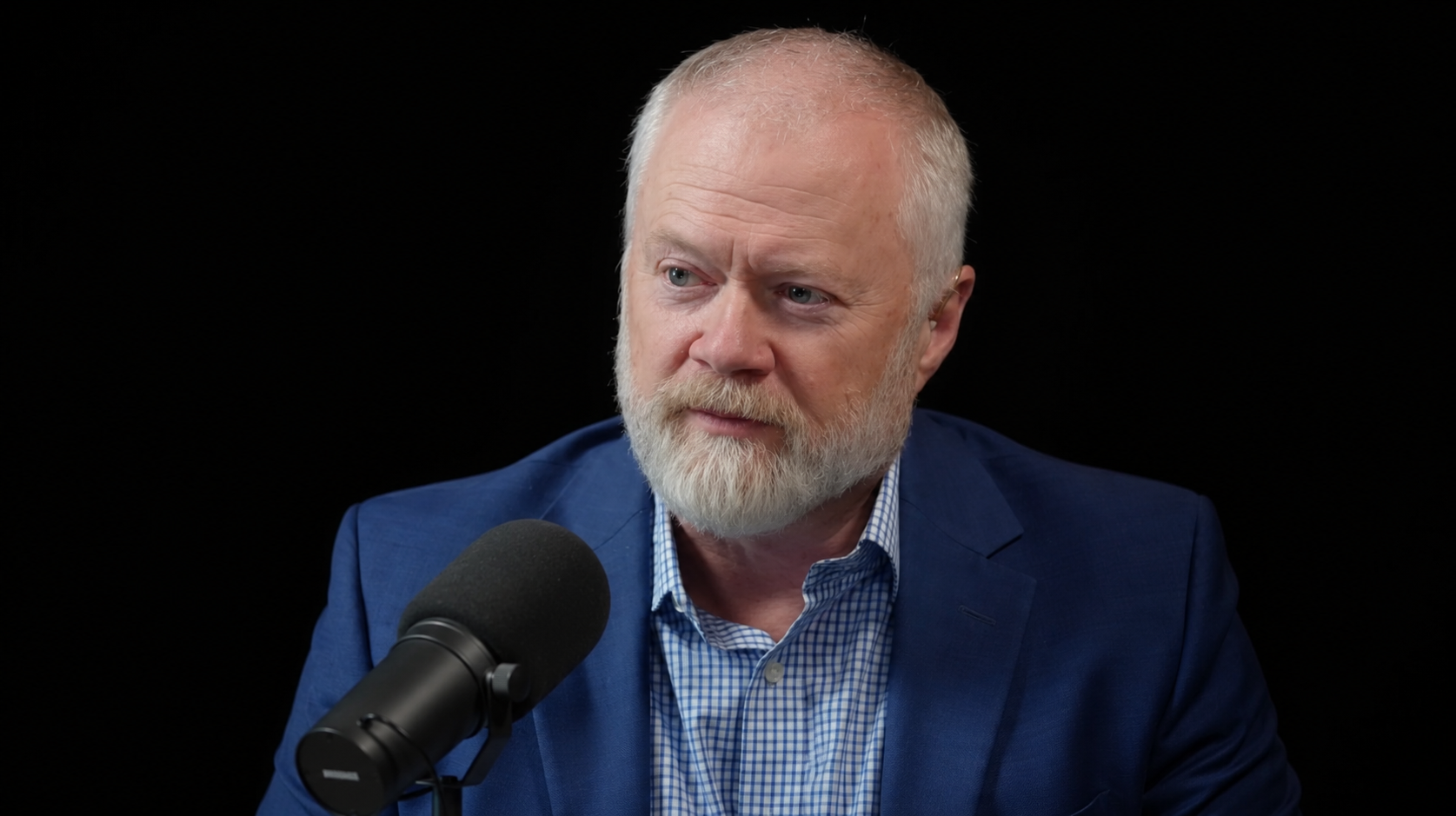
This briefing document synthesizes the key insights from an interview conducted on 9 July 2026, featuring Simon Dixon (Investor, Financial & Geopolitical Analyst, Bitcoin OG, and Co-Founder & CEO if Bnk To The Future), and host Dr. Chris Martenson (PhD) of Peak Prosperity. This 2-hour and 7-minute discussion—the second interview between the two—explores the dismantling of United States hegemonic power and the transition toward a multipolar world order.
The central thesis posits that current global conflicts and economic instabilities are "bounded escalations" managed by transnational interests to facilitate a transition into a private, technocratic control grid. The discussion highlights the roles of the Financial Industrial Complex (FIC), the Technical Industrial Complex (TIC), and the Military Industrial Complex (MIC) in asset-stripping the West while investing in a new regional stability in West Asia and the Middle East, primarily led by China and the BRICS nations. The interview concludes with strategic advice for individuals to prioritize decentralization, asset ownership, and local community resilience to survive the terminal phase of the current fiat currency system.
High-Level Overview
The interview frames the current global state not as a series of chaotic failures, but as a managed transition of empire. Simon Dixon argues that the U.S. government is no longer the entity in control; instead, private corporate interests and transnational capital have assumed dominance. The geopolitical "noise" of wars in Ukraine, Israel, and Iran is interpreted as theatrical manipulation intended to renegotiate international contracts, strategic choke points (such as the Strait of Hormuz), and the global financial architecture. The ultimate goal is a "multipolar world" where wealth is concentrated in a technocratic elite, while the general population is managed via Universal Basic Income (UBI) and programmable money (CBDCs).
Key Arguments Made by Simon Dixon
- Managed Geopolitical Transition: Simon Dixon believes that current conflicts (Ukraine, Iran, Israel) are "bounded escalations" intended to provide leverage in negotiating a new world order rather than leading to an uncontained World War III.
- The "West Asia" Realignment: Allegedly, a plan exists among transnational factions to stabilize the Middle East as "West Asia," primarily under Chinese and BRICS influence. This includes the normalization of relations between Saudi Arabia and Iran.
- FIC vs. MIC Interests:
- The FIC (Financial Industrial Complex) seeks regional stability to secure lucrative rebuild contracts in Iran and across the Gulf.
- The MIC (Military Industrial Complex) uses conflicts like the "Palestinian laboratory" and "Ukrainian laboratory" to test weapons and maintain profits, even as the U.S. managed exit from the Middle East begins.
- U.S. as a Private Corporation: Simon Dixon believes the United States has ceased to function as a nation-state and has become a private corporation servicing transnational capital. In this view, political leaders like Donald Trump are "delivery mechanisms" for private corporate instructions.
- Taiwan and Chip Independence: Dixon claims a war over Taiwan is unlikely because a deal has been negotiated for "chip independence," where the U.S. builds manufacturing (TSMC) domestically and China develops its own full-stack ecosystem (Huawei/DeepSeek).
- The Fiat "Doom Loop": Simon Dixon believes the U.S. debt system is in a terminal cycle. As foreign central banks sell treasuries, the Federal Reserve is forced to become the sole buyer, leading to the eventual implementation of programmable CBDCs and UBI to manage the resulting economic fallout.
- The K-Shaped Economy and AI: The concentration of wealth is accelerating toward those who own AI infrastructure and data centers. Dixon believes AI-driven productivity increases will lead to mass unemployment, necessitating a UBI to maintain a consumption market.
- Corporate Control and "Nudge" Algorithms: Dixon argues that freedom of speech is being replaced by "freedom of speech without freedom of reach," where algorithms radicalize users and weaponize narratives to maintain central control.
Key Arguments Made by Other Participants (Chris Martenson)
- Intentional Energy Sabotage: Martenson argues that the "one-two punch" of hitting Russian refineries and closing the Strait of Hormuz suggests a coordinated effort to "muck up" global energy systems and puncture Western hegemony.
- Institutional Looting: Martenson posits that the U.S. government is in a terminal phase of "looting the treasury," characterized by massive military expenditures and open grifting by the political class.
- The Tower of Babel Risk: Martenson questions the viability of the technocratic control grid, suggesting it is a "Tower of Babel" vulnerable to complex system failures, such as malicious code or natural disasters (e.g., coronal mass ejections).
- Systemic Demoralization: Martenson believes the current environment is designed to demoralize the public, stripping individuals of their humanity and cognitive maps of reality through fifth-generation warfare.
Points of Agreement
- Asset Stripping: Both agree that the U.S. and Europe are being systematically asset-stripped to fund a new global order.
- Failure of Representation: Both believe that Western governments no longer represent their citizens but rather serve as nodes for private corporate power.
- The End of the Petro-Dollar: They agree the petro-dollar is being dismantled in favor of alternative settlement currencies and central bank digital currency (CBDC) networks like "mBridge."
- Decentralization as the Solution: Both emphasize that the only way to resist the "global control grid" is through individual agency, local community, ownership of physical assets (gold, land, Bitcoin), and spiritual resilience.
Points of Disagreement
- Political Labeling: Martenson describes the emerging system as "Communism" with better tools; Dixon rejects this label, arguing that "Communism" implies government control, whereas the current trend is "socialism for the private corporations and capitalism for everyone else."
- The Feasibility of Central Control: Martenson is more skeptical of the elite’s ability to manage the complexity of global systems via AI, whereas Dixon focuses more on the existing roadmap for UBI and programmable money as a functional (if oppressive) plan.
Important Data, Claims, or References Mentioned
|
Data Point / Reference |
Context Provided in Source |
|
$40 Trillion |
Current U.S. national debt mark. |
|
$300 Billion Fund |
A fund (not reparations) allegedly discussed for rebuilding Iran, implying regional ownership and stability. |
|
3.3% |
The average cost on U.S. debt; the economy must grow faster than this to avoid immediate collapse. |
|
70% / 30% Ownership |
The Golden Pass LNG terminal: 70% owned by Qatar Energy, 30% by Exxon. |
|
2 Million Incarcerations |
Current U.S. incarceration rate, linked to private prison profits (GEO Group/Core Civic). |
|
$13 Billion Contract |
Cancellation of a defense contract to Taiwan prior to high-level U.S.-China meetings. |
|
mBridge |
A network of CBDCs connecting Gulf and Chinese central banks to circumvent Swift. |
|
Genius Act / Clarity Act |
Legislation cited as facilitating the move toward stablecoins and Fed-issued digital currency. |
|
FIC / TIC / MIC |
Financial Industrial Complex, Technical Industrial Complex, and Military Industrial Complex. |
Notable Quotes or Framing
- On Government Control: "The government isn't out of control, it's NOT in control."
- On Economic Systems: "The American system at the highest level of power is socialism with everyone else having capitalism."
- On Radicalization: "You don't get the reach... and you're building your social credit score... you are the product that they created."
- On Trump: "Trump is just your person for delivering this change in empire."
- On Personal Strategy: "Touch grass... the world doesn't seem quite as scary as when I open X."
- On the FIC’s Role: "Who invests, who rebuilds... marks the new world order."
Open Questions or Unresolved Issues
- The Exact Structure of the "Hormuz Toll": While Dixon predicts a partnership between Oman, Iran, and the Gulf to charge for passage, the specific legal or corporate structure remains unknown.
- The Timing of the "Doom Loop" Collapse: Both participants acknowledge the terminal state of the fiat system but admit the exact moment of failure is "anyone's guess."
- The Viability of AI as a Control Mechanism: Martenson remains unconvinced that AI can successfully manage a "complex system" like the global economy, leaving the success of the technocratic grid an open question.
- U.S. Domestic Stability: The extent to which "civil unrest" and "deportation systems" will be used to fuel the MIC’s profits within U.S. borders remains a point of concern rather than a settled fact.
Call To Action
- Share this post. Share this blog post to expose the "divide and conquer" trap.
- Subscribe to the Simon Dixon YouTube channel. Get my weekly deep dives into geopolitics, macro, and Bitcoin. Subscribe to my YouTube channel.
- Find me on Rumble. This is my backup channel, safe from censorship. Follow me on Rumble.
- Follow me on X @SimonDixonTwitt. I post real-time updates and analysis on X and am highly active there. Follow me on X.
- Follow me on instagram. Usually short clips are posted here.
- Follow me on TikTok. Usually short clips are posted here.
- SimonDixon.com This is my personal site and an archive of all my content, safe from de-platforming. Join the free membership portal.
About Dr. Chris Martenson (PhD)
Dr. Chris Martenson is an author, educator, and independent researcher focused on the intersection of economics, energy, and the environment. He is the founder of Peak Prosperity, where he publishes analysis on financial markets, macroeconomics, and long-term global trends. Martenson holds a Ph.D. in Pathology from Duke University and an MBA from Cornell University, and is the author of The Crash Course and Prosper!.
Watch On YouTube
Prefer To Listen? Available on Spotify & Apple Podcasts
Read Other Related Blogs
Disclaimer and Legal Notice
This Disclaimer forms an agreement between the publishers of this blog ("we", "us", "our") and you, the reader or visitor ("you", "your"). By accessing and using this blog, you acknowledge and agree to be bound by the terms of this Disclaimer.
1. General Disclaimer
Informational and Educational Purposes Only
All content published on this blog—including articles, interview summaries, transcripts, analysis, opinions, and commentary—is provided solely for informational, educational, and entertainment purposes. It is intended to offer food for thought, foster discussion, and encourage critical thinking regarding macroeconomic trends, geopolitics, and monetary systems.
Personal Opinions and Subjective Views
The views, thoughts, and opinions expressed on this blog belong solely to the authors, creators, or interview guests (such as Simon Dixon, Chris Martenson, and other contributors) in their individual capacities.
- Where opinions, hypotheses, or speculations are presented, they are to be treated strictly as such. Any claims regarding geopolitical realignments, corporate maneuvers, or governmental actions that are not publicly proven or legally verified are the subjective beliefs of the respective speakers and should be interpreted accordingly.
- Content does not necessarily reflect the official policy, position, or views of any associated institutions, employers, or corporate entities unless explicitly stated.
No Guarantees of Accuracy
While we strive to provide engaging and high-quality content, we make no representations or warranties of any kind, express or implied, about the completeness, accuracy, reliability, suitability, or availability of the information, data, or references contained on this blog. Any reliance you place on such information is strictly at your own risk.
2. Legal and Financial Disclaimer
No Financial or Investment Advice
We are not licensed financial advisors, brokers, dealers, or tax professionals. Nothing contained on this blog or within our published materials constitutes, or should be construed as:
- Financial, investment, legal, or tax advice.
- A recommendation, endorsement, or sponsorship of any specific security, company, asset class, cryptocurrency, stablecoin, precious metal, or investment strategy.
- An offer or solicitation to buy or sell any financial instrument.
Investment Risks
Macroeconomic shifts, asset ownership strategies, and alternative financial systems discussed on this blog—including but not limited to Bitcoin, gold, silver, real estate, stocks, stablecoins, and private equity—carry an inherent and extremely high risk of financial loss.
- Financial markets can be highly volatile, unpredictable, and subject to rapid change.
- Past performance is not indicative of future results.
- You should never invest money that you cannot afford to lose.
Do Your Own Research (DYOR)
You must not rely on the information on this blog as an alternative to financial advice from a professionally certified financial planner, accountant, or legal counsel. We strongly recommend that you conduct your own independent research, verify any data points, and consult with a qualified, licensed professional before making any financial, investment, or legal decisions.
No Fiduciary Relationship
Your use of this blog, subscription to its feeds, or consumption of its media does not create any fiduciary, advisory, or professional-client relationship between you and the blog publishers, Chris Martenson, Simon Dixon, Peak Prosperity, Bank to the Future, or any other featured guests or entities.
3. Third-Party Links and External Content
This blog may contain links to external websites, YouTube channels, social media platforms (such as X/Twitter), or online resources that are not owned or controlled by us. We have no control over, and assume no responsibility for, the content, privacy policies, or practices of any third-party sites. The inclusion of any link does not imply endorsement or verification of the content on that site.
4. Limitation of Liability
To the maximum extent permitted by applicable law, the publishers, authors, and interview guests of this blog shall not be held liable for any direct, indirect, incidental, consequential, special, or exemplary damages, or any loss of profits, data, goodwill, or other intangible losses arising out of or in connection with your access to, use of, or inability to use this blog or its content.