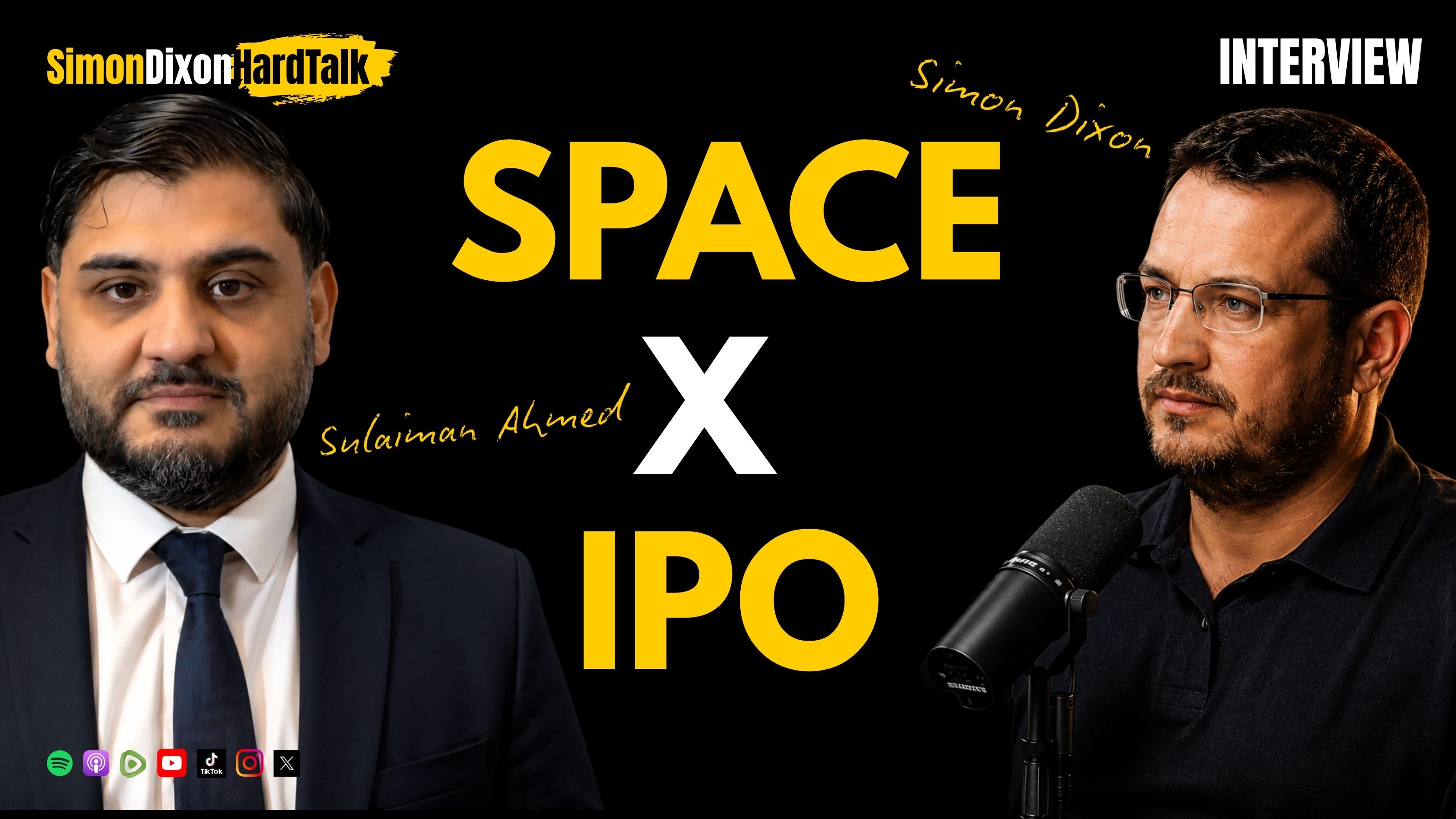
The SpaceX IPO Could Make or Break the Entire Stock Market | Simon Dixon on Moral Resistance w/ Sulaiman Ahmed
May 28, 2026Executive Summary
In Simon Dixon's opinion, the global economy is being reoriented from an oil-based system to one centered on Liquified Natural Gas (LNG), Artificial Intelligence (AI), and data center infrastructure. This briefing document synthesizes a discussion between host Sulaiman Ahmed and Dixon regarding global financial markets, the upcoming SpaceX IPO, and a transition toward a technocratic global governance model.
Simon Dixon believes the SpaceX IPO, scheduled for June 12th, is a significant market event. While SpaceX is a space exploration company, Dixon believes its valuation is predicated on its projected involvement in AI and data center markets. He also argues that there is a systemic shift affecting the middle class, the rise of Central Bank Digital Currencies (CBDCs), and the potential for a financial crisis that might lead to a multi-trillion-dollar bailout to support AI development.
High-Level Overview
The interview explores global economic shifts, characterized by energy and food security concerns. Simon Dixon believes current market behavior represents a bubble driven by AI-related companies, while the bond market faces significant pressure. The discussion connects geopolitical shifts—specifically renewables and EVs—with a strategy of privatization. Dixon believes there is a move toward a centralized control system managed by financial and technical entities.
Key Arguments Made by Simon Dixon
The Global Financial and Energy Crisis
- Market Stress: Simon Dixon believes the US is in a major stock market bubble, while the average citizen faces stress from higher energy prices and CPI increases.
- Bond Market Volatility: Simon Dixon believes global Central Banks are selling US treasuries, driving interest rates up. He notes that the 10-year Treasury recently spiked to 4.6% and the 30-year bond exceeded 5.1%, which he believes is causing credit markets to slow.
- Wealth Transfer: In Simon Dixon's opinion, while populations are affected by the cost of living, stock markets hit highs, which he describes as a transfer of wealth upward to asset owners.
The SpaceX IPO and the AI Bubble
- Valuation Logic: Simon Dixon believes the SpaceX IPO seeks a valuation between $1.75 trillion and $2 trillion.
- Data Center Pivot: Simon Dixon believes SpaceX's addressable market is $26 trillion, with the vast majority predicated on AI, compute, and data centers rather than just space exploration.
- Interconnected Contracts: In Simon Dixon's opinion, AI companies are signing contracts based on future investments from one another, and he believes that if IPOs fail to raise expected funds, it could cause significant market failure.
Geopolitics and the "China Trade"
- Energy Transition: Simon Dixon believes the world is moving from oil to LNG, and he notes differences in how the US and China manage their energy and manufacturing sectors.
- Technological Efficiency: Simon Dixon believes China possesses AI capacity that requires significantly less energy than US equivalents.
- The Shanghai Meeting: Simon Dixon believes recent meetings in Shanghai involved negotiations regarding global LNG supply and the future of AI and robotics.
The Technocratic Surveillance State
- Programmable Money: Simon Dixon believes the move toward CBDCs and stablecoin legislation aims to create integrated programmable money.
- Social Credit: Simon Dixon believes combining financial data with social media allows for systems that monitor an individual's spending or borrowing.
- Digital Management: Simon Dixon believes systems like Palantir are being used to manage public and private systems, moving toward increased surveillance.
Key Arguments Made by Other Participants
Sulaiman Ahmed (Host)
- Concerned Outlook: Describes the current trajectory as highly concerning, comparing it to the themes in Black Mirror.
- Skepticism of Corporate Narrative: Questions the feasibility of SpaceX hosting data centers in space, viewing the concept as highly ambitious.
- Impact on Employment: Expresses concern that AI and data centers will lead to significant layoffs, potentially leading to Universal Basic Income (UBI) models tied to behavioral metrics.
Points of Agreement
- Energy Requirements: Both participants agree that conventional energy sources may not be sufficient for the projected AI infrastructure, and suggest nuclear energy might be required.
- Governance Trends: Agreement that society is moving toward more centralized, data-driven control models.
- Market Concentration: Agreement that the stock market is heavily concentrated in a few technology companies.
Points of Disagreement
- There were no major points of contention between the host and guest. The host primarily sought clarification and expressed shock at the scale of the SpaceX data center strategy.
Important Data, Claims, or References Mentioned
|
Category |
Details |
|
Financial Figures |
10-year Treasury at 4.6%; 30-year Bond at 5.1%; SpaceX valuation $1.75T - $2T; SpaceX "addressable market" $26.7T. |
|
Key Dates |
June 12th (Target for SpaceX IPO via Goldman Sachs). |
|
Legislation |
Bank Secrecy Act, Patriot Act, Genius Act, Clarity Act. |
|
Companies |
SpaceX, Palantir, BlackRock, NVIDIA, Anthropic, OpenAI, Goldman Sachs, Oracle, Huawei, Intel. |
|
Nations/Regions |
US, China, India (rupee crisis), Turkey (selling treasuries/gold), UK/France (debt crisis), Iran (nuclear/bitcoin mining). |
|
Geopolitical Events |
Closure of the Strait of Hormuz; Shanghai meetings between tech/finance execs and the CCP. |
Open Questions or Unresolved Issues
- Technical Viability: How will SpaceX realistically deliver on the promise of space-based data centers given the immense energy and cooling requirements?
- Market Timing: Will the SpaceX IPO trigger a "buy the rumor, sell the news" correction that crashes the broader market?
- The "DeepSeek Moment": Will China reveal hardware or software efficiencies that render the hundreds of billions of dollars of Western AI infrastructure investment obsolete?
- The Federal Reserve's Role: Will the Fed intervene to purchase bonds and lower yields, or will a crisis be manufactured first to justify such intervention?
Watch on YouTube
Prefer to Listen? Available on Spotify & Apple Podcasts
Disclaimer:
The financial, macroeconomic, and geopolitical views expressed in this interview are strictly the personal opinions and analyses of the guest, Simon Dixon, and the host, Sulaiman Ahmed. The discussions regarding the impending SpaceX IPO, the sustainability of the AI data center build-out, the US Treasury and bond markets, and potential stock market crashes are intended for educational and conversational purposes only and do not constitute financial, investment, or legal advice.
This episode contains highly speculative and forward-looking statements based on Simon Dixon's personal interpretations of macroeconomic trends and corporate financial filings, such as SpaceX's projected $26 trillion addressable market. Furthermore, the conversation explores theoretical scenarios regarding a global "technocratic takeover," including the implementation of programmable Central Bank Digital Currencies (CBDCs), universal high income (UHI), AI-driven social credit systems, and the potential dismantling of constitutional rights.
At times, the guest explicitly frames his analysis through a speculative lens, noting how events might be interpreted "if you were to be a conspiracy theorist". Viewers should independently verify all claims, company valuations, and economic data mentioned in this broadcast and consult with a certified financial professional before making any investment decisions. The geopolitical forecasts and scenarios of manufactured national security crises discussed reflect the speakers' personal assessments and should not be taken as verified facts