They’re building a control grid to control you | Simon Dixon x Peter McCormack (Interview #4)
Aug 27, 2026This briefing document synthesizes the key insights, arguments, and data from Simon Dixon’s fourth appearance on The Peter McCormack Show, recorded on August 27, 2026. The discussion, titled “They’re Building a Control Grid to Control You,” explores the intersection of global debt, artificial intelligence, and the emerging systems of technocratic control. This document is intended to provide a structured reference for Simon Dixon’s upcoming livestream.
Executive Summary
The interview centers on the transition from a traditional debt-based economy to a technocratic "Control Grid" fueled by Artificial Intelligence (AI) and programmable money. Simon Dixon posits that the world is currently facing a massive debt rollover crisis, with the United States needing to refinance approximately $9.7 trillion by the end of 2026.
Dixon argues that the Financial Industrial Complex (FIC) is socializing losses through inflation and austerity while privatizing gains via the stock market and AI infrastructure. He warns of a looming "middle-class pinch," characterized by rapid job loss due to AI productivity and the implementation of Central Bank Digital Currencies (CBDCs) and Stablecoins linked to social credit scores. The proposed solution for individuals is a "digital resistance" based on asset ownership, self-custody of digital keys (Bitcoin), and utilizing AI to outperform inflationary pressures.
High-Level Overview
The discussion frames the current global economic state as a deliberate transition period. Major themes include:
- The Debt Super-Cycle: The unsustainable nature of US and UK national debt and the mechanics of "socializing losses."
- The AI Revolution: AI's role as a disinflationary force that simultaneously threatens to displace 50% of the middle-class workforce.
- The Control Grid: The move toward a "you will own nothing and be happy" paradigm, supported by programmable money and social credit systems.
- Sovereign Freedom: The necessity of "Key Management" as the fundamental skill of the future to resist centralized surveillance.
Key Arguments Made by Simon Dixon
Macroeconomics and Debt
- The Rollover Crisis: Dixon notes that the US has reached $40 trillion in debt, with $9.7 trillion (roughly 25%) requiring rollover by the end of 2026. This creates immense stress on the bond market.
- Socializing Losses vs. Privatizing Gains: Dixon believes the FIC dumps debt on the government, which then socializes the losses to the public via inflation. Meanwhile, gains are privatized into the stock market, where the wealthy own 92% of the value of the assets.
- Triffin’s Dilemma: Dixon explains that being the world reserve currency requires exporting debt globally, which creates a permanent deficit and strengthens the Financial Industrial Complex (FIC) at the expense of domestic manufacturing.
- The Role of War: Dixon suggests that "war spending" (formerly defense spending) acts as a stimulus for the Military Industrial Complex (MIC) and the stock market, driving a decoupling between the corporate economy and the reality of the "common man."
Artificial Intelligence and Employment
- Rapid Job Displacement: Dixon predicts a rapid loss of jobs with "no chance" of creating enough new opportunities to offset the displacement. He suggests up to 50% of roles—particularly middle-class office jobs—are under threat.
- Disinflationary Nature of AI: While AI causes job loss, Dixon notes it is "incredibly disinflationary," as productivity gains eventually reduce the cost of goods and services.
- The AI Debt Race: AI companies are now competing with governments for debt. Dixon cites projections of $800 billion in debt issuance this year and $1.3 trillion next year to fund data center buildouts.
The Control Grid and CBDCs
- Programmable Money: Dixon believes the "Control Grid" involves the introduction of CBDCs and stablecoins that require data and social credit scores. This money can be issued as "helicopter money" or bailouts during crises to ensure compliance.
- The Asset Strip: In Dixon’s opinion, policies like wealth taxes, exit taxes, and environmental reforms (e.g., carbon neutral policies) are designed to create distressed assets, allowing entities like BlackRock to purchase them "on the cheap."
Digital Resistance and Key Management
- The Three Types of People: Dixon categorizes the future population into three groups:
- The Asset Owners (The Wealthy).
- The Masses (On Universal Basic Income/Social Credit).
- The Digital Resistance (Self-sovereign individuals).
- The Importance of Keys: Dixon argues that "ownership is the governance of the system." Learning to manage cryptographic keys is the "sovereign freedom" skill required to protect identity, social data, and wealth.
Key Arguments Made by Other Participants
Peter McCormack
- The Middle-Class Pinch: McCormack highlights the visceral reality of inflation, noting that "casual dinners" and grocery shopping costs have nearly doubled, making the current path unsustainable for families.
- The "Snow Piercer" Fear: McCormack expresses concern that the future looks like a "dystopian film" with militarized police and a vast divide between the "haves" and "have-nots."
- Skepticism of Youth Engagement: McCormack questions whether young people can be recruited to the "digital resistance," noting they are often distracted by radicalizing algorithms or lured by socialist narratives that promise fairness but increase state control.
Points of Agreement
- Systemic Rigging: Both participants agree that the financial system is "rigged," with the wealthy benefiting from "corporate money printing" (stocks) while the poor suffer from currency debasement.
- Obsolescence of the "Old Way": They agree that the traditional path of university, a 9-to-5 job, and buying a house is "done" and no longer leads to wealth.
- AI Superiority: Both acknowledge that AI is becoming functionally better than humans in many tasks, rendering many traditional career paths obsolete.
Points of Disagreement
- Optimism vs. Realism: While Dixon presents a path for "digital resistance," McCormack remains more concerned about the psychological weakness being driven by social media algorithms and the difficulty of convincing the masses to take responsibility for their own security (keys).
Important Data, Claims, or References Mentioned
Economic Statistics
|
Metric |
Value Mentioned |
|
US National Debt |
$40 Trillion |
|
UK National Debt |
£3 Trillion |
|
US Debt Rollover (by end of 2026) |
$9.7 Trillion |
|
UK Debt Rollover (this year) |
~$285 Billion |
|
Stock Market Ownership |
Wealthy own 92% of the market |
|
Nvidia Quarterly Revenue |
$100 Billion (Projected $108B next) |
|
AI Corporate Debt Issuance (2026/27) |
$800B this year / $1.3T next year |
UK Housing Market Analysis (Inflation-Adjusted)
|
Period |
Nominal Change |
Inflation-Adjusted Change |
|
2016 – 2026 |
+37.6% (Avg price £196k to £271k) |
Significant decline in real value |
|
3 Years leading to Jan 2026 |
+4.9% |
-5.5% (CPI rose 10.4%) |
Key Entities and Legislation
- The Financial Industrial Complex (FIC): Banks, hedge funds, and bond vigilantes.
- The Technical Industrial Complex (TIC): AI frontier models (OpenAI, Anthropic, Nvidia).
- The Military Industrial Complex (MIC): Beneficiaries of "war spending."
- Genius Act (US): Mentioned as a mechanism for fast-tracking programmable money banks.
- Bond Vigilantes: Investors who demand higher yields, effectively controlling government policy.
Notable Quotes or Framing
- On the Economic System: "Socializing the losses and privatizing the gains."
- On Government Honesty: "That is one of the things I do like about Trump... he tells you the truth... amongst all his lies, narcissism, and gaslighting."
- On the Technocratic Future: "You will own nothing and be happy."
- On AI Productivity: "I spent £9,000 on AI tokens and I built about a million pound of software."
- On Bitcoin's True Value: "Bitcoin is a brutal mechanism for teaching you how to secure your key where money's on the line... these are the skills of the future."
- On Personal Resilience: "The world is a lot worse on the screen than it is in the garden... touch grass."
Open Questions or Unresolved Issues
- The Timing of the "Correction": While both agree a collapse or major correction is inevitable, the exact catalyst (AI debt bubble vs. sovereign bond failure) remains debated.
- Quantum Computing: Acknowledged as a future threat to Bitcoin’s security, but the timeline for "quantum resistance" remains unclear.
- Youth Radicalization: How to effectively steer the younger generation toward "digital resistance" instead of socialist or state-controlled "solutions."
- The End of the Reserve Currency: Whether JD Vance or similar "America First" proponents will successfully move the US away from the dollar as the world reserve currency to rebuild domestic manufacturing.
Call To Action
- Share this post. Share this blog post to expose the "divide and conquer" trap.
- Subscribe to the Simon Dixon YouTube channel. Get my weekly deep dives into geopolitics, macro, and Bitcoin. Subscribe to my YouTube channel.
- Find me on Rumble. This is my backup channel, safe from censorship. Follow me on Rumble.
- Follow me on X @SimonDixonTwitt. I post real-time updates and analysis on X and am highly active there. Follow me on X.
- Follow me on instagram. Usually short clips are posted here.
- Follow me on TikTok. Usually short clips are posted here.
- Follow me on NOSTR.
- SimonDixon.com This is my personal site and an archive of all my content, safe from de-platforming. Join the free membership portal.
Watch On YouTube

Prefer to Listen? Available on Apple Podcasts & Spotify

Read Other Related Blogs
Who Really Runs the World? | Peter McCormack interviews Simon Dixon (Interview #1)
The New World Order Has Already Begun | Peter McCormack interviews Simon Dixon (Interview #2)
The AI Government Is Already Here | Simon Dixon x Peter McCormack (Interview #3)
Want the faster version of this article?
If you don’t have time to read or watch the full discussion, you can access the AI Summary and Whiteboard Explainer for this post inside the Simon Dixon Hard Talk Membership Portal.
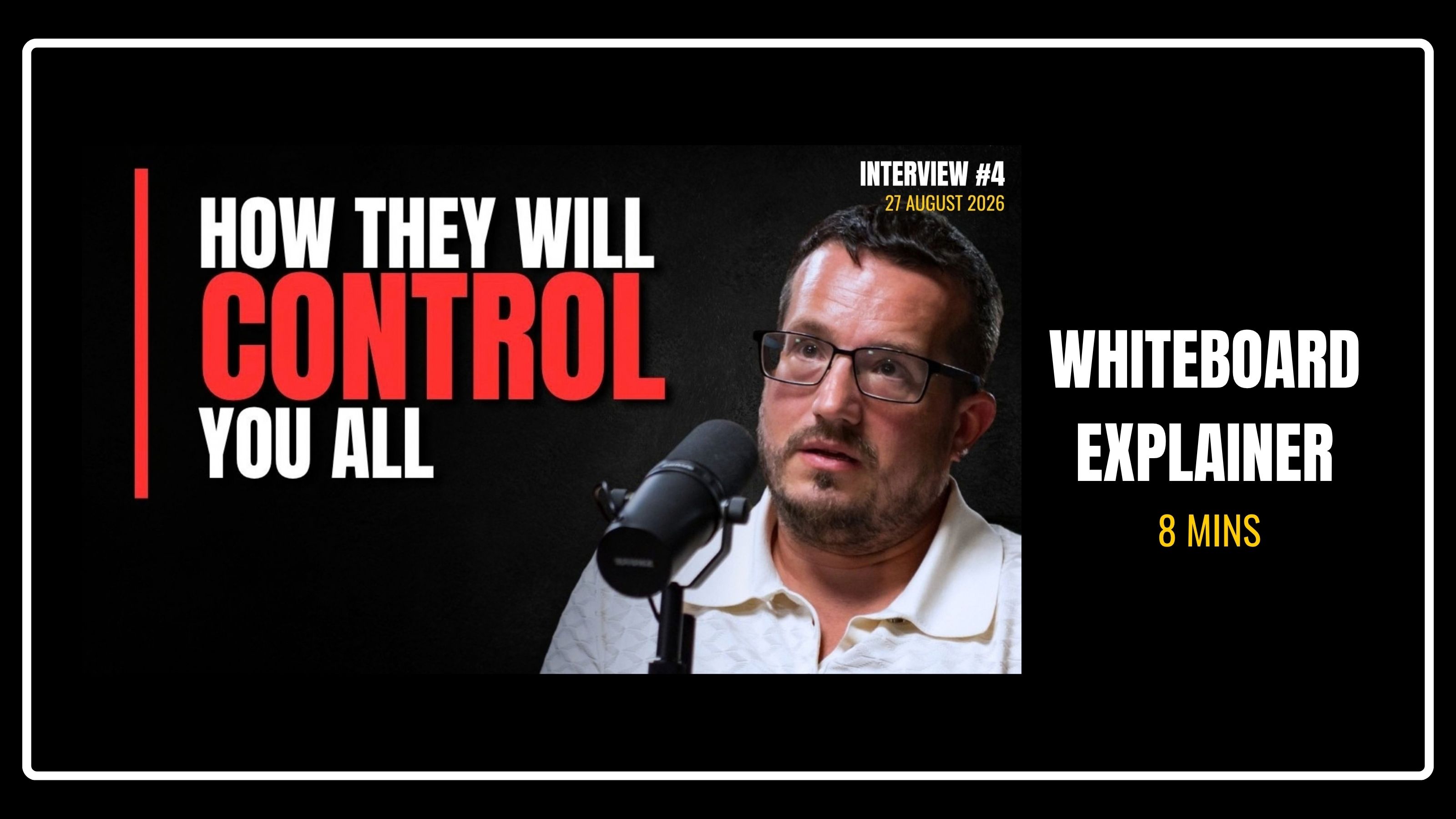
Already have your complimentary login? Simply sign in to access them.
Not a member yet? The portal is 100% complimentary to join and use.
You can also download a free PDF copy of Simon’s 2011 book and access the full archive of Simon Dixon Hard Talk LIVE episodes, interviews, long-form conversations, AI summaries and explainer videos.
Simon does not ask you to buy anything.
- No membership fees.
- No upsells.
- No sponsors.
- No ad revenue.
- No products being pushed.
The portal exists to build a sovereign community and independent archive that does not depend entirely on YouTube, X or any other social platform to stay connected.

Disclaimer: The content of this article is for educational and educational commentary purposes only and represents the personal opinions of Simon Dixon. It does not constitute financial, investment, legal, or tax advice. Geopolitical analysis, macroeconomic commentary, and opinion on sovereign assets like gold and Bitcoin carry inherent risks. Please conduct your own research and consult with a professional financial advisor before making any financial decisions.