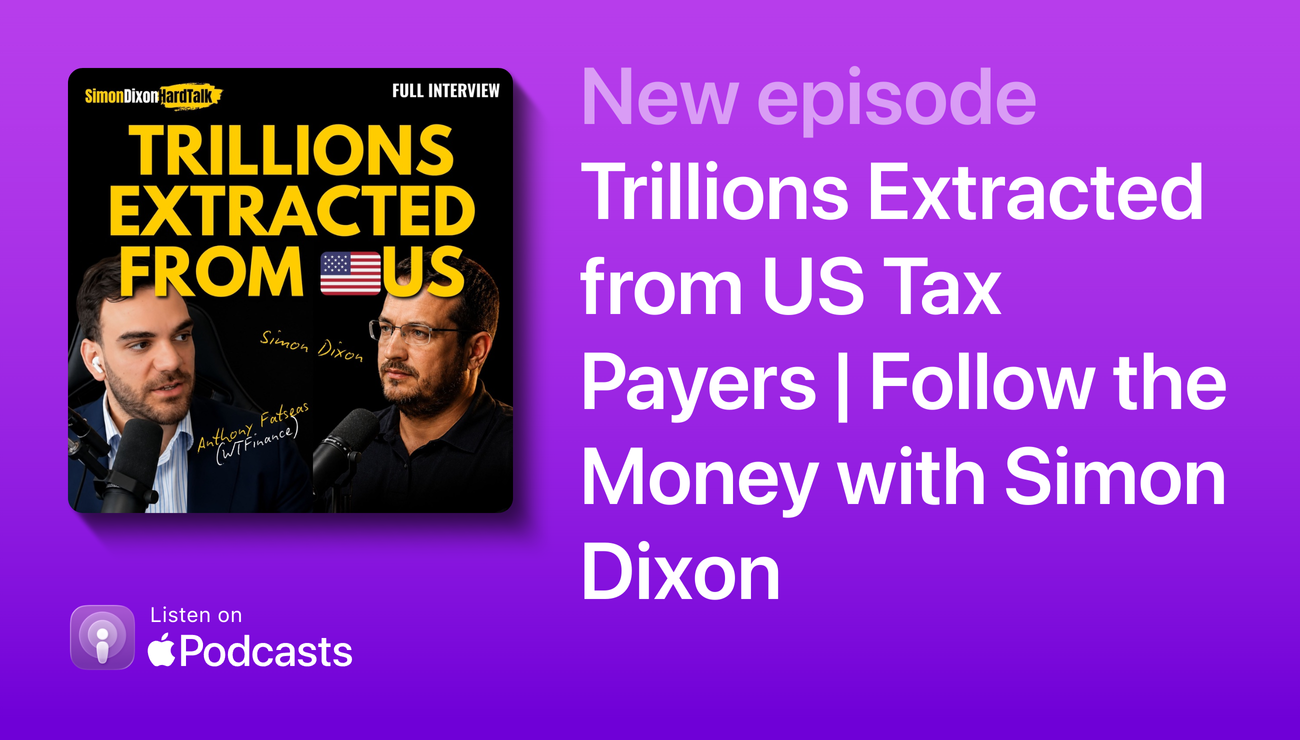
Trillions Extracted from US Tax Payers | Follow the Money | Simon Dixon on WTFinance (Anthony Fatseas)
May 13, 2026This briefing document synthesizes the key insights, arguments, and data from the WTFinance interview featuring Simon Dixon. It outlines the current state of the global financial system, the transition toward a multipolar world, and the strategic shift toward digital surveillance and asset stripping.
High-Level Overview
The discussion centers on the premise that current global instability is not a system failure but a deliberate outcome of a financial structure working exactly as designed. Simon Dixon employs a "follow the money" lens to argue that the world is transitioning from a US-led unipolar system to a multipolar architecture. This shift is characterized by the "asset stripping" of Western economies, the rise of transnational capital (unaligned with any single nation), and the replacement of the petrodollar with a "multi-polar layer" of financial centers and digital surveillance grids.
Key Arguments Made by Simon Dixon
The "Follow the Money" Framework
- Media and Politics as Distractions: Analysis must ignore media narratives and political rhetoric, focusing instead on monetary flows, incentives, and balance sheets.
- Transnational Capital vs. Nations: Real power resides in transnational capital that is not aligned with the interests of any specific country. Politicians are framed as "actors" or "front decision makers" for the complexes that fund them.
The Three Power Complexes Funding Politics (Example: The Trump Administration)
- Technical Industrial Complex: Backed primarily by nodes like Elon Musk. Their agenda includes a police/surveillance state, a shift from oil to LNG, and securing resources for AI, robotics, and battery infrastructure.
- Financial Industrial Complex: Represented by dynasties like the Mellons. They focus on shifting capital at the end of debt cycles, asset stripping the West, and moving toward regions with higher birth rates (Africa, Southeast Asia).
- Military Industrial Complex: Linked to figures like Miriam Adelson and interests in Israel. This complex views Israel as a "colony" for US proxy wars and profits from perpetual conflict and reconstruction contracts.
Historical Cycles and the "Ponzi" Nature of Debt
- A 400-Year System: The current model began with the Dutch Empire (Dutch East India Company/Bond Markets), transitioned to the British Empire (British East India Company), and finally to the US Empire.
- Structural Ponzi Scheme: Currency is created as debt, but the interest to repay it requires the economy to grow faster than the cost of debt. This eventually necessitates a bailout where wealth is extracted into private "East India Company" equivalents (e.g., BlackRock, State Street, Vanguard).
- The Federal Reserve Era: The 1913 creation of the Fed led to the transfer of global gold to the US, the engineering of the Great Depression, and eventually the 1944 Bretton Woods system.
The End of the Petrodollar and the Rise of China
- Three Pillars of the Dollar: Post-1971, the dollar was propped up by the Eurodollar (offshore creation), the Japan carry trade, and the petrodollar (pricing oil in USD).
- The Strait of Hormuz Event: The closure of the Strait of Hormuz is framed as the end of the pro-dollar system and the deconstruction of OPEC.
- China’s "Rug Pull" Strategy: China is building physical reserves and commodity markets while the West relies on paper derivatives. China utilizes nodes like the UAE and Hong Kong to transfer gold from the West to Shanghai.
- Mbridge Network: A central bank digital currency (CBDC) network linking UAE, Saudi Arabia, China, Hong Kong, and Thailand to circumvent Western control grids.
The Future: Surveillance and Resistance
- Digital Police State: The system is moving toward programmable money, social credit scores, and AI-driven surveillance (using Palantir technology tested in conflict zones).
- Universal Basic Income (UBI): As AI and robotics cause structural unemployment, UBI will be used as a tool of enforcement through programmable currency.
- Asset Self-Custody: The only way to "exit the system" is through hard assets like gold (in self-custody) and Bitcoin. Bitcoin is described as an "escape valve" for elites and individuals due to its unconfiscatable nature.
Key Arguments Made by Other Participants
Anthony Fatseas (Host)
- System Design: Framed the conversation by stating the system is not failing but functioning as designed to transform citizens into collateral.
- The Demographics Flip: Suggested that in an AI-driven world with few jobs, aging populations might actually be a benefit for a country’s stability compared to high numbers of unemployed, restless youth.
- Community Funding: Noted the importance of redirecting capital away from the central system and into local communities to mitigate the impact of the transition.
Points of Agreement
- Narrative vs. Reality: Both agreed that the public narrative is largely a distraction from the underlying financial movements.
- Asset Accumulation: Both emphasized that the "K-shaped" economy benefits only those who own hard assets, while the rest are becoming "debt slaves."
- Local Resilience: Both participants advocated for local community investment and decentralized supply chains as a defense against federal-level financial collapse or overreach.
Points of Disagreement
- No major areas of contention were identified in the dialogue; the host primarily prompted Dixon to expand on his "follow the money" thesis.
Important Data, Claims, or References Mentioned
Statistics and Valuations
- BlackRock Assets: Mentioned as having grown from $12 trillion to $14 trillion under administration.
- DeepSeek vs. OpenAI: DeepSeek (China) is raising finance at a $45 billion valuation with 90% the capacity of US AI, while OpenAI is valued at $1 trillion+.
- BnkToTheFuture: Has facilitated over $2.5 billion in investments into companies like Coinbase and Kraken.
Historical/Legislation References
- 1913: The creation of the Federal Reserve.
- 1944: The Bretton Woods system.
- 1971: Closing of the gold window and transition to the petrodollar.
- The Dutch East India Company: Cited as the 17th-century precursor to modern asset managers like BlackRock.
Specific Entities and Technologies
- Palantir: Identified as the technology behind "pre-crime" integration, drones, and social credit score scraping.
- Mbridge: The CBDC network for international settlement.
- The "Magnificent 7": Companies that represent approximately 45% of the S&P 500.
Notable Quotes or Framing
- "Socializing losses and privatizing gains": Used to describe the cycle of bailouts (LTCM, Global Financial Crisis, COVID).
- "Financial Industrial Complex": A term used to describe the decentralized "Dutch East India Company" of the modern era (BlackRock, State Street, Vanguard).
- "System working exactly as it was designed": The host’s framing of global volatility.
- "The dollar is debt": Used to explain why the national debt cannot be "paid off" without collapsing the currency.
- "A World Economic Forum agenda on steroids": Dixon's description of the transition to a digital surveillance state.
Open Questions or Unresolved Issues
- The Midterm Election Impact: Dixon suggests a forthcoming "decapitation" of the Republican party's decision-making power during the midterms, but the specific political mechanism for this remains an open forecast.
- The Timing of the "Flip": While Dixon notes infrastructure is being built to "flip the switch" to a new architecture, the exact timeline for the full abandonment of the dollar by the "Financial Industrial Complex" is not specified.
- UBI Implementation: The practical logistics of how a social credit score-linked UBI would be rolled out in Western democracies (beyond beta tests in conflict zones) remains a point of future observation.
Call to Action
- Share this post. Share this blog post to expose the "divide and conquer" trap.
- Subscribe to the Simon Dixon YouTube channel. Get my weekly deep dives into geopolitics, macro, and Bitcoin. Subscribe to my YouTube channel.
- Find me on Rumble. This is my backup channel, safe from censorship. Follow me on Rumble.
- Follow me on X @SimonDixonTwitt. I post real-time updates and analysis on X and am highly active there. Follow me on X.
- Follow me on instagram. Usually short clips are posted here.
- Follow me on TikTok. Usually short clips are posted here.
- SimonDixon.com. This is my personal site and an archive of all my content, safe from de-platforming. Join the free membership portal.
Watch on YouTube

Prefer to Listen? Available on Spotify & Apple Podcasts
Read Other Related Blogs
The Dollar System Is Dead - What Comes Next? | Simon Dixon on WTFinance w/ Anthony Fatseas
DISCLAIMER
The content provided in this blog, including the analysis of macroeconomic trends, transnational capital flows, and asset preservation strategies like holding self-custodied Bitcoin and gold , is for informational and educational purposes only. Simon Dixon's "follow the money" framework and discussions regarding the global financial system represent his personal geopolitical and financial analysis . This content does not constitute financial, investment, or legal advice. As discussed in the interview, individuals should make their own conscious decisions about exiting the fiat system and "voting with their money" by building decentralized, community-led investments . Always conduct your own research before making financial decisions.