Why Banks Fear Full Reserve Banking | Simon Dixon on What Bitcoin Did w/ Danny Knowles
Jun 16, 2026Hey hey Sovereign Wealth Builders,
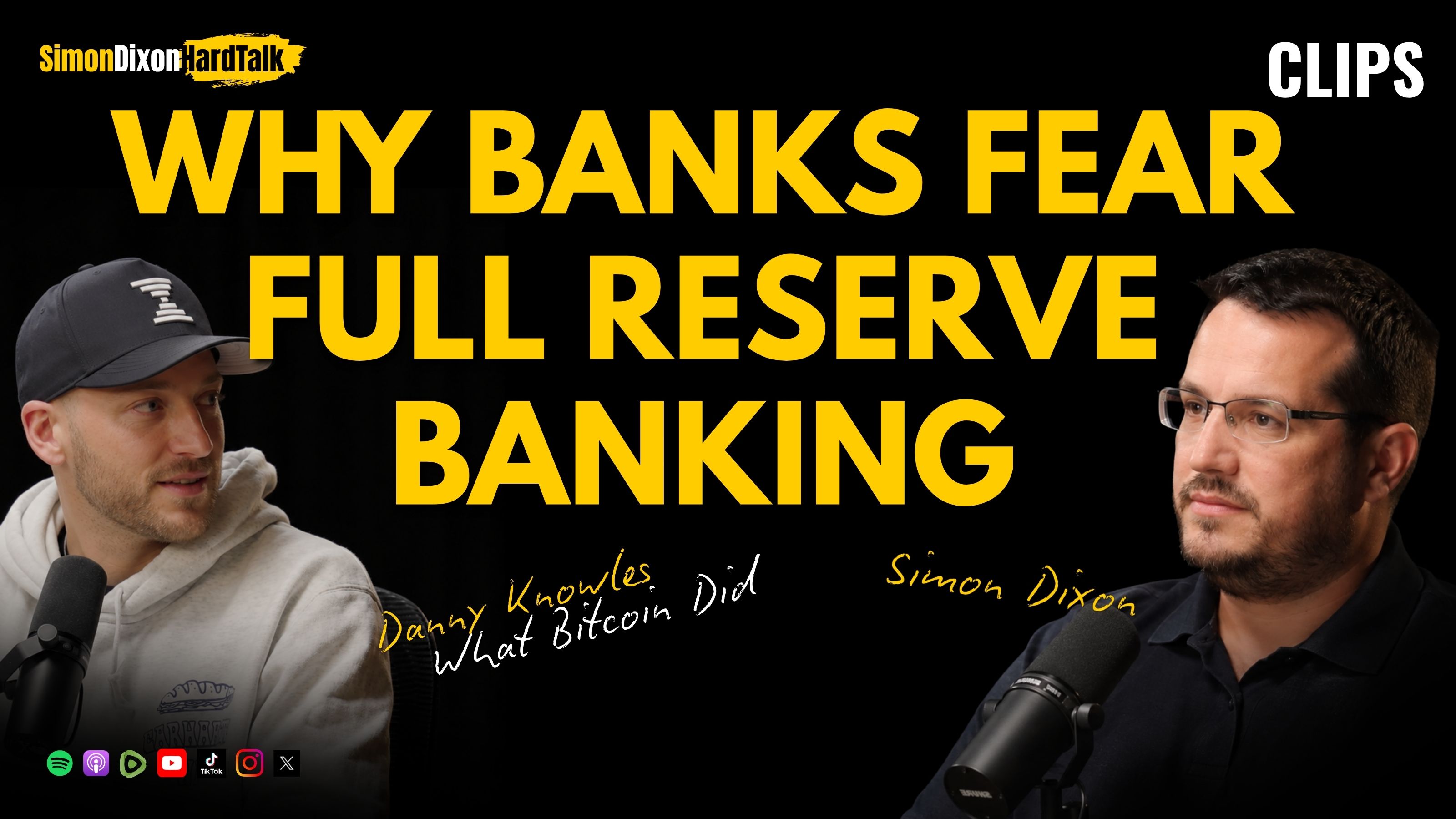
Welcome back. I recently sat down with Danny Knowles on the What Bitcoin Did podcast (dated 7 January 2026) for a deep-dive conversation into my history and the mechanics of the global financial machine. We covered a lot of ground in the full 1 hour and 46 minute interview, 🇬🇧 Chased Out of UK by the Bank of England: My Story, Told on What Bitcoin Did, but there is one specific 3-minute segment that is important to understand.
It’s called "Why Banks Fear Full Reserve Banking," and it discusses why the current system, in my opinion, is mathematically designed to fail you. Today, I’m discussing why the establishment, I believe, is concerned of a world where your money actually exists.
The Monopoly on Money Creation
Let’s be clear: the ability to create money is a legal monopoly that, in my opinion, creates an inherent imbalance before you even start. If you or I were to print £1,000 in our basement, it’s called counterfeiting, and we’d end up in prison. However, if you possess a banking license, that same act is considered a regulated business model.
Every time a licensed bank issues a loan, they aren't lending out existing savings. They are creating digital currency out of thin air the moment they type numbers into a ledger. I believe it creates a fundamental imbalance.
Key Insight: The Fractional Reserve System (In My Opinion)
From my perspective, I believe the current fractional reserve system operates in a manner similar to a Ponzi scheme. When a bank creates the principal of a loan (say, £1,000), they do not create the money required to pay the interest on that loan. I believe that because the interest money allegedly does not exist in the system, new loans must be constantly issued to provide the liquidity for old debts to be serviced. In my opinion, this creates a mathematical constraint—a system that requires perpetual, exponential growth just to avoid immediate collapse.
A Brief History of the Current Financial System: 1694 to Today
I believe this is a fundamental part of the system's design. I believe the "perpetual cycle" of debt was established centuries ago and has allegedly been protected ever since.
- 1694: We can trace this back to the transaction involving William Patterson and the Bank of England (which history often associates with the debt to the Crown/King Charles). They issued a £1.2 million loan, but it came with interest. The problem? I believe the money to pay that interest was never created.
- 1913: Allegedly, after two previous attempts by the banking elite to force this model onto the United States, it was finally solidified with the creation of the Federal Reserve.
Why would they ever let you out of that cycle?
I believe this design ensures a trajectory toward financial instability that, in my opinion, is likely to eventually affect individuals, corporations, and even governments. Because the total debt (principal plus interest) allegedly always exceeds the total money supply, in my opinion, financial failure for some entities is inevitable.
Full Reserve Banking: Concerns About Its Implementation
If the current system is a Ponzi, then "Full Reserve" banking—where the bank is required to hold 100% of the assets backing your deposits—is a major challenge to the existing model.
Think about the market today. People are flocking to stablecoins because, in a true full-reserve stablecoin model, you essentially own the underlying asset (like government debt) that backs the coin.
I believe that if the Bank of England allowed a Full Reserve bank to exist alongside fractional reserve banks, there would be a massive, immediate exodus of capital. You would naturally choose to move your wealth from a fractional system (where the money isn't there) to a full reserve system (where you actually own the asset). In my opinion, this mass outflow would significantly challenge the legacy system because the current perception of solvency, I believe, would diminish. This is why I believe there is significant resistance to it.
The "Challenger Bank" Model (In My Opinion)
When I tried to bring true innovation to the UK banking sector, the Bank of England’s response was a response that I viewed as cynical. They offered a compromise: for £60 million to n reserve, they would give us the "ability" to operate a Full Reserve model—but only if we built it "on top" of a clearing bank like Barclays.
I believe this was a restrictive arrangement. By building on top of a clearing bank, you aren't creating a Full Reserve system at all. You are simply handing your customers' deposits to a giant institution like Barclays so they can rehypothecate those funds for other purposes. They make all the money on your deposits while you take the risk.
The UK government marketed this as "innovation" and called these entities "Challenger Banks." Whether it was Zopa in the peer-to-peer space or Revolut, these companies were forced into a model that ultimately feeds the same clearing banks. I believe it is an illusion of choice that, in my opinion, keeps the same players in power.
Dixon’s Bottom Line: The Sovereign Strategy
I believe the banking establishment created a loophole that favors the status quo.
If your "Full Reserve" bank is sitting on top of a fractional reserve clearing bank, your money is allegedly still being rehypothecated. The way I believe to truly win is to step outside this circular logic.
Why This Matters for Your Sovereignty
Understanding these mechanics is essential for any Sovereign Wealth Builder. In my opinion, the trajectory of the current financial system suggests potential failure is likely. I believe its design makes financial difficulties predictable.
I believe the legacy system is built on debt that, in my opinion, can never be fully repaid. When you realize that the money to pay the interest on the world's debt allegedly doesn't exist, you realize that looking for "safety" within a licensed bank is not guaranteed.
Final Thoughts & Perspective
I believe we are witnessing the eventual outcome of a model that started in 1694. I believe the refusal of the banking establishment to allow true Full Reserve banking is a strong indication they know the system is fragile and survives only through a regulated structure.
I believe systemic change is a mathematical necessity. This is why I believe Bitcoin is a critical option—it offers a viable alternative to the debt model. It is not me or the only ways to move toward true financial sovereignty.
Take Action
To understand the full depth of this "Ponzi" and the story of how I was chased out of the UK for trying to fix it, I personally invite you to watch the full discussion:
- Watch the Full Interview: Why Banks Fear Full Reserve Banking - What Bitcoin Did
- Stay Connected: Follow me on X (formerly Twitter) and subscribe to my channels to stay ahead of the next phase of this financial transition.
- Share: If you value sovereignty, share this with another Sovereign Wealth Builder who needs to see behind the curtain.
Watch on YouTube
Read Other Related Blogs


Disclaimer
The content of this article is for informational and educational purposes only. It represents the professional opinions of Simon Dixon and does not constitute financial, legal, or investment advice. Banking models, regulatory requirements, and historical interpretations are subject to change and represent "alleged" historical contexts as described in the source material.