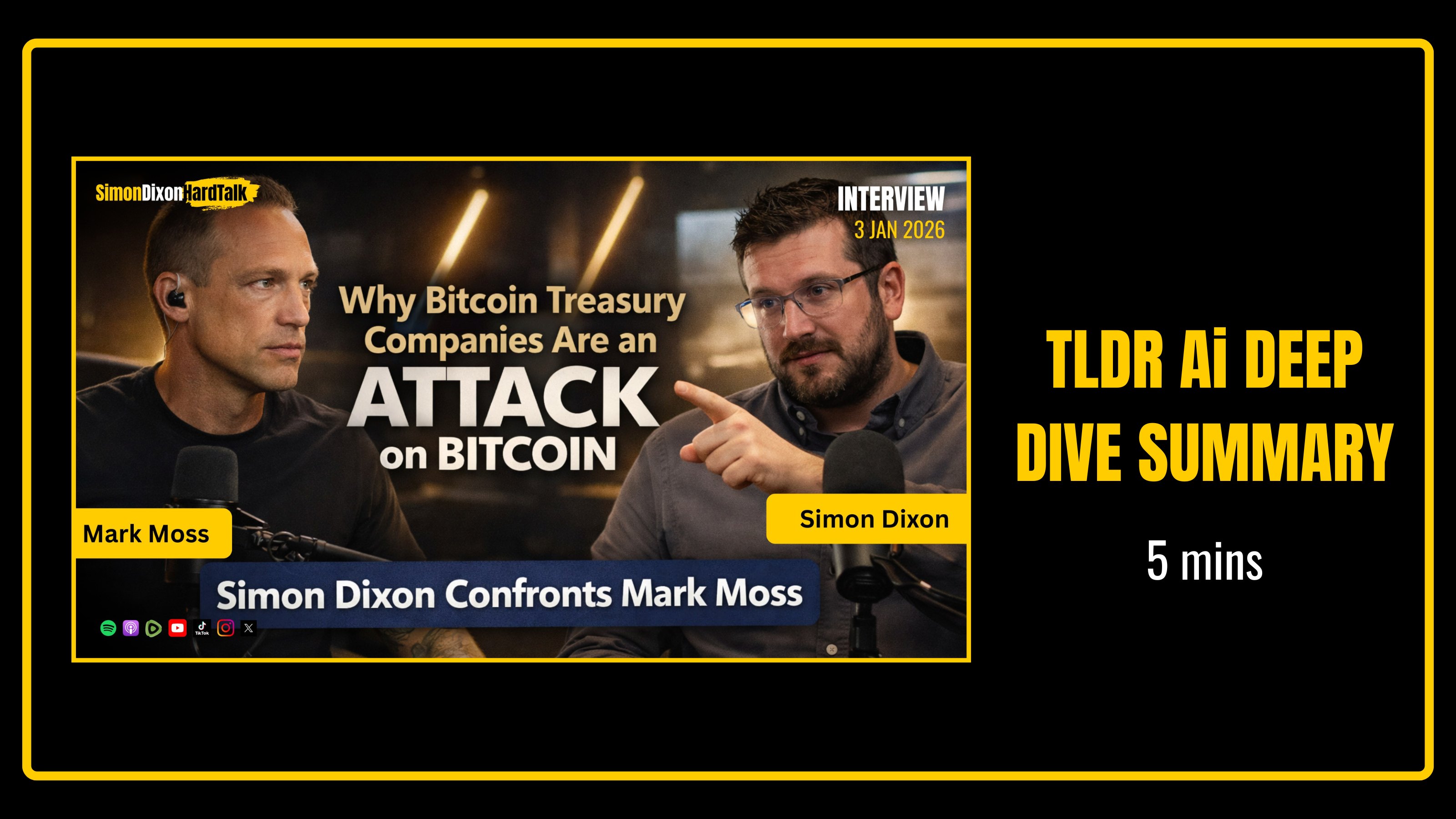
Why Bitcoin Treasury Companies Are an Attack on Bitcoin | Simon Dixon Confronts Mark Moss
Dec 17, 2025No time for the full 48m video? Watch the 10-minute AI-generated TL;DR Podcast Style Discussion instead. Or watch the 5-minute Ai generated Whiteboard Explainer Video.

Hey hey Sovereign Wealth Builders,
On this 3rd of January 2026, we find ourselves navigating a global architecture that feels increasingly fractured, volatile, and inherently chaotic. For many, the whipping markets and the erosion of institutional trust appear to be random side effects of a world losing its grip, but for those of us who have spent decades analyzing the plumbing of capital markets, this is not chaos—it is a meticulously managed systemic transition. I recently sat down for a forty-seven-minute conversation on the Market Disruptors YouTube channel to unpack these shifts with Mark Moss. Our discussion centered on a hard reality that most are not yet prepared to face: the struggle for control over Bitcoin is no longer about its survival or its technological viability. Bitcoin has already won the battle for existence. The current war is about its centralization and attempted capture by the same predatory forces that have managed the fiat debt-based Ponzi scheme for centuries. We are witnessing the birth of a Technical Industrial Complex designed to strip you of your sovereignty under the guise of adoption.
To understand the gravity of our current moment, we must first unveil the true nature of what I call the Financial Industrial Complex. This is not merely a loose collection of banking interests; it is a sophisticated Proof of Weapons Network. This network does not rely on a decentralized consensus of nodes; it relies on the weaponization of financial, media, technology, and military/covert operations to enforce global subordination. It is a hierarchy of power where massive asset managers—proxies for the elite like BlackRock, Vanguard, and State Street—direct passive index flows into ETFs and private equity to control the narrative of entire industries. This complex has mastered the art of "vassalization" across three distinct tiers. At the individual level, you are turned into a debt slave, holding your assets in structures where someone else maintains custody. At the corporate level, companies are forced to borrow against their equity value, becoming subordinate to debt instruments and index fund managers who dictate their ESG and strategic mandates. At the sovereign level, nations are brought to heel through financial weapons of mass destruction like IMF debt, covert wars, and the requirement to align with a centralized global agenda to maintain market access. Most Western governments are now fully subordinate to this asset-manager-driven complex, serving the interests of capital over the needs of their own citizens.
This system did not emerge in a vacuum but is the latest iteration of a historical arc of financial subjugation that traces its lineage back to the late 1600s. When the British Empire sought to fund its perpetual wars, it established the Bank of England, perfecting a brilliant and predatory accounting trick. This model was a private-public partnership where the government would borrow as much as possible, with the interest on that debt covered by taxing the people. This capital was then siphoned into mercantile expeditions, such as the Dutch East India Company, to pillage resources and secure real assets like gold and silver. This was the model of the Dutch Empire successfully finding a new "host" in Britain. Once the Bank of England had successfully asset-stripped the British government and its colonial holdings, the financial parasite sought a more powerful host, leading to the eventual creation of the Federal Reserve in America after three strategic attempts to install a central bank.
The transition between these empires was never peaceful or accidental; it required world wars to reset the global order. Throughout the 20th century, we saw the Financial Industrial Complex fund competing ideologies to ensure the debt-based model remained supreme. The Bolshevik Revolution, for instance, was a strategic maneuver to replace the Russian Tsar and his gold with a Soviet Union that could be managed within the centralized clearing systems. We saw a similar mechanism during the rise of the Nazi regime. When Hitler invaded Czechoslovakia, the gold did not physically move; the Bank for International Settlements (BIS) simply changed the labels on the account drawers, transferring ownership from the Czechs to the Germans via the Bank of England’s clearing system. By the end of World War II, America had drained the world’s gold reserves through the provision of weapons, allowing the dictates of the Bretton Woods system to emerge. The 1971 shift to a pure fiat, debt-based standard was the final evolution, allowing the system to scale its power without the physical limitations of gold, turning every individual into a product to be leveraged and sold.
We have now reached the end of that debt cycle, entering a modern pivot where the Financial Industrial Complex is overseeing a managed transition from a U.S.-led hegemony to a multipolar world. We see regional blocks—the BRICS, the GCC, the African Union, and the Shanghai Cooperation Organization—organizing around de-dollarization. However, this is not a spontaneous collapse of the dollar; it is a sophisticated, economic version of World War II. We are in a Currency War environment where the "milkshake" effect is being utilized to drain global assets back into the U.S. government through the strategic weakening of the dollar. The breakage of the Japan carry trade and the turning of Europe into a war zone to break the Euro dollar system are intentional moves to repatriate capital. The current phase is one of "Asset Stripping," where the U.S. stock market, bond market, and real estate are being pumped to consolidate power before a final global reset. The goal is a new order based on algorithmic control, energy, and data centers, where nations negotiate acquisition terms for resources like Venezuelan oil or Gulf energy while the Financial Industrial Complex maintains the underlying ledger.
This brings us to the core of my confrontation with the current industry narrative: the rise of Bitcoin Treasury companies. While the "strategy" model of companies acquiring massive amounts of Bitcoin is often hailed as a victory for the network, it is, in reality, a primary attack vector for Wall Street. These companies, by taking on massive debt and issuing perpetual instruments to buy Bitcoin, have become subordinate entities to investment banks like JP Morgan and primary dealers like Cantor Fitzgerald. When a company holds 650,000 Bitcoin but carries hundreds of millions in liabilities to the legacy system, it is no longer a sovereign holder. It is a vehicle for the Financial Industrial Complex to manipulate the price through the derivatives market and index fund inclusion. This is the foundation of the Technical Industrial Complex. By creating "paper Bitcoin" and fractional reserve products, Wall Street can separate the individual from their private keys. They are rebuilding the same corrupt structure that Operation Chokepoint 1.0 and 2.0 sought to protect by destroying the independent Bitcoin exchanges and banks. Now that the independent players are gone, the complex is rebuilding the ecosystem under its own control.
The recent legislative pushes, such as the Genius Act and the deregulation of stablecoins, are not the pro-innovation signals many believe them to be. These are mechanisms for rolling over distressed government debt onto retail and pension holders. The Genius Act essentially allows banks to take their federal reserves and use them as collateral for stablecoins, creating a "rounding error" of demand for U.S. treasuries that props up the short-term debt of a bankrupt government. By encouraging the public to hold Bitcoin in ETFs or to borrow against it in custodial arrangements, the system is setting a trap. They want to use your Bitcoin as collateral to mine fiat currency, keeping you in an eternal debt trap while they manipulate the price to trigger margin calls. This is a massive psychological operation designed to convince you that "Wall Street Bitcoin" is the same as the sovereign asset envisioned by Satoshi Nakamoto. It is not. It is a programmable surveillance asset integrated into a future social credit system.
The only effective counter-strategy for the individual is the pursuit of Sovereign Power. This begins with a fundamental boycott of the legacy system and an understanding of the "spiritual energy" of money. When your wealth is built through degenerate gambling in shitcoins or by supporting globalist infrastructure like the S&P 500, it carries a baggage that leads to personal and financial instability. Conversely, when you invest in decentralized businesses and local communities, your wealth multiplies with purpose. The most potent tool of resistance remains the combination of self-custody and running your own node. This is not a technical hobby; it is the ultimate defense in the ongoing war for the network. We are moving toward a two-tiered system: "Wall Street Bitcoin," which is custodial and censored, and "Sovereign Bitcoin," which is held by the individuals who run their own infrastructure. In any future "block size war" or struggle over network implementations, the only people who will have a voice are those who can verify their own transactions and refuse to follow the dictated chain of the centralized exchanges and asset managers.
Building sovereign wealth requires the discipline to resist the easy paths offered by the Financial Industrial Complex. You must avoid the "SCOP" of the Bitcoin ETF, which trades your freedom for the convenience of a brokerage account. You must resist the urge to borrow against your Bitcoin in ways that leave you vulnerable to the whims of JP Morgan’s margin desk. Instead, use Bitcoin as it was intended—as an alternative resistance. It is a tool that allows you to move your wealth across borders without permission, to invest in sustainable, local production, and to opt out of the debt-based Ponzi scheme. As the dollar is strategically weakened and the world is carved into regional blocks, your ability to remain sovereign depends entirely on who holds the keys to your wealth. The defining theme of this era is Control, and if you do not control your money, the Technical Industrial Complex will use it to control you.
The transition we are witnessing is historic, and the forces arrayed against individual sovereignty are formidable. However, by maintaining your private keys, running your own node, and refusing to participate in the custodial traps of Wall Street, you preserve the original intent of Bitcoin. You become part of a new elite that values freedom over the illusion of security. The struggle for the future of money is a struggle for the future of human agency. Stay focused, stay disciplined, and stay sovereign.
To gain a more comprehensive understanding of these macro shifts and the technical industrial complex, I encourage you to watch the full forty-seven-minute interview on the Market Disruptors channel. For real-time analysis of the financial industrial complex and regular updates on how to navigate these currency wars, you can follow me on X and subscribe to my YouTube and Rumble channels where I go live weekly to follow the money through macro, geopolitics, and technology. If you found this strategic analysis valuable, please share this post with others who are seeking to protect their legacy and build true sovereign wealth in an age of centralization.
Watch on YouTube

Prefer to Listen? Available on Spotify & Apple Podcasts

Other Related Blogs


Disclaimer
This blog is provided for informational and educational purposes only and does not constitute financial, legal, or investment advice. The analysis herein pertains to complex macro-economic, geopolitical, and technological trends that involve significant risk, including jurisdictional risk and the potential for total loss of capital. Decisions regarding capital allocation, the use of leverage, and the custody of digital assets should be made based on your own due diligence and in consultation with professional advisors. The author assumes no responsibility for any financial losses or adverse outcomes resulting from the use of the information contained in this blog. Past performance in any market, including Bitcoin, is not indicative of future results, and the geopolitical landscape is subject to rapid, unpredictable, and potentially violent change. Individuals are solely responsible for ensuring their own compliance with the laws and regulations of their respective jurisdictions, particularly regarding self-custody and international capital flows.