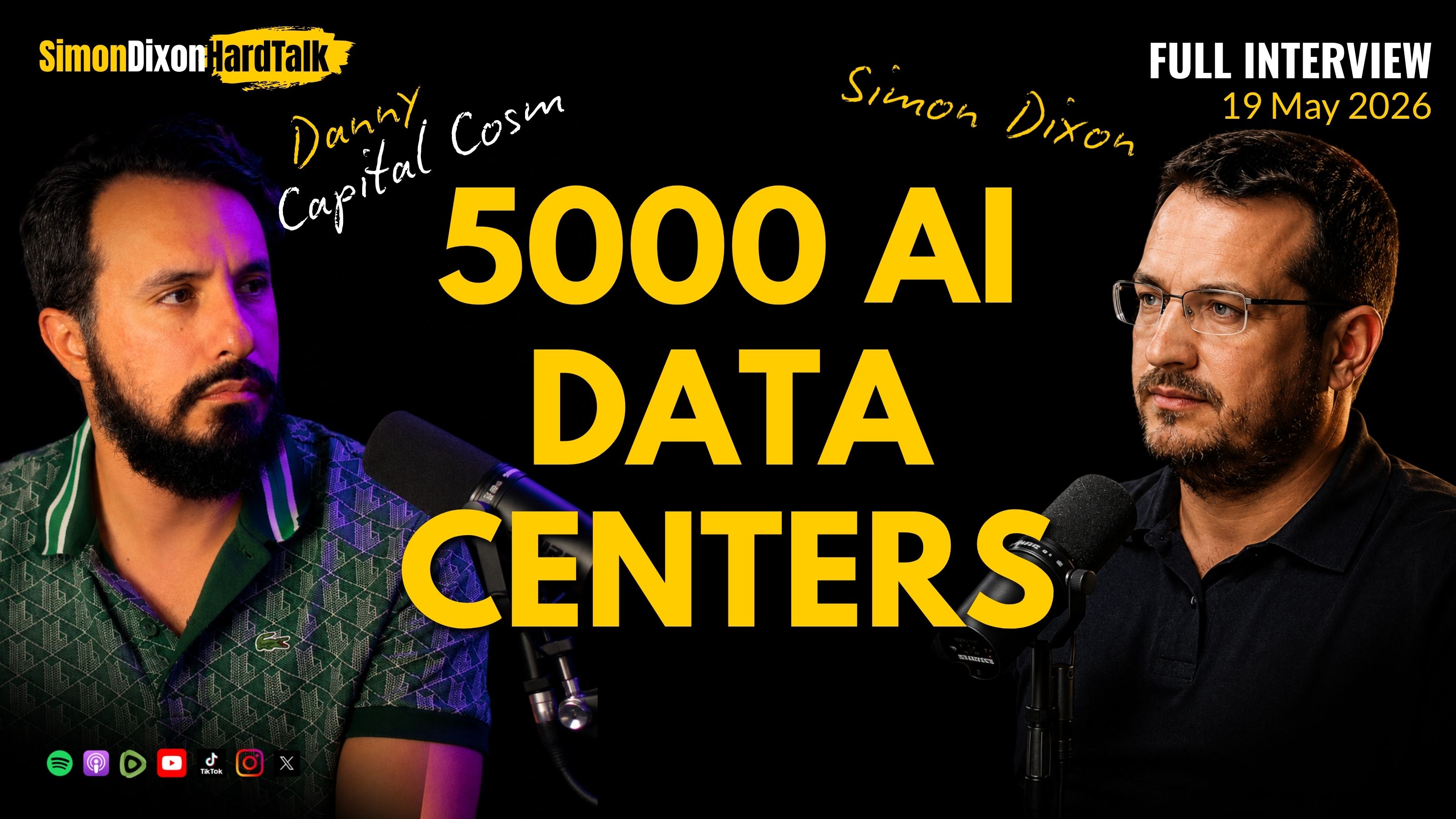
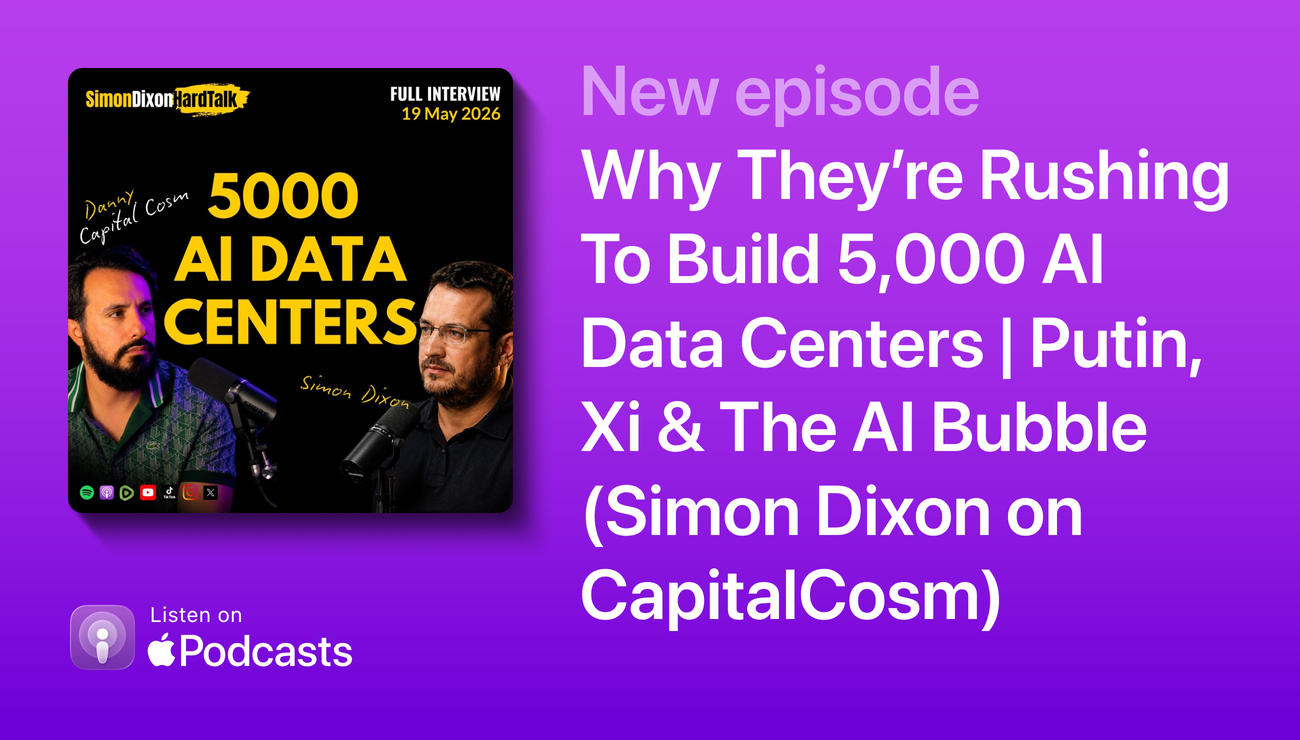
🇨🇳🇷🇺 🇺🇸 Why They’re Rushing To Build 5,000 AI Data Centers | Putin, Xi & The AI Bubble | Danny (CapitalCosm) interviews Simon Dixon
May 22, 2026No time for the full 1h37m video? Watch the AI-generated TL;DR Podcast Style Discussion instead (18m). Or watch the whiteboard explainer — a more visual breakdown of the full discussion (7m).
Executive Summary
This briefing synthesizes an analysis provided by Simon Dixon on May 19, 2026, regarding the rapid expansion of AI data centers and the shifting global power structure. The central thesis posits that the current global volatility—ranging from the closure of the Strait of Hormuz to soaring bond yields—is part of a "managed transition" toward a multipolar world order dominated by a "Technical Industrial Complex" and a "Financial Industrial Complex" (FIC). Key takeaways include:
- The AI Surveillance State: The massive build-out of 5,000 data centers in the U.S. is intended to power a domestic surveillance and "pre-crime" apparatus rather than just commercial AI.
- Economic Engineering: High energy prices and bond market distress are being utilized to justify a "massive print" by the Federal Reserve, facilitating a wealth transfer during a dot-com-style boom and bust involving major AI IPOs (SpaceX, OpenAI).
- Geopolitical Realignment: The U.S. and China are moving toward a symbiotic but multipolar relationship. Traditional concepts of "World War III" are considered impossible due to deep economic and military dependencies.
- Domestic Focus: Simon Dixon rgues that the "Deep State" and elite classes are pivoting to view domestic populations as the primary adversary, utilizing manufactured crises to implement social credit systems and digital IDs.
High-Level Overview
The discussion frames the global landscape not as a series of chaotic, accidental conflicts, but as a coordinated restructuring of power. It examines recent summits between the U.S., China, and Russia as public signals of long-negotiated deals. The overarching theme is the transition from the "Petrodollar" era to a new system based on AI, robotics, and tokenized energy, where transnational capital blocks (like the World Economic Forum and major investment firms) supersede national interests.
Key Arguments Made by Simon Dixon
The AI Infrastructure and Surveillance End-Game
- Purpose of Data Centers: The build-out of 5,000 data centers in the U.S. (compared to 500 in China) is disproportionate to population size. The end result is intended to be a "police and surveillance state" featuring social media scraping, pre-crime arrests based on predicted behavior, and enforcement via robotics.
- Energy as the Driver: There is insufficient energy globally to power this vision, leading to a desperate "war" for energy resources, including LNG and vital minerals.
- Efficiency Mismatch: China’s AI infrastructure (e.g., Huawei, DeepSeek) is portrayed as more efficient and cost-effective, being 100% integrated across hardware and software with zero U.S. dependency.
Geopolitics and the "Managed Transition"
- U.S.-China Dynamics: Recent summits are described as "symbolic rituals" showing the U.S. as a falling superpower and China as a rising one. The guest argues that World War III is a conceptual impossibility because the U.S. military and stock markets are too dependent on China.
- The Strait of Hormuz: The continued closure of the Strait benefits nearly all major players (except perhaps the general public) by keeping energy prices high, which allows for the renegotiation of global contracts and forces Europe into U.S. LNG deals.
- The Role of the FIC: The Financial Industrial Complex (BlackRock, State Street, Vanguard) is hedging against U.S. currency risk by setting up multipolar financial centers in the UAE, Saudi Arabia, and Hong Kong.
Economic "Wealth Transfer" Strategy
- Engineered Crisis: High interest rates (10-year yields at 4.7%) and energy costs are creating a "loop" that will eventually necessitate a massive Federal Reserve intervention ("the big print").
- The AI Bubble: Large-scale IPOs for SpaceX (2 trillion) and OpenAI (1 trillion) are being timed to coincide with market pumps. This is compared to the 1999 dot-com bust, the 2007 financial crisis, and the 1973 energy crisis combined.
- Tokenization: The push for the "Clarity Act" and tokenized securities is seen as a way for custodians to maintain control while giving users "claims" on assets rather than direct ownership.
Domestic Conflict vs. External War
- The Internal Enemy: The guest posits that the "Deep State" uses tactics formerly used abroad to stoke civil unrest within the U.S., UK, and Europe.
- Manufactured Crises: Domestic violence or nationalistic uprisings are viewed as "beta tests" to justify digital IDs, central bank digital currencies (CBDCs), and the expansion of the privatized prison system.
Key Arguments Made by Other Participants
Danny (Host)
- Market Data Points: Highlighted the Thompson Reuters commodity CRB index being up 33% year-to-date and the 10-year yield reaching 4.7% (with the 30-year at 5.19%).
- Infrastructure Disparity: Questioned why the U.S. is building 5,000 data centers while China manages its surveillance grid with only 500.
Donald Trump (Cited via footage/context)
- The "Ballroom" Bunker: Descriptions of a massive underground facility built six stories deep under a ballroom, featuring a military hospital, research facilities, and "sniper capacity." This is framed by the host as evidence of a "military fortress" or bunker for an upcoming conflict.
Points of Agreement and Disagreement
Points of Agreement
- Energy and AI Linkage: Both the host and guest agree that the AI build-out is the primary driver of current global GDP and geopolitical maneuvers.
- Bond Market Distress: Alignment that the current trajectory of bond yields (above 4.5%–5%) represents a "capitulation" point for government debt sustainability.
Points of Disagreement/Clarification
- Timing of Events: Simon Dixon acknowledged he previously "got the timing off" regarding the resolution of the Iran situation, noting that the "manufactured crisis" is being extended to lock in higher-priced energy deals.
- Kinetic War vs. Currency War: While the host questioned if a World War II-style conflict was imminent (citing Trump's bunker), Dixon maintained that the real "war" is internal and financial, rather than external and kinetic.
Important Data, Claims, or References Mentioned
|
Category |
Specific Reference |
|
Financial Figures |
10-year yield: 4.7%; 30-year yield: 5.19%; CRB Index: +33% (5 months). |
|
Valuations |
SpaceX IPO: $2 trillion; OpenAI IPO: $1 trillion. |
|
Infrastructure |
U.S. Target: 5,000 data centers; China Current: 500 data centers. |
|
Key Entities |
BlackRock, State Street, Vanguard, Palantir, Nvidia, Huawei, DeepSeek. |
|
Legislation/Policy |
Clarity Act, Bank Secrecy Act, Patriot Act, Genius Act. |
|
Key Dates |
April 2, 2025 (Tariff policy start); Feb/May 2025 (China stopped buying U.S. LNG/Oil). |
|
Energy Projects |
Power of Siberia 2 (Russia-China); UAE leaving OPEC to join Fed FX swap lines. |
Notable Quotes or Framing
- "Humiliation Ritual": Used to describe Xi Jinping’s positioning of Trump in a lower chair during their meeting.
- "Technical Industrial Complex": Framing the alliance between big tech, intelligence agencies, and the military.
- "Managed Transition": The idea that global chaos is a controlled process to move toward a new world order.
- "The next enemy is the domestic population": Strategic framing of why elites are building surveillance and "sniper capacity" (the ballroom).
- "A bit of a fake narrative": Referring to public focus on fentanyl or nuclear programs while the real deals involve energy and financial rails.
Open Questions or Unresolved Issues
- The July NATO Deadline: It remains unclear if NATO will actually deploy to the Strait of Hormuz if it is not open by July, or if this is a "good cop/bad cop" tactic to force deal-making.
- The "Big Print" Timing: While predicted as inevitable, the exact trigger point for the Federal Reserve to begin massive bond purchases remains speculative.
- Iran's Bitcoin Standard: The discussion left open how Iran's use of nuclear-mined Bitcoin and multi-signature wallets will affect the broader global financial system once the country "opens up."
- The "Ballroom" Complexity: Whether the underground facility described by Trump is for protection against domestic uprising or a precursor to kinetic war remains a point of differing interpretation.
Call to Action
- Share this post. Share this blog post to expose the "divide and conquer" trap.
- Subscribe to the Simon Dixon YouTube channel. Get my weekly deep dives into geopolitics, macro, and Bitcoin. Subscribe to my YouTube channel.
- Find me on Rumble. This is my backup channel, safe from censorship. Follow me on Rumble.
- Follow me on X @SimonDixonTwitt. I post real-time updates and analysis on X and am highly active there. Follow me on X.
- Follow me on instagram. Usually short clips are posted here.
- Follow me on TikTok. Usually short clips are posted here.
- SimonDixon.com. This is my personal site and an archive of all my content, safe from de-platforming. Join the free membership portal.
Watch on YouTube
Prefer to Listen? Available on Spotify & Apple Podcasts
Read Other Related Blogs
Disclaimer
The content provided in this blog post is for informational and educational purposes only and does not constitute legal or financial advice.
As explicitly stated in the sources, the analysis of alternative financial systems and international trade routes does not constitute sanction circumvention legal advice. There are serious, severe legal consequences for violating international sanctions laws, which can include imprisonment. The information discussed is solely intended to explain the parallel financial and technological infrastructures that are currently being built globally.
Furthermore, any discussion regarding bond yields, upcoming IPOs, or macroeconomic trends is not investment advice. The speaker specifically cautioned against using this analysis to "start pumping into stocks," warning that market reactions to geopolitical events and technological build-outs could easily result in volatile "buy the rumor, sell the news" events. Please conduct your own due diligence before making any financial decisions.