🇺🇸 They're Deliberately Winding Down America — Here's the Plan for What Comes Next | Simon Dixon on Impact Theory w/ Tom Bilyeu
Jun 18, 2026Executive Summary
The following briefing synthesizes a deep-dive discussion featuring Simon Dixon on the hidden power structures governing global affairs. The central thesis posits that the West is not governed by democratic processes but by a hierarchy of transnational "industrial complexes"—Financial (FIC), Military (MIC), and Technological (TIC)—that operate above the level of nation-states. These entities utilize debt-based monetary systems (described as Ponzi schemes) to extract resources, consolidate wealth, and subordinate populations.
Critical takeaways include:
- The Primacy of Finance: The Financial Industrial Complex sits at the apex, controlling the creation of fiat currency and the movement of global capital.
- Politicians as Actors: Elected officials are framed as "WWE actors" whose role is to provide acceptable narratives for the extraction of wealth by private corporate interests.
- Managed Transition: The global elite are currently managing a multi-decade transition away from a U.S.-centric world toward a "multipolar" order, integrating with China and the Gulf states while asset-stripping the West.
- Technological Subjugation: Emerging technologies (AI, surveillance, and "Genocide as a Service") are tested in conflict zones like Palestine before being deployed domestically in the West.
- The Sovereign Exit: Bitcoin is identified as the primary technological off-ramp from this system, provided it is held in self-custody rather than through centralized financial "wrappers" like ETFs.
High-Level Overview
The discussion frames the current state of the world as a "theatrical moment" defining the end of the American empire and the transition to a New World Order. The dialogue deconstructs the illusion of democracy, arguing that political "left versus right" dynamics are distractions from a ruthless, top-down hierarchy of power. This hierarchy thrives on a cycle of debt, war, and rebuilding, where human populations are treated as collateralized debt obligations. The conversation moves from the mechanics of central banking to the geopolitical significance of regional conflicts (Israel, Iran) and concludes with a strategic path toward individual sovereignty.
Key Arguments Made by Simon Dixon
The Hierarchy of Power Complexes
- The Financial Industrial Complex (FIC): Sits at the top of the pyramid. It controls the creation of fiat currency and global capital flows, subordinating both the military and technology sectors which require access to capital.
- The Military-Industrial Complex (MIC): A group of companies (e.g., Lockheed Martin, Palantir, Boeing) that require continual revenue from war and defense contracts. Their quarterly earnings can be used to predict future war zones.
- The Technological Industrial Complex (TIC): Comprises major firms (the "Magnificent Seven") that control data centers, algorithms, and neo-media. It is subordinate to finance but essential for engineering public narrative and surveillance.
The Debt-Based Ponzi Scheme
- Money Creation: Money is created by private commercial banks as credit/debt. Because it must be repaid with interest that was never created, the system requires infinite growth or constant rolling over of debt to avoid collapse.
- The Federal Reserve: Owned by private banks, not the government. The bigger the Fed's balance sheet (government debt), the more dividends the member banks receive.
- Fiscal Dominance: The government acts as a "piggy bank" for bondholders, using debt to prop up stock markets and specific corporate contracts.
Geopolitical "Nodes" and Narratives
- Israel as a Military Node: Argues Israel was created as a strategic node for the MIC to destabilize the Middle East and ensure control over oil. It serves as a laboratory for testing extreme surveillance and killing technologies (e.g., "Lavender" AI) that are later sold globally.
- The Iran Strategy: Claims the historical and current focus on Iran is about controlling oil and preventing regional independence. Operations involve destroying the Iranian currency to force civilian uprisings.
- The Managed Decline of the West: The FIC is "asset-stripping" the West (U.S., UK, Europe) because the populations are maxed out on debt, show declining birth rates, and are increasingly dissatisfied.
Individual Sovereignty and Bitcoin
- The Political Illusion: There is no political solution in the West; lobbies choose and groom candidates (e.g., JD Vance) long before they reach the national stage.
- Bitcoin as an Exit: Bitcoin allows individuals to own money without a bank and spend without permission. It is the only way to sit outside the "compromised networks" of the FIC.
- Self-Custody vs. Wall Street: Warns that ETFs (BlackRock) and "Wall Street wrappers" are attempts by the FIC to pull Bitcoin back into a debt-based, centralized control grid.
Key Arguments Made by Other Participants (Tom Bilyeu)
The Coordination Problem
- Human Nature: Questioned how such a high level of global coordination is possible among elites. Using the TV show Succession as an analogy, Bilyeu argued that the "narcissistic, hyper-aggressive" nature of powerful people usually leads to internal infighting and betrayal rather than seamless cooperation.
- The "Swarm of Locusts": Used the metaphor of a "swarm of locusts" to describe how wealth is extracted from one region before the power structure moves to the next.
The Role of the Masses
- The Power of Exposure: Argued that "the people" hold power through their potential to "tear apart" compromised leaders if their secrets are exposed.
- Information Velocity: Suggested that social media and the volume of available information allow for an "age of waking up," where individuals can find a meaningful voice.
The Utility of Debt
- Productive Debt: Contested the idea that all interest/debt is bad, noting that debt can be "awesome" when used as a tool to build and grow society.
Points of Agreement
- The Illusion of Choice: Both participants acknowledged that the current political narrative often serves as "bread and circus" to distract the public while resources are consolidated.
- The Power of Narrative: Agreement that politicians are primarily performers whose job is to "make up a narrative" to justify actions taken on behalf of lobbies.
- BlackRock’s Dominance: Recognition of BlackRock as a massive, centralized node of power that manages global scenario planning through its "Aladdin" technology.
- The Existential State of the West: Alignment on the observation of "K-shaped" economies, where wealth concentrates at the top while the majority of the population faces declining purchasing power and rising "deaths of despair" (suicide).
Points of Disagreement
- Cooperation vs. Conflict: Bilyeu emphasized the likelihood of internal wars between the complexes (FIC vs. TIC vs. MIC), while Dixon argued that the "architecture" of the system and mafia-like hierarchies preserve the overall structure regardless of individual power plays.
- Morality of Interest: Dixon expressed an ideological opposition to interest-based systems (usury), preferring profit-sharing or equity. Bilyeu maintained that debt is a necessary and potentially positive economic driver.
- Satoshi’s Origin: While Dixon presented a detailed theory that Bitcoin was a rogue breakaway intelligence operation by Len Sasserman, Bilyeu remained in a position of inquiry, testing the logic of how and why such an operation would be open-sourced.
Important Data, Claims, or References Mentioned
|
Category |
Specific References |
|
Corporations |
Lockheed Martin, General Dynamics, Raytheon, Boeing, BAE Systems, BlackRock, Palantir, State Street, Vanguard. |
|
Technology/AI |
Aladdin: BlackRock’s scenario-planning AI. Lavender: AI used for targeting in Gaza. XAI: Elon Musk's AI initiative. |
|
Historical Events |
1917: Balfour Declaration & Bolshevik Revolution. 1953: Operation Ajax (Iran coup). 2008: Global Financial Crisis/Bailouts. |
|
Key Individuals |
Larry Fink (BlackRock), Peter Thiel (TIC/Palantir), JD Vance (Groomed politician), Len Sasserman/Hal Finney (Satoshi candidates), Jeffrey Epstein (Compromat network). |
|
Economic Concepts |
Usury: Interest-based subordination. Petrodollar: The system propping up U.S. debt. Japan Carry Trade: A mechanism for funding U.S. debt. |
|
Geopolitical Entities |
GCC: Gulf Cooperation Council. BRICS: Emerging block led by China/Russia. The "Great Wall of China": Metaphor for Chinese capital controls. |
Notable Quotes or Framing
- On Politicians: "I see politicians as actors, WWE actors. Their job is to create an acceptable narrative to justify why all of the money is serving a smaller group of private corporate interests."
- On War: "More profitable is war and less profitable is defense contracts... quarterly earnings give you clues as to where the next war zone will be."
- On the System: "The government is just another form of bondholder really, because it’s just a piggy bank for bondholders."
- On Israel/Palestine: "It is a laboratory for the technology that America cannot test...I call what they’re doing in West Bank 'Occupation as a Service.'"
- On the FIC: "The Financial Industrial Complex doesn't care what happens; they're just doing bank the whole way. Killing people is not a concept that they care about."
- On Personal Power: "They don’t mind you having freedom of speech and no money and deep in debt... what they don’t like is wealthy people with no debt... that have assets that sit outside the system."
Open Questions or Unresolved Issues
- The Survival of China: If China has successfully insulated itself from Western corporate "complexes," will it eventually be forced to integrate, or will it remain a completely separate, authoritarian alternative?
- The "Straight of Hormuz" Event: The potential for a "theatrical" closure of the Straight of Hormuz to act as the "Suez Canal moment" for the American Empire—marking the official end of U.S. naval/economic dominance.
- The Fate of the Dollar: How long can the U.S. maintain "fiscal dominance" before the inability to find buyers for its debt leads to a terminal collapse rather than a managed transition?
- Satoshi’s True Intent: If Bitcoin was an intelligence operation that went "rogue" through open-sourcing, what was the original intended purpose for the technology?
About Tom Bilyeu

Tom Bilyeu is an American entrepreneur, media executive, and business commentator best known as the co-founder of the health food brand Quest Nutrition and the digital media studio Impact Theory. After building and exiting his operational role at Quest Nutrition prior to its corporate acquisition, he transitioned into digital media to focus on broad-scale content production. Through Impact Theory, he acts as a broadcaster hosting long-form discussions, deep-dive interviews, and structured debates with public-facing subject matter experts across multiple sectors. His content primarily focuses on analyzing macroeconomic trends, banking infrastructure, and digital asset markets, alongside exploring developments in artificial intelligence, corporate enterprise, and organizational strategy.
Watch interview on Impact Theory YouTube channel
Call To Action
- Watch the 3-minute clip: “I’ve Been in Bitcoin Since the Beginning. Here’s Who I Think Satoshi Nakamoto Is.”
- Watch the full 2-hour 21-minute interview on Impact Theory: “They're Deliberately Winding Down America — Here's the Plan for What Comes Next.”
- Share this post. Share this blog post to expose the "divide and conquer" trap.
- Subscribe to the Simon Dixon YouTube channel. Get my weekly deep dives into geopolitics, macro, and Bitcoin. Subscribe to my YouTube channel.
- Find me on Rumble. This is my backup channel, safe from censorship. Follow me on Rumble.
- Follow me on X @SimonDixonTwitt. I post real-time updates and analysis on X and am highly active there. Follow me on X.
- Follow me on instagram. Usually short clips are posted here.
- Follow me on TikTok. Usually short clips are posted here.
- SimonDixon.com This is my personal site and an archive of all my content, safe from de-platforming. Join the free membership portal.
No time for the full 2h19m video? Watch the AI-generated TL;DR Podcast Style Discussion instead. Or watch the whiteboard explainer — a more visual breakdown of the full discussion.
Watch on YouTube
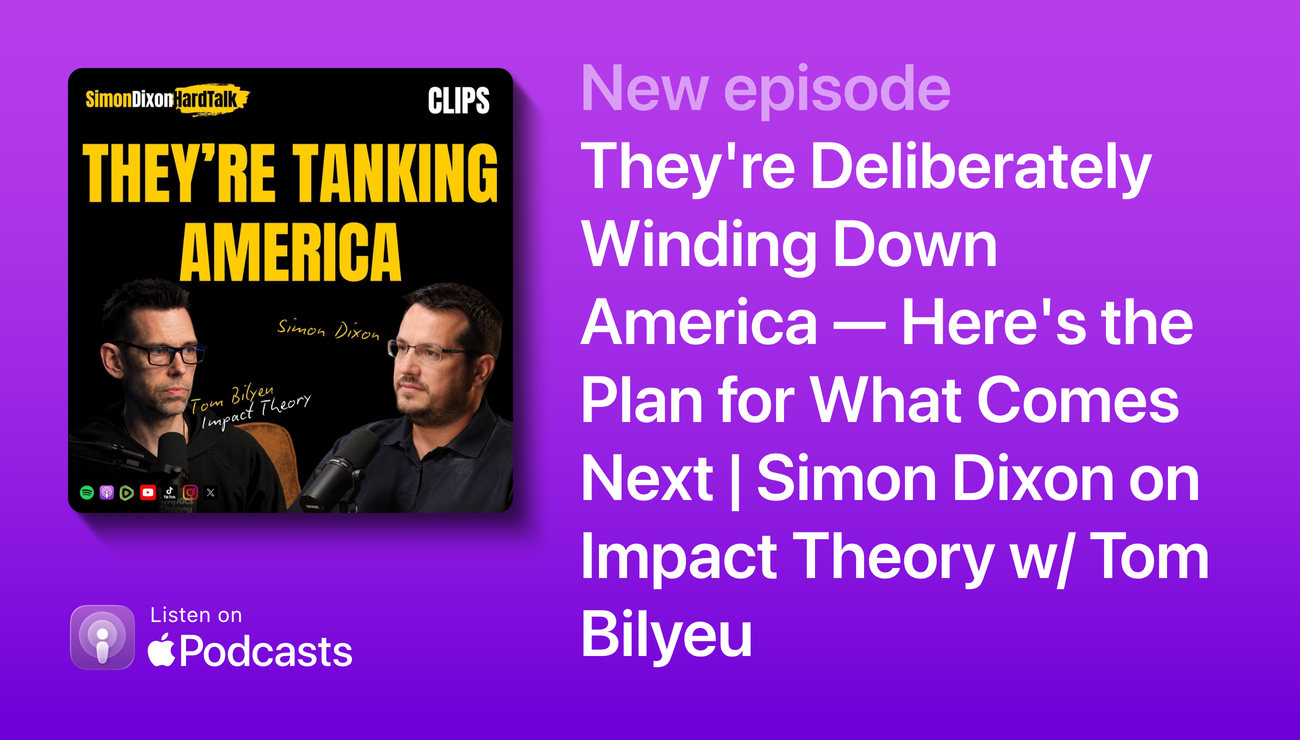
Prefer To Listen? Available on Spotify & Apple Podcasts
Disclaimer
This interview and accompanying blog post are for educational, informational, and entertainment purposes only. The views, theories, and opinions expressed by Simon Dixon and Tom Bilyeu are entirely their own and should not be considered financial, investment, legal, tax, or professional advice.
Discussions regarding macroeconomic trends, global power structures (such as the Financial, Military, and Technological Industrial Complexes), Bitcoin, gold, central banking, fiat currency systems, debt markets, jurisdictional arbitrage, and individual sovereignty are theoretical and reflect personal analysis. Nothing in this content should be interpreted as a recommendation or endorsement to buy, sell, hold, or otherwise act on any specific financial asset or strategy.
Any references to legal, tax, or jurisdictional matters—including strategies for moving assets outside of traditional financial systems—are for general discussion only and are not intended to encourage or facilitate the avoidance of laws, regulations, or tax obligations. Viewers and readers should seek independent advice from qualified financial, legal, and tax professionals before making any decisions.
This episode also explores hypothetical thought experiments about geopolitical transitions, historical events, and economic structures. These discussions are not calls to action. Digital assets like Bitcoin and alternative financial structures involve significant inherent risk, including the potential loss of capital.
By engaging with this content, you acknowledge that Simon Dixon, Tom Bilyeu, Impact Theory, and their affiliates are not liable for any financial losses, damages, legal consequences, or other outcomes resulting from reliance on the information, opinions, or theories presented in this interview.