Amir Taaki Reveals: Epstein Contact & Attempts to Compromise Bitcoin Developers
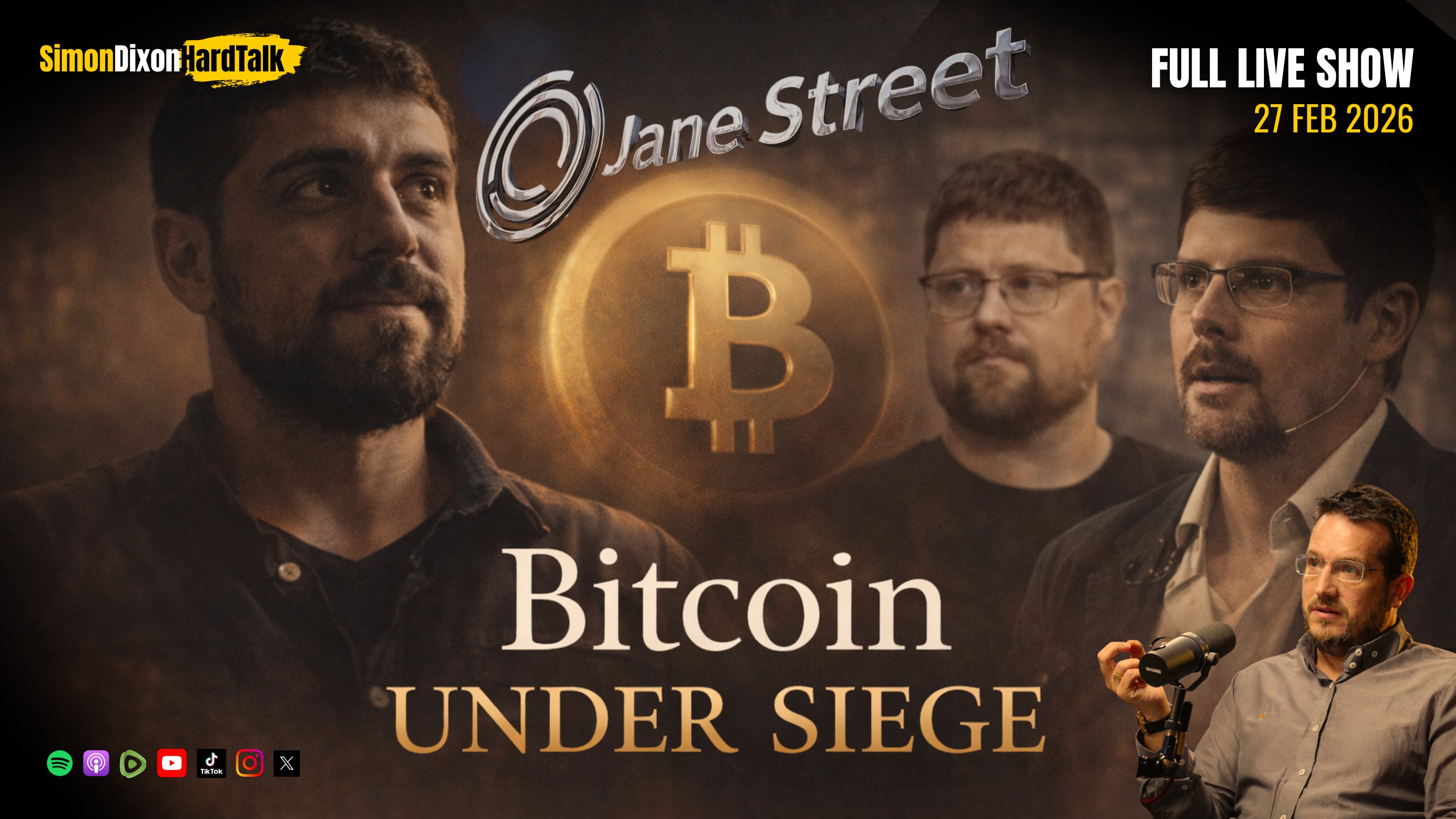
Feb 27, 2026No time for the full 1h57m video? Watch the 21-minute AI-generated TL;DR Podcast Style Discussion instead. Or watch the 9-minute Ai generated Whiteboard Explainer Video.
Hey hey Sovereign Wealth Builders,
This blog summarizes an investigation on a significant episode of "Simon Dixon Hard Talk Live" that aired on February 17, 2026. For nearly two hours, I sat down with my co-host Sulaiman Ahmed and one of Bitcoin’s most controversial and brilliant pioneers, Amir Taaki. As an early developer who spearheaded privacy-focused technologies like Dark Wallet and pioneered the Bitcoin Improvement Proposal process, Amir’s history is inextricably linked to the early attempts by state actors and high-level predators to compromise the foundational layer of our digital sovereignty.
Before we dive into the technical and geopolitical depths of this conversation, I must address the importance of factual authenticity. During the initial broadcast, I found it necessary to offer a public correction regarding Amir’s history. In a previous interaction, I had misread a communication and inadvertently suggested that Amir had admitted to receiving funding from the late Jeffrey Epstein. This was a factual error on my part, and as a champion for sovereign wealth builders, I believe our narrative must be grounded in an authentic representation of the facts. Amir has explicitly denied receiving such funding, and it is vital to clear the record before we analyze the very real attempts at infiltration that occurred during Bitcoin's infancy. For any capital allocator, understanding how these early layers were tested by intelligence agencies and predatory networks is not just historical curiosity; it is a prerequisite for understanding the modern war on financial privacy.
The discussion opened with a startling look at the Epstein files, which document the predator’s attempts to contact the "Bitcoin guys" as early as 2011. To put this in a macro context, Bitcoin was virtually worthless at the time, yet Epstein was already circling. The records reveal an email dated June 12, 2011, where Epstein tells Amir that "the Bitcoin idea is brilliant." This interaction was allegedly facilitated by venture capitalist Jason Calacanis, who had previously hosted Amir and Gavin Andresen on his podcast. Interestingly, while Calacanis initially appeared supportive, later communications reportedly showed him warning Epstein that these developers were "bad news," "radical," and "crazy open-source folks" whose motivations aligned more with WikiLeaks than with Silicon Valley corporate culture. This reveals a strategic inquiry: was Epstein exploring money laundering, acting as a talent scout for intelligence purposes, or attempting to infiltrate the burgeoning cypherpunk movement?
A primary point of contention during the interview was the interpretation of Epstein’s "brilliant" comment. Sulaiman Ahmed pushed back with a skeptical lens, arguing that such high praise logically implies a prior pitch or direct engagement that has not yet come to light. Amir defended the interaction as a cold reach-out regarding the general concept of the technology, which was still a fringe idea. However, the logistical inconsistencies regarding Amir’s co-founder, Donald Norman, added another layer of mystery. Amir recalled that Norman traveled to meet Epstein, possibly on his private island, to explore potential banking or funding connections for their exchange, Interango. While an email from Epstein suggested a meeting in New York with a "tonight or tomorrow" timeline—making a trip to the island logistically improbable for a short-notice meeting—Amir maintained that Norman returned with a harrowing warning. Norman reportedly identified Epstein as "bad news" involving "pedo stuff," leading the team to immediately sever all ties. This early encounter serves as a chilling reminder that the decentralized movement was targeted by high-level predators long before it reached the mainstream.
This period of Bitcoin’s history was defined by a profound ideological schism that still echoes through the halls of modern finance. On one side was Gavin Andresen, whom Satoshi Nakamoto had reportedly designated as the project’s lead. According to Amir, Andresen viewed Bitcoin as a "corporate startup" that needed to be sanitized for integration with big banks and regulatory frameworks. On the other side stood Amir and the radical cypherpunks, who viewed Bitcoin as "open-source project freedom money"—a tool for hard-coded liberty that should never seek permission from the legacy system. This split eventually led to what Amir describes as the "corporate hijacking" of the space via the Bitcoin Foundation. When the Foundation hosted its 2013 conference under the banner of "Bitcoin Payments Innovation," it was interpreted as a direct betrayal of the project’s libertarian and privacy-focused roots.
This ideological battle was the catalyst for Amir’s work on privacy-enhancing technologies like CoinJoin and stealth addresses. These were not merely technical features; they were defensive weapons against the encroaching surveillance of the state and the corporate capture of the development process. For the sovereign individual, this tension highlights a recurring macro theme: the constant pressure to sacrifice individual privacy for the sake of institutional acceptance. Amir’s team responded by forking the project, essentially drawing a line in the sand between those who wanted to build a new financial system and those who wanted to become a subservient layer of the old one.
The interview then took a darker turn as we analyzed the alleged infiltration of the development community by intelligence agencies. A central figure in this narrative is Peter Todd, the former chief scientist of the Dark Wallet project. Amir synthesized claims based on leaked email archives suggesting that Todd was in secret communication with an individual named "John Dillon," who reportedly identified himself as a member of US intelligence. This collaboration allegedly served to sabotage the funding for privacy-focused projects through the manipulation of the CoinJoin bounty fund.
Amir provided granular detail on the "John Dillon" mechanism, a sophisticated operation of financial and social engineering. According to the account, Dillon created a Bitcoin address and coordinated with Todd to recycle funds, allowing Dillon to appear as the majority donor to the bounty fund. This allowed the alleged intelligence asset to retroactively change the rules of the bounty, objecting to Amir’s team receiving the payout despite their delivery of a functioning prototype. This strategic denial of resources was interpreted as a deliberate effort by state actors to stifle the development of anonymity tools. It is a cautionary tale of how "naivety," as seen in Gavin Andresen’s 2011 visit to the CIA, can be weaponized. Amir reflected on the HBO documentary’s attempt to label Peter Todd as Satoshi Nakamoto as a potential distraction or misdirection, taking the evidence of Todd being a potential "agent" and repurposing it into a "Satoshi" narrative to confuse the public record. In Amir’s view, candidates like Paul Le Roux or Dorian Nakamoto remain far more plausible for the true identity of the creator.
The conversation eventually shifted from the digital trenches to the physical battlefields of Syria, where Amir spent three and a half years fighting with the YPG/SDF. Far from being a departure from Bitcoin, Amir framed this as a continuation of the struggle for decentralized, democratic civilizations. He explained the ideology of "Democratic Confederalism," a theory developed by Abdullah Öcalan that argues the Western nation-state model is a colonial import ill-suited for the Middle East. This model, he suggested, relies on the erasure of local identities and authoritarianism to maintain power. Amir saw the YPG’s project in Rojava as a real-world experiment in decentralized economics and political autonomy, akin to the principles that govern the Bitcoin protocol.
The geopolitical complexity of this era cannot be ignored. Sulaiman Ahmed critiqued the YPG for acting as a proxy for the US Department of Defense (DoD), particularly in guarding Syrian oil. Amir defended the movement’s pragmatism, noting that in a region where "pragmatism rules," survival often requires temporary and uncomfortable alliances. He recounted a striking story of a UK soldier who had defected to the YPG and was taking selfies for the Daily Mail. Almost instantly, blacked-out vehicles arrived at their unit, and suit-wearing agents—likely CIA—extracted the soldier by force. This story serves as a visceral reminder that intelligence agencies were actively managing the personnel on the ground in Syria.
Perhaps the most profound insight regarding the state’s true nature came from the legal treatment of returning fighters. Amir pointed out a startling statistical signal: roughly 25% of returning YPG fighters faced terrorism investigations or charges in the UK, compared to a reported 3% of returning ISIS members. This suggests that the state perceives ideological revolutionaries—those fighting for decentralized, autonomous political structures—as a far more existential threat than manufactured extremist groups. Amir himself was placed under house arrest for a year during a terrorism investigation, despite his actions being directed against a group universally recognized as a threat to global security.
There is a direct, undeniable line from the historical attempts to oppress Dark Wallet to the current legal crusade against Samourai Wallet and Tornado Cash. The government’s continued targeting of anonymity software—while simultaneously legalizing "shitcoin casinos"—is a signal that the state identifies financial privacy as the "final boss battle" in the war for control. For those of us focused on sovereign wealth, privacy technology is not a tool for illicit activity; it is a fundamental requirement for individual liberty.
The targeting of these developers is an attempt to frighten the community into compliance. However, the lessons from Amir Taaki’s journey suggest that the most impactful resistance lies in the uncompromising pursuit of hard-coded liberty. The "corporate capture" of Bitcoin did not end with the Bitcoin Foundation; it merely evolved into more sophisticated forms of institutional pressure. As capital allocators and sovereign individuals, we must remain vigilant against the constant threat of infiltration and stay steadfast in the defense of the technologies that enable true financial and individual freedom.
CONCLUSION
In conclusion, the strategic takeaways from this nearly two-hour deep dive are clear: we must prioritize verified facts over convenient narratives, recognize the persistent threat of institutional capture, and refuse to compromise on privacy. Amir Taaki’s transparency during the interview, despite his controversial past and his time in a war zone, invites us to review the data ourselves and form our own conclusions. The path to sovereignty is not a passive one; it requires an active defense of the tools that keep our wealth and our identities beyond the reach of those who seek to compromise them.
Interview Summary
Here is the comprehensive bullet-point summary of the interview:
High-Level Overview
- Topic: The interview investigates early Bitcoin developer Amir Taaki’s historical connections to Jeffrey Epstein, early ideological conflicts within Bitcoin development, and Amir's past controversies.
- Framing: The discussion acts as a critical fact-finding session where the hosts present primary documents (emails, forum posts) to Amir Taaki, asking him to explain inconsistencies and address serious allegations regarding his past associations and actions.
- Secondary Themes: The conversation extensively covers the ideological split in early Bitcoin between corporate integration and cypherpunk privacy, Amir's time fighting alongside the YPG in Syria, and allegations of US intelligence infiltrating the crypto space.
Key Arguments Made by Simon Dixon
- Authenticity and Fact-Correction: Simon emphasized the macro importance of factual accuracy, publicly apologizing for a previous error where he claimed Amir admitted to taking Epstein's funding. Simon framed this by stating, "It's important to use the facts to build whatever narrative, but also like the facts are represented authentically".
- Epstein’s Motives in Crypto: Simon explored the macro argument of why Epstein wanted to meet Bitcoin developers, questioning if Epstein was acting as a venture capitalist, exploring money laundering avenues, or trying to infiltrate the community.
- Logistical Inconsistencies in the Epstein Meeting: Simon challenged Amir's narrative regarding his co-founder Donald Norman's meeting with Epstein. He pointed out the specific logistical flaw: if Norman was in New York and Epstein suggested meeting "tonight or tomorrow," it strongly implies a meeting in New York, not a hastily arranged flight to Epstein's private island.
- Questioning Intelligence Infiltration: Simon specifically questioned whether early Bitcoin lead developer Gavin Andresen was an asset or "turned by the CIA," noting that Satoshi Nakamoto left the project right after Andresen visited the CIA, and that Andresen later vouched for Craig Wright.
- Contrasting Government Treatment of Crypto Devs: Simon highlighted a macro hypocrisy in the current political climate, noting the Trump administration pardoned many in the crypto space but actively kept privacy-focused Samurai Wallet developers in prison, using this to emphasize the government's crusade against anonymity software.
Key Arguments Made by Other Participants
- Amir Taaki (On Jeffrey Epstein):
- Claimed he never met Jeffrey Epstein in real life; his interactions were limited to a few emails in 2011.
- Stated his business co-founder, Donald Norman, attended a brief meeting with Epstein (which Amir believes was on Epstein's island) and immediately killed the deal, warning Amir that Epstein was "bad news" and involved in "pedo stuff".
- Argued that Epstein's email stating "the Bitcoin idea is brilliant" referred to the general concept of Bitcoin (which was obscure in 2011), not a specific business pitch Amir made prior.
- Amir Taaki (On the 2011 Bitcoin Talk Forum Post):
- Claimed his 2011 post offering 16-year-old boys and girls for Bitcoin was a "stupid troll joke" and a "hustle" to scam people out of Bitcoin, vehemently denying that he was actually engaged in human trafficking.
- Amir Taaki (On Bitcoin Intelligence Infiltration):
- Argued that Gavin Andresen attempted a "corporate takeover" of Bitcoin to appease banks, showing immense political naivety by voluntarily meeting with the CIA and regulators.
- Claimed former friend Peter Todd actively collaborated with a US intelligence agent (John Dillon) to sabotage funding for their privacy project, Dark Wallet, and that HBO's recent documentary twisted this evidence to falsely label Todd as Satoshi Nakamoto.
- Sulaiman Ahmed (Host - Rebuttals & Pressure):
- Argued that Epstein's wording ("Amir, the Bitcoin idea is brilliant...") unequivocally implies there was prior communication or a pitch between the two men.
- Deconstructed Amir's defense of his forum post, arguing that the pricing logic (20 BTC for one person, 50 BTC for two) and specific operational details prove it was a thought-out service, not a random, thoughtless joke or a simple scam.
- Challenged Amir's view of his time in Syria as purely "virtuous," pointing out that the YPG/SDF was directly financed and supported by the US Department of Defense (Pentagon), operating as a proxy force.
Points of Agreement
- Factual Corrections: Amir and Simon explicitly agreed that Simon had previously misread Amir's tweet regarding Epstein funding, and Amir accepted Simon's clarification and apology.
- ISIS as a Western Construct: Both Amir and Sulaiman agreed that the rise of ISIS in Syria was heavily tied to, or manufactured by, Western intelligence operations (CIA/Mossad) to destabilize the region.
- Naivety of Early Bitcoin Devs: All participants aligned on the view that Gavin Andresen and Charlie Shrem exhibited extreme naivety by voluntarily approaching three-letter agencies and regulators, which ultimately harmed the cypherpunk movement.
Points of Disagreement
- The Meaning of Epstein's First Email: Sulaiman strongly maintained the email implies prior engagement; Amir insisted it was a cold reach-out discussing the general concept of Bitcoin.
- The Intent of the 2011 Forum Post: Sulaiman argued the post's coherent structure indicates actual intent to traffic or provide a service. Amir continuously framed it as a contradictory mix of an edgy "shitpost," a joke, and a scam to get free Bitcoin.
- Location of the Epstein Meeting: Simon found it highly illogical that Donald Norman met Epstein on his private island given the tight "tonight or tomorrow" timeline from New York; Amir vaguely maintained his belief that the meeting happened on the island.
- Morality of the YPG Alliance: Sulaiman argued that serving alongside a DoD-funded group compromises the "virtuous" nature of Amir's deployment; Amir defended the Kurds' ideological autonomy and necessity for survival.
Important Data, Claims, or References Mentioned
- Jason Calacanis: Allegedly emailed Jeffrey Epstein in early 2011 warning him that Amir Taaki and Gavin Andresen were "bad news" and "radical" open-source folks.
- Dates of Epstein Emails: The earliest mentioned email from Epstein to Jason Calacanis is from April/June 2011. Epstein emails Amir directly on June 12, 2011.
- Bitcoin Consultancy / Interango: The UK-based companies run by Amir Taaki and Donald Norman in 2011/2012, which faced heavy banking blockades.
- The Dark Wallet / CoinJoin Bounty: Amir claims Peter Todd and Gregory Maxwell retroactively changed the rules of a CoinJoin bounty to prevent Amir's team from receiving funds, allegedly using an intelligence asset named John Dillon.
- Syrian Conflict Stats: Amir claimed 25% of returning YPG fighters faced terrorism charges in the UK, compared to only 3% of returning ISIS members.
- Paul Le Roux / Dorian Nakamoto: Amir's personal guesses for the true identity of Satoshi Nakamoto.
Notable Quotes or Framing (For Simon's Reuse)
- On Accuracy: "Most people don't go check out the source info... So that's why it's important to use the facts to build whatever narrative, but also like the facts are represented authentically."
- On the Epstein Timeline: "When someone's in New York and they said, 'I'll see you tomorrow.'... What makes you think they met on the island?"
- On Gavin Andresen: "Satoshi left the project when he joined the CIA... Do you have any opinion on Gavin Andresen and whether he was ever turned by the CIA?"
Open Questions or Unresolved Issues
- Donald Norman's Experience: It remains unknown what exactly Donald Norman discussed with Jeffrey Epstein, where the meeting definitively took place, and what specific "pedo stuff" he witnessed or learned that caused him to immediately kill the deal.
- The Missing Forum DMs: It was left unresolved whether Amir actually received funds or engaged in transactions via the 2011 Bitcoin Talk forum post, pending potential future access to the account's direct messages.
- Prior Epstein Communications: The debate did not resolve whether there are missing emails or prior communication channels between Amir and Epstein before the June 12th email.
- The Fate of the Defected UK Soldier: Amir told a story of a UK soldier who defected to the YPG, only to be forcefully extracted by alleged CIA agents in blacked-out vehicles. The soldier's fate remains unknown.
I invite you to watch the full "Simon Dixon Hard Talk Live" interview for the complete, unedited context of these revelations. The raw data provided in the nearly two-hour discussion offers a level of nuance that no essay can fully capture. Subscribe to my YouTube and Rumble channels for more investigations into the intersection of macro finance and decentralized tech. Follow me on X for real-time analysis, and share this post with other Sovereign Wealth Builders who value truth and financial autonomy.
Call To Action
If you’re ready to stop being a victim of the "Proof of Weapons" network, join the movement:
- Share this post. Share this blog post to expose the "divide and conquer" trap.
- Subscribe to the Simon Dixon YouTube channel. Get my weekly deep dives into geopolitics, macro, and Bitcoin. Subscribe to my YouTube channel.
- Find me on Rumble. This is my backup channel, safe from censorship. Follow me on Rumble.
- Follow me on X @SimonDixonTwitt. I post real-time updates and analysis on X and am highly active there. Follow me on X.
- Follow me on instagram. Usually short clips are posted here.
- Follow me on TikTok. Usually short clips are posted here.
- SimonDixon.com. This is my personal site and an archive of all my content, safe from de-platforming. Join the free membership portal.
Watch on YouTube
Prefer to Listen? Available on Spotify & Apple Podcasts
Read other related blogs

Disclaimer
The content of this article is for informational and educational purposes only and does not constitute financial, legal, or investment advice. All mentions of individuals acting as "agents," "assets," or participating in "compromise"—specifically regarding Gavin Andresen, Peter Todd, or individuals like "John Dillon"—are based on interpretations of the provided source materials, including interview transcripts and referenced email archives. These claims have not been adjudicated in a court of law and are to be treated as analysis and personal accounts, not as settled legal facts. The discussions regarding geopolitical conflicts and legal allegations are summarized from the perspective of the interview participants. Readers are encouraged to conduct their own due diligence and verify all information through primary sources. Neither the author nor the platform assumes liability for any actions taken based on the information presented herein.