Are The Elite Trying To Destroy The World...On Purpose? | Simon Dixon & Simon Michaux
May 01, 2026No time for the full 1h39m video? Watch the AI-generated TL;DR Podcast Style Discussion instead (26 mins). Or watch the whiteboard explainer — a more visual breakdown of the full discussion (6 mins).
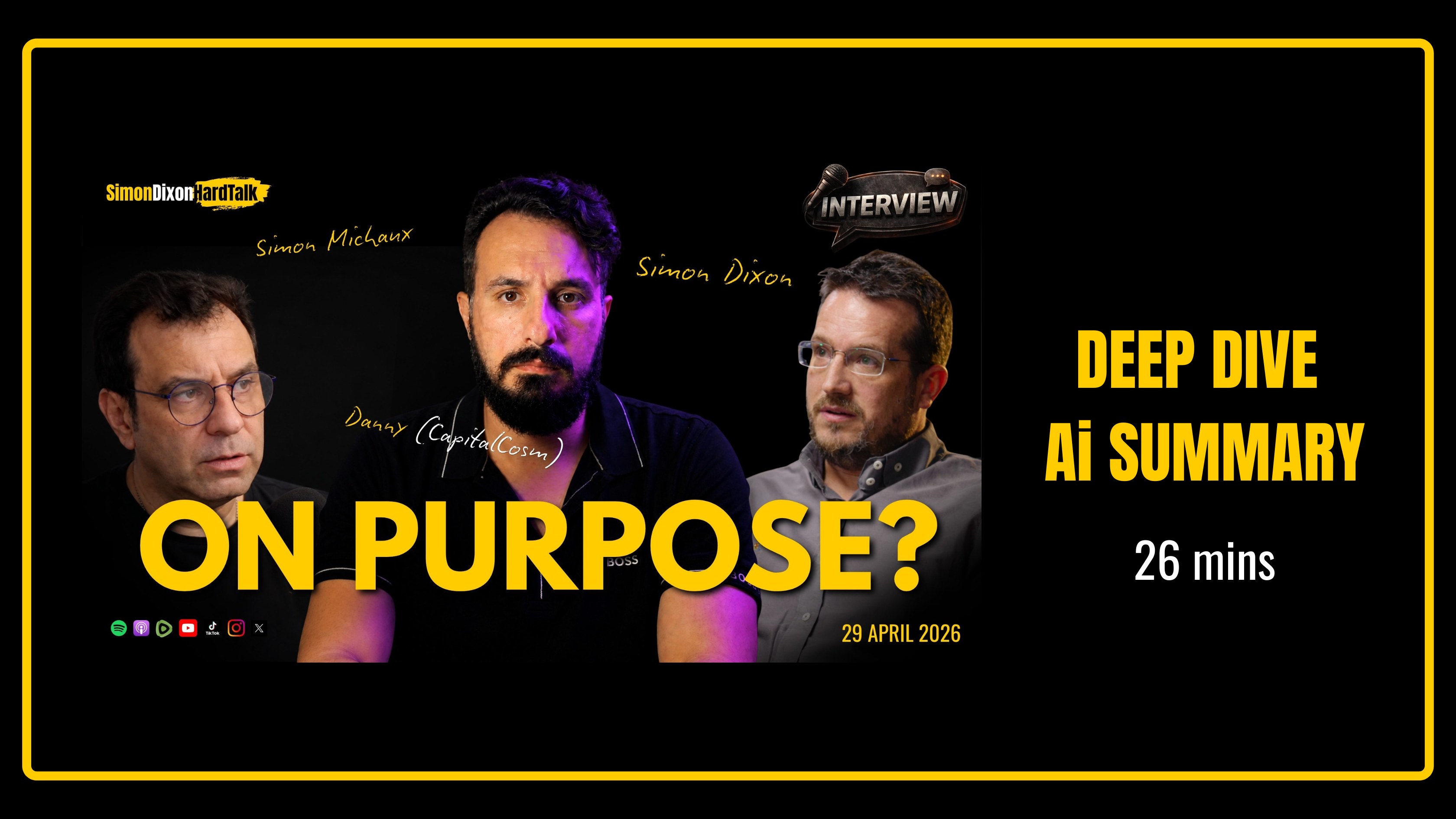
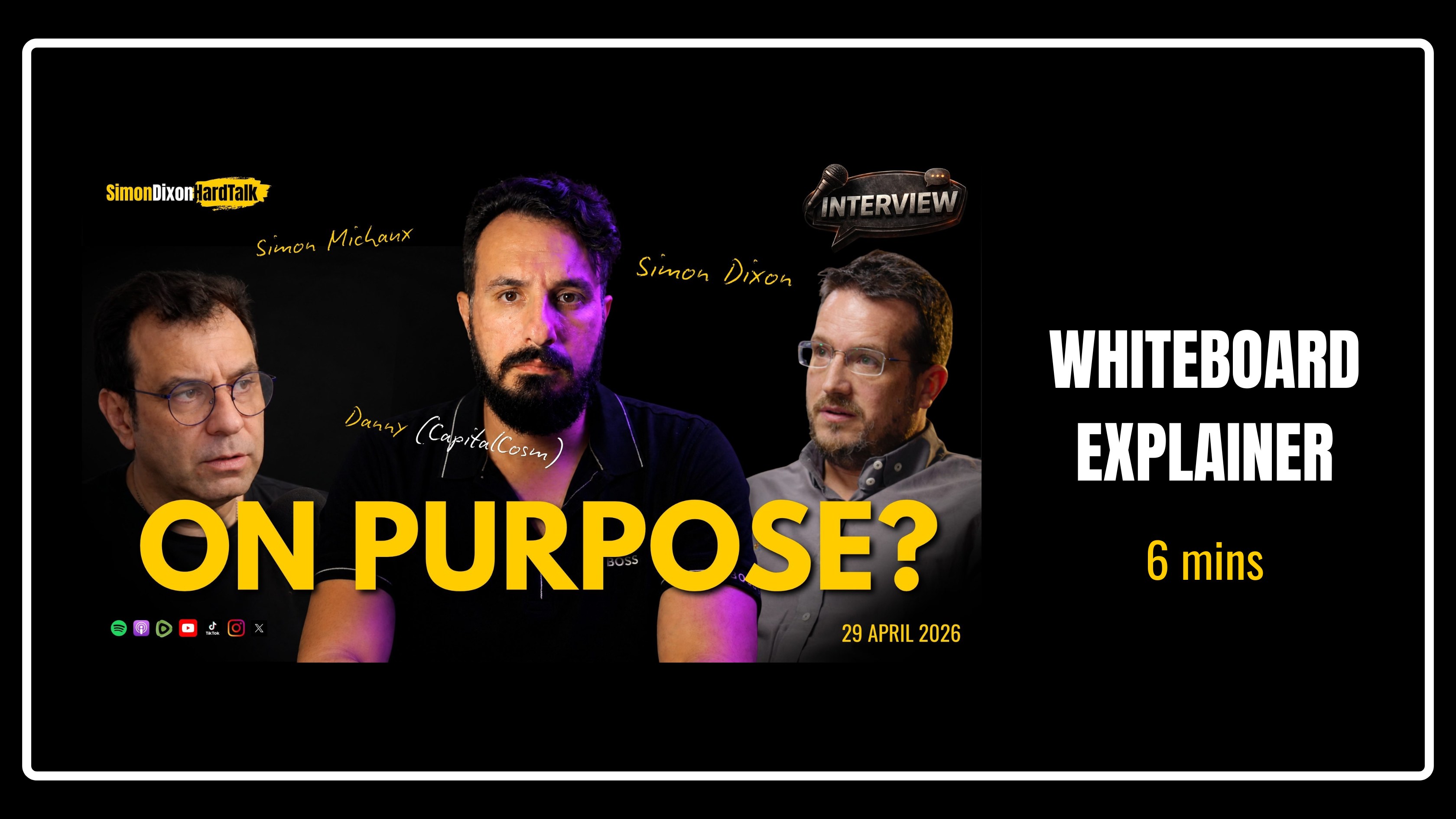
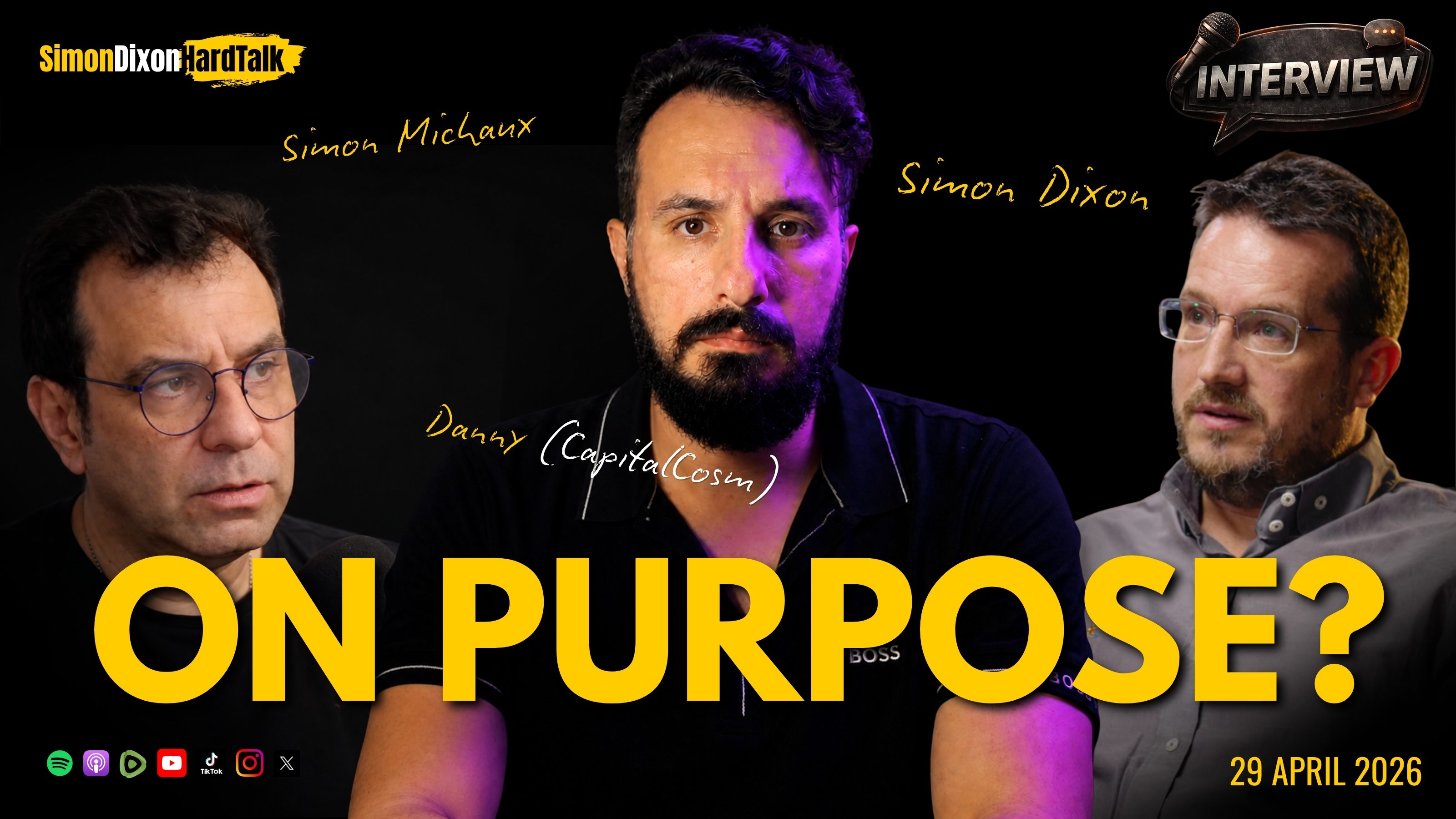
This document synthesizes the key insights, arguments, and data points from the April 29, 2026, conversation between Simon Dixon and Simon Michaux on the Capital Cosm program. The discussion focused on structural models of geopolitics, the transition of global financial systems, and the potential for an engineered collapse of existing industrial models.
High-Level Overview
The interview examines two primary models of global power and systemic change. Simon Michaux presents a model based on industrial structures, energy signatures, and a "Technofeudalist" transition, while Simon Dixon offers a model centered on transnational capital flows, the "Financial Industrial Complex," and the technological takeover of money. Both participants agree that the current global system is being intentionally dismantled to make way for a new, technocratic surveillance state characterized by programmable money and social credit systems. The framing suggests that whether through elite infighting or a unified "Grand Bargain," the outcome is a move toward a multipolar world governed by algorithms rather than traditional capital.
Key Arguments Made by Simon Dixon
- The Power Complex Triad: Global power is a struggle between three major factions: the Military-Industrial Complex, the Financial-Industrial Complex (FIC), and the Technical-Industrial Complex. While they often sync for profit (war, rebuilding, surveillance), they can fall out of alignment.
- Transnational Capital Supremacy: Capital and financial power remain at the top because they control currency creation, insurance contracts, and securitization. Even military companies are ultimately just shares traded within this system.
- Operation Ajax 2.0: Recent attempts at regime change and civil unrest (specifically referencing Iran) are part of a broader strategy where financial powers engineer resource extraction and use derivatives to hedge against the failure of these interventions.
- The "Bitcoin as an Elite Exit" Theory:
- Bitcoin likely originated from intelligence agencies (CIA/NSA) but was accidentally "open-sourced," creating a genuine resistance infrastructure.
- The elite’s true goal was the creation of stablecoins and Central Bank Digital Currencies (CBDCs) for traceability and control (e.g., "Fed Now," "Digital Euro").
- Elites view self-custody Bitcoin as a "safe haven" exit strategy for themselves, similar to how the British Empire created tax havens in its colonies.
- The Technocratic Takeover via MAGA: The Trump administration, supported by figures like Elon Musk and Peter Thiel (Palantir), is framed as an infiltration. While promising to take on the "Deep State," it is effectively building an "Orwellian 1984 programmable nightmare" through the Genius Act and Clarity Act.
- The Algorithm vs. Money: A shift is occurring where the algorithm is becoming more important than capital. The Technical-Industrial Complex may eventually make money irrelevant, using data and AI as the ultimate tools for social control and resource allocation.
- Financial Warfare and Rug-pulling: The Western system is fragile due to paper derivative contracts. The transition to a single CBDC will be a "rug-pull" where retail bank accounts are converted into app-based programmable currency under new terms and conditions.
Key Arguments Made by Other Participants
Simon Michaux
- Technofeudalism Model: This theory suggests the intentional destruction of current economic and industrial models to make the public desperate and susceptible to a new system involving AI, automation, 5G infrastructure, and digital passports.
- Elite Civil War: Michaux explores the possibility of a "civil war" within the deep state or "Committee of 300." One faction represents the global imperial petrodollar empire, while the other is a localized regional system (a new American power block) looking to destroy the global system's reputation so it is never trusted again.
- Energy and Commodity Signatures: Using technical analysis of raw materials, Michaux argues that the system is trying to "thermodynamically correct" itself. He notes that oil production plateaued in 2005, triggering decades of volatility.
- The "Synthetic" Event: The current energy and geopolitical tensions (e.g., Strait of Hormuz) are "in-your-face unnecessary" and likely synthetic, designed to orchestrate the destruction of the old control structures that have been in place for 50 years.
- Resource Balancing: Proposes a "Resource Balanced Economy" as an evolution of Jacque Fresco’s work, using systems ecology to manage resources rather than traditional financial metrics.
Danny (Host)
- Model Consolidation: Framed the episode as an attempt to see if the industrial/resource model and the financial/geopolitical model could be consolidated into one working model of "elite society."
Points of Agreement
- Intentional Systemic Transition: Both agree the current system is being destroyed on purpose to facilitate a "Great Reset."
- The Technocratic End State: Agreement on the implementation of a global surveillance state, programmable money, social credit scores, and the end of private ownership ("You will own nothing and be happy").
- The Worthlessness of Politics: Both participants agree that voting does not matter and there is no political solution to the current trajectory.
- Failure of the WEF: They suggest the World Economic Forum (WEF) may be "sacrificed" or disbanded as a branding exercise, while the system they promoted is implemented under a different name.
- The Move to Multipolarity: Both see a shift away from a US-centric world toward a multipolar world where nodes like the UAE, Singapore, and Hong Kong play central roles.
Points of Disagreement
- Origin of Conflict: Michaux toys with the idea of a "Committee of 300" or a deep-seated civil war between specific elite factions. Dixon views it more as a shifting struggle between different "industrial complexes" (Military vs. Financial vs. Technical) and transnational capital vs. nationalistic interests.
- The Nature of Trump: While Michaux views the Trump vs. Establishment feud as a potential sign of a genuine elite civil war, Dixon views the MAGA movement as a "psy-op" that facilitates the technocratic surveillance state while appearing to fight it.
Important Data, Claims, or References Mentioned
|
Category |
Specific Reference / Data Point |
|
Legislation/Documents |
Genius Act, Clarity Act (extensions of the Patriot Act); TPP, TTIP, TISA (trade agreements); Epstein files (reference to infiltration). |
|
Financial Data |
US Debt average interest at 3.3%; Fed Now (wholesale CBDC); Mbridge project (BIS-led CBDC network); 70% of global industrial network controlled by China. |
|
Energy/Commodities |
Oil production plateaued in Jan 2005; 146% increase in Saudi rig count for 4% contraction; Propane gas prices up 4x in India. |
|
Companies/Entities |
Saudi Aramco, Exxon, Chevron, Palantir, BlackRock, State Street, Vanguard, Lloyds of London, Bank for International Settlements (BIS). |
|
Geopolitics |
UAE leaving OPEC; Abraham Accords; NorthStream pipeline shutdown; Shanghai gold trade (circumventing sanctions). |
Notable Quotes or Framing
- Simon Dixon: "The second they want to rug-pool the system into one CBDC... you say to Americans: download this app, sign these terms and conditions, and you don't have $10,000 anymore."
- Simon Dixon: "America is not a country; it is a series of companies and a financial industrial complex."
- Simon Dixon: "Bitcoin was an exit for the elites... they created the exit and they created the psy-op."
- Simon Michaux: "The magician does something with one hand, but really something is happening over there... we're seeing the break apart of the conventional control systems."
- Simon Dixon: "The number one career choice for men is gambling and the number one career choice for women is OnlyFans."
Open Questions or Unresolved Issues
- Timing of the "Rug-pull": While both agree a transition is coming, the exact trigger (Cyber attack? Famine? Energy lockdown?) remains speculative.
- Effectiveness of Resistance: The debate leaves open whether "winning the game" to allocate capital toward good can actually stop the momentum of the "Technocratic Industrial Complex."
- The Role of the UAE: There is ongoing debate about whether the UAE's move to leave OPEC is a genuine break or a "good cop/bad cop" theatrical maneuver within the GCC.
- Human Consciousness: Michaux questions if a shift in human consciousness or a refusal to "play along" is the only real way to defeat the system, whereas Dixon focuses on the need for the "new elites" to use capital to change it from within.
Call to Action
- Share this post. Share this blog post to expose the "divide and conquer" trap.
- Subscribe to the Simon Dixon YouTube channel. Get my weekly deep dives into geopolitics, macro, and Bitcoin. Subscribe to my YouTube channel.
- Find me on Rumble. This is my backup channel, safe from censorship. Follow me on Rumble.
- Follow me on X @SimonDixonTwitt. I post real-time updates and analysis on X and am highly active there. Follow me on X.
- Follow me on instagram. Usually short clips are posted here.
- Follow me on TikTok. Usually short clips are posted here.
- SimonDixon.com. This is my personal site and an archive of all my content, safe from de-platforming. Join the free membership portal.
Watch on YouTube
Prefer to Listen? Available on Spotify & Apple Podcasts

DISCLAIMER
The information provided in this blog and the accompanying interview is strictly for educational and informational purposes. It does not constitute financial, investment, or legal advice. As Simon Dixon explicitly states, you must always follow the laws and regulations of your own country regarding your money and financial activities.
Furthermore, the discussions regarding the global power complex, geopolitical transitions, and institutional influence explore theoretical models and macroeconomic analysis. The views and structural models presented by the participants are investigative in nature and should be treated as analysis rather than established fact. Always conduct your own independent research and consult with a certified professional before making any financial decisions.