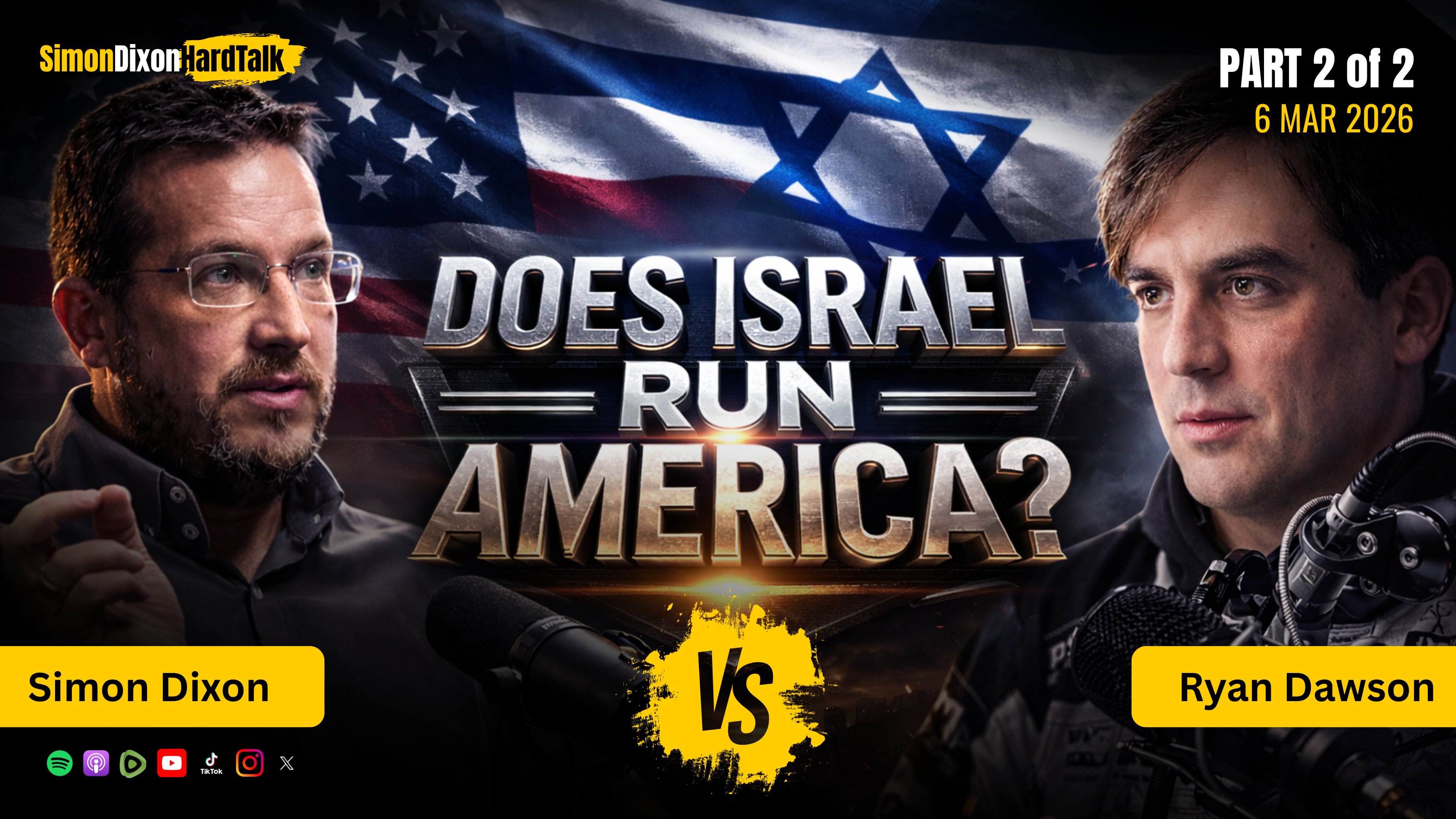
Does Israel Really Control U.S. Foreign Policy? | Ryan Dawson vs Simon Dixon Debate
Mar 06, 2026No time for the full 1h40m video? Watch the 20-minute AI-generated TL;DR Podcast Style Discussion instead. Or watch the 9-minute Ai generated Whiteboard Explainer Video.
Hey hey Sovereign Wealth Builders,
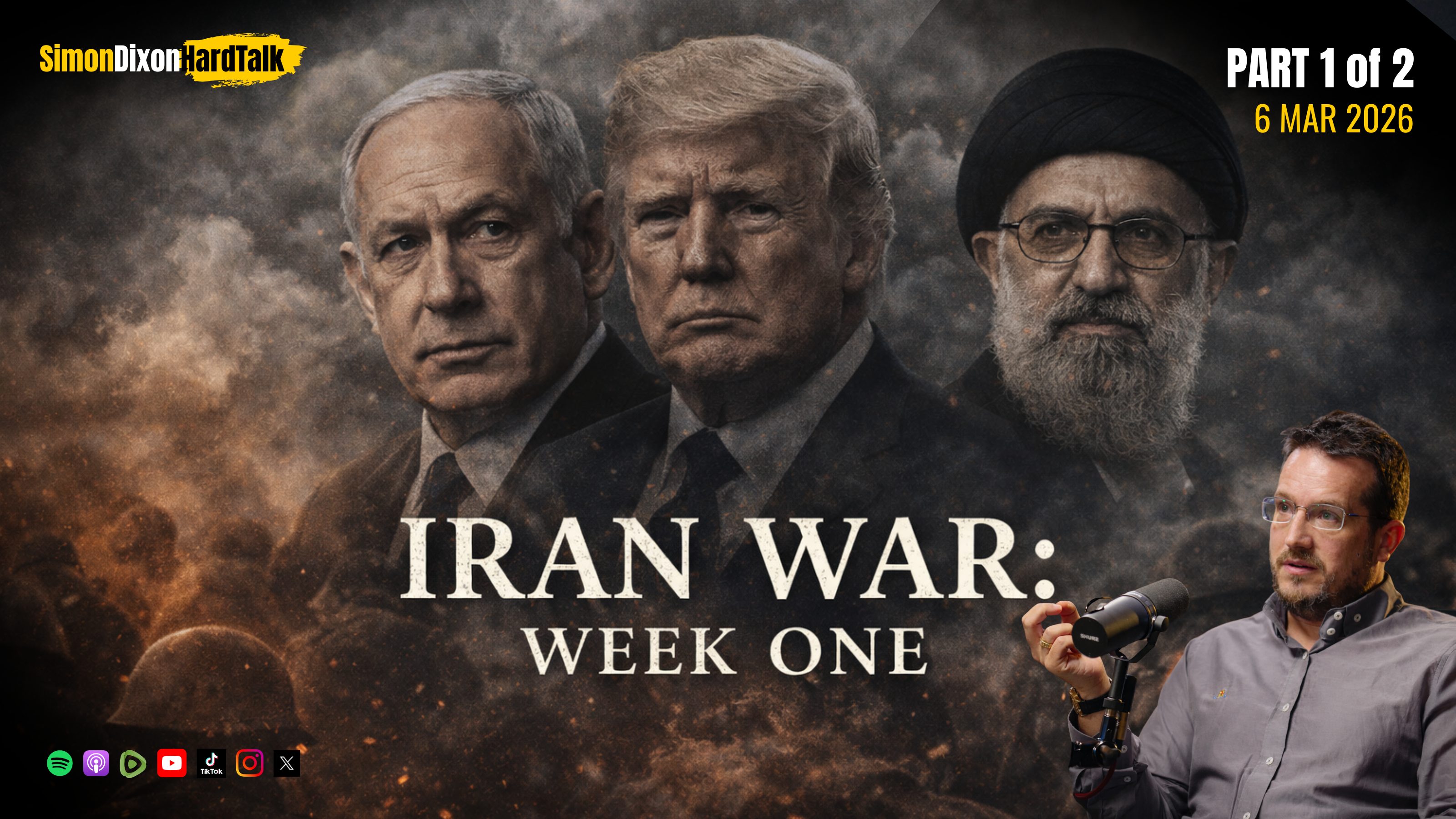
Welcome to an essential deep-dive into the structural transformations currently dismantling the old world order. This analysis is built upon the comprehensive insights shared during our recent livestream, “This Iran War is the Global Reset | SimonDixonHardTalk LIVE,” which aired on March 7th, 2026. This marathon session, spanning three hours and seven minutes, was strategically partitioned into two critical segments. Part 1, “Iran War Week One: The Managed Transition To A Multipolar World,” established the macroeconomic foundations of the conflict, while Part 2, “Does Israel Really Control U.S. Foreign Policy? | Ryan Dawson vs Simon Dixon Debate,” provided a robust, often heated clash of frameworks over the course of an hour and 39 minutes. It is this second part—the fundamental disagreement over whether the world is governed by financial-industrial interests or ideological drivers—that we will dissect here.
As a Sovereign Wealth Builder, your primary objective is clarity over deception. We are living through an era of profound "strategic tension," where the fog of war is used to obscure the largest wealth transfer in human history. To navigate this, we must identify the "head of the snake." Is the current conflict in the Middle East a product of ancient religious animosities and ideological crusades, or is it a calculated maneuver by the financial-industrial complex to manage a transition into a multipolar reality? Understanding these drivers is not an academic exercise; it is a prerequisite for survival. The movement of capital, the stability of neutral assets, and the eventual weakening of the US dollar are all dictated by the forces we discussed in this debate.
Real-Time Market Contagion: Energy, Stocks, and Neutral Assets
The current geopolitical theater has moved beyond mere skirmishes into the realm of total economic warfare. The closure of the Strait of Hormuz, intensified by Qatar’s declaration of force majeure on its liquefied natural gas (LNG) production, has sent shockwaves through the global economy. This is not just a disruption of shipping; it is a systematic "vassalization" of Europe. Following the energy shifts seen in the Ukraine conflict, Europe has been severed from its Russian and Middle Eastern dependencies, effectively becoming a captive market for American LNG. This coordinated operation by transnational capital is designed to trigger austerity across the UK and the continent, forcing a deeper dependency on the US security and energy umbrella.
While the European citizenry faces a state of disaster, the "war stock markets" are thriving on the extraction of wealth. In the United States, defense and energy sectors are propping up indices that would otherwise be reeling. We see a clear divergence: the US and Israeli stock markets have remained resilient, fueled by wartime profiteering and the socialization of losses. Conversely, the Asian markets are bearing the brunt of the instability. South Korea, a critical hub for global electronics and manufacturing, recently suffered a 12% crash, triggering circuit breakers that paralyzed trading. This market contagion illustrates the cost of being caught on the wrong side of the energy blockade. In comes Russia to save the day.
In response to this volatility, we have seen a significant resurgence in "neutral assets"—those that sit outside the control of any single nation-state. Gold has established a formidable new range, oscillating between $5,000 and $5,300, recovering half of its recent losses as capital flees fiat instability. Bitcoin has mirrored this flight to safety, bottoming at $62,000 at the war's onset before aggressively climbing back toward the $72,000 mark. These movements suggest that the market is beginning to price in the end of the unipolar era. Investors are no longer looking for the protection of the dollar; they are looking for assets that cannot be sanctioned, frozen, or printed into oblivion.
The Great Debate: Financial Framework vs. Ideological Framework
The core of our Hard Talk debate centered on a fundamental question of agency: who is leading whom by the nose? My thesis, the Dixon Thesis, posits that the world is governed by a Global Financial-Industrial Complex (FIC) that utilizes ideologies as tools of management. In this framework, Israel is not the architect of Western policy but a strategic tool—a proxy used to enforce dollar dominance and wartime profiteering. The FIC, consisting of transnational banks, insurers, and asset managers, views the current conflict as a "managed transition." From this perspective, the banksters and insurers are the ones who truly enforced the blockade of the Strait of Hormuz, not the Iranian Navy. By raising insurance premiums to a staggering 75% of a shipment's value, the financial complex effectively shut down the world’s most vital energy artery more efficiently than any carrier strike group could.
Opposing this is the Dawson Thesis, which argues that Zionism—as a religious, ethnic, and political ideology—is the primary driver of US foreign policy, even when it directly harms American strategic and economic interests. Ryan Dawson contends that the US is not a sovereign actor in this regard but a "parasite's host," being bled dry to fulfill the territorial and ideological ambitions of the Israeli state. Dawson supports this by pointing to the tactical failures on the ground: the US is running out of munitions and is forced to deploy outdated PAC2 Patriot systems with a dismal 19% intercept rate. He argues that this is not a "managed" shift but a genuine train wreck caused by religious zealots like Pete Hegseth, who view the conflict through the lens of a biblical crusade.
"A stalemate is still a loss for the US. The invincibility is gone. They can’t sell their defense—the 'we'll protect you' narrative is already dead." — Ryan Dawson
This clash of frameworks forces us to ask: is the world a series of calculated moves by an international financial clique hedging their bets across a multipolar board, or is it a descent into chaos driven by "obedient goyim" and radicalized ideologues? My analysis remains focused on the capital flows. I believe we are witnessing the planned demolition of the old order to usher in a multipolar system where the financial elite can diversify their returns away from a decaying American empire. However, Dawson’s evidence regarding the sheer irrationality of current policy—the preemptive attacks on Iran and the destruction of US diplomatic standing—suggests that if there is a plan, it is being executed by psychopaths who are increasingly losing control of the variables.
The Mechanics of the Dollar Ponzi: War as a Backing
To truly follow the money, one must understand that the US dollar is not an organic currency; it is a debt-based Ponzi scheme. Since the Bretton Woods system was established in 1944, the International Monetary Fund (IMF) has served as the enforcer of this system, using debt, color revolutions, and covert regime change to ensure the world remains on the dollar standard. The dollar is fundamentally backed by war and the Military-Industrial Complex (MIC). It requires the constant creation of artificial demand and the rolling over of trillions in debt. This is achieved by ensuring that energy is priced exclusively in dollars and that no competing financial rails are allowed to exist.
The extraction mechanism is mathematically precise. The Federal Reserve prints trillions to manage the national debt, but this capital does not reach the average person. Instead, it is funneled into the US stock market, where 92% of the value is owned by the top 10% of stockholders. This process destroys the purchasing power of the individual through inflation—the "hidden tax"—while the asset-owning class sees their net worth explode. The average citizen is left with the debt—the mortgages, the student loans, and the credit cards—while the financial elite extract the real resources of the nation. War provides the ultimate justification for this "money printer go burr" reality, as it allows for infinite munitions spending and the socialization of losses under the guise of national security.
However, we have reached the end of this debt cycle. As Ryan Dawson correctly noted, the use of sanctions and the freezing of assets (as seen with Russia and Venezuela) have turned the dollar into a weapon rather than a neutral tool. This has forced the rest of the world to build "alternative rails." Historically, the dollar was used because it was the most stable and liquid option. Today, because the US has overplayed its hand with economic warfare, the world is shifting. We are seeing a move toward bilateral trade in regional currencies and gold, signaling that the "backing" of the dollar—the threat of military and financial annihilation—is no longer a sufficient deterrent in a world where competing powers offer a different model.
China and the Rise of Reverse-Mercantilism
A critical pivot in this Global Reset is the emergence of China as the primary competing implementation. China operates under a model I describe as "reverse-mercantilism" or "un-mercantilism." In the Western model, private banking interests control the government, using mercantilism to extract wealth for private shareholders. In the Chinese model, the state maintains absolute control over the banking system. Chinese state-owned banks print money not for private profit, but to reinvest in infrastructure, manufacturing, and the long-term stability of the state. This "government over private interest" approach has allowed China to build a manufacturing base that the financialized West can no longer compete with.
China is currently decolonizing the world from the IMF through the Belt and Road Initiative. Instead of the debt-trap diplomacy associated with the Western model, China offers loans structured for infrastructure development and the purchase of Chinese goods. This creates a network of partners who are no longer dependent on the dollar. Furthermore, China provides the "eye in the sky" that has fundamentally changed the military balance of power. By sharing vital satellite data with Iran, China has enabled the Iranian military to counter US and Israeli technology with unprecedented accuracy.
This model of "Mass Producer" (China) vs. "Mass Consumer" (USA) is reaching its breaking point. In the US, systems like Social Security and Medicare have been transformed into subsidies for private fund managers, where the "wealth redistribution" is merely a loop back into the financial industrial complex (FIC). China, by contrast, subsidizes its export industries to ensure global dominance. This is why China has a vested interest in Iranian stability; they cannot allow the US to control the Gulf and shut off the oil that fuels their manufacturing engine. The rise of China means the FIC must now negotiate with a player that doesn't follow the Western "debt-extraction" ruleset.
Internal Fractures and the Off-Ramp Scenarios
The conflict within Iran is far from a monolith. We are seeing a profound internal struggle between the "reformists," who are aligned with China and the transnational financial complex, and the IRGC "hardliners," who are driven by ideological resistance and a refusal to negotiate with a West they perceive as deceptive. The recent "decapitation campaigns" and targeted strikes are often tactical attempts to eliminate the hardline elements that stand in the way of a managed off-ramp. If the reformist faction can secure control, we may see a transition that includes sanction relief and a restructuring of the regional order—a "soft landing" for the bankers, if not for the ideologues.
What is most revealing about the current "Global Reset" is the coordination between the financial elite and geopolitical events. Consider Donald Trump’s response to the 75% insurance premiums that paralyzed shipping. His announcement that the US would guarantee these insurance premiums with taxpayer money was, in effect, another massive bank bailout.
"Trump made that announcement and the insurance shipments may or may not get through. It was essentially a bank bailout... socializing losses and privatizing gains in order to get those shipments through." — Simon Dixon
Furthermore, we must look at the shifting influence of Sovereign Wealth Funds. The Kuwaiti Sovereign Wealth Fund and other Gulf interests have increasingly co-opted Western institutions like BlackRock to exert influence over US policy. Even the use of Jared Kushner’s Affinity Partners serves as a management tool for Gulf capital. These players are no longer subordinate to the old Zionist-led MIC; they are playing their own game of 5D chess, hedging their bets and ensuring that if the American empire falls, their capital is safely transitioned into the new multipolar order.
Common Ground: The Path for Sovereign Wealth Builders
Despite the friction between the financial and ideological frameworks, there is significant common ground. Both sides of the debate acknowledge that radical religious supremacy—whether in the form of radical Zionism or Christian Zionism—acts as a "cancer" to global stability. These ideologies drive the world toward "suicide missions" that ignore the practical realities of economic survival. Furthermore, there is a shared realization that the United States is rapidly losing its military and diplomatic footprint in the Middle East. The "invincibility" of the Western defense system has been shattered, and the world's power is dynamically shifting from the West to the East.
This Global Reset is the inevitable conclusion of a multi-decade debt cycle that has reached its mathematical limit. Whether this is a "managed transition" by the banksters or a "train wreck" caused by ideologues, the result for you remains the same: the old rules of the game are gone. The dollar is being devalued, the US is retreating to a regional power status, and the world is moving toward a system of neutral assets and competing manufacturing hubs.
To thrive in this environment, you must build your plan on structural realities rather than mainstream deceptions. The "banker class" is already moving toward the next system, utilizing Bitcoin ETFs and other mechanisms to control access to capital even in a decentralized world. Clarity is your greatest asset. By following the money and understanding the mechanics of wealth extraction, you can position your wealth to survive the transition from a debt-based unipolar world to a resource-backed multipolar reality.
Call to Action
To fully grasp the evidence and the intensity of this debate, I highly encourage you to watch the full livestream replay. We dive into the granular details of the munitions shortages, the satellite data exchanges, and the specific banking mechanics that the mainstream media will never discuss. You can find the entire three-hour broadcast above.
Stay ahead of the curve by subscribing to my YouTube and Rumble channels for regular macro-updates. Follow me, Simon Dixon, on X for real-time analysis as these events unfold in the Middle East and the global markets. Most importantly, register at SimonDixon.com for our newsletter. I do not monetize this information with adverts or sponsorships; there is no business agenda. I am here to share the "rules of the game" so that you can build and protect your sovereign wealth in a world of deception.
- Share this post. Share this blog post to expose the "divide and conquer" trap.
- Subscribe to the Simon Dixon YouTube channel. Get my weekly deep dives into geopolitics, macro, and Bitcoin. Subscribe to my YouTube channel.
- Find me on Rumble. This is my backup channel, safe from censorship. Follow me on Rumble.
- Follow me on X @SimonDixonTwitt. I post real-time updates and analysis on X and am highly active there. Follow me on X.
- Follow me on instagram. Usually short clips are posted here.
- Follow me on TikTok. Usually short clips are posted here.
- SimonDixon.com. This is my personal site and an archive of all my content, safe from de-platforming. Join the free membership portal.
Watch on YouTube
Prefer to Listen? Available on Spotify & Apple Podcasts

Read other related blogs

Disclaimer
The content provided in this article is for informational and educational purposes only and does not constitute financial, legal, or investment advice. Macroeconomic and geopolitical commentary regarding the Middle East, Iran, Israel, the US dollar, and the global financial system reflects an analysis and interpretation of structural trends, historical patterns, and the "follow the money" methodology, rather than statements of absolute fact. All investments involve risk, and the "Global Reset" described herein involves extreme volatility. You should conduct your own research and consult with professional advisors before making any financial decisions. The views expressed regarding various ideologies, political factions, and military hardware are part of a broader macroeconomic debate and reflect the interpretive frameworks of the participants.