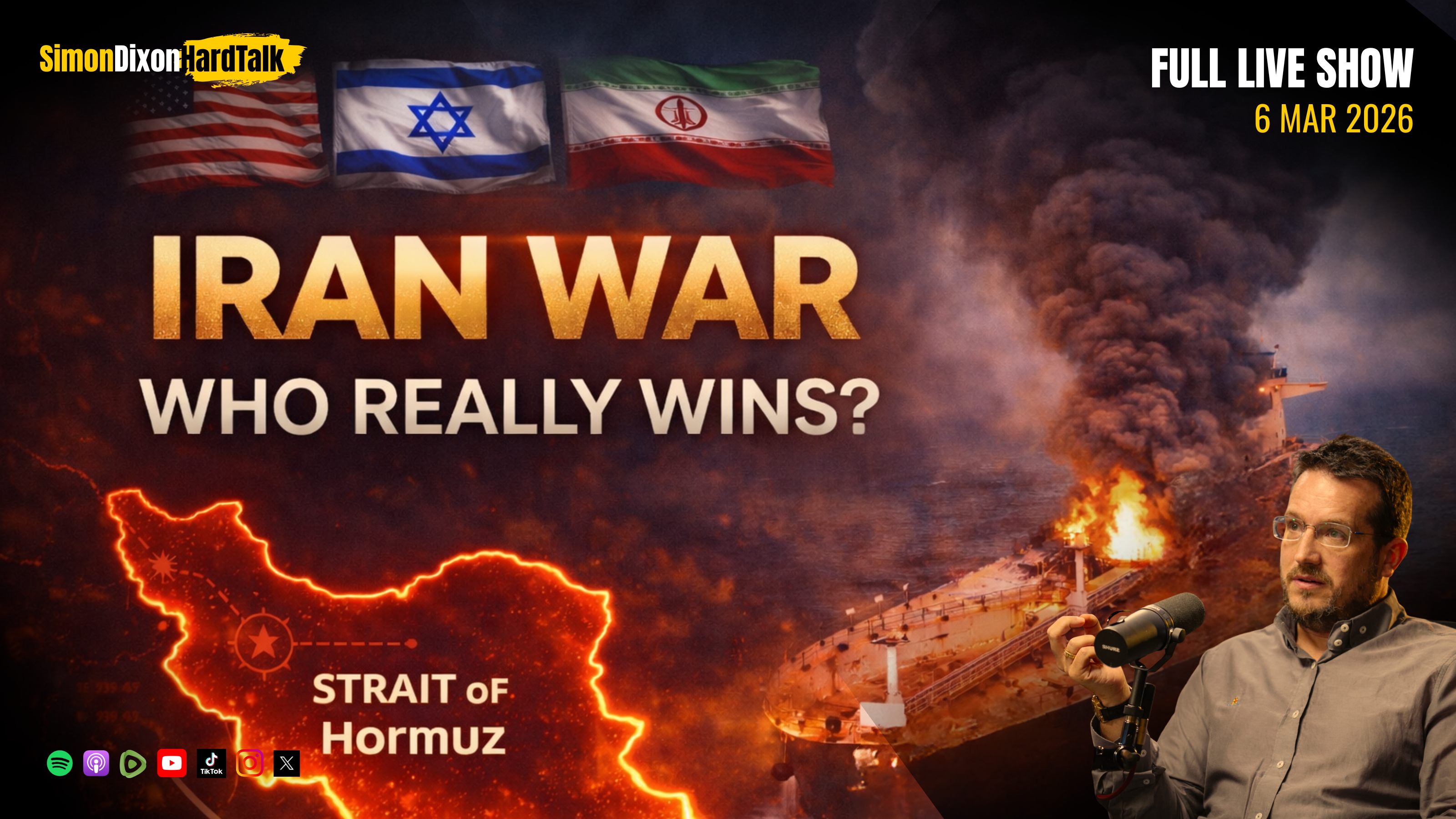
🇮🇷 🇺🇸 🇮🇱 This Iran War is the Global Reset | SimonDixonHardTalk LIVE
Mar 06, 2026No time for the full 3h27m video? Watch the 22-minute AI-generated TL;DR Podcast Style Discussion instead. Or watch the 8-minute Ai generated Whiteboard Explainer Video.
Hey hey Sovereign Wealth Builders.
We are currently standing at the precipice of a historical reorganization so profound that the mainstream media lacks the vocabulary to even describe it. In my recent livestream, "This Iran War is the Global Reset," aired on March 7, 2026, I spent over three hours deconstructing the first week of a conflict that many are calling the start of World War III. However, if you follow the money and look past the cartoonish propaganda of "good versus evil," a much more calculated reality emerges. This article synthesizes our deep-dive analysis of the initial week of the Iran-Israel-U.S. conflict and my rigorous debate with Ryan Dawson regarding the true nature of power. We are not witnessing an existential war of annihilation; we are witnessing a managed transition to a multipolar world order where war is used as the ultimate mechanism to reset the global financial and political system.
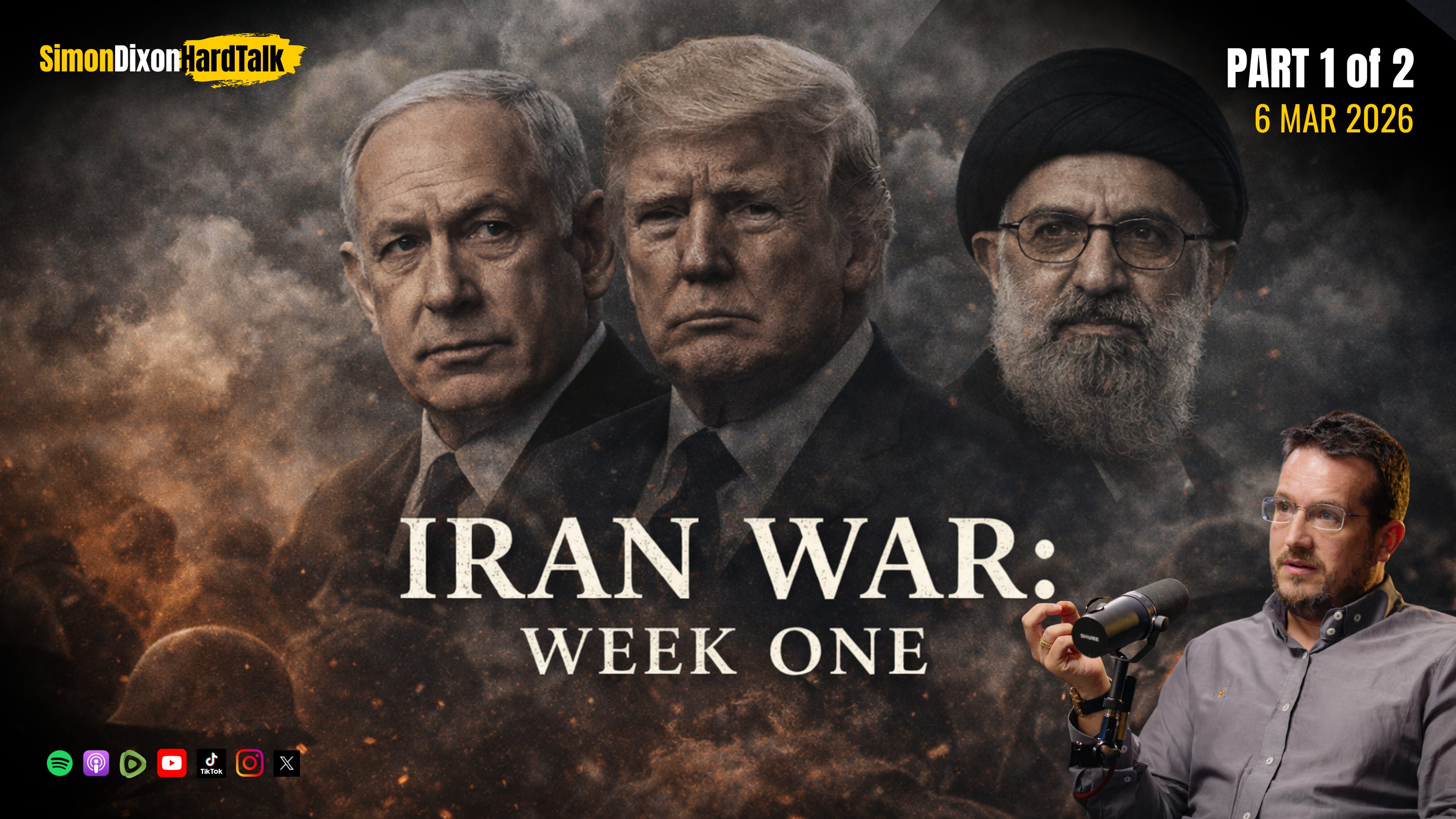
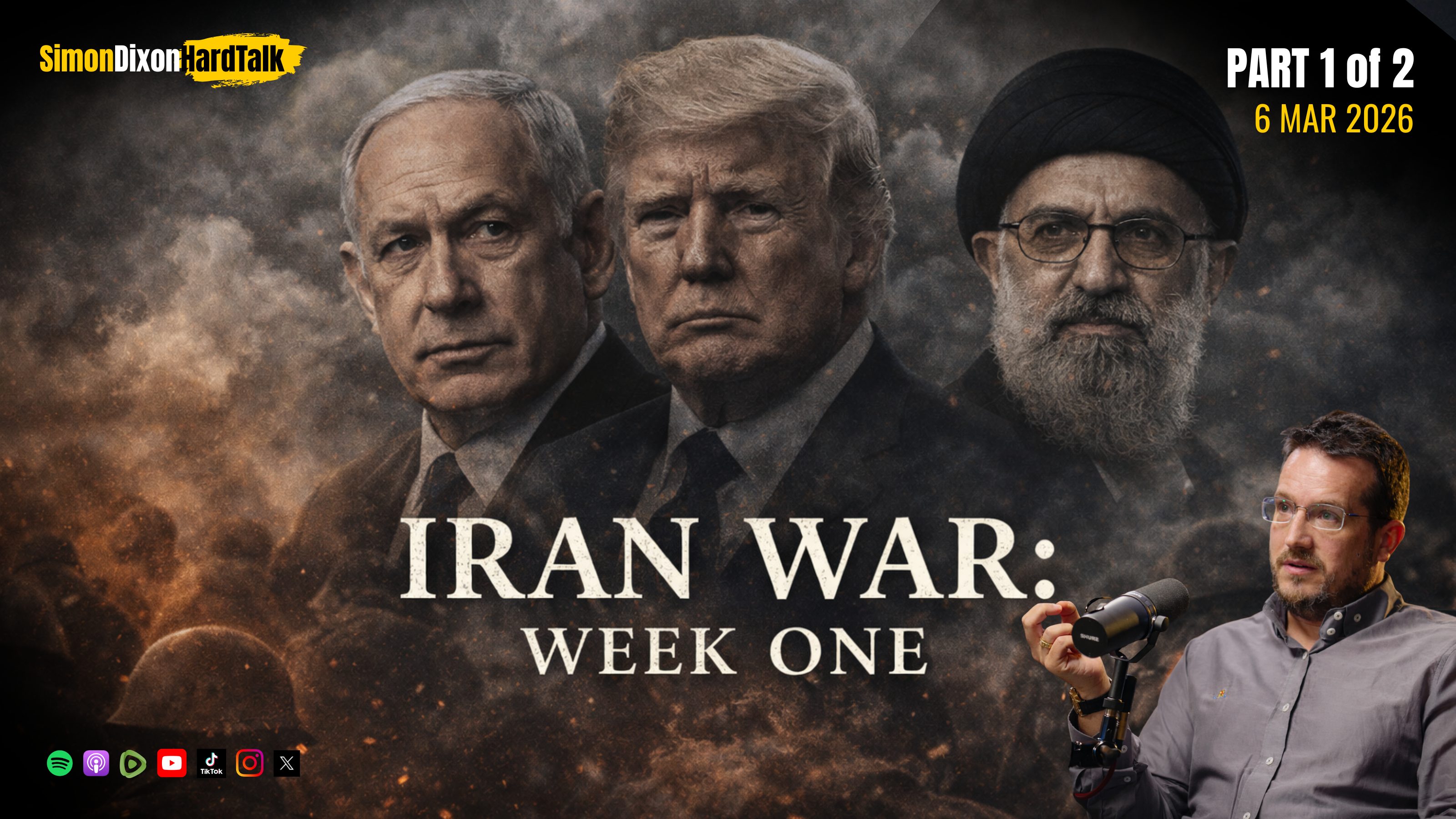
PART 1: Iran War Week One: The Managed Transition To A Multipolar World
The Analytical Framework: The Two Transnational Factions
To navigate this fog of war, we must identify the two core transnational factions driving the escalation. My analysis suggests that the primary driver is the Financial-Industrial Complex (FIC). This faction prioritizes regional stability, energy security, and trade integration because these are the precursors to long-term capital appreciation in the Middle East. The key players in this network include the massive sovereign wealth funds of the Gulf Cooperation Council (GCC), global asset managers like BlackRock, and the manufacturing engine of China, which notably brokered the Saudi-Iran rapprochement. Within Iran, this faction is allegedly represented by the reformist administration of President Pezeshkian, negotiators like Araghchi, and institutionalists such as Ali Larijani. Their goal is a stable Middle East that is fully integrated into a multipolar world where trade flows are no longer subject to the whims of a single hegemonic gatekeeper.
In direct competition, yet structurally intertwined, is the Military-Industrial Complex (MIC). This faction thrives on permanent instability, weapons procurement, and the maintenance of the U.S. hegemonic security model. The players here allegedly include the hardline IRGC factions who profit from a "resistance economy," the far-right Zionist elements in Israel pursuing a "Greater Israel" expansionist doctrine, and the neoconservative establishment in Washington. My thesis, based on following the capital, is that a "Deal" likely exists between these two complexes. In this managed transition, the MIC is permitted its theatre of war and its associated trillion-dollar expenditures, while the FIC secures the post-war architecture, reconstruction contracts, and new ETF-driven capital frameworks. The war is not a failure of the system; it is the system’s way of recalibrating itself.
The Theatre Rule: Why This War is Bounded by Design
To understand the chronology of the first week, we must apply the "Theatre Rule." Analysis suggests that the conflict is bounded by pre-negotiated parameters where the outcomes are often predetermined. In this framework, what is allegedly shot down was meant to be shot down, and what is spared is intentionally preserved. The strongest signal of this managed theatre is the glaring contradiction in U.S. behavior. While the U.S. was allegedly bombing Iranian targets, the U.S. Development Finance Corp was simultaneously moving to provide political risk insurance for shipping, and the Navy was preparing tanker escorts. From a strategist’s perspective, you do not build a sophisticated insurance and escort regime for a shipping lane you expect to be a permanent war zone. This implies that the disruption to the Strait of Hormuz has an alleged known expiry date known to the financial elite.
The strikes themselves appear highly calibrated. Analysis suggests that the Israeli targets—command centers, missile sites, and IRGC infrastructure—were chosen to degrade specific "spoiler" factions without triggering a total societal collapse. Even the Iranian retaliations, featuring missiles directed at Gulf bases and Israeli cities, appeared largely contained by air defenses that functioned exactly as the "theatre" required. While the MIC potentially engaged in alleged false flag operations, such as the tragic strike on a school in Iran to stir emotional radicalization, the broader trajectory remained tied to the February 27 Oman framework. This framework, which allegedly included agreements on zero nuclear enrichment and regional security guarantees, remains the hidden script behind the kinetic activity.
Selection by Elimination: The Mechanics of Internal Regime Change
The strikes against Iranian leadership during week one offer a look at "Selection by Elimination." Analysis suggests that the alleged removal of the Supreme Leader Khamenei, along with the defense minister and the IRGC chief of staff, was designed to create a specific type of power vacuum. However, the alleged survival of Mojtaba Khamenei suggests that a continuity candidate was protected to ensure the state does not descend into the kind of chaotic collapse we saw in Iraq or Libya. This is not external regime change; it is an alleged internal reorganization where the "old guard" hardliners are removed to make way for a normalized, institutional state.
Crucially, the primary negotiators capable of speaking the language of transnational capital, such as Pezeshkian and Araghchi, allegedly remain functional and protected. This allows Iran to transition into a state that is more closely aligned with the interests of BRICS and the GCC. By pruning the hardline elements that served as the primary antagonists for the MIC, the system facilitates an Iranian "soft landing" into the multipolar architecture. This is a cold, financier-led logic: a normalized Iran is a more profitable partner for reconstruction and energy trade than an isolated pariah state.
The Global Commodity Stress Test: The Hormuz Experiment
We must view the closure of the Strait of Hormuz as a massive global economic experiment. Interestingly, the Strait was not physically closed by missiles, but by the financial infrastructure of the insurance markets. When war-risk premiums allegedly spiked to 75% of tanker value, the "banksters" effectively enforced the blockade. This "Hormuz Experiment" allows the FIC to study the worldwide impact on every commodity, from crude oil to petrochemical derivatives. The data is staggering: roughly 25% of India’s fertilizer imports transit through Hormuz. The disruption has already caused domestic fertilizer production in India to be curtailed as the government redirects natural gas to meet power shortages.
The pain is felt most acutely in developing economies and energy-dependent hubs. Bangladesh is allegedly cutting power supplies due to the disruption of Qatari LNG, while Europe faces a renewed energy shock. With the Ras Laffan facility in Qatar—which supplies roughly 20% of global LNG—allegedly disrupted by drone strikes, European gas prices (TTL) spiked by 50% instantly. This forces Europe into a deeper, more expensive dependency on U.S. LNG, effectively turning the European public into the paying customers for the Middle East’s regional restructuring. Furthermore, the conflict exposed a critical bottleneck in the AI supply chain. The 12% crash in the South Korean market, specifically affecting Samsung and SK Hynix, reminds us that the true constraint for AI is not the chips themselves, but the imported energy required to run the fabrication plants.
Geopolitical Leverage and the Multipolar Security Shift
One of the most significant developments of the first week was the Financial Times report indicating that GCC states are reviewing hundreds of billions of dollars in U.S. investment commitments. Funds like Saudi Arabia’s PIF and Qatar’s QIA are not merely passive investors; they are the primary engines of U.S. infrastructure, private credit, and AI data center development. The threat of capital flight from these sovereign wealth funds creates an immediate and powerful off-ramp pressure for Washington. The Gulf states are no longer subordinate to the U.S. security umbrella; they are allegedly using their financial leverage to demand an end to the "forever war" model in favor of regional autonomy.
This pivot is part of a broader trend of "Multipolar Hedging," where the Gulf states diversify their alliances toward China, Russia, and India. Simultaneously, we must look at the "Turkey Factor." While U.S. bases across the GCC were allegedly struck by Iranian missiles, Turkey remained effectively untouched. Analysis suggests that Turkey, occupying a unique position as a NATO platform, a migration buffer for Europe, and an energy corridor for Russia and China, has been positioned as an untouchable neutral ground. This suggests that the new regional order already has its designated safe zones, even as the kinetic "sorting mechanism" continues elsewhere.
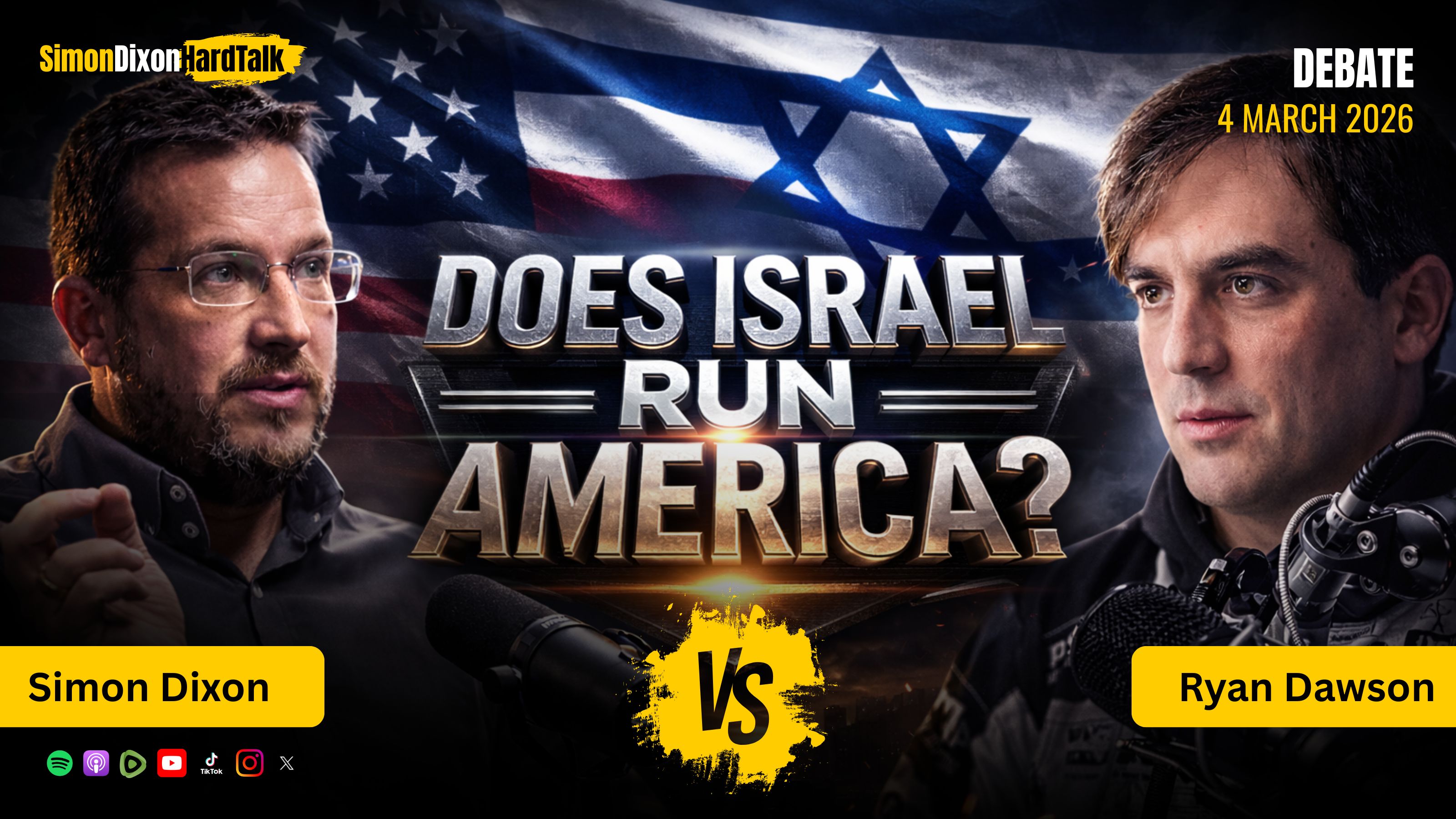
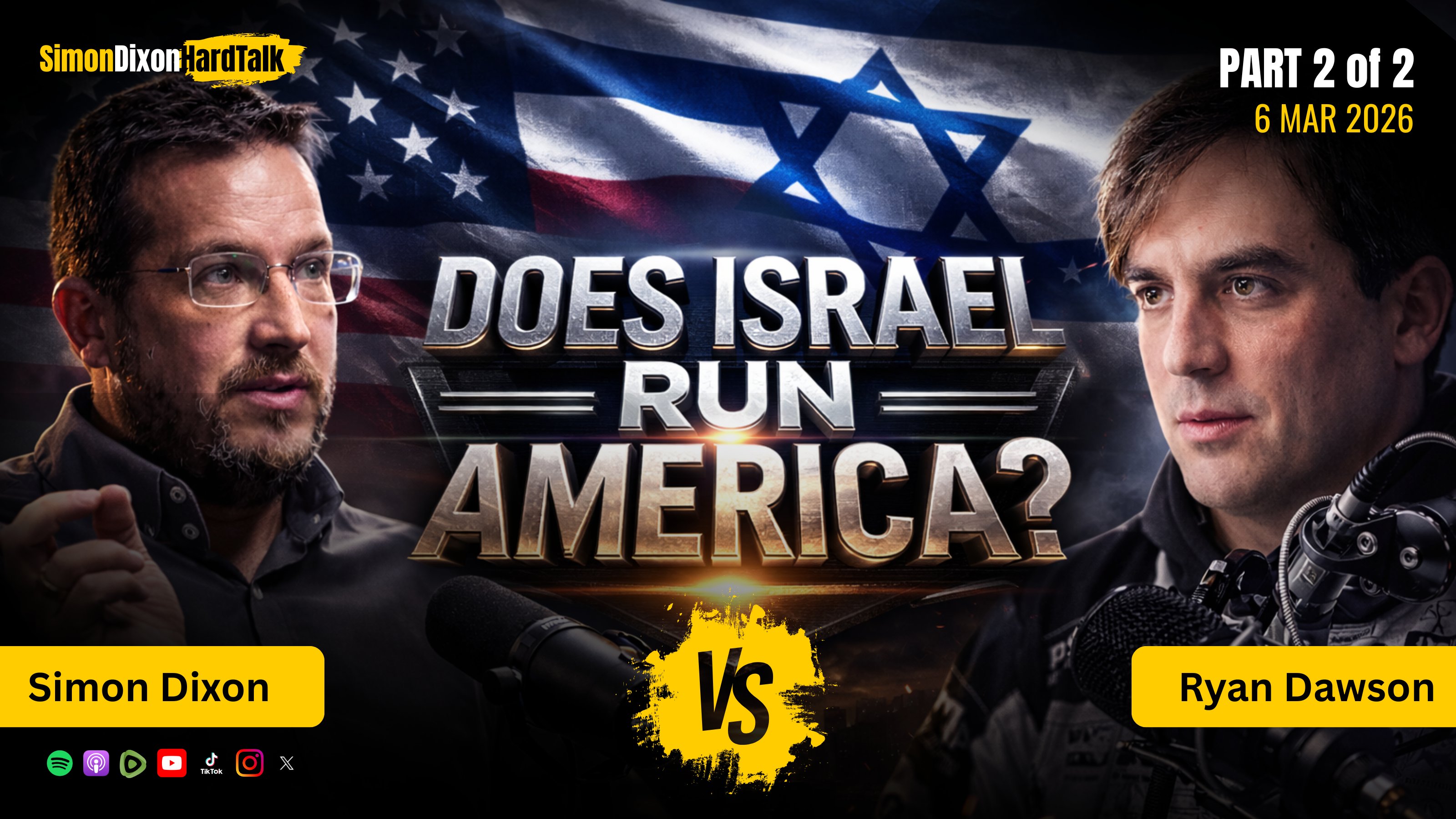
PART 2: Does Israel Really Control U.S. Foreign Policy? | Ryan Dawson vs Simon Dixon Debate
The Great Debate: Ideology versus Transnational Capital
The debate between myself and Ryan Dawson highlights the fundamental tension in geopolitical analysis. Ryan’s thesis is that Zionist ideology and religious supremacy are the primary drivers of U.S. foreign policy. He argues that the war is a genuine, unmanaged conflict driven by a desire for "Pax Judaica" and ethnic cleansing—a framework where the U.S. acts against its own interests to satisfy a parasitic ideological interest. In this view, the conflict is an existential battle between a Zionist-controlled West and an anti-Zionist Iran.
My thesis, conversely, is that transnational capital uses ideology as a tool to manage the world order. I argue that while the MIC and Zionism provided the "strategic tension" necessary to back the dollar via war for decades, that model has hit the end of its debt cycle. As China and the BRICS nations offer a competing model of "Reverse-Mercantilism," the global financial elite are hedging their bets and transitioning to a multipolar system. While Ryan and I found common ground in condemning radical ideologies and recognizing that China cannot allow Iran to fall, the question for the Sovereign Wealth Builder is: which framework better explains a war where the U.S. insures the very ships it is allegedly putting at risk? I contend the dollar is fundamentally the collateral of the "Proof of Weapons" network, and this war is the final rollover of that debt-based Ponzi scheme.
Wealth Extraction: The Mercantilist End-Game
To truly grasp the "Global Reset," we must deconstruct the mechanism of wealth extraction via the fiat currency system. The current dollar standard is a debt-based system that requires constant expansion and conflict to maintain its liquidity. This "American Mercantilism" extracts value from the American public through inflation and debt, transferring that value to the stockholder class and the financial elite. The American people absorb the costs of the military-industrial complex, while the corporate class reaps the profits of reconstruction and military contracts.
Contrast this with "Chinese Reverse-Mercantalism," where state-led banking reinvests in infrastructure and production to build a manufacturing base that eventually challenges the debt-based hegemony of the West. The traditional narrative of "Capitalism vs. Communism" is a psychological operation designed to hide the reality of this mercantilist extraction. Both systems, in their current forms, are tools used by the top of the capital structure to reorganize resources. The Iran war is the latest chapter in this process, using high-tension conflict to justify the devaluation of old currencies and the implementation of a new, AI-driven surveillance and financial state. Analysis suggests that the post-war architecture will involve a "Board of Peace" mechanism for Palestine, which is essentially a Technical-Industrial Complex (TIC) surveillance and police state model funded by GCC capital.
Conclusion: The Architecture of the New World
As we look toward the predicted end-state, the outlines of a new regional architecture are becoming clear. The likely result is a normalized Iran that has undergone an alleged internal regime change, the removal of IRGC hardliners, and the preservation of an institutional state aligned with the GCC and BRICS. We are likely to see a GCC-led security architecture that provides regional stability without the same level of total dependency on the United States. Furthermore, Israel will likely emerge from this conflict weakened, laden with debt, and forced to integrate into regional economic structures—possibly through the acquisition of its strategic technological assets by Gulf or Indian capital.
The global reset is already underway, and the system has been reshaped regardless of when the kinetic strikes cease. The stress test of the global commodity system has shown the world exactly where the vulnerabilities lie and who holds the levers of power. The transition to a multipolar world is not a future possibility; it is the current reality being forged through this calibrated conflict. The old world order, backed by the petrodollar and the "proof of weapons" network, is being liquidated to make way for a system based on different capital flows, AI-driven surveillance, and strategic alliances.
Call to Action
To fully grasp the nuances of this transition and the financial data driving it, I strongly encourage you to watch the full replay of the "This Iran War is the Global Reset" livestream. We dive much deeper into the specific "theatre" signals and the banking transactions that define this conflict. For those looking for historical context on the "Deep State" and "theatre" frameworks, I recommend revisiting my blog posts on the 9/11, Epstein, and JFK documentaries, which provide the foundation for understanding how these power structures operate.
If you value this type of "follow the money" analysis:
- Share this post. Share this blog post to expose the "divide and conquer" trap.
- Subscribe to the Simon Dixon YouTube channel. Get my weekly deep dives into geopolitics, macro, and Bitcoin. Subscribe to my YouTube channel.
- Find me on Rumble. This is my backup channel, safe from censorship. Follow me on Rumble.
- Follow me on X @SimonDixonTwitt. I post real-time updates and analysis on X and am highly active there. Follow me on X.
- Follow me on instagram. Usually short clips are posted here.
- Follow me on TikTok. Usually short clips are posted here.
- SimonDixon.com. This is my personal site and an archive of all my content, safe from de-platforming. Join the free membership portal.
Watch on YouTube
Prefer to Listen? Available on Spotify & Apple Podcasts
Read other related Blogs
Disclaimer
The commentary and analysis provided in this article are for informational and educational purposes only. This content does not constitute financial, legal, or investment advice. Macro-economic and geopolitical commentary reflects the author’s personal analysis and interpretation of global events based on available information and should not be taken as statements of absolute fact. Investing in any asset class, including but not limited to stocks, bonds, gold, and digital assets, involves significant risk. You should perform your own due diligence and consult with a qualified professional before making any financial decisions. The author is not responsible for any financial losses or damages resulting from the use of this information. The frequent use of the term "alleged" and "analysis suggests" is intended to reflect that many aspects of the discussed geopolitical events are based on reports, interpretations, and strategic wargaming that may be subject to change as more information becomes available. The views expressed regarding political and religious ideologies are for analytical purposes only and do not constitute an endorsement of any particular movement.