This Iran War is the Global Reset: A Managed Transition to a Multipolar World
Mar 06, 2026No time for the full 1h48m video? Watch the 20-minute AI-generated TL;DR Podcast Style Discussion instead. Or watch the 8-minute Ai generated Whiteboard Explainer Video.
Hey hey Sovereign Wealth Builders,
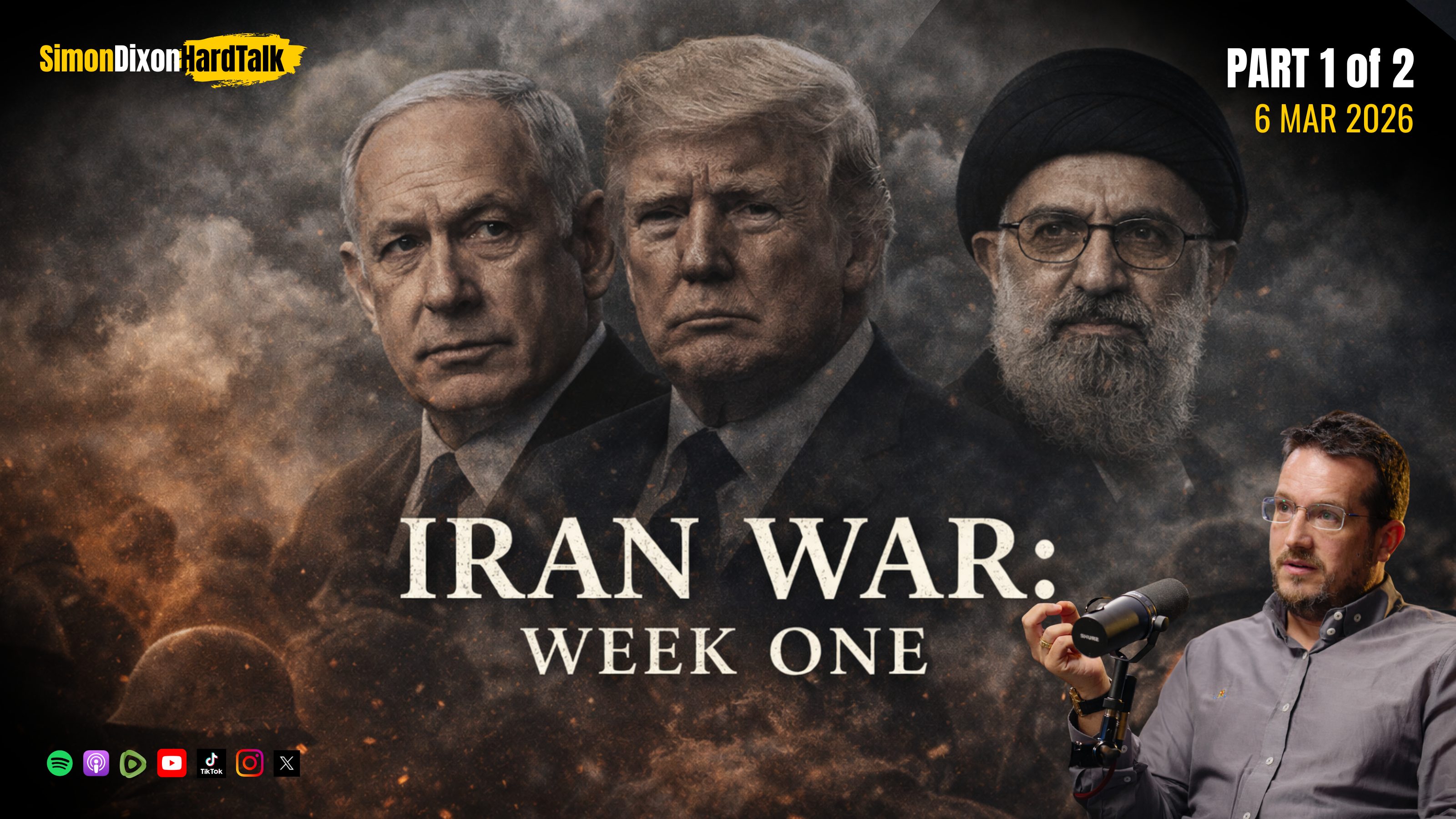
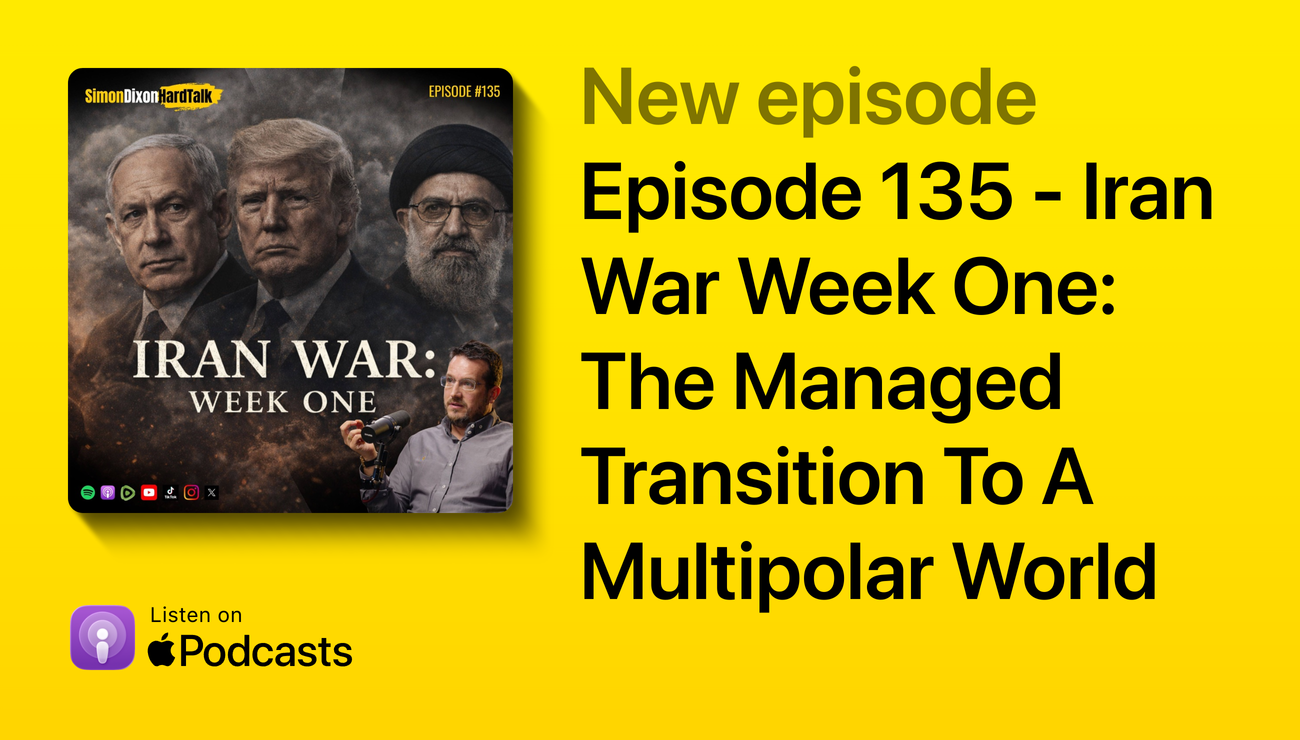
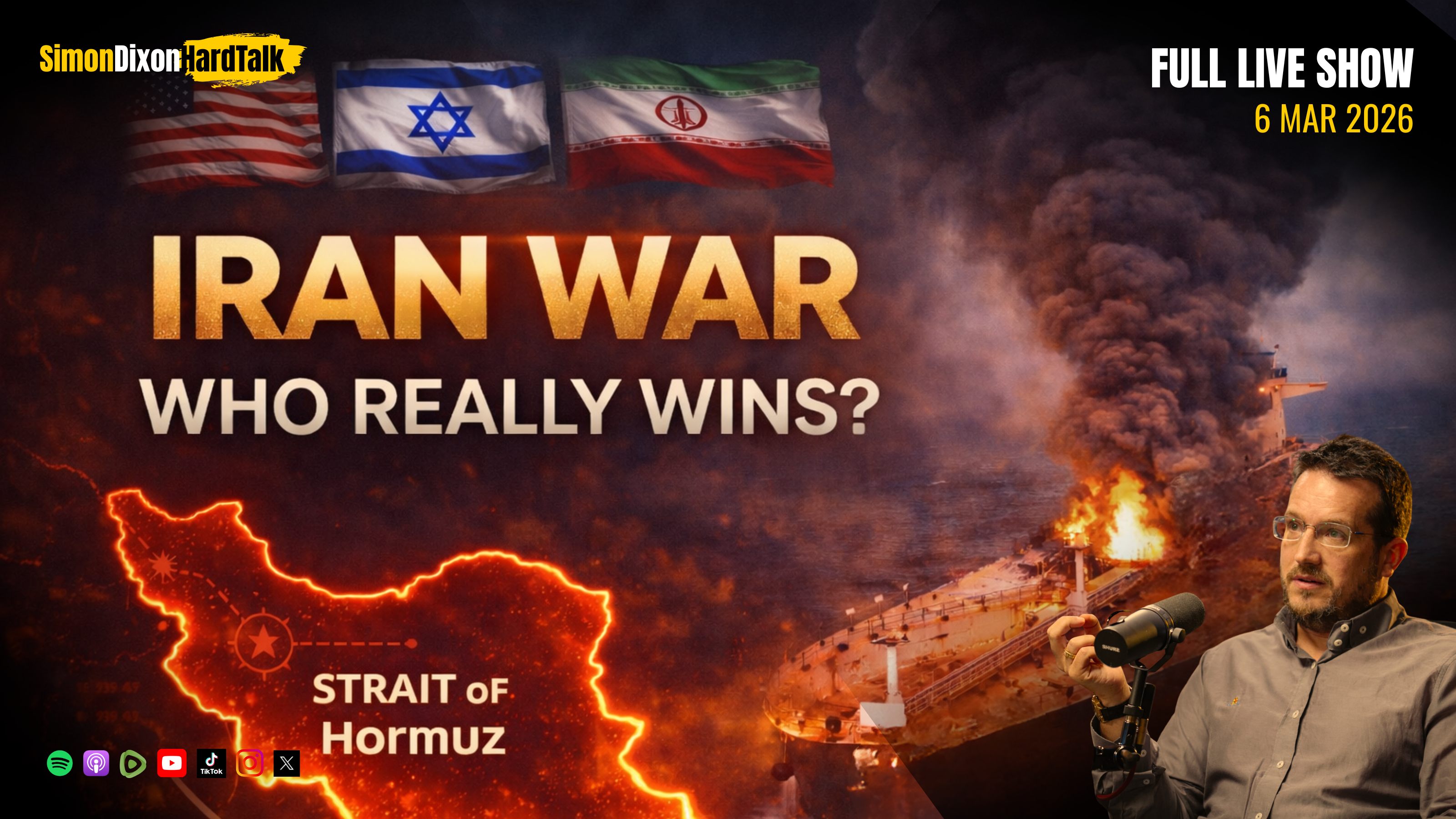
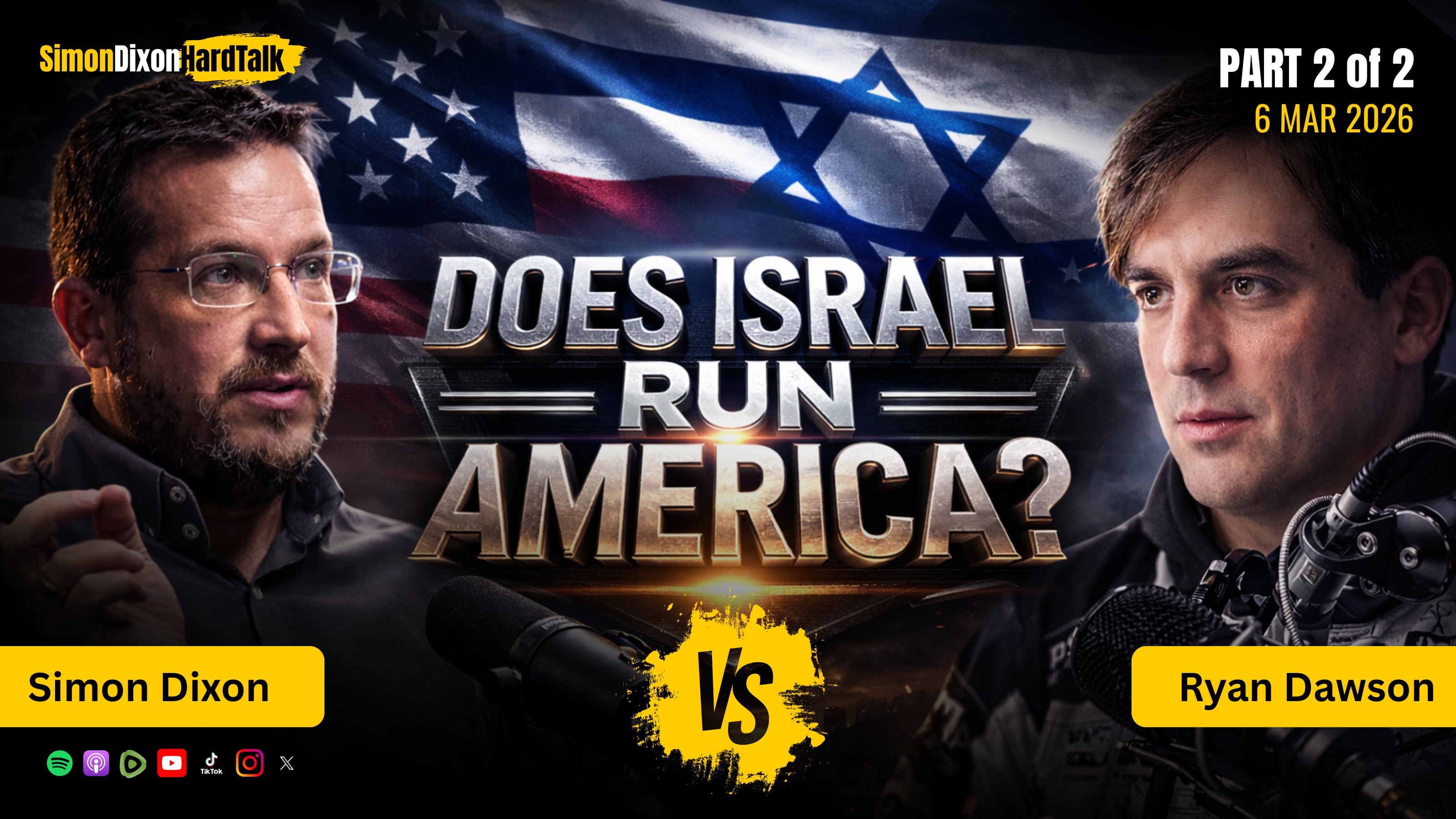
Simon Dixon here. We are currently navigating one of the most significant structural shifts in the history of the modern monetary system. To understand the gravity of the present moment, we must look past the headlines and "follow the money" to the institutional architecture being redesigned beneath our feet. This analysis is a deep dive into the first week of a conflict that I believe serves as the catalyst for a total systemic overhaul. This discussion is based on the livestream titled This Iran War is the Global Reset | SimonDixonHardTalk LIVE, which aired on the 6th of March 2026, with a total duration of 3 hours and 7 minutes. The broadcast was structured into two critical segments to provide a full spectrum of macro-analysis. Part 1, titled Iran War Week One: The Managed Transition To A Multipolar World, lasted 1 hour and 48 minutes and serves as the primary source for this briefing. Part 2 featured a rigorous debate with Ryan Dawson titled Does Israel Really Control U.S. Foreign Policy? | Ryan Dawson vs Simon Dixon Debate, where we examined the nuances of power structures, the deep state, and the differing interpretations of who truly directs the engine of global conflict. This post focuses exclusively on the analysis provided in Part 1, detailing the strategic maneuvers of the first week of the war and its long-term implications for your capital.
The central thesis we are exploring is that the current Iran War is not an accidental escalation or a failure of traditional diplomacy, but rather a managed mechanism—a Global Reset—designed to transition the world from a US-led, debt-based hegemony into a Multipolar World. This is the most critical discussion for capital allocators today because it marks the end of the post-1971 financial order. Since the abandonment of the gold standard, the world has operated on a "proof of weapons" network where US government debt served as the global collateral. Power was enforced by a military-industrial complex that used covert regime changes and dollar-debt standards to ensure every nation purchased US Treasuries. We are now witnessing the controlled demolition of that system. The new order is being dictated by resource extraction, strategic choke points, and the massive leverage of sovereign wealth funds. This is the reorganization of global capital flows in real time, moving away from a single hegemon toward a system where power is distributed among those who control the means of production and the strategic corridors of trade.
Beyond the Cartoon Characters: Deconstructing the Propaganda Narratives
To achieve analytical clarity, we must first strip away the "cartoon character" narratives manufactured for the "lowest denominator of stupidity." On one side, we have the Western and MAGA-aligned propaganda which frames Iran as the nuclear "head of the snake," a theological hub of global terrorism that must be decimated to save Western civilization. This narrative has been recycled for forty years, repeatedly claiming Iran is "two weeks away" from a nuclear bomb to justify permanent military expansion. On the opposing side is the Iranian "anti-imperialist" resistance narrative, which paints the regime as a purely honorable, theological force fighting a holy war against a Zionist-controlled imperialist threat. Both sides utilize emotional rhetoric to obscure the underlying reality: this conflict is about the transition from a "proof of weapons" network to a world governed by financial weapons of mass destruction. These are not ballistic missiles, but rather the ability to reset capital flows, manipulate insurance markets, and reconfigure global supply chains to determine which nations remain sovereign and which become corporate-captured.
The shift we are observing is fundamentally the conclusion of the debt cycle that began when the US dollar became the world's reserve collateral. In the legacy system, the US military functioned as a "pay-for-rent" militia for transnational capital, enforcing the pricing of oil in dollars and ensuring the global demand for American debt. However, as we move toward a Multipolar World, the utility of this model is expiring. The "Epstein class"—the captured political and financial elite exposed through the Epstein files, Wikileaks, and historical anchors like the JFK and 9/11 investigations—is being subordinated by a more efficient, technologically advanced power structure. This new structure does not rely on the blunt instrument of forever wars but on the surgical application of financial pressure to "vassalize" nations through debt. The goal is to move beyond the nationalistic "America First" or "Iran First" rhetoric into a "Transnational Capital First" reality, where the world is reorganized into blocks that facilitate a global AI and surveillance state.
The Factional Power Struggle: Financial vs. Military Industrial Complexes
The current conflict is the outward expression of a high-level power struggle between two transnational entities: the Financial Industrial Complex (FIC) and the Military Industrial Complex (MIC). The Financial Industrial Complex is a global faction that prioritizes the returns of stability, economic integration, and the transition to a multipolar order. This group is hosted in the West but is increasingly aligned with the Gulf Cooperation Council (GCC) sovereign wealth funds—specifically Saudi Arabia’s PIF, the UAE’s ADIA, and Qatar’s QIA. Major players include asset management titans like BlackRock, Vanguard, and State Street, alongside the sovereign power of China. Their objective in the Middle East is to end the "forever war" model and replace it with regional stability that allows for massive infrastructure investment and the implementation of a Technical Industrial Complex focused on AI and data centers. They view the military not as a tool for hegemony, but as a security service to protect the "Build Back Better" programs that follow the reset.
In opposition stands the Military Industrial Complex, a faction that profiteers from permanent conflict and the maintenance of US dominance. This group includes deep state elements within the CIA, Mossad, and MI6, hardline factions of the Islamic Revolutionary Guard Corps (IRGC), and the radical Zionist coalition led by Netanyahu. Their revenue models depend on the $1.5 trillion Pentagon budget and the continued sales of hardware from companies like Lockheed Martin, General Dynamics, Raytheon, and Palantir. For the MIC, instability is the product. They utilize strategic tension to justify the expansion of debt and the propping up of the dollar. However, they are currently being outmaneuvered by the FIC’s multi-trillion dollar asset management budgets. The FIC is effectively "hiring" the conflict to serve as a sorting mechanism, determine which actors are on board with the multipolar transition, and eliminate those who are not. This is why we see transnational capital moving away from the "war is a racket" model toward a "stability is a return" model in the Middle East, provided that stability is managed through a centralized, technical surveillance architecture.
Defining Theatrical War: Bounded Conflict and Agreed Parameters
When I describe this conflict as "theatrical," I am not suggesting that the destruction is illusory or that lives are not being lost. On the contrary, the consequences are tragically real. However, the term "theatrics" refers to the fact that the conflict is "bounded" by pre-negotiated parameters between global superpowers. We are witnessing the second round of the “12-day war model”, characterized by a "controlled escalation ladder" designed to reach a specific off-ramp without triggering a total global financial collapse or unmanaged World War III. The framework for this was likely solidified during the Aman negotiations on February 27th, where a framework for nuclear enrichment and regional security was discussed among the survivors of the various factions. The war serves as the narrative mechanism to justify the radical changes that are already agreed upon at the highest levels of the Financial Industrial Complex.
In this theatrical framework, strikes are often symbolic. We see the targeting of "empty" US military bases that were likely evacuated in advance, or "tick-for-tac" strikes on command centers that allow both sides to claim a domestic victory while moving toward a pre-arranged settlement. If a fighter jet is shot down or a specific building is destroyed, it is often a "sacrificial" move on the geopolitical chessboard to facilitate the next stage of the reset. This bounded escalation allows for the removal of "wild cards"—the hardline factions within the IRGC or the Netanyahu coalition that might go "off script." By increasing the pressure, the FIC and its partners (Russia and China) can force these actors into a position where they are either integrated into the new multipolar architecture or eliminated through the "fog of war." The goal is to reach the April meeting between Xi Jinping and Trump with a clean slate for a new global trade and security agreement.
If you want to truly grasp the foundation of the "12-day war model" we are witnessing again right now, you need to understand exactly how the first round was executed. Back in June 2025, I broke down this exact playbook in my post, The Play-by-Play Theatre of the Iran, Israel & US War. While the mainstream media was screaming about an imminent World War III, I followed the financial flows to expose how that initial 12-day conflict was actually a pre-scripted, 5-act performance designed to shift power from the military to the financial-industrial complex. In that analysis, I reveal how symbolic, agreed-upon strikes were used to strategically weaken assets for corporate takeover, eliminate hardliners, and vaporize over 240,000 Bitcoin to fund the "proof of weapons network". The bounded, theatrical escalation we are seeing today is just the next phase of that same global financial reset, so I highly recommend you go back and read that original breakdown to see exactly how this geopolitical theatre is choreographed behind the curtain.
🇮🇷🇮🇱🇺🇸The Play-by-Play Theatre of the Iran, Israel & US War

The Strait of Hormuz: A Global Commodity Stress Test
The first week of the war saw the execution of a sophisticated global commodity stress test: the closure of the Strait of Hormuz. While the Iranian parliament and the IRGC provided the military pretext, the actual closure was enforced by the Financial Industrial Complex using its most potent weapon—the insurance markets. By setting war risk premiums at an unprecedented 75% of tanker value, the FIC effectively paralyzed the shipping route. This move was not just about oil; it was an experiment to observe the systemic impact of resetting global resource flows. The market reactions were immediate, with oil spiking to 92 per barrel**—a significant jump, though still below the $125–$130 highs seen during previous crises, suggesting that capital markets already anticipate a managed off-ramp.
The closure sent a systemic shock through the AI memory chip supply chain, as South Korea and Japan are heavily dependent on the strait for both energy and the movement of semiconductors. This disruption was strategically timed with the Bank of Japan rate hikes, creating immense pressure on the Japan carry trade. By controlling the flow of oil and gas, the FIC has accelerated the "vassalization" of Europe. As the TTL index for European gas surged by 50% due to the shutdown of Qatari and Russian supplies, Europe was forced to negotiate from a position of extreme weakness. The result is Europe’s transition into a high-value trade dependency on US LNG, ensuring that while the US as a nation-state may be weakening, the US-hosted Financial Industrial Complex secures long-term control over the European energy market. This is the "Build Back Better" strategy applied at a continental scale, where destruction facilitates a new, more integrated dependency.
The Managed Outcome: Weaker Actors, Stronger Alliances
The predicted end-state of this managed transition involves the fundamental weakening of primary combatants to facilitate their integration into the new order. Israel is currently being "vassalized" through a combination of massive debt and the privatization of state assets. With the war costing an estimated 3 billion per week, Israel is rapidly depleting its -$230 billion in reserves, making the state subordinate to international bondholders and the FIC. I believe this process is designed to lead to an internal regime change where the Netanyahu coalition is replaced by a government aligned with the GCC and the Financial Industrial Complex. This new leadership will likely accept a Palestinian statehood model, funded by GCC sovereign wealth and managed through the Technical Industrial Complex, effectively ending Israel’s utility as a "Mick antagonizer" and turning it into a regional tech and security hub for the new multipolar order.
Similarly, Iran is undergoing an internal regime change to facilitate its normalization. The helicopter crash that took out the Prime Minister and Defense Minister served as a catalyst to remove hardline obstacles. The remaining leadership, including reformists like Pezeshkian, negotiators like Araghchi, and figures like Larijani, are the faces of an Iran that will be integrated into the BRICS and China-GCC framework. This Iran will be "weaker" in terms of its legacy military posture but "normalized" in terms of its participation in global capital markets. As these regional powers align, the traditional US military bases—the primary enforcement mechanism for the petrodollar—become obsolete. These bases are being replaced by a security architecture where regional powers take autonomy, and the US military transitions into a regional force, no longer capable of or required for global hegemony.
Strategic Implications for Sovereign Wealth Builders
For the Sovereign Wealth Builder, the most significant signal from the first week of the war was the Financial Times announcement that the GCC is reviewing hundreds of billions of dollars in US investments. This is the climax of the "follow the money" thesis. We are witnessing a strategic shift where sovereign wealth funds are moving their capital away from US Treasuries—the legacy collateral of the debt standard—and into US equities and AI infrastructure. This is an "asset-stripping" mechanism. Foreign capital is no longer interested in funding American deficits; it wants ownership of the data centers, energy grids, and the "means of production" for the coming AI era. The FIC is using this war to facilitate the redistribution of global wealth, allowing the US & Russia to become a regional power while foreign markets and currencies are positioned to outperform the dollar in the long term.
The strengthening of the dollar (DXY) to 99 during the initial shock of the war is a temporary phenomenon, a final "sucking in" of liquidity before the long-term weakening campaign resumes. The goal is a "soft landing" for the global elite, where the US dollar is de-leveraged and the world transitions to a multipolar system managed by a decentralized but highly integrated digital infrastructure. This transition will be delivered through the "Build Back Better" reconstruction contracts that follow the war’s destruction, funded by the very sovereign wealth funds currently reviewing their US Treasury holdings. For capital allocators, the play is to align with the Financial Industrial Complex and the Technical Industrial Complex, moving away from debt-based instruments and toward the "ownership" of the infrastructure that will define the surveillance and AI-driven global economy.
Conclusion & Call to Action
We are witnessing the birth of a Multipolar World through a managed, theatrical, yet highly consequential transition. The Iran War is the catalyst for the Global Reset, a reorganization of the world's financial, military, and technical structures. While the mainstream narratives focus on "good vs. evil" or nationalistic pride, the real struggle is between the legacy Military Industrial Complex and the emerging Financial Industrial Complex. The old world order is not returning; it is being surgically dismantled to make way for a system where resource control and technical surveillance are the new reserve collateral. As sovereign wealth builders, your task is to remain objective, ignore the "cartoon characters," and follow the flows of capital into the new architecture of power.
To gain a deeper understanding of these shifts and to see the full play-by-play analysis of the financial transactions and geopolitical maneuvers, I encourage you to watch the full livestream replay.
- Share this post. Share this blog post to expose the "divide and conquer" trap.
- Subscribe to the Simon Dixon YouTube channel. Get my weekly deep dives into geopolitics, macro, and Bitcoin. Subscribe to my YouTube channel.
- Find me on Rumble. This is my backup channel, safe from censorship. Follow me on Rumble.
- Follow me on X @SimonDixonTwitt. I post real-time updates and analysis on X and am highly active there. Follow me on X.
- Follow me on instagram. Usually short clips are posted here.
- Follow me on TikTok. Usually short clips are posted here.
- SimonDixon.com. This is my personal site and an archive of all my content, safe from de-platforming. Join the free membership portal.
Staying informed and analytical is your best defense in a world of managed theater.
Watch on YouTube
Prefer to Listen? Available on Spotify & Apple Podcasts
Read other related blogs

Disclaimer
This content is for informational and educational purposes only and does not constitute financial, legal, or investment advice. Macroeconomic and geopolitical commentary reflects analysis and interpretation based on the source material rather than statements of fact. All investment decisions should be made based on your own research and the consultation of qualified professionals. The author is not responsible for any financial losses or decisions made based on the information provided in this article. The concept of "Theater" and "Managed Transition" are analytical frameworks used to describe complex geopolitical events and should not be interpreted as a denial of the real-world consequences of conflict. Participants in financial markets should be aware that geopolitical instability carries significant risk.