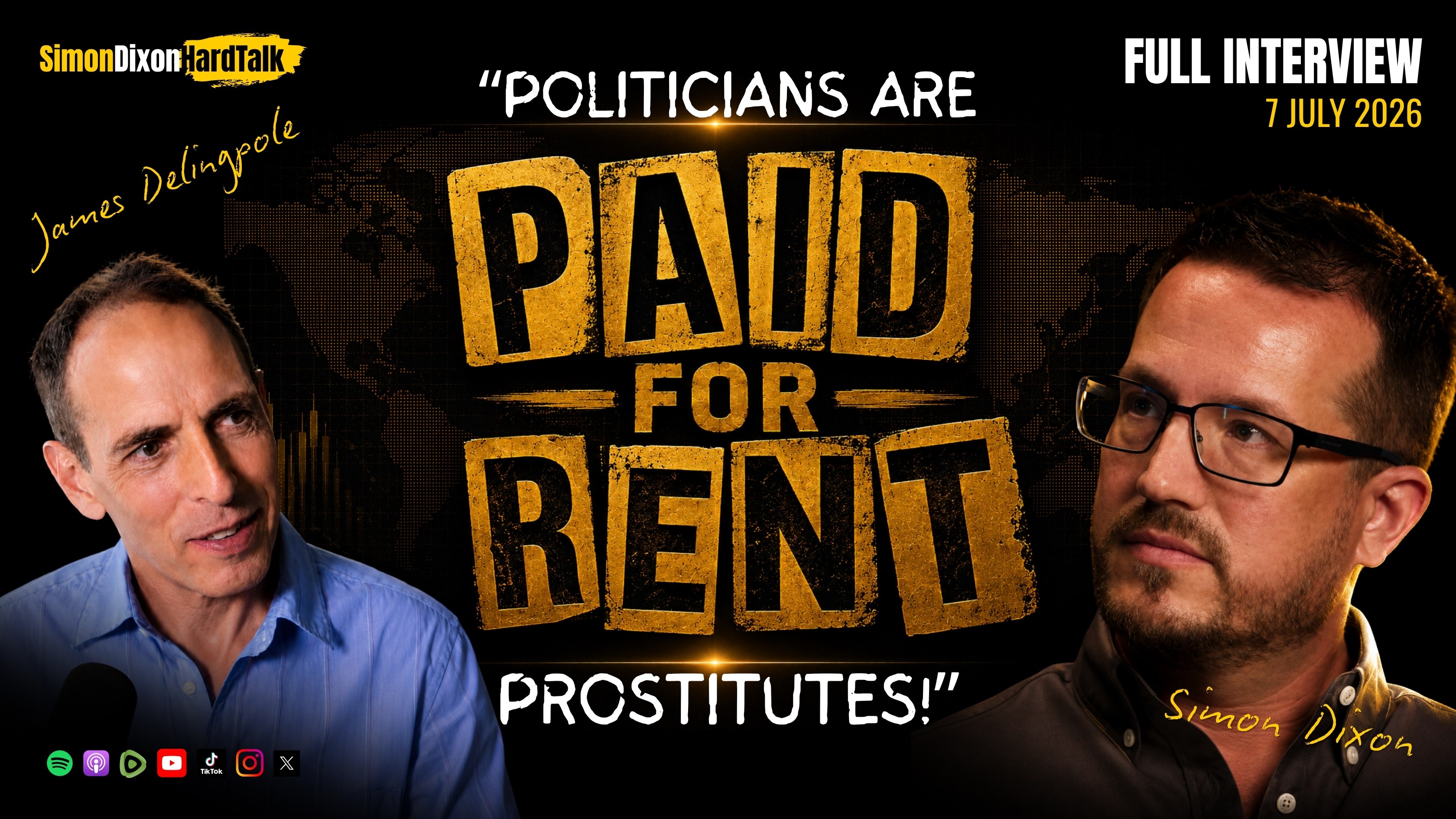
Politicians Are "Paid-for-Rent Prostitutes": The True Mechanics of Power | Simon Dixon on The James Delingpole Channel w/ James Delingpole
Jul 07, 2026Executive Summary
On 7 July 2026, Simon Dixon participated in his first-ever interview with James Delingpole on The James Delingpole Channel. In this two-hour discussion, Dixon synthesizes 26 years of experience in the financial sector to outline the "Financial Industrial Complex" (FIC), the "Military Industrial Complex" (MIC), and the emerging "Technical Industrial Complex" (TIC).
The central thesis posits that modern nation-states are subordinate to these transnational complexes, which maintain power through "socialized losses and privatized gains." Dixon argues that politicians are essentially "paid-for-rent prostitutes" who are groomed and compromised to serve the interests of capital rather than the electorate. He identifies a global shift where the FIC is being displaced by the TIC, where data and algorithms—rather than just money—become the primary levers of control.
The primary recommendation for individuals is to move from a state of "subordination" to "sovereignty" by exiting the legacy financial system. This is achieved through self-custody of assets like Bitcoin and gold, boycotting institutional investment vehicles (like ETFs), and supporting local community networks to bypass the surveillance grid being established by the TIC.
High-Level Overview
The interview serves as an autopsy of the global power structure and a strategic guide for personal financial independence. The discussion frames global events—including the COVID-19 pandemic, the war in Ukraine, and Middle Eastern tensions—not as isolated political incidents, but as deliberate operations designed to concentrate wealth, test surveillance technology, and facilitate a "global reset" of the world order.
The conversation moves from Dixon’s personal origin story—motivated by his father’s financial ruin—to a macro-analysis of how central banking, intelligence agencies, and technology monopolies cooperate to manage a "forever war" business model.
Key Arguments Made by Simon Dixon
The Mechanics of the "Complexes"
- The FIC (Financial Industrial Complex): Dixon believes the root of the system is central banking, specifically the Bank of England and the Federal Reserve. These institutions allow for an "elaborate money laundering scheme" where losses are socialized (passed to taxpayers) while gains are privatized by clearing member banks and asset managers like BlackRock, State Street, and Vanguard.
- The MIC (Military Industrial Complex): War is described as a "racket" and a primary business model. Dixon argues that 95% of intelligence/deep state funding allegedly comes from "black ops" such as drug, human, and weapons trafficking. The goal is the "forever war," which justifies debt issuance; the ultimate profit is realized in the "rebuild contracts" which are 10 times more profitable than the war itself.
- The TIC (Technical Industrial Complex): Power is currently shifting from money (FIC) to data (TIC). Dixon identifies companies like Palantir, SpaceX, and X (formerly Twitter) as nodes in a new surveillance grid. He believes the TIC aims to implement a global technocratic grid involving "Universal Basic Income" and "Smart Cities" (which he compares to open-air prisons like Gaza) to manage a population that is increasingly in debt.
Political Subordination and Grooming
- Politicians as Prostitutes: Dixon argues that politicians do not hold real power. They are groomed through financial incentives, lobby funding, and "net-brat operations" (e.g., Jeffrey Epstein) to ensure they are compromised before reaching high office.
- The Liz Truss Example: Dixon cites the brief tenure of Liz Truss as evidence that the Bank of England and financial markets can "rug-pull" any politician who attempts to implement policy contrary to FIC interests.
- Regime Change: He claims the UK has seen seven "regime changes" in ten years, suggesting that changing the party in power does not change the underlying system, as all sides are funded by the same complexes.
The Strategy of Exit (Bitcoin and Sovereignty)
- Bitcoin as a Breakaway Project: Dixon believes Bitcoin was a "breakaway project" from the digital surveillance grid being built by the banks. He suspects Len Sassaman was Satoshi Nakamoto and that Bitcoin was designed to allow peer-to-peer transactions without a central authority.
- The ETF Trap: He warns that Wall Street's push for Bitcoin ETFs is an attempt to "centralize" and "paperize" Bitcoin, similar to what was done with gold, to manipulate the price and prevent people from owning the actual asset in self-custody.
- Sovereignty: The path to freedom is a "multi-decade unwinding process." This involves moving from a "subordinate" (debt-ridden, dependent on banks) to a "sovereign" (self-custodied assets, debt-free, local community support) lifestyle.
Key Arguments Made by James Delingpole
- Media Manipulation: Delingpole reflects on his career as a mainstream journalist, noting that he eventually realized the entire system was corrupt. He argues that the media uses "Operation Mockingbird" tactics to marginalize dissenters.
- Skepticism of Narratives: He expresses skepticism regarding the "lab leak" theory of COVID-19, suggesting it might be "another bollocks theory" designed to distract from the idea that the entire pandemic narrative was manufactured.
- Divide and Conquer: Delingpole observes that even within the "resistance" movement, podcasters and figures are often manipulated by algorithms to fight each other, which serves the interests of the power structure.
- Financial Epiphany: He admits to having a personal epiphany regarding the corruption of the system, which led him to leave mainstream journalism and move down the "rabbit hole" of alternative history and finance.
Points of Agreement
- The Illusion of Democracy: Both participants agree that voting for different political parties (Labour vs. Conservative, Democrat vs. Republican) is a distraction, as the policy is written by NGOs, think tanks, and the FIC.
- Strategic Tension: They agree that the "divide and conquer" strategy is used to radicalize the public into opposing camps (e.g., left vs. right, religious tensions) to prevent a unified uprising against the power structure.
- War as a Racket: Both agree with the Smedley Butler premise that war is a business model used to transfer wealth from the public to private contractors and banks.
- Psychological Operations: They agree that the term "conspiracy theorist" was a CIA-invented label designed to ridicule and ostracize anyone who exposes the mechanics of power.
Points of Disagreement
- The Origins of COVID-19: While both agree the pandemic was weaponized, Dixon focuses on the "incentives" and the flow of money (e.g., Fauci funding labs in Wuhan/Ukraine), whereas Delingpole is more inclined to believe the entire "virus" narrative might have been a total fabrication or a psychological operation from the start.
- Interpretation of Public Figures: Delingpole expresses sympathy for figures like Ross Ulbricht, whereas Dixon remains more skeptical, questioning if certain figures or platforms (like Silk Road or certain high-profile whistleblowers) might be "honeypots" or part of a larger intelligence operation.
Important Data, Claims, or References Mentioned
The Three Industrial Complexes
|
Complex |
Primary Actors Mentioned |
Mechanism of Control |
|
FIC (Financial) |
Bank of England, Fed, BlackRock, Vanguard, State Street |
Central banking, debt issuance, ETFs, socialization of losses. |
|
MIC (Military) |
Lockheed Martin, BAE Systems, General Dynamics, CIA, MI6, Mossad |
Forever wars, black ops, drug/human trafficking, rebuild contracts. |
|
TIC (Technical) |
Palantir, SpaceX, X, OpenAI, Anthropic |
Data, AI, surveillance, social credit scores, "Smart Cities." |
Historical Operations and References
- 1694: Creation of the Bank of England to fund war for the Crown and the East India Company.
- Operation Mockingbird: CIA operation to take over and influence the media.
- Operation Ajax: Regime change in Iran.
- Operation Gladio: Manufacturing "stay-behind" armies and strategic tension/terrorism in Europe.
- The Club of Rome (1968): Think tank credited with writing depopulation policy.
- Petrodollar (1974): Agreement between US and Saudi Arabia to price oil in dollars and reinvest in US treasuries.
- Mbridge: A network of central bank digital currencies (CBDCs) currently being built to circumvent the SWIFT system.
Financial Statistics
- Bitcoin Price: Referenced at roughly $63,000 (with an all-time high of $125,000 mentioned in the context of the future).
- SpaceX Valuation: $175 billion (used as an example of a TIC company using stock as currency).
- Asset Management: BlackRock’s assets under management grew from $12 trillion to $14 trillion recently.
Notable Quotes or Framing
- "Politicians are just paid-for-rent prostitutes."
- "Socialize the losses and privatize the gains."
- "The goal was to follow the work of Digicash... Bitcoin was a breakaway project."
- "War is a racket... peace is only allowed when it is 10 times more profitable than the forever war."
- "Your job is to slowly each month say: 'Am I more subordinate or more sovereign?'"
- "They want you gambling, degenerate, short-term thinking, borrowing, leveraged... they want you captured."
Open Questions or Unresolved Issues
- The Role of China: Whether China is a genuine "sovereign" challenger to the FIC/TIC or if they are ultimately cooperating to build a global technocratic grid remains a point of interpretive analysis.
- The Identity of Satoshi Nakamoto: While Dixon strongly believes it was Len Sassaman, it remains unproven and denied by Sassaman's family.
- The "Moneyless World": Dixon suggests we may be moving toward a "moneyless world" under a TIC grid, but the exact mechanism of how this replaces the current debt-based FIC system is speculative.
- The "Singularity": The point at which AI and the TIC completely displace traditional human-governed financial and military structures.
About James Delingpole
James Delingpole is an independent podcaster, author, and former mainstream media journalist. During his career in traditional media, he wrote comment pieces for publications such as the Mail on Sunday and the Telegraph, and held a regular column in The Spectator. He is also the author of the 2012 book Watermelons, which details his skeptical views on man-made climate change and the "climategate" controversy.
Delingpole later transitioned away from mainstream journalism to establish his own independent media platform. He currently hosts The Delingpod on The James Delingpole Channel, a podcast where he interviews guests on various topics including alternative history, finance, and global power structures. Additionally, he has publicly shared that he was an early adopter of cryptocurrency, having first purchased Bitcoin when it was trading at approximately $300.
Watch On YouTube
Call To Action
- Share this post. Share this blog post to expose the "divide and conquer" trap.
- Subscribe to the Simon Dixon YouTube channel. Get my weekly deep dives into geopolitics, macro, and Bitcoin. Subscribe to my YouTube channel.
- Find me on Rumble. This is my backup channel, safe from censorship. Follow me on Rumble.
- Follow me on X @SimonDixonTwitt. I post real-time updates and analysis on X and am highly active there. Follow me on X.
- Follow me on instagram. Usually short clips are posted here.
- Follow me on TikTok. Usually short clips are posted here.
- SimonDixon.com This is my personal site and an archive of all my content, safe from de-platforming. Join the free membership portal.
Prefer To Listen? Available on Spotify & Apple Podcasts

Read Other Related Blogs
- FULL EPISODE: The AI Sell-Off, Bitcoin Wallet Hacks & Global Realignment | Simon Dixon Hard Talk LIVE
- PART ONE: AI Unwinds, Bitcoin Wallet Hack & the Middle East Realigns | Simon Dixon Hard Talk LIVE


General and Legal Disclaimers
- General Information & Expression of Opinion The content provided in this blog post is a summary of an interview between Simon Dixon and James Delingpole, originally hosted on The James Delingpole Channel on 7 July 2026. The views, theories, and opinions expressed in this document—including those concerning the "Financial Industrial Complex" (FIC), "Military Industrial Complex" (MIC), and "Technical Industrial Complex" (TIC)—belong solely to the speakers and do not necessarily reflect the views of the author, publisher, or any affiliated organizations. Simon Dixon explicitly notes that many of his statements regarding geopolitical shifts and institutional motives are his own "interpretive" analysis and that he "couldn't prove any of this" definitively.
- No Financial, Investment, or Legal Advice While this blog discusses Simon Dixon’s 26 years of experience in the financial sector, his historical background as an investment banker, and his personal strategies regarding wealth management, the content is provided for educational and informational purposes only. Discussions surrounding the self-custody of assets like Bitcoin and gold, the boycotting of ETFs, and the navigation of the legacy financial system do not constitute professional financial, investment, or legal advice. References to historical or current asset valuations, such as Bitcoin's price fluctuations, are for illustrative context only. Readers should always consult with a certified financial advisor or legal professional before making any financial decisions or investments.
- Unverified Claims and Allegations This document contains statements and allegations regarding public figures, political systems, intelligence agencies, and historical events that represent the personal beliefs and theories of the speakers. For example, claims regarding the funding of intelligence agencies through "black ops," the origins and management of the COVID-19 pandemic, and the characterization of politicians as "paid-for-rent prostitutes" are presented as the opinions and allegations of Simon Dixon and James Delingpole. Furthermore, Dixon’s belief that Len Sassaman was Satoshi Nakamoto is an unproven theory that Sassaman's own family denies, as Dixon himself acknowledges. Readers are strongly encouraged to independently verify any historical references, data points, or legal claims mentioned in this text.
- Limitation of Liability The author and publisher of this blog make no representations as to the absolute accuracy, completeness, or validity of any information contained herein. They will not be liable for any errors, omissions, or delays in this information or any losses, injuries, or damages arising from its display or use. All information is provided on an as-is basis.