They’re Preparing to Collapse Europe: War, Energy Crisis & the Global Control Grid | Simon Dixon on CapitalCosm w/ Danny
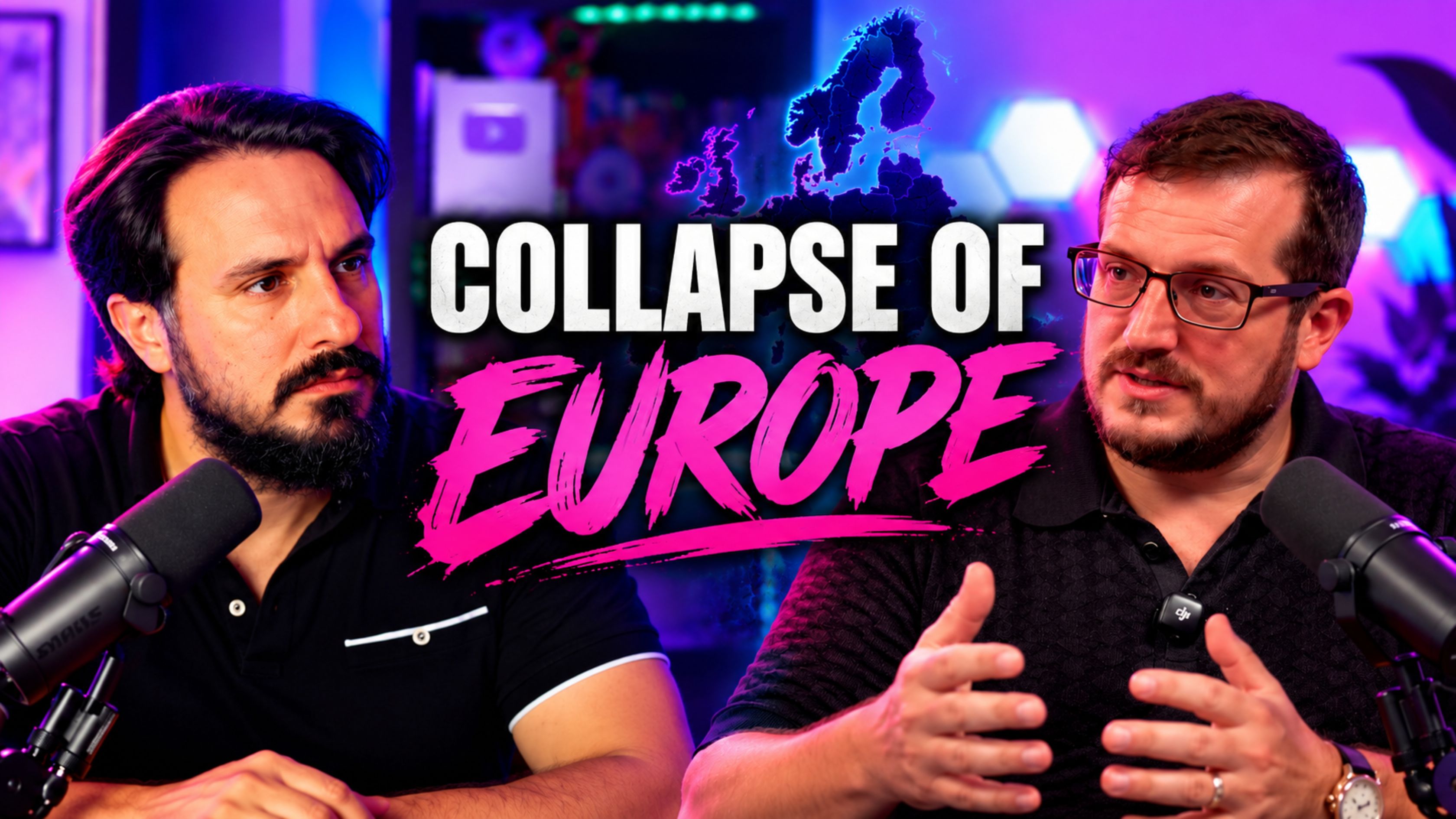
Oct 23, 2026Context: On 21 October 2026, Simon Dixon was invited as a guest by Danny, the host of the YouTube channel Capital Cosm, for a 47-minute interview titled "They're Preparing To Collapse Europe (what's next is terrifying) | Simon Dixon".
High-Level Overview
The interview centered on the convergence of global macroeconomics, energy market dislocations, technology infrastructure consolidation, and geopolitical realignments. The central framing posits that the global economy is undergoing a structural wealth transfer from the consumption layer (Main Street consumers, mortgage holders, energy-dependent states) to the ownership layer (creditors, asset managers, energy refiners, and defense technology operators).
Key topics covered include:
- The Global Energy & Diesel Shortage: The disconnect between WTI crude futures pricing ($97/barrel) and refined product prices (diesel/jet fuel crack spreads), and its potential to trigger demand destruction within five months.
- Cost of Capital & Sovereign Debt: Rising interest rates, US national debt exceeding $40 trillion, Treasury yield curve interventions, and the shift from Federal Reserve Quantitative Easing (QE) to US Treasury auction manipulations.
- The Interlocking Power Complexes (FIC, TIC, and MIC): The institutional hierarchy where the Financial Industrial Complex (FIC) subordinate both the Technology Industrial Complex (TIC) and the Military Industrial Complex (MIC) through capital allocation control.
- Technological Consolidation & Digital Surveillance: The valuation spikes of SpaceX and potential merger with Tesla, serving as a unified control grid (robotics, AI, social credit/analytics, financial rails, and military communications).
- Geopolitical and Regional Realignments: The economic and structural decline of European states, the rise of regional blocks in West Asia/Middle East (including the Mecca Agreement), and the utilization of military conflicts (Ukraine and Iran) as testing grounds for surveillance, drone technology, and police state deployment.
Key Arguments Made by Simon Dixon
Macroeconomics, Debt, and Energy Shocks
- Crack Spread Disconnect: Simon Dixon stated that the crude oil benchmark price ($97/barrel WTI) is misleading; the real economic pressure lies in the wide crack spread between crude oil and refined products like diesel and jet fuel.
- Impending Demand Destruction: In Simon Dixon's view, global energy markets face severe diesel shortages within the next five months, which could lead directly to demand destruction across Western economies.
- Inefficacy of Strategic Releases: Simon Dixon noted that announcements regarding Strategic Petroleum Reserve (SPR) releases (primarily by the US and Japan) and sanction relief optics (e.g., regarding Russian diesel or Indian cooking oil deals) represent minor, temporary interventions (equivalent to ~1 day of supply) that fail to resolve structural 5-month supply gaps.
- Shift to Energy Protectionism: Simon Dixon argued that nation-states are shifting from exporting energy to hoarding reserves for domestic security, re-routing energy corridors through new pipelines (e.g., Cyprus to Egypt) and maritime agreements (e.g., Turkey and Libya).
- Treasury Interventions vs. Federal Reserve QE: Simon Dixon explained that current US Treasury market interventions (buying long-term bonds at high yields and issuing short-term debt at lower rates) do not constitute Federal Reserve Quantitative Easing (QE) yet. Instead, they represent emergency sovereign debt rollover management driven by the FIC requiring higher yields.
- Monetization of Volatility: Simon Dixon asserted that investment banks (such as JPMorgan and Goldman Sachs) generate substantial profits by monetizing market volatility and driving M&A activity, concentrating capital upward regardless of broader equity index performance.
Institutional Architecture: FIC, TIC, and MIC
- Structural Subordination: In Simon Dixon’s analytical model, power is structured across three primary institutional vectors:
- FIC (Financial Industrial Complex): Asset managers (e.g., BlackRock), central/commercial banks, pension funds, and debt issuers.
- TIC (Technology Industrial Complex): Data center operators, AI developers, and hardware manufacturers.
- MIC (Military Industrial Complex): Defense contractors and state military departments.
- Dominance of Capital: Simon Dixon emphasized that the MIC and TIC are ultimately subordinate to the FIC because the FIC controls capital allocation, debt markets, board seats, and corporate executive incentives.
Technology Infrastructure and the Centralized Control Grid
- Data Infrastructure as Financial Backbone: Simon Dixon believes data centers and artificial intelligence represent the core technical infrastructure of the financial system, mirroring how US Treasuries form the financial backbone.
- SpaceX-Tesla Integration: Simon Dixon argued that a potential merger between SpaceX ($1.75 trillion IPO valuation framework) and Tesla would unite key components of a centralized surveillance and operational grid: physical robotics, AI processing, private financial rails (X money), social analytics, and satellite military communications.
- Corporate Subordination via Debt: Highly valued tech firms (e.g., OpenAI, Anthropic, Oracle) remain dependent on FIC debt markets to fund massive data center expansion plans (e.g., Anthropic's projected $450 billion 10-year expenditure), making executives compliant with institutional shareholders.
Geopolitical Trends and the European Surveillance State
- Decline of European Sovereignty: Simon Dixon argued that European empires are the primary economic and geopolitical losers in current global shifts, manifesting in severe cost-of-living crises, social unrest, and decolonization losses in Africa (e.g., Niger, Chad).
- Civil Unrest as a Beta Test: In Simon Dixon's opinion, civil unrest across Europe and the UK is being utilized by governing authorities to justify increased NATO expenditures, higher defense budgets, and the beta-testing of police and surveillance technologies (e.g., CBDCs, pre-crime detection, digital identity verification, and social media screening).
- Middle Eastern Regional Realignment: Simon Dixon stated that conflict in the Middle East is moving away from the "forever war" paradigm toward regional power balance and state integration involving Saudi Arabia, Turkey, Egypt, Iran, and Pakistan (e.g., via the Mecca Agreement).
- Political Irrelevance of Elections: Simon Dixon expressed the view that US midterm and presidential elections do not alter macro trajectories because the FIC controls both major political parties. He described partisan political fixation as a distraction for "useful idiots."
Individual Protection Strategy
- Consumption Layer vs. Ownership Layer: Simon Dixon advised that individuals on the "consumption layer" (those reliant on wages, paying high interest on debt/mortgages, and consuming AI passively) will continue to lose wealth in a K-shaped economy.
- Asset Allocation Imperative: Simon Dixon recommended that individuals transition to the "ownership layer" by consistently acquiring income-producing or capital assets every month via dollar-cost averaging, regardless of market timing.
Key Arguments Made by Other Participants
Danny (Host of Capital Cosm)
- Energy and Supply-Side Inflation: Danny highlighted that crude oil reaching $97/barrel combined with historic crack spreads indicates an acute crisis in final refined fuels (diesel, jet fuel) rather than raw crude availability.
- Unprecedented Macro Intersections: Danny argued that the current intersection of demand-side monetary inflation (money printing, Treasury buybacks) and supply-side energy bottlenecks is significantly more dangerous than the 1970s stagflation crisis due to the unprecedented level of US national debt ($40+ trillion).
- Bond Market Vulnerability: Danny pointed out that the 20-year US Treasury bond ETF (TLT) has lost over half its value since 2020, cautioning that standard retirement IRAs heavily allocated in bonds (20% to 60% depending on age) are exposed to severe real-capital losses.
- Pension Fund Exposure to Private Credit: Danny raised concerns that retirement funds and university endowments are absorbing bad debt by purchasing high-risk "junk bonds" and private credit associated with AI and data center expansions, echoing the repackaging of subprime mortgages prior to 2008.
- Market Manipulation via News Cycles: Danny observed that whenever market crashes appear imminent, major corporate news releases (such as SpaceX beating earnings and floating a Tesla merger) are pulled out to shift media sentiment from extreme bearishness to bullishness.
- Escalation and Conscription Clues: Danny cited recent military rhetoric—including a UK general stating citizens must prepare for personal sacrifices regarding the Ukraine war—and Ukrainian micro-drone deployments in Iraqi Kurdistan as evidence of potential war escalation involving Europe and Iran.
Points of Agreement
- Energy as the Foundation: Both participants agreed that energy constitutes the fundamental backbone of all economic activity and that refined diesel availability dictates real-world supply chain mechanics.
- Severity Relative to the 1970s: Both agreed that comparing current conditions to the 1970s understates the systemic risk, as US debt-to-GDP was 50–60% in the 1970s compared to over 120% today.
- Pension System Risk: Both agreed that retail pension funds and retirement accounts are being systematically exposed to high-risk private credit, discounted illiquid assets, and depreciating sovereign bonds.
- Efficacy of Technology Infrastructure: Both agreed that technology companies (such as SpaceX, Tesla, OpenAI) act as essential infrastructure providers for both state defense mechanisms and private financial systems.
- Political Continuity: Both agreed that changes in political leadership (Democrats vs. Republicans) fail to interrupt structural wealth transfers managed by financial markets.
Points of Disagreement & Nuances
- Timeline of Energy Crisis Realization:
- Simon Dixon's Nuance: Simon acknowledged that his initial timeline projections for acute Western market disruptions were overly aggressive (expecting full crisis impacts earlier than 7 months post-war outbreak). He noted that alternative trade routes, ship-to-ship transfers, and dark market re-routing delayed the immediate onset of shortages.
- Imminence of World War III:
- Danny's Angle: Danny posited that escalating European rhetoric, conscription warnings, and expanding drone operations (e.g., Ukraine operating near Iran) suggest an impending direct global military conflict (World War III).
- Simon Dixon's Counter-Argument: Simon Dixon rejected the World War III framing. He argued that the Middle East is transitioning toward a regional power equilibrium, while European destabilization is being intentionally prolonged to justify domestic military spending, debt issuance, and internal surveillance expansion rather than total external war.
- Nature of Treasury Actions:
- Danny's Angle: Framed Treasury bond buyback programs as an ongoing form of Quantitative Easing (QE) and money printing.
- Simon Dixon's Clarification: Clarified that Treasury buybacks represent debt maturity management on the yield curve (rolling over short-term vs. long-term debt) driven by the FIC's yield requirements, noting that full Federal Reserve balance sheet QE has not yet been formally re-engaged.
Important Data, Claims, and References Mentioned
Financial and Macroeconomic Data
|
Metric / Reference |
Stated Value / Detail |
Context / Significance |
|
Crude Oil Benchmark Price |
$97 / barrel |
Base WTI price cited during the interview. |
|
US National Debt |
> $40 Trillion |
Doubled in less than a decade (from $20T in 2017). |
|
US Debt-to-GDP Ratio |
~120% |
Compared to 50%–60% during the 1970s stagflation era. |
|
TLT (20-Yr Treasury ETF) Loss |
> 50% value loss |
Depreciated from peak in 2020 through 2026. |
|
BlackRock AUM Growth |
$12T → $15.3T |
$3.3 Trillion increase in Assets Under Management during the period tracked. |
|
Saudi Arabia Debt Issuance |
$58 Billion bond offering |
Issued following a shift from trade surplus to trade deficit. |
Corporate Valuations and Capital Projections
|
Company / Entity |
Valuation / Expenditure Claim |
Context / Details |
|
SpaceX |
$1.75 Trillion |
Framed IPO valuation baseline discussed in capital markets. |
|
OpenAI |
$1.4 Trillion |
Valuation cited for private funding rounds. |
|
Anthropic |
$450 Billion |
Projected 10-year capital expenditure on data center infrastructure (per leaked S1 filing). |
|
SpaceX Stock Surge |
+ 8% jump |
Jump following an earnings beat and rumors of a Tesla merger. |
|
Greek Military IP Deal |
25% expenditure allocated |
Portion of Greece-Israel deal involving domestic IP transfer/manufacturing. |
Specific Legislation, Entities, and Geopolitical References
- Institutional Entities: FIC (Financial Industrial Complex), TIC (Technology Industrial Complex), MIC (Military Industrial Complex), BlackRock, JPMorgan, Goldman Sachs, IMF, NATO, Pentagon.
- Corporate Entities: SpaceX, Tesla, OpenAI, Anthropic, Oracle, Rafael Advanced Defense Systems, Israel Aerospace Industries (IAI).
- Geopolitical Treaties & Regions: The Mecca Agreement (regional pact involving Turkey, Pakistan, Saudi Arabia, with potential expansion to Egypt/Iran), Strait of Hormuz, Baltic States, Iraqi Kurdistan (Tasnim news agency report on Ukrainian drone deployments), Niger, Chad.
- Financial Terms: Crack spread, Strategic Petroleum Reserve (SPR), Quantitative Easing (QE), K-shaped economy, Central Bank Digital Currency (CBDC), Private Credit, Debt Rollover.
Notable Quotes and Strategic Framing
Simon Dixon utilized several key phrases and analytical frameworks during the discussion that may be re-used for content framing:
- On the Core Economic Driver:
"Energy is the economy."
- On the Institutional Power Structure (FIC, TIC, and MIC):
"Mick and Tick are tools for FIC... Executives are always subordinate to the board, the board is subordinate to capital, and all of these companies have the same shareholders."
- On Proxy Warfare Incentives:
"The FIC, TIC, and MIC will just fight till the last Ukrainian."
- On Market Volatility:
"If you look at where the money is being made, it's monetizing volatility... Mass change in sentiment is the optimum environment to monetize."
- On Electoral Politics and Systemic Control:
"If you're still in the belief that this midterm election is actually important or changes anything, then you're still a useful idiot for real power, because real power has bought both sides."
- On Economic Stratification:
"The wealth transfer is happening from those that consume energy and are dependent upon paying interest... over to the ownership layer."
Open Questions and Unresolved Issues
- Diesel Crisis Trigger Point: The exact timeframe for when Western refined diesel deficits will transition from supply chain friction into widespread, catastrophic demand destruction remains unresolved.
- Middle Eastern Pact Integration: It remains unclear whether Iran's reformed government under President Pezeshkian can overcome internal IRGC opposition to formally join regional stability frameworks like the Mecca Agreement.
- European Sovereign Debt Bailouts: The specific mechanism by which European states will manage debt defaults—whether through direct IMF austerity programs, private equity asset-stripping, or structural monetization—was debated but not definitively concluded.
- Private Credit Liquidity Shocks: The threshold at which retail redemptions in private credit funds force large asset managers to systematically buy out distressed AI debt portfolio assets remains an open quantitative question.
Call To Action
- Share this post. Share this blog post to expose the "divide and conquer" trap.
- Subscribe to the Simon Dixon YouTube channel. Get my weekly deep dives into geopolitics, macro, and Bitcoin. Subscribe to my YouTube channel.
- Find me on Rumble. This is my backup channel, safe from censorship. Follow me on Rumble.
- Follow me on X @SimonDixonTwitt. I post real-time updates and analysis on X and am highly active there. Follow me on X.
- Follow me on instagram. Usually short clips are posted here.
- Follow me on TikTok. Usually short clips are posted here.
- Follow me on NOSTR.
- Subscribe to my Substack.
- SimonDixon.com This is my personal site and an archive of all my content, safe from de-platforming. Join the free membership portal.
Watch On YouTube
Prefer to Listen? Available on Apple Podcasts & Spotify
Want the faster version of this article?
If you don’t have time to read or watch the full discussion, you can access the AI Summary and Whiteboard Explainer for this post inside the Simon Dixon Hard Talk Membership Portal.
Already have your complimentary login? Simply sign in to access them.
Not a member yet? The portal is 100% complimentary to join and use.
You can also download a free PDF copy of Simon’s 2011 book and access the full archive of Simon Dixon Hard Talk LIVE episodes, interviews, long-form conversations, AI summaries and explainer videos.
Simon does not ask you to buy anything.
- No membership fees.
- No upsells.
- No sponsors.
- No ad revenue.
- No products being pushed.
The portal exists to build a sovereign community and independent archive that does not depend entirely on YouTube, X or any other social platform to stay connected.

Disclaimer: This blog post is provided solely for educational and informational commentary and reflects personal opinion. It does not constitute financial, investment, legal, or tax advice.