The Real Agenda Behind Hormuz: Oil, China & The Biggest Wealth Transfer in History
Apr 13, 2026Hey hey Sovereign Wealth Builders,
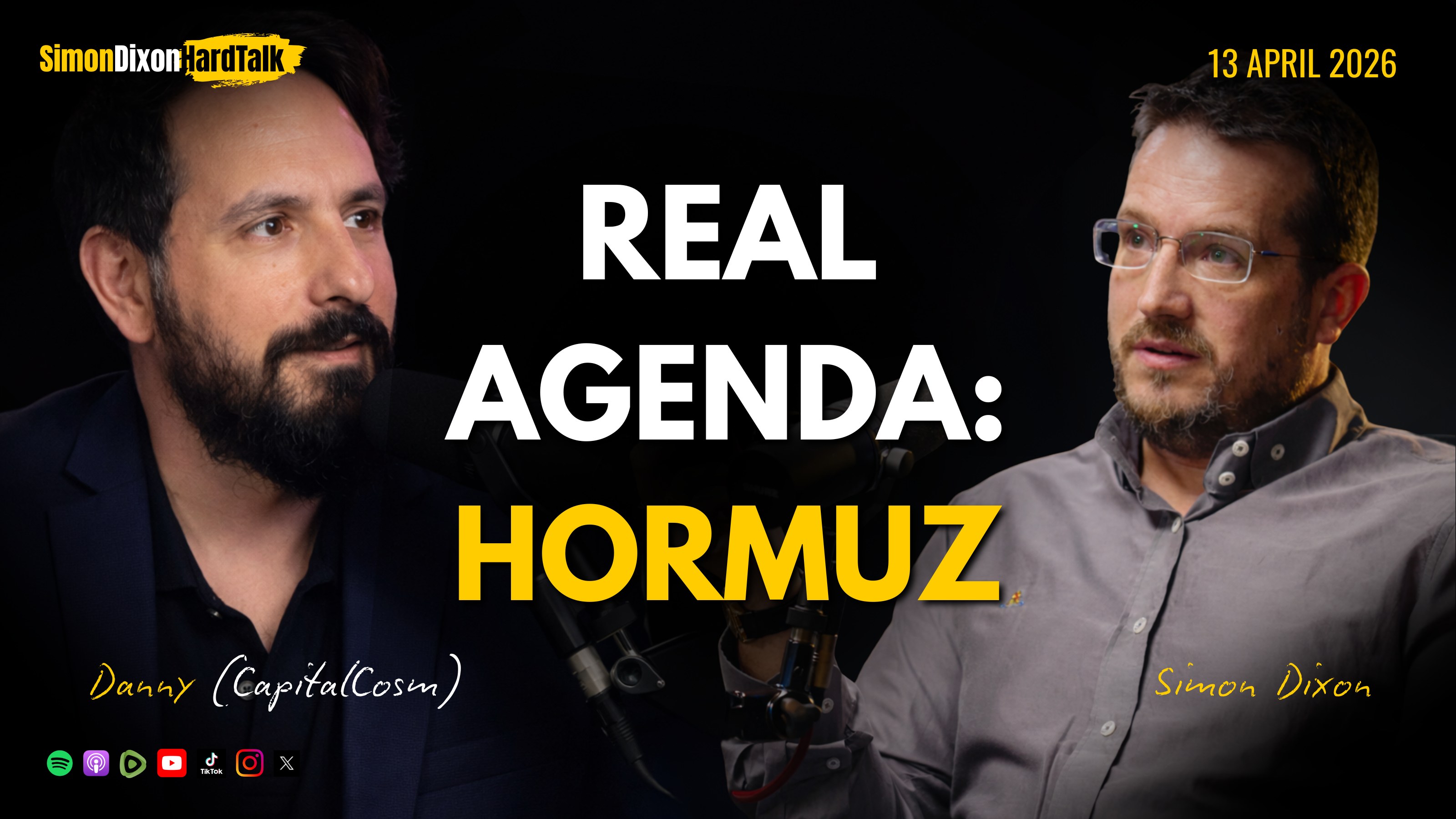
We have arrived at the most significant inflection point for capital allocators since the 2020 COVID era. It is Monday, April 13, 2026, and we are exactly twenty-four hours removed from the high-stakes Islamabad negotiations and the formal imposition of a U.S. naval blockade in the Strait of Hormuz. I recently sat down for a definitive one-hour intensive with Danny from CapitalCosm to map a reality that is shifting under our feet in real-time.
As I reflected during my last debate with Professor Jiang, every time we speak, we seem to be inhabiting a different world order. The board is being reset daily. With the U.S. Navy now actively turning back Chinese-bound vessels, we are no longer speculating about the end of the Bretton Woods system; we are witnessing its tactical dismantling. For those of us focused on sovereignty, this is the "5D chess" of transnational capital playing out in its most aggressive form yet.
The Bounded Escalation: Oil as a Macro Lever
What the mainstream media characterizes as a chaotic lurch toward World War III is, in professional macro-strategic terms, a "theatrical war." This is a bounded escalation cycle. Both Washington and Tehran are operating within a strict financial grid, cognizant of the "tripwires" that would otherwise incinerate the global financial system. These thresholds are precise: Brent Crude Oil between $115 and $150, 10-year Treasuries at 4.5%, and 30-year Treasuries at 5%.
The Trump administration is utilizing these escalations to manage a volatility that the "AI productivity miracle" failed to solve. While AI was marketed as a deflationary force, it has instead become an energy-guzzling black hole for capital, arriving just as private credit markets began to seize. To manage this, the U.S. Treasury has structurally shorted oil, attempting to manipulate prices through controlled geopolitical tension. We are also seeing a massive "Force Majeure" event where energy giants like Exxon and Qatar’s Golden Pass are using the conflict to void low-price LNG contracts and renegotiate at significantly higher levels.
"Every time that oil hits approximately $115 and we have the 10-year Treasury hitting almost 4.5%... then Trump pulls a new rabbit out of a bag—an escalation cycle and something that leads to the market calming down."
Islamabad and the Proxy Power Play
The Islamabad negotiations serve as the primary proxy battleground for China’s long-term vision. Pakistan, traditionally a U.S. vessel, has become the "stuck" point in the Belt and Road Initiative. Having faced a terminal dollar shortage during the COVID era, Pakistan was initially bailed out by the UAE and China.
However, we are now seeing a sophisticated capital rotation: the UAE called in its loans, forcing Qatar and Saudi Arabia to step in as the new creditors. This may have been a calculated move to prevent China from exerting total leverage over the Pakistani corridor. While the earlier "Oman framework" established the baseline for peace, China’s "Pragmatic Survival" model for Iran demands a total normalization with its Gulf neighbors and the systematic expulsion of U.S. influence from the region.
The Invisible War: Decapitation and Underground Infrastructure
The conflict currently being waged is a three-way operation that relies on a specific division of labor. While U.S. forces conduct strikes on Iranian surface infrastructure—ostensibly to "end the nuclear program"—the Israelis are focused on "decapitation campaigns" against hardliner IRGC elements who resist normalization. This is a cold, surgical effort to clear the path for a new, pragmatic Iranian leadership.
It is essential to understand that Iran is a natural fortress. Its asymmetric weaponry, including ballistic missiles and drone swarms, is housed in a decentralized network of underground facilities that no B2 bomber can reach. A ground invasion is a strategic impossibility—a "death box" that would require millions of troops the U.S. simply does not have. Therefore, the real war is not for territory, but for the supply chains. China and Russia are ensuring that the underground infrastructure remains functional, transitioning the IRGC from a revolutionary force into a managed component of the new multipolar system.
The PR Battle and the Rebranding of Iran
We are witnessing a game-changing psychological operation aimed at the American youth. Through the strategic use of AI-generated propaganda and viral content, the IRGC is being rebranded. To a generation that views its own leadership as a corrupt "Epstein class," the IRGC is being presented as a heroic resistance against a decaying establishment.
This "moral rebranding" is augmented by high-level symbolic theater. We’ve seen the calculated timing of military escalations during Ramadan and Christian holidays, and even the circulation of controversial religious symbology—such as the AI-generated imagery thar Trump posted of himself as a Christ-like figure. These are "scops" (psychological operations) designed to fracture old narratives and prepare the public for an "America First" withdrawal. If the youth believe the U.S. is fighting for a corrupt status quo, the political resistance to bringing the naval fleet home vanishes.
The Financial Reset: A Stimulus Check for the Deep State
The shift from the "Forever War" to a "Regional Stability" model requires the largest injection of liquidity in human history. We are anticipating the "Big Print"—a $7 to $10 trillion infusion that will make the COVID stimulus look like a rounding error. As Larry Lepard often notes, this is the inevitable endgame of a system that can no longer sustain its own debt.
This print is designed to nourish three specific pillars of the transnational elite. The Military-Industrial Complex receives its stimulus through a defense budget that has now ballooned to $1.5 trillion. The Technical-Industrial Complex receives its funding under the guise of "national security" to win the AI arms race against China. Finally, the Financial-Industrial Complex uses the print to bail out the mortgage and private credit markets. This is the ultimate "socialize the losses, privatize the gains" mechanism, ensuring that while the middle class is wiped out by the resulting inflation, the asset-owning class remains entrenched.
The Multipolar Future: Toll Booths and Sea Lanes
The finality of the Bretton Woods era is represented by the transition of the U.S. Navy from a global policeman to a regional protector. In this new multipolar world, the "commons" of international waters will be replaced by "toll booths" managed by regional powers. If the rules for the Strait of Hormuz are rewritten, Singapore and Malaysia may follow.
The May 15th deadline for the meeting between Xi Jinping and Donald Trump is the "ticking clock" for this reset. Within the U.S. power structure, we see a clash between Trump’s "Financial-Industrial" focus and the "Technical-Industrial" faction represented by JD Vance—the "Palantir guy" groomed by Peter Thiel. Vance represents a pivot toward a high-tech surveillance state that will manage the domestic fallout of this global wealth transfer.
Survival Strategy for the Sovereign Individual
For the Sovereign Wealth Builder, the strategy must be one of radical self-reliance. This crisis is the ultimate accelerator for the "you will own nothing" agenda. As inflation-driven demand destruction destroys the purchasing power of wages, the gap between the middle class and the "Asset Owner" class will become an unbridgeable chasm.
The only shield is the ownership of fixed assets and the construction of community infrastructure. You cannot rely on a federal government that is in the process of deconstructing its own obligations. You must secure your own sovereign wealth and build supply chains at the local level with your neighbors. The "Big Print" will rescue the banks and the defense contractors, but it will not rescue you. The question is not whether the system will reset, but whether you have positioned your capital to survive the transition.
Call to Action
The "5D chess" being played by transnational capital is far too complex for a single sitting. To grasp the full scope of how these energy shocks and financial maneuvers will impact your personal sovereignty, I invite you to watch the full 1-hour interview on the CapitalCosm YouTube channel.
Remember, your engagement is a superpower in bypassing the algorithms that seek to bury this analysis. Please hit the "LIKE" button on the video, subscribe to the Simon Dixon YouTube and Rumble channels, and follow me on X (formerly Twitter) for real-time strategic updates. Share this with other capital allocators who understand that in this era, information is the ultimate asset.
- Share this post. Share this blog post to expose the "divide and conquer" trap.
- Subscribe to the Simon Dixon YouTube channel. Get my weekly deep dives into geopolitics, macro, and Bitcoin. Subscribe to my YouTube channel.
- Find me on Rumble. This is my backup channel, safe from censorship. Follow me on Rumble.
- Follow me on X @SimonDixonTwitt. I post real-time updates and analysis on X and am highly active there. Follow me on X.
- Follow me on instagram. Usually short clips are posted here.
- Follow me on TikTok. Usually short clips are posted here.
- SimonDixon.com. This is my personal site and an archive of all my content, safe from de-platforming. Join the free membership portal.
Watch on YouTube
Prefer to Listen? Available on Spotify & Apple Podcasts
Disclaimer
The discussion regarding geopolitics, energy markets, the "Big Print," and international trade maneuvers contained in this document is provided for informational and educational purposes only. Simon Dixon is a macro-strategist and investor, not a licensed financial, legal, or investment advisor. All market participation involves substantial risk, including the potential loss of principal. The analysis of "5D chess" and geopolitical transitions is speculative in nature. Individuals must conduct their own due diligence and manage their own risk independently. Past performance, particularly in unprecedented "reset" environments, is not indicative of future results.