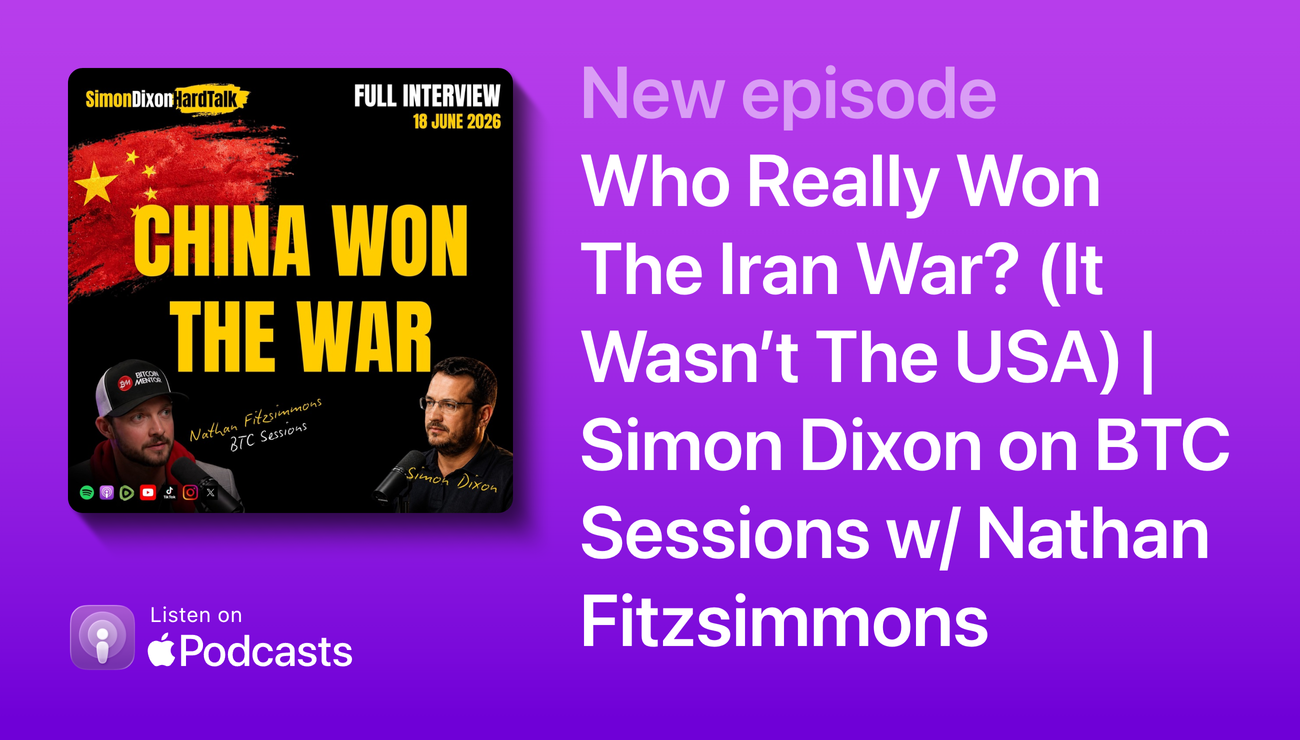
🇮🇷 Who Really Won The Iran War? (It Wasn't The USA) | Simon Dixon on BTC Sessions w/ Nathan Fitzsimmons
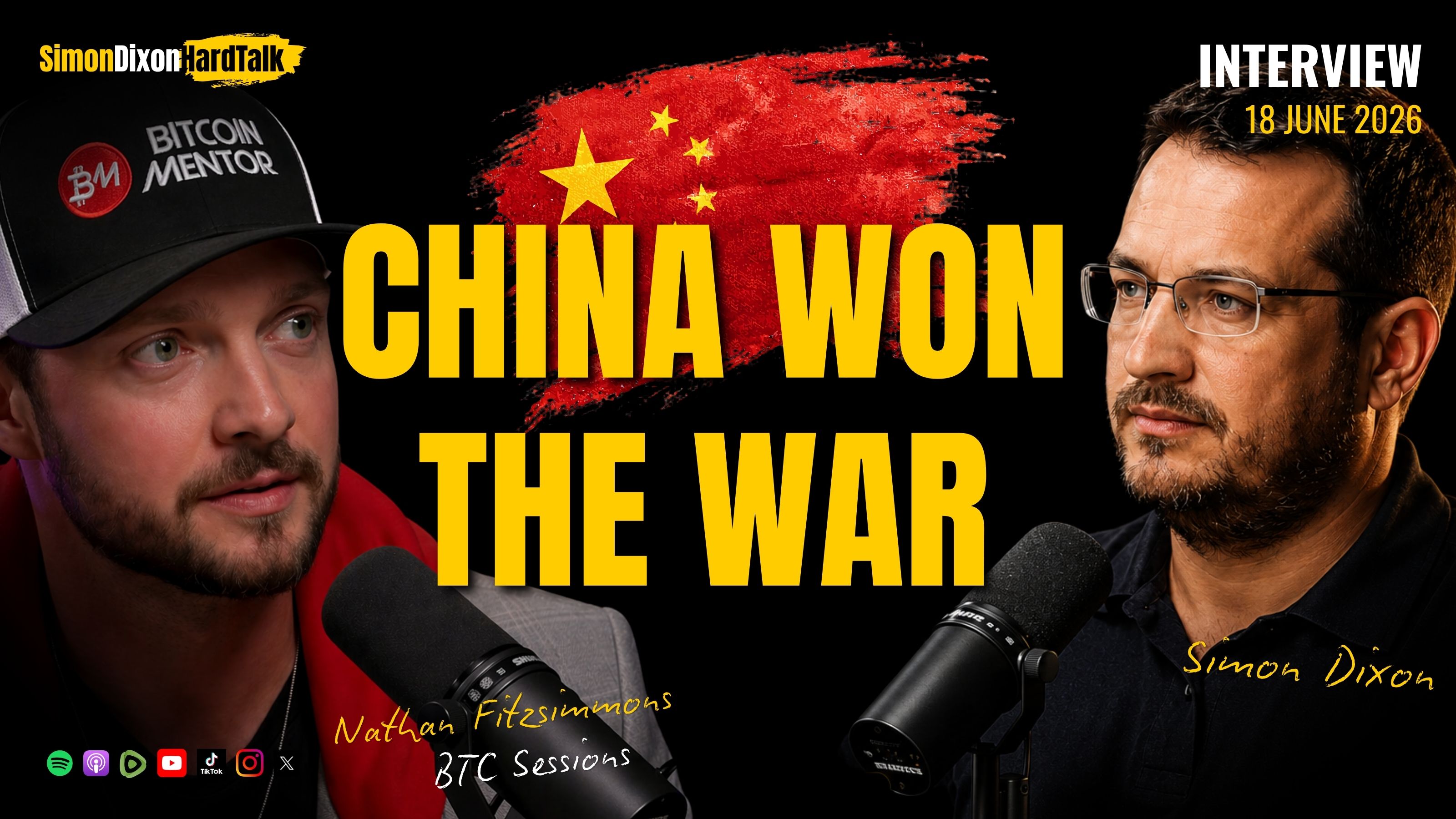
Jun 19, 2026On June 17, 2026, Simon Dixon participated in an interview on the program BTC Sessions, hosted by Nathan Fitzsimmons. The interview, titled “Who Really Won The Iran War? (It wasn't The USA),” lasted 1 hour and 15 minutes.
Executive Summary
The central thesis of the discussion is that the conflict involving Iran was not a conventional war of national interests, but a "theatrical," managed transition orchestrated by global corporate and financial complexes. Simon Dixon argues that the primary victors are China and the Financial Industrial Complex (FIC), who utilized the conflict to accelerate a shift toward a multipolar world order.
Critical takeaways include:
- The Three-Complex Framework: The world is currently governed by a struggle and eventual integration between the Military Industrial Complex (MIC), the Financial Industrial Complex (FIC), and the Technical Industrial Complex (TIC).
- Managed Escalation: The timing of the "war" and its resolution were allegedly synchronized with major financial events, specifically the SpaceX IPO and Trump/Xi meeting in Briging, to manage global liquidity and market narratives.
- China’s Dominance: China is identified as the strategic winner, now positioned to control both the Petro-dollar and Petro-yuan through its role as a manufacturing base and its diplomatic normalization of regional rivals.
- Asset Centralization: A primary goal of these maneuvers is the asset stripping of the middle class and the forced migration of Bitcoin into custodial "FIC" wrappers (ETFs and corporate treasuries) to prevent individual sovereignty.
High-Level Overview
The interview frames the Iran war as a "bounded escalation" designed to renegotiate global contracts and reset the world order. In Simon Dixon’s opinion, the conflict served as a mechanism to transition from the post-WWII Bretton Woods order (dominated by the MIC) to a technocratic, multipolar system (dominated by the FIC and TIC). The discussion explores how political figures act as "middle management" for these corporate interests and how the narrative of war is used to manipulate markets, bond yields, and energy prices.
Key Arguments Made by Simon Dixon
The Triad of Power Complexes
Simon Dixon believes the current global landscape is defined by three distinct factions:
- Military Industrial Complex (MIC): Represents the nationalistic, US-dominated order. Figures like Benjamin Netanyahu are categorized as middle management for this group.
- Financial Industrial Complex (FIC): Transnational capital hosted in New York and London. Its goal is a multipolar world where sovereign wealth funds (funded by Chinese energy purchases) asset-strip the West with global western financial institutions. Donald Trump is framed as a "transaction guy" working for FIC lobbies.
- Technical Industrial Complex (TIC): Focuses on an Orwellian AI surveillance state, social credit scores, and Central Bank Digital Currencies (CBDCs). Its motto is described as "You will own nothing and be happy."
The "Theatrical" Nature of the Iran War
- Market Signals: Dixon alleges that the markets never signaled a "real" war. He notes that if the conflict were genuine, gold would have moved in parallel with oil, and bond yields would have reacted differently.
- Timing and Liquidity: In Simon Dixon’s opinion, the end of the war was timed to coincide with the SpaceX IPO to ensure sufficient market liquidity. He points out that whispers of a deal emerged the Thursday before the Friday IPO.
- Managed Narrative: Dixon believes the 14 points of the peace deal are essentially financial transactions. The "theatrical" escalation allowed for the renegotiation of energy contracts and the flow of funds globally.
Regional Realignment and China’s Role
- China as the Architect: China allegedly "won" by normalizing relations between Iran and Saudi Arabia, effectively positioning itself to control the primary energy currencies (dollar and yuan).
- Decapitation Strategy: Dixon believes Israel acted as an outsourced "decapitation" force to remove hardliners within the IRGC who opposed China’s regional stability model.
- Pakistan’s Role: Pakistan is identified as the new regional security hub through the "Islamabad Accords," acting as a recipient of China's Belt and Road Initiative and expelling IMF influence.
The Attack on Bitcoin Sovereignty
- Custodial Capture: Dixon argues that the FIC (via Blackrock and others) is attempting to "corner" the price of Bitcoin to force it into custody.
- Financial Engineering: He believes vehicles like the Blackrock Bitcoin Income ETF and Michael Saylor’s treasury strategies are designed to subordinate Bitcoin to the FIC, turning holders into "perpetual gamblers" and subordinates rather than sovereign owners.
- The Strategy: Dixon emphasizes that the only defense is Bitcoin in self-custody, as the FIC/TIC agenda aims for a Universal Basic Income (UBI) model where the state/corporations own all assets.
Key Arguments Made by Other Participants
Nathan Fitzsimmons (Host)
- Verification of Timing: Fitzsimmons noted that Dixon was "dead right" regarding the war ending in line with the SpaceX IPO.
- Asset Stripping: He raised concerns regarding the push for digital ID verification in the UK and Canada (e.g., age verification for social media) as a potential TIC imposition.
- Market Sentiment: He observed that market apathy is at an all-time high, even while institutional capture of Bitcoin accelerates.
Points of Agreement
- The Multipolar Shift: Both participants agree that the world is moving away from a US-centric unipolar model toward a multi-nodal system involving the GCC (Gulf Cooperation Council), BRICS, and the SCO.
- The Inevitability of AI: There is a consensus that an AI-dominated world is being ushered in, requiring vast amounts of energy and serving as the next major investment "bubble."
- The Importance of Self-Custody: Both emphasize that self-custody is the only legitimate resistance against the centralization efforts of the FIC and TIC.
Points of Disagreement/Contention
- Trump’s Intentions: While some of Fitzsimmons' other guests believe Trump is fighting the World Economic Forum (WEF) agenda, Simon Dixon firmly believes Trump has done more to advance the WEF/TIC/FIC agenda than any other figure by serving his lobbies.
- The Nature of the "War": The discussion highlights a divide between the public narrative (nuclear weapons and terrorism) and Dixon’s analytical view (renegotiation of energy and reconstruction contracts).
Important Data, Claims, or References Mentioned
Financial and Political Events Calendar
|
Date (2026) |
Event Mentioned |
Significance |
|
Monday, June 15 |
G7 Meeting |
Discussion on Ukraine, Russia, and the energy crisis. |
|
Tuesday, June 16 |
Bank of Japan Meeting |
Raised rates to 1% (first time since 1995); breaking the "carry trade." |
|
Wednesday, June 17 |
Federal Reserve Meeting |
Anticipated rate decision; market sensitivity is at a peak. |
|
Thursday, June 18 |
Bank of England Meeting |
Expected to remain unchanged or hike; influences UK liquidity. |
|
Friday, June 19 |
Alleged Deal Signing |
The official finalization of the Iran/regional peace accords. |
Key Entities and Figures
- Affinity Partners: Trump’s venture capital fund, which Dixon notes received $2 billion from Saudi Arabia.
- The 14 Points: The specific financial transactions that reportedly constitute the Iran peace deal.
- $300 Billion: The figure JD Vance allegedly mentioned regarding the reconstruction of Iran.
- Blackrock iShares Bitcoin Premium Income ETF: A new derivative product mentioned by Fitzsimmons as a "carrot" to get people to yield their Bitcoin.
- Islamabad Accords: The regional security model brokered by Pakistan.
Notable Quotes or Framing
- On Politics: "If you think Trump works for the American people, then nothing makes sense. Trump's a transaction guy."
- On the New World Order: "You will own nothing and be happy will custody the assets. You get the token and you become a perpetual gambler."
- On the "War": "The markets were never saying that this was a real war... the markets were telling me that this was theatrical, but also a power struggle."
- On Institutional Bitcoin: "Their goal is to get your Bitcoin in custody... they have completely cornered the short-term price of Bitcoin to manipulate it."
- On the TIC Agenda: "The technical industrial complex ushering in an Orwellian A.I. surveillance state. One world control grid."
Open Questions or Unresolved Issues
- The Reconstruction Funding: It remains unclear whether the $300 billion for Iran’s reconstruction will be funded autonomously by Iran (via returned frozen assets and fees) or if it will be structured as FIC-controlled investment contracts.
- The West Bank: Dixon notes that while Gaza and Lebanon may follow a GCC-funded reconstruction plan, the "illegally occupied" West Bank remains a major unresolved friction point in the transition from a two-state to a one-state solution.
- MIC Blowback: There is a lingering question of whether the MIC (or figures like Netanyahu) will attempt to "reassert" themselves and derail the FIC’s managed transition through unauthorized escalations in Lebanon or the Strait of Hormuz.
- The AI Bubble Burst: While Dixon predicts a "ginormous pump" in AI infrastructure, the timing of when China might "burst" this bubble remains speculative.
Call To Action
- Share this post. Share this blog post to expose the "divide and conquer" trap.
- Subscribe to the Simon Dixon YouTube channel. Get my weekly deep dives into geopolitics, macro, and Bitcoin. Subscribe to my YouTube channel.
- Find me on Rumble. This is my backup channel, safe from censorship. Follow me on Rumble.
- Follow me on X @SimonDixonTwitt. I post real-time updates and analysis on X and am highly active there. Follow me on X.
- Follow me on instagram. Usually short clips are posted here.
- Follow me on TikTok. Usually short clips are posted here.
- SimonDixon.com This is my personal site and an archive of all my content, safe from de-platforming. Join the free membership portal.
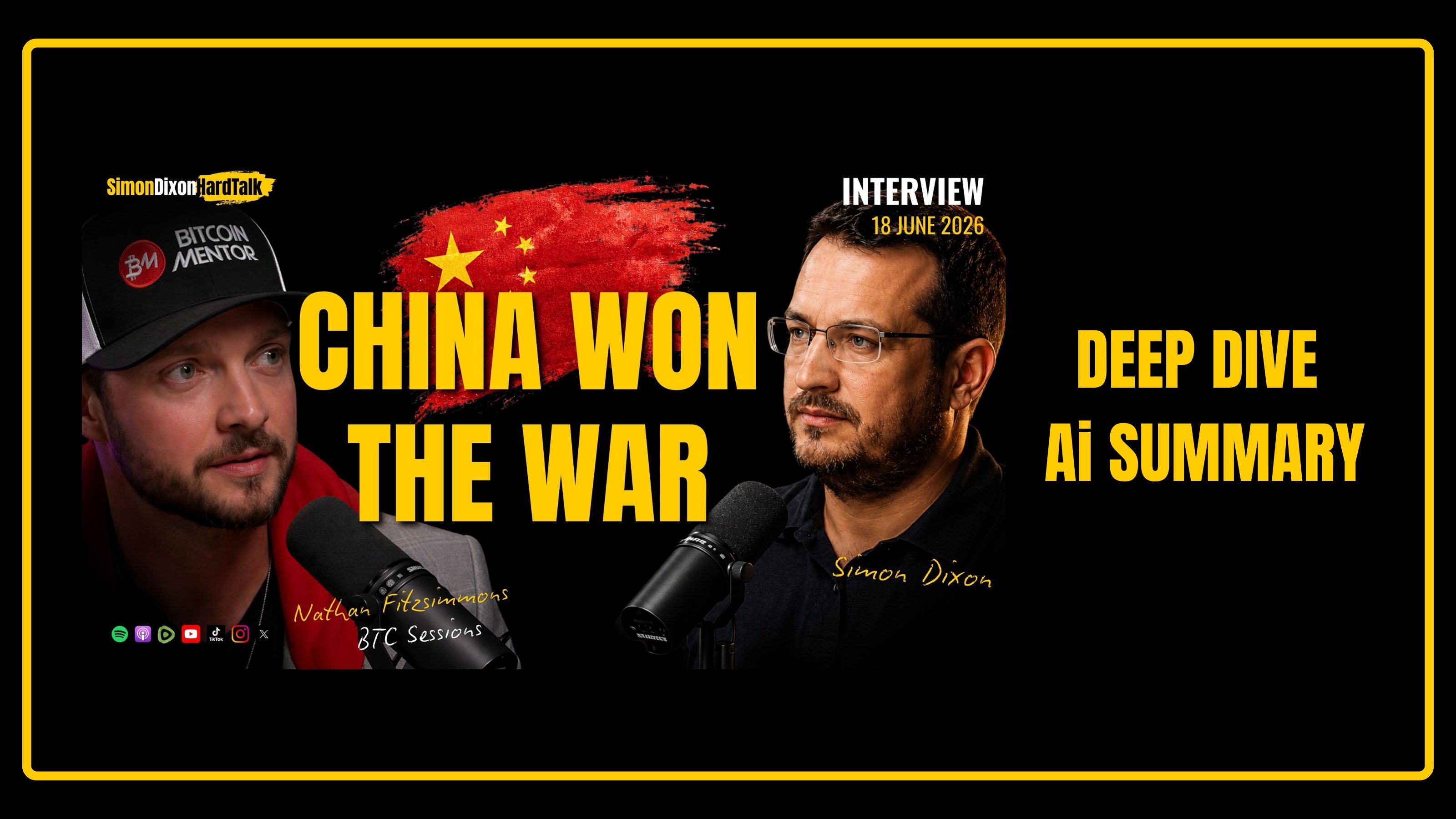
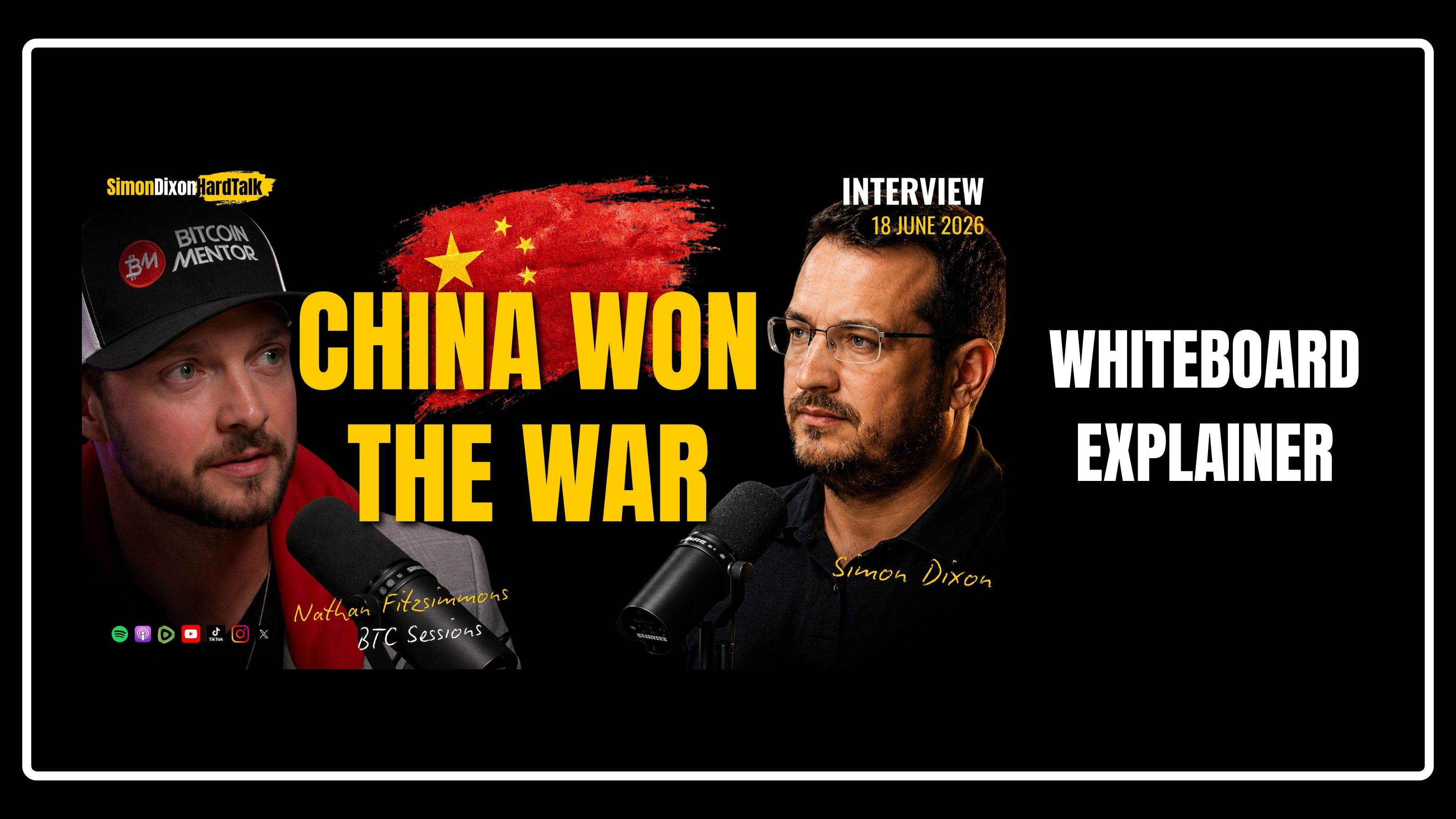
No time for the full video? Watch the AI-generated TL;DR Podcast Style Discussion instead. Or watch the whiteboard explainer — a more visual breakdown of the full discussion.
Watch on YouTube
Prefer To Listen? Available on Spotify & Apple Podcasts
Read Other Related Blogs

General & Legal Disclaimer:
The views, thoughts, and opinions expressed in this blog post belong solely to Simon Dixon and are based on his personal analysis shared during his appearance on BTC Sessions. They do not necessarily reflect the official policy or position of BTC Sessions or its host, Nathan Fitzsimmons. The information provided in this article is for educational and informational purposes only and should not be construed as financial, investment, tax, or legal advice.
Any statements regarding macroeconomic trends, geopolitical events, global power structures (such as the Military, Financial, and Technical Industrial Complexes), or financial markets represent Simon Dixon's personal opinions and alleged market movements. These are not publicly or legally verifiable facts. Always consult with a certified financial planner, legal professional, or independent financial advisor before making any financial or investment decisions, including those related to holding or managing digital assets like Bitcoin.