The Five Events That Repositioned The World This Week | Simon Dixon Hard Talk LIVE (Part One)
Jun 19, 2026Hey hey sovereign wealth builders, Simon Dixon here.
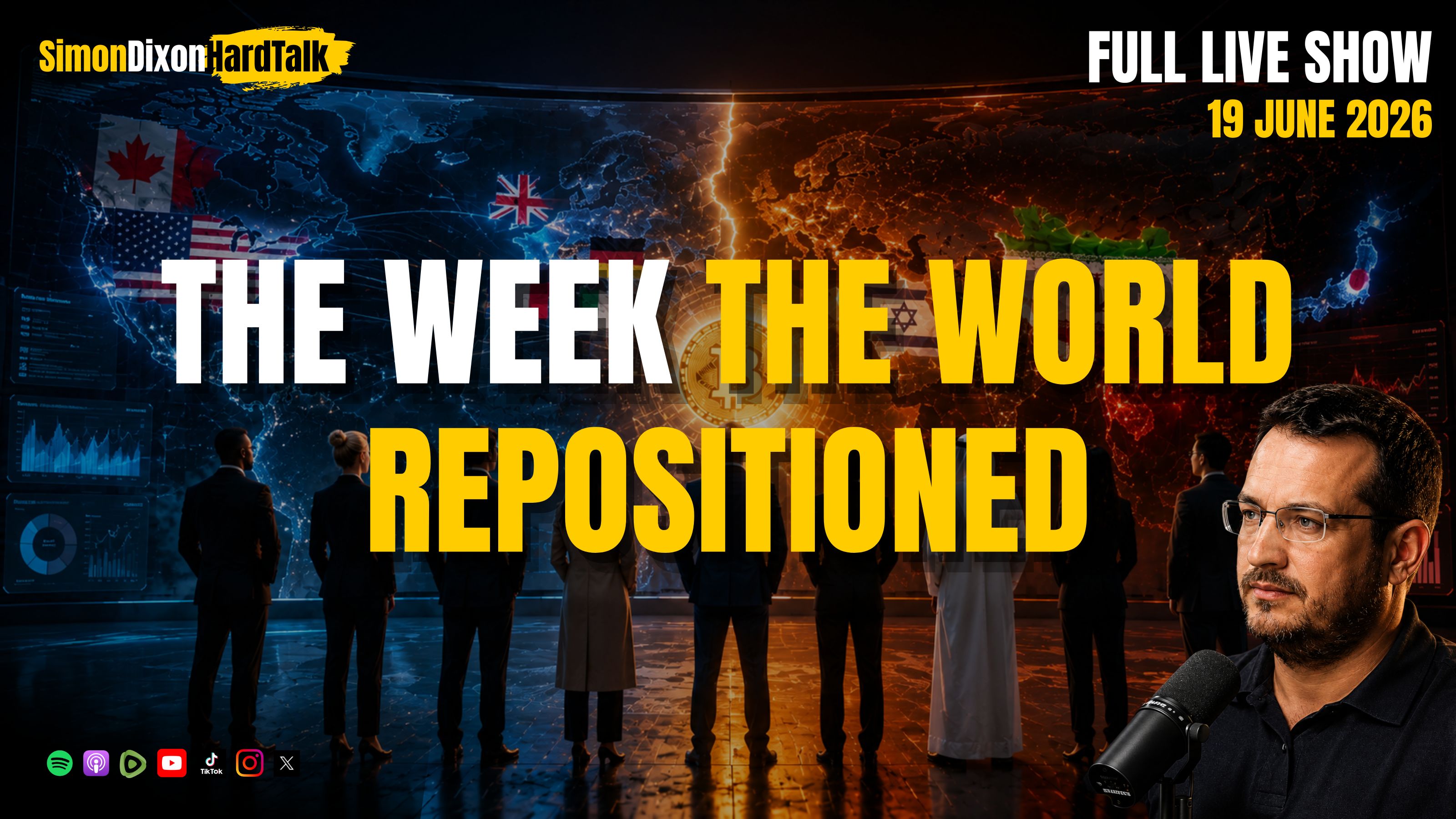
This article synthesizes the "Simon Dixon Hard Talk LIVE" episode titled THE WEEK THE WORLD REPOSITIONED: G7, Iran, Israel, Central Banks & Bitcoin Treasury Companies. We are diving deep into the segment The Five Events That Repositioned The World This Week | Simon Dixon Hard Talk LIVE (Part One), which originally spanned a duration of 1 hour and 56 minutes.
My core thesis for this week is that we are witnessing the single most consequential series of capital shifts in years. Five seemingly unrelated events are, in reality, a singular story of global repositioning. To understand this, you must look at the "Sovereignty vs. Subordination" spectrum. My goal is to help you peel off the layers of subordination to the Financial Industrial Complex (FIC), the Technical Industrial Complex (TIC), and the Military Industrial Complex (MIC). If you don't have a plan to move toward individual sovereignty, you remain a collateralized debt obligation for the FIC.
1. Event 1: The G7 and the "Managed Divorce" of the West
At the G7 meeting, Donald Trump signaled what I suspect is a "Managed Divorce" between the U.S. and current Israeli leadership. Trump publicly criticized Israel’s strategy in Lebanon, stating the fighting has gone on "far too long." In my opinion, this isn’t just political rhetoric; it’s a narrative shift designed to decouple the U.S. from a MIC-driven strategy of forever wars in favor of an FIC-led regional stability plan.
I believe we are witnessing the "Suez Canal Moment" for the American Empire. Much like the 1956 crisis signaled the end of British global dominance, this week proved the U.S. can no longer exert unilateral influence. The "Zionist meltdown" we’re seeing from media figures like Ben Shapiro or Mark Levin is a reaction to the fact that the money is moving elsewhere.
To understand who is actually in charge, you have to look past the politicians, who are merely "prostitutes for real power," and look at the Order of Power in the region that I’ve identified:
- Tier 1: Gulf Funding (GCC) & GCC Interests – The primary capital providers for regional stability.
- Tier 2: TIC (Technical Industrial Complex) – Represented by Elon Musk and the Peter Thiel/Palantir faction (the "JD Vance" role).
- Tier 3: FIC (Financial Industrial Complex) – Legacy banking power, specifically the Melon family dynasty.
- Tier 4: MIC (Military Industrial Complex) – Represented by figures like Miriam Adelson and "Israel-first" policies. The MIC is being deprioritized as the world shifts toward FIC trade nodes.
2. Event 2 & 3: Central Bank Regime Changes (Japan and the Fed)
On Tuesday, the Bank of Japan (BoJ) increased interest rates to 1%. I suspect this is the definitive end of "free money" and the breaking of the "Japan carry trade." For decades, Japan was a "zombie land" providing cheap liquidity for global speculators. By raising rates, they are signaling a move eastward, managing liquidity away from the U.S. and toward domestic and regional purchases.
This was followed by a regime change at the Federal Reserve under Kevin Warsh. While the MAGA narrative claims Warsh is a puppet who will slash rates to "take on the Fed," the Fed kept rates unchanged. In my opinion, the Fed "wins either way" because it is owned by the banks within the FIC. Warsh has already set up five task forces, including one focused on "Data"—which I believe is a code word for changing how inflation is measured so they can move the goalposts.
The Fed's Two Strategic Outcomes
|
Option |
Name |
Description |
Impact |
|
Option 1 |
The Crack-up Boom |
Lowering rates to refinance debt, letting inflation rip. |
Massive asset inflation, stock market bubbles, and a K-shaped economy that punishes the poor. |
|
Option 2 |
The Controlled Rugpull |
Holding or increasing rates to "fight inflation." |
Economic slowdown, debt restructuring, and asset price corrections to finalize the multipolar transition. |
I suspect the FIC will rinse the "crack-up boom" for as long as possible before initiating a controlled correction to manage the transition to a multipolar world.
3. Event 4: The Iran-US Memorandum and the Versailles Symbolism
The signing of the Iran-U.S. Memorandum of Understanding (MOU) is the biggest event of the week. This is a pivot from the MIC "Old Model" (resistance and war) to an FIC "New Model" (trade and infrastructure).
Key financial terms found in the source:
- 147 Million Barrels of Oil: Ready to hit the market, likely priced in Yuan or Bitcoin.
- Sanction Relief & Asset Release: Trump admitted the frozen funds belonged to Iran, signaling a surrender of the old narrative.
- The Lebanon Holdout Clause: Used as bounded escalation leverage for the final 60-day term sheet negotiations.
The symbolic importance of signing this in Versailles cannot be overstated. Versailles is the birthplace of the Bank for International Settlements (BIS). History is repeating; the BIS was originally formed to manage German reparations and famously facilitated the transfer of gold from Czechoslovakia to Germany during Hitler's rise. I suspect this choice of location signals that the FIC—with the Fed as the largest shareholder of the BIS—is renegotiating the global order.
We are seeing a parallel to the "Silicon Shield" in Taiwan. Just as the U.S. and China are seeking chip independence to collapse the Silicon Shield, they are now negotiating the "re-rooting" of energy and data centers. Iran’s FIC integration moves them from a resistance node to an energy-hub node for the TIC (AI and robotics).
4. Event 5: The Bitcoin Financialization Trap
I must warn you about "Bitcoin Treasury Companies" and the Subordination Industrial Complex (SIC). This is a leverage trap. Take the example of Nakamoto: they purchased Bitcoin with debt, but after the "10/10 operation" on Binance was used to engineer a price crash, they were forced to pledge their Bitcoin as collateral. Reportedly, 85% of their Bitcoin is now pledged to Kraken.
This is a "subordination vehicle" designed to centralize supply for the FIC. I have a strong critique of "convertible debt" models used by companies like MicroStrategy. They are now pushing "STRC" (Digital Credit)—a product that essentially turns your Bitcoin upside into a debt trap. If the price doesn't go up, the debt must be repaid in cash or through massive equity dilution. This financialization is the risk, not Bitcoin itself.
The Sovereign’s Defense:
- Self-Custody: If you don't own the keys, you are just a paper-claim holder.
- No Counterparty Risk: Resist the urge to pledge your coins for yield.
- No Margin Calls: Volatility cannot liquidate a sovereign holder.
- No Liquidation Terms: You own the asset; you don't owe the debt.
5. Synthesis: Who Actually Won the Iran/US War?
The winners of the week are the Gulf countries (GCC), the FIC, and China/TIC. We are seeing a precise Multi-Polarity Split:
- The Middle East: Transitioning into an FIC infrastructure hub for trade and energy.
- Europe: Positioned as a "MIC stimulus zone." The narrative is to "fight to the last Ukrainian" to justify NATO expansion and weapon sales.
- Global Grid: A TIC-led collaboration between China and U.S. tech interests to build a global AI surveillance state and "social credit" infrastructure.
6. Final Thought & Strategy
My advice remains: Follow the money. The politicians are just the "prostitutes for real power," distracting you with identity politics while the FIC, TIC, and MIC carve up the world.
Your strategy must be a 10-year plan. Prioritize the ownership of hard assets over paper claims. Use self-custody to resist the financialization of Bitcoin. The goal is to move from being a "product" of the system to a sovereign builder of wealth.
See you next week, peace.
Watch On YouTube

No time for the full video? Watch the AI-generated TL;DR Podcast Style Discussion instead. Or watch the whiteboard explainer — a more visual breakdown of the full discussion.
Prefer To Listen? Available on Spotify & Apple Podcasts
Read Other Related Blogs
Disclaimer This content represents Simon Dixon’s personal interpretations and opinions and does not constitute financial, legal, or tax advice. Investing in Bitcoin, central bank policies, and digital assets involves significant risk. Geopolitical volatility and shifts in monetary regimes can lead to a total loss of capital. Always conduct your own due diligence and follow the money yourself.[END OF FINAL DOCUMENT]