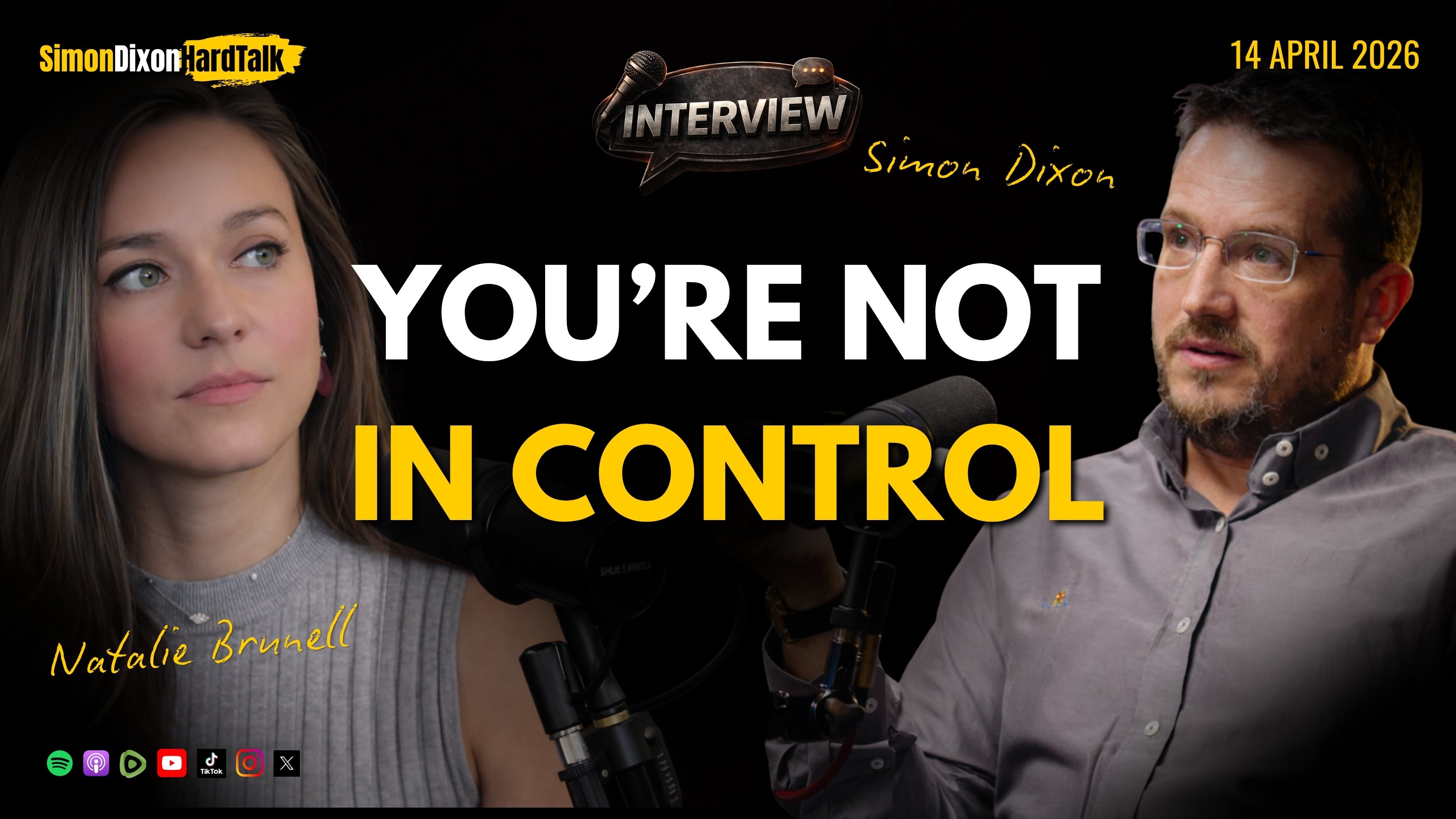
If this happens, I will sell all my Bitcoin and buy Gold | Simon Dixon on Coin Stories w/ Natalie Brunell (Interview #2)
Oct 02, 2026Context and Session Framing: This briefing document synthesizes the interview between host Natalie Brunell and guest Simon Dixon on the show Coin Stories. The recording took place in person at Natalie Brunell’s NYC studio on 25 September 2026, marking Simon Dixon’s second interview on the channel. The interview lasted approximately 1 hour and 30 minutes.
Executive Summary
The discussion provides a deep examination of the ongoing structural transformation of the global financial system, the interplay between major industrial-power complexes, the macroeconomic realities of mounting sovereign debt, and the evolving role of Bitcoin.
Simon Dixon asserts that current global instability is not accidental, but rather an engineered change of global order ("chaos is the design"). The world is transitioning from a unipolar American financial hegemony to a multi-node, regionalized power structure. This transition is governed by three primary power centers: the Financial Industrial Complex (FIC), the Military Industrial Complex (MIC), and the Technical Industrial Complex (TIC).
Key takeaways include:
- Fiscal Dominance and Debt Realities: The US national debt has surpassed $40 trillion, with debt-to-GDP at 125%. Dixon highlights that the debt cannot and will not be paid off. To prevent market collapse, the US economy must generate nominal GDP growth above the average debt cost (~3.3%). This is being pursued through aggressive industrial expansion in Artificial Intelligence (AI) and defense spending.
- The AI Capital Crunch: Major AI firms in the TIC are issuing massive amounts of corporate debt, entering direct competition with the US Treasury's debt rollover requirements ($10 trillion needing rollover within a year). AI infrastructure requires heavy reinvestment roughly every 3 years.
- Generational Inversion & Asset Accumulation: The traditional path to wealth (higher education, traditional employment, standard mortgages) is structurally broken for younger generations. Dixon advocates for strict cash-flow management—spending less than one earns and converting surplus into assets (Bitcoin, gold, AI equity).
- Bitcoin as Digital Resistance vs. Risk of FIC Capture: Dixon defines Bitcoin as a tool of digital resistance enabling data, key, and monetary sovereignty. However, he warns of directional risks toward centralization. Dixon explicitly outlines the exact parameters that would force him to sell 100% of his Bitcoin: if the FIC captures 70% of the Bitcoin supply, BlackRock’s ETF exceeds 50–60% ownership, mining becomes hyper-centralized, or node operations become cost-prohibitive.
High-Level Overview
The overarching narrative centers on how individuals can navigate an era marked by rapid inflation, sovereign debt saturation, and the construction of a technological "global control grid."
Dixon argues that world leaders cannot be transparent about the systemic devaluation of fiat currencies because doing so would trigger immediate market panic. Consequently, governments and institutions employ conflicting narratives—such as demanding a strong dollar while simultaneously executing actions that weaken it—to manage market expectations and roll over debt.
The debate contrasts two primary futures:
- The Control Grid: A world dominated by Central Bank Digital Currencies (CBDCs) in Europe, programmable dollar stablecoins in the US, integrated social data, and AI surveillance, leading to a population reliant on Universal Basic Income (UBI).
- Individual Sovereignty: A path preserved by self-custody of private keys, hard assets, private data ownership, and localized AI tools.
Key Arguments Made by Simon Dixon
Macroeconomics, Geo-Finance, and the Global Order
- Engineered Order Transition: Dixon contends that current geopolitical conflict, economic tension, and news algorithms are designed to drive short-term fear and high time preference behavior. The world is moving away from a unipolar American Empire into regional alliances (the Middle East, Global South, West Asia) with competing settlement rails clearing outside the Western SWIFT system.
- The Power Triad (FIC, MIC, TIC):
- FIC (Financial Industrial Complex): Sovereign wealth funds, institutions (e.g., BlackRock), central banks, and investment banks (e.g., JP Morgan).
- MIC (Military Industrial Complex): Stimulated by war economies to generate state-driven growth and debt issuance.
- TIC (Technical Industrial Complex): Mega-tech firms (the "Magnificent 10" including SpaceX, Google) building global data center infrastructure and AI models.
- Dollar Dilemma and Deception: The US faces a structural contradiction. To rebuild domestic manufacturing, the dollar must weaken (similar to China’s multi-decade weak-currency export strategy). However, the Federal Reserve system requires a strong, dominant dollar to attract foreign capital and roll over government debt. Dixon argues political leaders must practice deception because admitting a planned dollar devaluation would crash financial markets.
- Fiscal Dominance & Growth Threshold: The US national debt will never be paid off; attempting to do so would collapse the debt-based monetary system. To sustain the scheme without immediate hyperinflation or depression, nominal GDP growth must consistently exceed the average interest cost of the debt (approximately 3.3%).
- Bond Vigilantes and Yield Pressures: Bond vigilantes—primary broker-dealers, foreign sovereign funds (e.g., Singapore, Gulf States, Norway), Cayman Islands hedge funds, and central banks—are demanding higher yields to hold US treasuries due to inflation and currency risks, driving yields to levels not seen since 2007.
- The Eurodollar Shadow System: Dixon highlights the opaque, off-shore Eurodollar market (estimated at $14 trillion, untracked by M2 metrics), originating from the City of London and international banking nodes. Foreign banks generate dollar-denominated debt out of thin air, using US treasuries as collateral to multiply leverage globally.
Housing, Generational Wealth, and Wealth Inequality
- The Inverted Boomer Strategy: The economic model used by the Boomer generation (work hard, obtain a degree, take on a mortgage, rely on real estate appreciation) is non-viable for younger generations due to starter homes pricing at extreme valuations with ~7% interest rates.
- Housing Market Deadlock: The housing market is a core pillar of the FIC banking system and will not be allowed to crash naturally. Systemic corrections manifest as asset transfers to institutional capital (e.g., BlackRock acquiring residential property).
- Comparative Social Models:
- Hong Kong Model: High density and hyper-financialization resulted in an extreme divide, driving 200,000 marginalized residents into subterranean or micro "coffin homes."
- Singapore Model: Post-colonial state intervention ensured local citizens received favorable land and real estate terms, giving the population a direct stakeholder interest in national success.
- Universal Basic Income (UBI): Dixon expects populations priced out of asset ownership and displaced by AI automation to be transitioned onto government-controlled UBI schemes and public housing.
The Artificial Intelligence (AI) Race
- AI Capital Competition: Major AI firms are aggressively issuing corporate debt yielding higher returns than US treasuries, competing directly with the US government for investment capital.
- Infrastructure Obsolescence: Unlike traditional infrastructure (railroads, energy grids) that lasts decades, AI data center hardware requires complete capital reinvestment cycles roughly every 3 years.
- US vs. China AI Models: The US model leans toward centralized, proprietary subscription models to capture recurring revenue. China emphasizes open-source, lower-cost, hardware-efficient models (e.g., DeepSeek, Huawei independent chip architecture) to automate physical manufacturing.
Bitcoin, Sovereignty, and Conditions for Selling
- Core Definition of Bitcoin: Dixon values Bitcoin based on three fundamental properties:
- The ability to hold money in self-custody without banking permission.
- The ability to transact peer-to-peer globally.
- A mathematically fixed, predictable monetary policy.
- Digital Resistance: Bitcoin represents a tool for digital resistance against the rising global control grid, though Dixon laments that only a small minority of the global population will discipline themselves to practice true self-custody.
- The "Doomer" Scenario (Conditions to Sell ALL Bitcoin): Dixon explicitly states he would sell 100% of his Bitcoin, reallocate into physical gold, and issue a public explanation if the following capture conditions occur:
- The FIC acquires control of 70% or more of the total Bitcoin supply.
- Wall Street ETF products (e.g., BlackRock) control over 50–60% of the circulating coins.
- Mining pools and ASIC manufacturing become hyper-centralized and subject to direct state/regulatory capture.
- Node validation costs increase to a level where average individuals cannot independently verify the blockchain.
- Reflection on Bitcoin Civil Wars: Reflecting on past protocol splits (e.g., Bitcoin Cash in 2017), Dixon notes that while he actively opposed block-size increases at the time, ideological purges historically alienate valuable talent. His current risk-mitigation strategy is to hold split tokens defensively rather than engaging in destructive community infighting.
Key Arguments Made by Other Participants (Natalie Brunell)
- The Rigged Monetary System: Brunell emphasizes that public anger and growing sociopolitical polarization stem from the lack of a level playing field. Those closest to the Federal Reserve's money printer disproportionately benefit, while wage earners suffer purchasing-power degradation.
- Policy Contradictions: Brunell points out conflicting political messages: figures like JD Vance acknowledge that a strong reserve currency hollows out American manufacturing, while Donald Trump advocates for total dollar dominance backed by stablecoins.
- Generational Financial Disempowerment: Brunell shares her personal experience as a first-generation immigrant from Poland (arriving in 1991). She outlines how lack of financial literacy led her family to fear equity markets, keeping savings in low-yield bank accounts that lost real value to inflation. She argues that real empowerment occurs when individuals shift from saving fiat to acquiring scarce assets like Bitcoin.
- Tax Advantages of Retirement Accounts: Brunell highlights the strategic utility of vehicles like Roth IRAs for Bitcoiners, noting that tax-free growth within a Roth allows investors to turn a $5,000 investment into $500,000 without incurring capital gains liquidations when converting to local fiat.
- Prediction Markets on Debt Trajectory: Brunell cites data from Kalshi prediction markets showing that over 60% of participants expect national debt under the Trump administration to exceed $47 trillion, with 27% forecasting it to top $50 trillion.
Points of Agreement
- Systemic Financial Rigging: Both participants agree that the legacy financial architecture is fundamentally designed to privilege asset owners over wage-dependent workers.
- Ineffectiveness of Traditional Wage Saving: Both align on the reality that saving fiat currency in commercial bank accounts guarantees real purchasing power loss due to central bank debasement.
- Broken Youth Playbook: Both agree that standard higher education coupled with high-interest student debt and a traditional home mortgage no longer guarantees economic mobility.
- Unpayable National Debt: Both agree that the US national debt will never be paid off through budget surpluses or austerity; it will either be inflated away or managed through forced economic expansion.
Points of Disagreement
- Radical Optimism vs. Pragmatic Realism/Skeptical Realism:
- Natalie Brunell maintains a posture of radical optimism regarding Bitcoin’s capacity to spark a broader social, economic, and moral renaissance for the working class.
- Simon Dixon explicitly rejects ungrounded optimism, describing his outlook as a balance between skeptical realism ("seeing the world as it is") and objective strategy. He acknowledges that while Bitcoin offers an escape valve, the broader population is likely heading toward algorithmic control grids and UBI dependency.
Important Data, Claims, or References Mentioned
Macroeconomic Metrics & Financial Data
|
Metric / Concept |
Value / Reference Cited |
Context / Description |
|
US National Debt |
> $40 Trillion |
Current baseline national debt figure cited. |
|
US Debt-to-GDP Ratio |
125% |
Ratio demonstrating fiscal dominance constraints. |
|
Average Cost on US Debt |
~ 3.3% |
Threshold nominal GDP growth rate required to maintain debt rollover. |
|
US Annual Deficit |
$2 Trillion |
Ongoing structural deficit figure. |
|
US Debt Rollover Volume |
~$10 Trillion |
Amount of short/medium-term US debt requiring rollover within a year. |
|
Offshore Eurodollar Market |
~$14 Trillion (Estimated) |
Unofficial, unregulated dollar-denominated credit created outside the Fed. |
|
Hong Kong Coffin Home Population |
200,000 people |
Sub-divided living spaces illustrative of hyper-financialization extremes. |
|
China US Treasury Holdings |
~$600 Billion |
Downward trend of Chinese central bank holding US sovereign debt. |
Corporate, Institutional, and Geopolitical Entities
|
Entity Name |
Category |
Significance / Reference |
|
Anthropic |
AI / TIC Entity |
Cited at a $2 Trillion valuation benchmark in private/debt markets. |
|
SpaceX |
TIC / Infrastructure |
Valued at $1.75 Trillion; framed as fundamentally an AI data center/network provider. |
|
BlackRock |
FIC Institution |
Primary asset manager; operates the Aladdin AI risk analytics platform ($25T managed/influenced). |
|
City of London |
Financial Jurisdiction |
Sovereign financial enclave governed by ~700 banks; birth jurisdiction of the Eurodollar. |
|
Bank for International Settlements (BIS) |
Sovereign Central Bank Hub |
Based in Switzerland with independent legal jurisdiction and its own security apparatus. |
|
DeepSeek / Huawei |
Chinese TIC Competitors |
Cited as open-source AI and independent hardware chip developments threatening US tech valuations. |
|
Kalshi |
Prediction Market |
Cited regarding market odds on peak US national debt metrics (47T–50T). |
Analytical Acronyms and Terms
|
Term / Acronym |
Full Name / Meaning |
Simon Dixon's Contextual Definition |
|
FIC |
Financial Industrial Complex |
Central banks, sovereign wealth funds, BlackRock, JP Morgan, institutional capital. |
|
MIC |
Military Industrial Complex |
Defense contractors and war-economy infrastructure driving state spending. |
|
TIC |
Technical Industrial Complex |
Mega-tech corporations, AI developers, data center builders, and surveillance firms. |
Notable Quotes or Framing
- On the Design of Modern Crises:
"Chaos is the design. The world is being split up... I think it's being engineered. It's the biggest change we will ever witness in our lifetime." — Simon Dixon
- On Political Honesty and Systemic Failure:
"The world leaders can't be honest around what's actually happening because you're not meant to know... If you were to be honest about what's actually happening—'Oh, by the way, we're weakening the dollar'—then that would crash all the markets and the whole house of cards will come down." — Simon Dixon
- On Bitcoin's Core Role:
"I see Bitcoin now as a digital resistance—the ability to own your own data, own your own key. And sadly, I think that very few are actually going to do that." — Simon Dixon
- On the Universal Asset Formula:
"By hook or by crook, you have to find a way of spending less than you earn and investing the difference in assets. And there is no other choice." — Simon Dixon
- On Sovereign Individual Philosophy:
"In the end, we're all subordinate to something... Picking what you're subordinate to is my definition of sovereign." — Simon Dixon
- On Protocol Doomsday / Selling Condition:
"The moment that changes, that would be my doomer scenario, and I'd immediately sell all my Bitcoin, buy gold, and tell everyone why I did it." — Simon Dixon
Open Questions or Unresolved Issues
- Institutional Capture Threshold: At what point does the entry of Wall Street capital via spot ETFs and corporate debt issuance irreversibly alter Bitcoin’s underlying consensus mechanism and neutrality?
- The Debt vs. Yield Spiral: How long can the Federal Reserve and Treasury rely on administrative financial engineering (such as FX swap lines and Treasury buybacks) before bond vigilantes force a explicit yield curve control regime?
- AI Displacement and Stability: How will Western domestic economies manage the structural employment shocks caused by rapid AI integration without triggering hyperinflationary UBI responses?
- The Eurodollar Unwind: How will the untracked, leverage-heavy $14 trillion Eurodollar system resolve as international central banks transition their primary balance sheet reserves from US Treasuries to physical gold?
Call To Action
- Share this post. Share this blog post to expose the "divide and conquer" trap.
- Subscribe to the Simon Dixon YouTube channel. Get my weekly deep dives into geopolitics, macro, and Bitcoin. Subscribe to my YouTube channel.
- Find me on Rumble. This is my backup channel, safe from censorship. Follow me on Rumble.
- Follow me on X @SimonDixonTwitt. I post real-time updates and analysis on X and am highly active there. Follow me on X.
- Follow me on instagram. Usually short clips are posted here.
- Follow me on TikTok. Usually short clips are posted here.
- Follow me on NOSTR.
- SimonDixon.com This is my personal site and an archive of all my content, safe from de-platforming. Join the free membership portal.
Watch On YouTube

Prefer to Listen? Available on Apple Podcasts & Spotify

Want the faster version of this article?
If you don’t have time to read or watch the full discussion, you can access the AI Summary and Whiteboard Explainer for this post inside the Simon Dixon Hard Talk Membership Portal.


Already have your complimentary login? Simply sign in to access them.
Not a member yet? The portal is 100% complimentary to join and use.
You can also download a free PDF copy of Simon’s 2011 book and access the full archive of Simon Dixon Hard Talk LIVE episodes, interviews, long-form conversations, AI summaries and explainer videos.
Simon does not ask you to buy anything.
- No membership fees.
- No upsells.
- No sponsors.
- No ad revenue.
- No products being pushed.
The portal exists to build a sovereign community and independent archive that does not depend entirely on YouTube, X or any other social platform to stay connected.
Read Other Related Blogs
Bitcoin Is the Exit—Simon Dixon on Natalie Brunell

Disclaimer: This blog post is provided solely for educational and informational commentary and reflects personal opinion. It does not constitute financial, investment, legal, or tax advice.