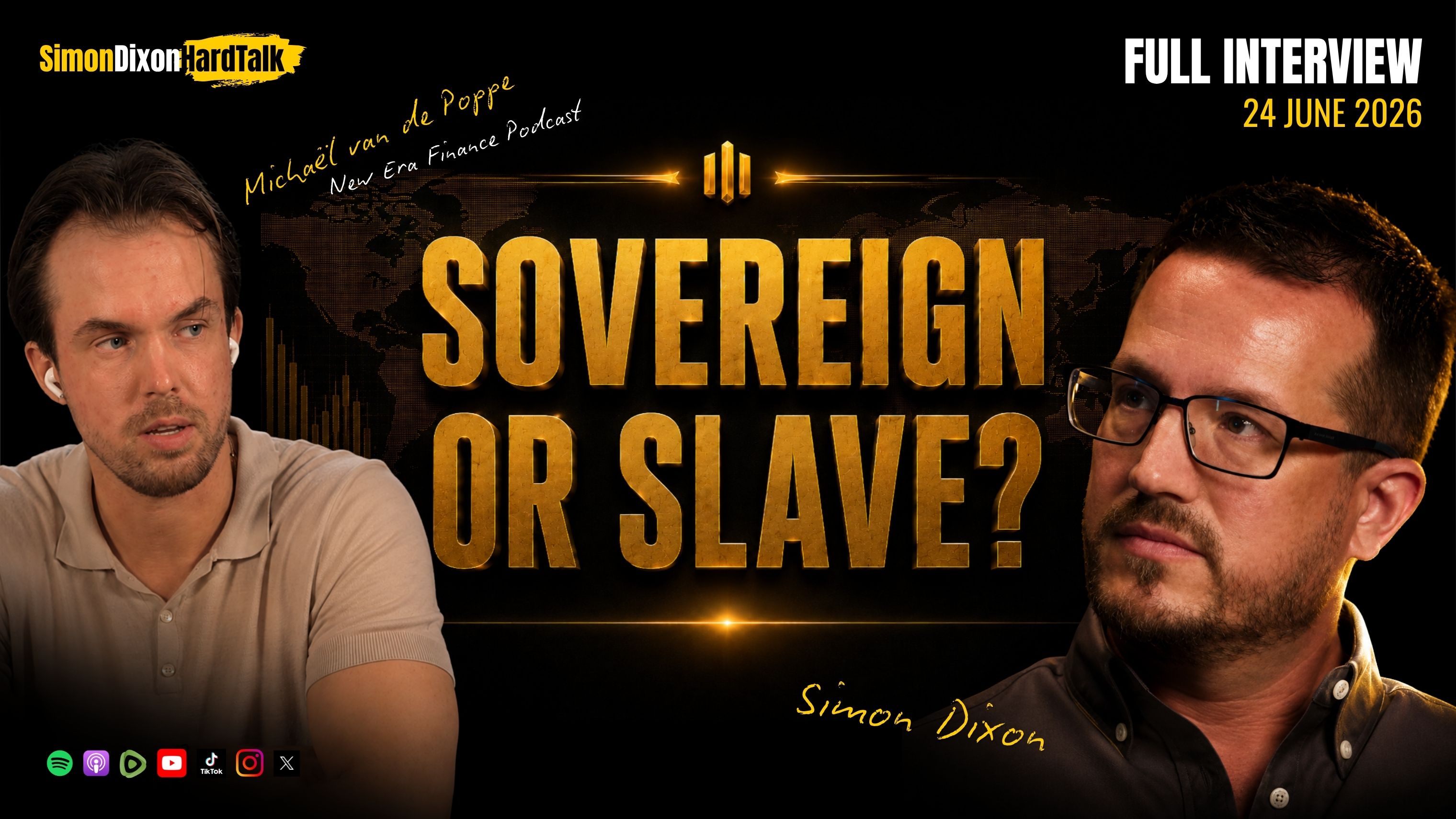
"The New World Order Wants To Steal Your Bitcoin" | Simon Dixon on New Era Finance Podcast w/ Michaël van de Poppe
Jun 24, 2026This document provides a comprehensive synthesis of the interview between Simon Dixon and host Michaël van de Poppe on the New Era Finance Podcast. This was the first interview Simon Dixon did for Michaël van de Poppe.
- Interview Title: The New World Order Wants To Steal Your Bitcoin
- Date: 24 June 2026
- Duration: 1 hour 10 minutes
Executive Summary
The interview centers on the intensifying struggle between individual sovereignty and institutional subordination. Simon Dixon argues that the Financial Industrial Complex (FIC), in coordination with the Military Industrial Complex (MIC) and Technology Industrial Complex (TIC), is actively working to co-opt Bitcoin. Through vehicles like the Bitcoin ETF and MicroStrategy (referred to as a "Bitcoin strategic reserve company"), Wall Street now allegedly controls the short-term price of Bitcoin to facilitate mass centralization and asset stripping. Dixon posits that legislative efforts like the Clarity Act and the Genius Act are designed to integrate Bitcoin and other assets into a programmable "police and surveillance state" aligned with the World Economic Forum's vision. To resist, Dixon advocates for a transition toward sovereignty through self-custody, running nodes, and jurisdictional arbitrage.
High-Level Overview
The discussion explores how global financial and political entities are re-architecting the financial system to move individuals toward a "Universal Basic Income (UBI)" model where they "own nothing and are happy." The framing of the debate focuses on:
- The transition of Bitcoin from a decentralized tool of resistance to a centralized "Wall Street wrapper."
- The use of "Paper Bitcoin" and derivatives to manipulate prices and "rugpool" retail investors.
- The geopolitical shift toward a multipolar world where China, the UAE, and Iran are emerging as dominant nodes in Bitcoin mining and programmable finance.
- The definition of personal success as the weekly increase of "sovereignty" over "subordination."
Key Arguments Made by Simon Dixon
On Michael Saylor and MicroStrategy (SDRC)
- Institutional Incentive over Personality: Dixon argues that Michael Saylor must be viewed as an executive with a fiduciary duty to shareholders, whom Dixon identifies as the FIC.
- Arbitrage Vehicle: In Simon Dixon's opinion, MicroStrategy has transitioned from a software company to a "semi-quasi ETF" with significant counterparty risk. It acts as a "central bank for paper Bitcoin," providing a tool for hedge funds and arbitrageurs to manipulate the price of Bitcoin.
- Conflict of Interest: Simon Dixon believes Saylor has a conflict of interest between equity holders, debt holders, and the original Bitcoin mission.
- The "Golden Egg": Dixon views MicroStrategy as "the goose that lays the golden egg" for the FIC, allowing them to centralize Bitcoin through complex financial structuring (convertible notes, preference shares, etc.).
On the Financial, Military, and Technology Industrial Complexes (FIC, MIC, TIC)
- FIC Control: The FIC (asset managers like BlackRock, banks, and central banks) allegedly controls the market through ETFs, which now represent 50% of the market.
- The "Neo Currency War": ETFs are the new front in the currency war, allowing firms like BlackRock to dictate capital flows into emerging markets.
- Symmetry of Control: Simon Dixon argues that the TIC provides the surveillance and AI infrastructure, the MIC handles the physical/geopolitical enforcement, and the FIC manages the asset stripping.
On Legislation and the "Clarity Act"
- The Genius Act: Allegedly designed to give legacy banks a head start by allowing them to use Federal Reserve reserves as collateral for stablecoins.
- The Clarity Act: In Dixon's view, this legislation aims to put every asset into a "box," facilitating the tokenization of everything. This allows the FIC to hold the real asset while issuing programmable, surveillance-ready "IOUs" to the public.
- Covert CBDCs: Simon Dixon believes the US is creating a "covert central bank digital currency" through private-public partnerships (e.g., Circle, JP Morgan) rather than a direct government-issued token.
On Geopolitics and the Multipolar World
- Asset Stripping the West: Policies like unrealized gains taxes (e.g., in the Netherlands and UK) are described by Dixon as "asset stripping" exercises by the FIC to reallocate capital to the East.
- China’s "Rugpool" Potential: Dixon claims China has the power to "rugpool" the Western economy through three levers: its dominance in physical gold vs. paper derivatives, its ability to blow out US Treasury yields, and its superior, cheaper open-source AI (e.g., DeepSeek).
- The UAE and Iran: Dixon highlights the importance of Mbridge (a CBDC network circumventing SWIFT) and the emergence of Iran as a major sovereign Bitcoin miner.
On Personal Sovereignty
- Subordination vs. Sovereignty: Subordination means being in debt, using custodians, and having assets in one jurisdiction. Sovereignty means self-custody, multiple income streams, and jurisdictional arbitrage.
- Boycotting the System: Dixon advocates boycotting the Federal Reserve by owning Bitcoin and boycotting banks by holding it in self-custody.
Key Arguments Made by Host (Michaël van de Poppe)
- Political Disillusionment: The host expressed skepticism that politicians represent the people, citing the Dutch unrealized gains tax (revisiting a 36% tax and only reducing it to 35%) as a "joke" and an attack on property.
- Elizabeth Warren and the Economy: He noted that Elizabeth Warren publicly claimed the Clarity Act would "destroy the economy," questioning her motives.
- Algorithmic Suppression: The host raised the issue of "Proof of Reach," noting how centralized platforms like YouTube or X can suppress content that challenges the status quo.
Points of Agreement
- Asset Confiscation: Both agreed that the current global trend involves governments and financial institutions attempting to confiscate or strip assets from the middle class.
- Politicians as Lobbies: They agreed that high-level politicians act as "pay-for-rent prostitutes" for powerful interest groups (banking, military, pharma).
- The Netherlands' Situation: Both viewed the Dutch tax policy as a deliberate attempt to push the wealthy and their assets out of the country.
Points of Disagreement
- Michael Saylor’s Relevance: The host initially suggested Saylor might not be as relevant as narratives suggest; Dixon countered that while the personality is a distraction, the incentive structure of his company is highly relevant and dangerous to Bitcoin's decentralization.
Important Data, Claims, or References Mentioned
Key Entities and Concepts
|
Category |
Entities/Terms Mentioned |
|
Institutions |
BlackRock, Vanguard, State Street, Cantor Fitzgerald, Jane Street, Coinbase, JP Morgan, Bank of America, ASML. |
|
Geopolitical Nodes |
UAE, Iran, China (Shanghai vs. London/NY gold), El Salvador, Hong Kong. |
|
Technology/AI |
DeepSeek, SpaceX, Palantir, Anthropic, Huawei, Open-source AI movement. |
|
Legislation |
Clarity Act, Genius Act, Mica (EU), SEC, CFTC. |
|
Economic Systems |
Mbridge (CBDC network), SWIFT, FedNow, UBI (Universal Basic Income). |
Specific Claims
- ETF Market Share: ETFs allegedly control 50% of the market.
- Stock Ownership: 92% of the US stock market is reportedly owned by the top 10% of institutions.
- Bitcoin Custody: Approximately 3 million to 4 million Bitcoin are estimated to be held within "Wall Street wrappers" or custodians like Coinbase.
- Dutch Tax: The unrealized gains tax was reportedly adjusted from 36% to 35% in the Netherlands.
Notable Quotes or Framing
- "Short-term price of Bitcoin is now controlled by Wall Street... they want you to borrow against it, they don't want you to self-custody it."
- "Sovereign means you have assets that you can access with no permission from a bank or a broker or a custodian."
- "MicroStrategy is the goose that lays the golden egg for our enemies."
- "Politicians are pay-for-rent prostitutes of the lobbies... including Trump himself. The higher you get in politics, the more compromised you have to be."
- "You boycott the Federal Reserve by owning Bitcoin. You boycott the banks by owning it in self-custody."
- "Measure your wealth in Bitcoin... the further the price goes down, the more Bitcoin you end up with."
- "Every week ask yourself: Did I take an action that made me more subordinate or more sovereign?"
Open Questions or Unresolved Issues
- The Future of SpaceX: Dixon questioned why SpaceX is raising $20 billion in debt despite its high valuation and recent executive meetings in Beijing.
- Iran and the Global Deal: Dixon alluded to a "major moment" regarding a deal signed with Iran that is "bigger than anyone can ever possibly imagine," but left it as a "cliffhanger" for a future episode.
- Effectiveness of the Clarity Act: Whether the Clarity Act will ultimately serve as a "center of crypto" for the US or merely a tool for the FIC to consolidate power remains a point of debate.
- Decentralized AI: The practical implementation of "running your own AI" and whether truly decentralized AI can compete with state-sponsored or big-tech models remains unclear.
Call To Action
- Share this post. Share this blog post to expose the "divide and conquer" trap.
- Subscribe to the Simon Dixon YouTube channel. Get my weekly deep dives into geopolitics, macro, and Bitcoin. Subscribe to my YouTube channel.
- Find me on Rumble. This is my backup channel, safe from censorship. Follow me on Rumble.
- Follow me on X @SimonDixonTwitt. I post real-time updates and analysis on X and am highly active there. Follow me on X.
- Follow me on instagram. Usually short clips are posted here.
- Follow me on TikTok. Usually short clips are posted here.
- SimonDixon.com This is my personal site and an archive of all my content, safe from de-platforming. Join the free membership portal.
About Michaël van de Poppe
Dr. Chris Martenson is an author, educator, and independent researcher focused on the intersection of economics, energy, and the environment. He is the founder of Peak Prosperity, where he publishes analysis on financial markets, macroeconomics, and long-term global trends. Martenson holds a Ph.D. in Pathology from Duke University and an MBA from Cornell University, and is the author of The Crash Course and Prosper!.

Watch On YouTube
Prefer To Listen? Available on Spotify & Apple Podcasts
Read Other Related Blogs
General Disclaimer
The content presented in this document, interview, or related broadcast is for general informational, educational, and strategic preparation purposes only. It strictly reflects the subjective opinions, individual macroeconomic analyses, and personal perspectives of the guest, Simon Dixon, and the host, Michaël van de Poppe. These views are intended to foster critical discussion regarding the global monetary system and should not be taken as definitive representations of fact or guaranteed future outcomes.
Legal & Financial Disclaimer
This content does not constitute financial, investment, legal, tax, or professional advice. No fiduciary relationship or client agreement is established through this material. None of the information or observations shared should be interpreted as a solicitation, recommendation, or endorsement to buy, sell, hold, or trade any specific security, corporate stock, digital asset, or financial product.
Specifically, all strategic evaluations, market assertions, or critiques of corporate entities and institutions—including but not limited to the Financial Industrial Complex (FIC), the Technology Industrial Complex (TIC), the Military Industrial Complex (MIC), MicroStrategy (STRC/MSTR), Coinbase, or Wall Street exchange-traded funds (ETFs)—represent the personal theories of Simon Dixon. In his own words regarding market projections and asset movements, he "could be completely wrong" and explicitly advises viewers and readers "don't trade upon this".
The decision to manage your own assets, engage in self-custody, or implement sovereign jurisdictional strategies involves a high degree of financial risk. You must perform your own due diligence and consult with a licensed financial advisor, legal professional, or certified accountant in your specific jurisdiction before making any financial commitments.