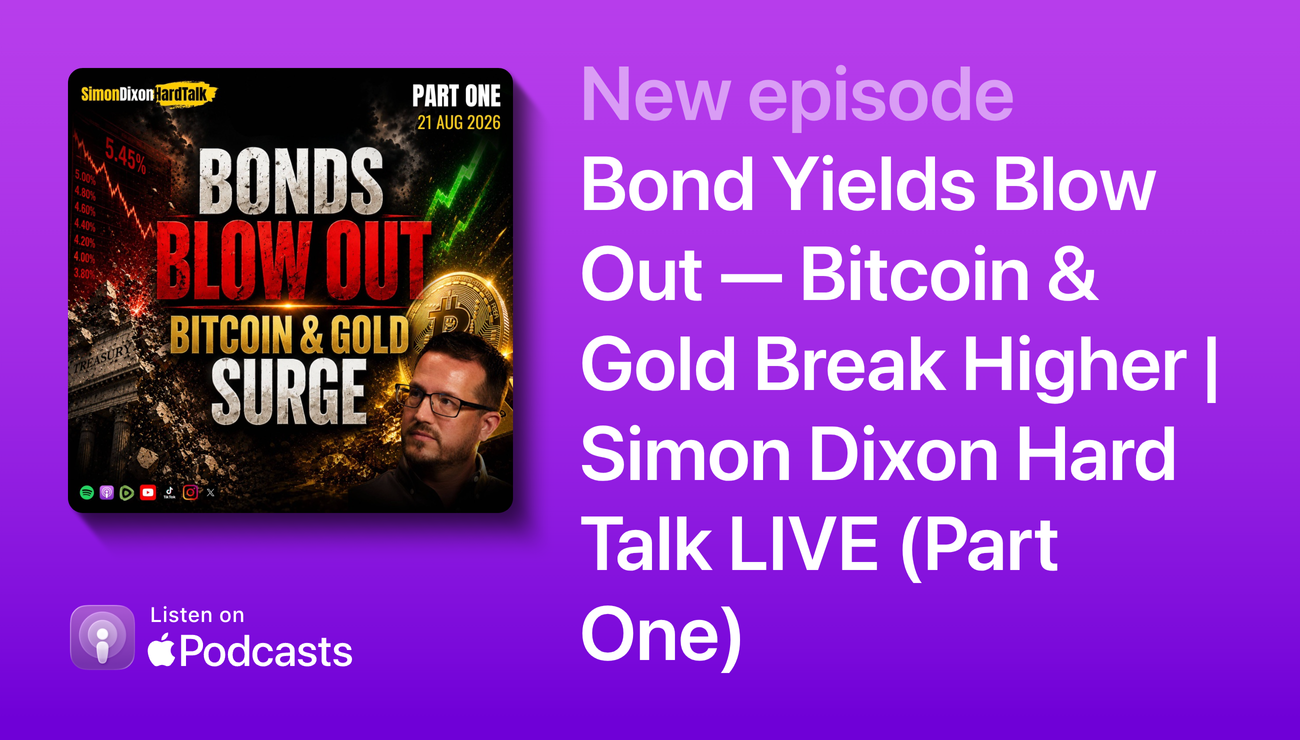
Bond Yields Blow Out — Bitcoin & Gold Break Higher | Simon Dixon Hard Talk LIVE (Part One)
Aug 21, 2026Hey hey sovereign wealth builders, Simon Dixon here.
Something fundamental changed in the global markets this week, and for those of you who have been long-term listeners, this is not a surprise. To fully understand the structural cracks forming in the legacy monetary system, I want to unpack the critical themes from Part One of our latest episode of Simon Dixon Hard Talk LIVE, titled "The Bond Market Is Screaming — America Is Sacrificing the Reserve Currency". Over the course of this 2-hour and 12-minute segment, we analyzed the immediate market panic, the historic rotation of capital, and the return of forces that the central banking elite hoped to bury forever. The signals we received this week are now loud, clear, and impossible to ignore, and this article is designed to help you understand the strategic implications and risks of this systemic reset even if you missed the live broadcast.
To navigate these changes, we must first define the four powerful complexes that shape our modern financial reality:
- The Financial Industrial Complex (FIC): The global banking and central banking elite that controls the monetary plumbing, orchestrating a system designed to socialize losses and privatize gains.
- The Technical Industrial Complex (TIC): The borderless, technocratic giants building the digital control grid, including AI infrastructure, programmable stablecoins, and tokenised assets.
- The Military Industrial Complex (MIC): The geopolitical force that applies physical and kinetic pressure to control key energy corridors, supply chains, and resources.
- The Subordination Industrial Complex (SIC): The systemic apparatus that subordinates sovereign governments and their citizens to massive national debts, debasing their currency and forcing them onto centralized rails, universal basic income (UBI), and programmable stablecoins to keep the debt-backed system functioning.
1. The Return of the Bond Vigilantes and the $40 Trillion Debt Wall
The defining structural event of the week was the U.S. national debt officially passing the $40 trillion mark, representing the largest money printing and debt expansion we have seen since COVID-19, the global financial crisis, and the Russia-Ukraine war. At the exact same time, investors began demanding substantially higher yields to hold long-duration government debt, pushing the U.S. 30-year Treasury yield to its highest rate since 2007. This blowout in sovereign yields is not unique to America; long-duration German, French, UK, and Japanese government debt have also been under severe pressure.
In my view, we are seeing the ultimate return of the "bond vigilantes," who are actively rejecting the low yields offered by highly indebted governments. As I explained during the broadcast:
"The question isn’t whether America can print dollars to repay dollar debt. The question is: At what yield will somebody voluntarily hold that debt?"
This matters because when the cost of government borrowing blows out, it creates an unsustainable sovereign debt doom loop. Traditional foreign buyers are already backing away; official data revealed that Japan, China, and the UK collectively reduced their Treasury holdings by $61 billion in June alone, with China and Japan selling $26 billion each, and the UK trimming $9 billion. Without foreign buyers, the U.S. government is forced to find other ways to clear its expanding debt.
2. The Illusion of Treasury Intervention vs. Quantitative Easing
In a desperate mid-quarter move, U.S. Treasury Secretary Scott Bessent announced that the Treasury would double the maximum size of its long-duration bond buybacks—from $2 billion to at least $4 billion per operation. This emergency intervention temporarily pushed yields down, but the relief lasted less than 24 hours. Soon after, the bond market screamed "not enough," sending the 10-year yield back up to 4.71% and the 30-year yield back above the 5.2% mark.
I believe it is critical for you to understand that this buyback program is NOT quantitative easing (QE). The Federal Reserve is not creating new reserves to print money and buy these bonds. Instead, the Treasury is retiring long-duration debt by issuing short-term liabilities (bills)—effectively engaging in a massive duration swap to manage market liquidity.
In my opinion, this duration management creates an even more dangerous problem. By shifting the government’s funding to the short end of the curve, the Treasury increases its refinancing risk, meaning the debt must be rolled over far more frequently. I suspect that if these liquidity constraints become sufficiently difficult, the Federal Reserve will eventually be forced to intervene with actual QE, which will trigger the next wave of massive currency debasement.
3. The Great Decoupling: Hard Assets Rise as Equities Correct
Typically, a macro shock causes an "everything sell-off" where all assets drop in unison. However, this week we witnessed a historic decoupling. AI and semiconductor stocks corrected sharply, with the Philadelphia Semiconductor Index falling 5.6%, Nvidia sliding 2.3% (wiping out massive value from its $5 trillion market cap), Broadcom down 3.2%, and Micron falling 7%. On Thursday, the Dow Jones Industrial Average plummeted roughly 700 points, with the S&P 500 falling 0.9% and the Nasdaq down 1%.
Yet, as traditional growth equities corrected, Bitcoin and gold broke higher in a significant way. Gold remained highly elevated at $4,587, while Bitcoin surged past $78,000 (peaking rapidly at $79,270).
This sudden divergence shows that capital is actively rotating out of paper promises and into hard, sovereign assets. The upward move in Bitcoin was hyper-accelerated by a historic short squeeze that absolutely destroyed bearish traders, liquidating $1.37 billion in Bitcoin shorts and contributing to a record-breaking $2.74 billion total wipeout of bearish crypto bets over a 24-hour period. In my opinion, this decoupling is a powerful signal that the market is beginning to hedge against sovereign debt risk and the slow sacrifice of the dollar's world reserve status.
4. The BIP-110 Resolution and the Path to Bitcoin Sovereignty
For weeks, we have closely tracked the BIP-110 consensus battle. I am pleased to report that we have reached an important resolution: the BIP-110 battle is officially over on the main BTC chain. Mandatory signaling began around block 961,632, but the BIP-110 branch only managed to mine four blocks before stalling. Bitcoin's normal chain continued with overwhelmingly more accumulated proof of work, and the BIP-110 protocol proposal was officially marked Closed.
Supporters of the proposal are now pursuing a separate hard-fork chain with a completely different proof-of-work algorithm (BLAKE2b instead of SHA-256d), targeting a September 1st launch. This means it will launch as an entirely separate coin rather than a split of BTC.
In my opinion, the timing of this resolution is highly symbolic; the removal of this protocol uncertainty coincided perfectly with Bitcoin's explosive price bottom. But more importantly, this battle highlighted the absolute necessity of Bitcoin sovereignty. If you hold your Bitcoin with an institutional custodian or an ETF wrapper, the custodian will decide which chain to support, sell, or ignore during a fork. Only if you control your own private keys and run your own node do you retain the power to claim and control your assets. Wall Street is quietly absorbing Bitcoin—with JPMorgan disclosing $610 million in BlackRock's spot ETF, UBS disclosing $83.2 million, and Citi planning to launch native Bitcoin custody on its Custody+ platform—but true security remains in self-custody.
5. Geopolitical Energy Warfare and the Petro-Doom Loop
We cannot analyze the financial markets in isolation from geopolitics, which is why the MIC connects straight back into the FIC. This week, geopolitical risks pushed Brent crude back above $90. Energy is one of Iran's most powerful asymmetric weapons when negotiating with western financial powers. Reports from senior Iranian officials in Tehran suggest systematic preparations for preemptive economic warfare before the U.S. midterms, specifically aiming to strike Gulf oil terminals and destroy the remaining Hormuz bypass infrastructure, including Saudi Arabia's Yanbu and the UAE's Fujairah pipelines, which move a combined 5.5 million barrels of crude per day.
The operational chain of this geopolitical risk is direct: crude oil shocks lead to higher pump prices with a 2-to-4 week lag, which spikes CPI inflation, sours voter mood, and complicates Federal Reserve policy. When oil spikes, bond investors demand higher inflation compensation, which drives yields up and increases government debt servicing costs. This forces Treasury intervention, which ultimately debases the currency and pushes capital toward gold and Bitcoin. To build resilience, Saudi Arabia has reportedly begun moving and selling its crude through waters off Oman, attempting to bypass the volatile Hormuz chokepoint.
Final Thought
The K-shaped economy is playing out in real time. The FIC and the TIC are converging to build a programmable digital control grid designed to socialize losses, privatize gains, and inflate assets for the wealthy, while pushing the rest of the population toward centralized stablecoins, Central Bank Digital Currencies (CBDCs), and UBI. We saw this beta-tested this week with Thailand's AI dividend and Taiwan's official cash payout of an $314 "AI dividend" to all citizens. Under the SIC, if you do not own hard assets, you are the product—a collateralized future tax stream supporting a debt-backed Ponzi scheme.
The only way to win this game is to step off their centralized financial rails. Do not panic into high-time-preference gambling on shitcoins. Instead, extend your time horizon, accumulate fixed-supply assets like Bitcoin and gold, run your own node, and secure your own private keys.
Call To Action
- Share this post. Share this blog post to expose the "divide and conquer" trap.
- Subscribe to the Simon Dixon YouTube channel. Get my weekly deep dives into geopolitics, macro, and Bitcoin. Subscribe to my YouTube channel.
- Find me on Rumble. This is my backup channel, safe from censorship. Follow me on Rumble.
- Follow me on X @SimonDixonTwitt. I post real-time updates and analysis on X and am highly active there. Follow me on X.
- Follow me on instagram. Usually short clips are posted here.
- Follow me on TikTok. Usually short clips are posted here.
- SimonDixon.com This is my personal site and an archive of all my content, safe from de-platforming. Join the free membership portal.
Watch On YouTube

Prefer to Listen? Available on Apple Podcasts & Spotify
Read Other Related Blogs
FULL EPISODE: America Is Sacrificing the Reserve Currency| Simon Dixon Hard Talk LIVE

Disclaimer:
The content of this blog is for educational, informational, and illustrative purposes only. It represents the personal opinions and macroeconomic commentary of Simon Dixon and does not constitute financial, investment, legal, or tax advice. Past performance is not indicative of future results. Always conduct your own research, assess your personal risk tolerance, and consult with a licensed professional before making any financial decisions regarding sovereign assets, bond markets, self-custody, or digital assets.