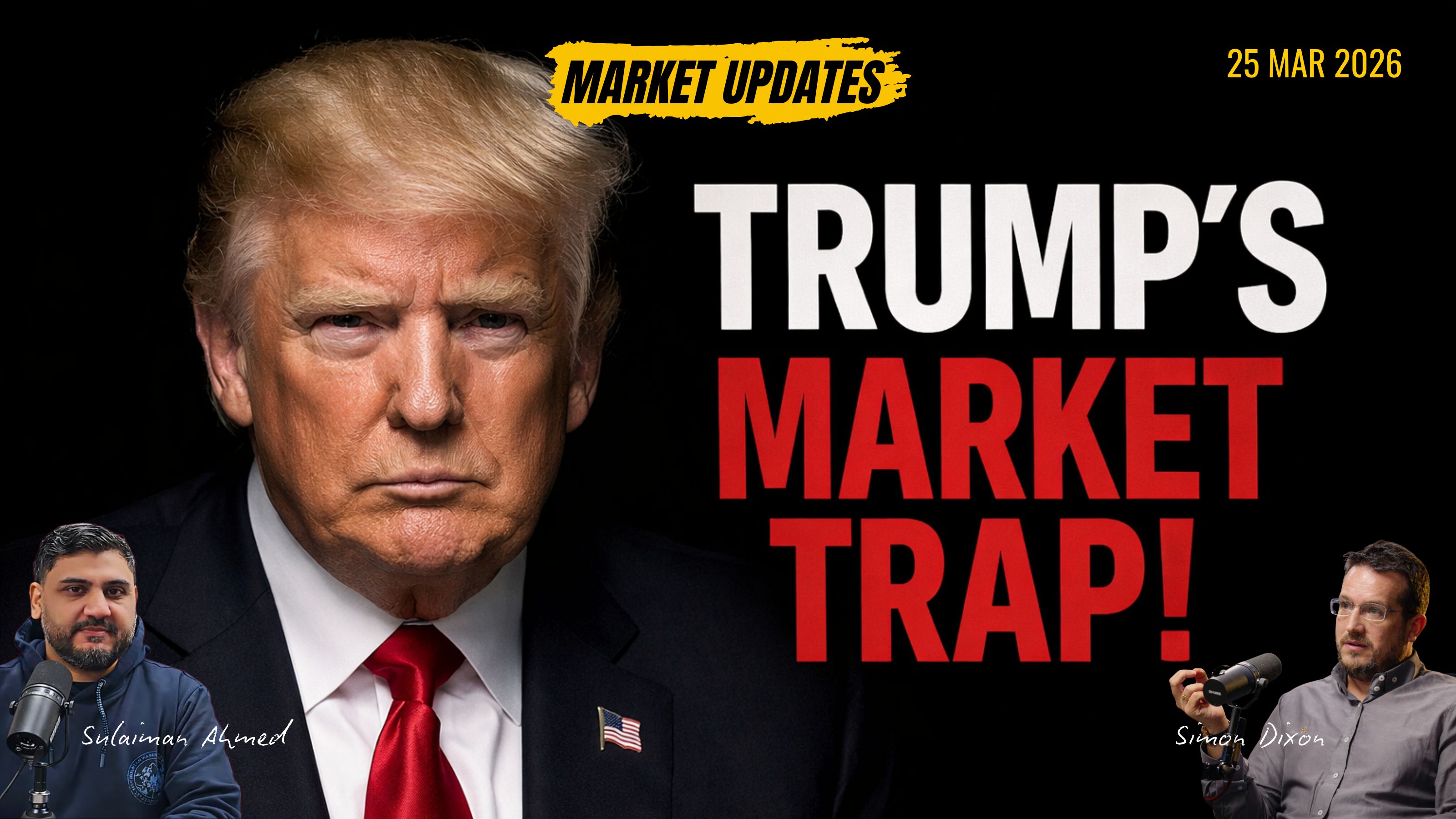
Trump Manipulating the Financial Market with 15 Point Ceasefire Plan | Market Update (25 March 2026)
Mar 25, 2026Introduction: The Geopolitical Roller Coaster
Hey hey Sovereign Wealth Builders,
We find ourselves navigating an era defined by the desperate gasps of a dying debt-based monetary system, where the line between geopolitical diplomacy and raw market manipulation has completely evaporated. On 25 March 2026, I sat down with Sulaiman Ahmed to dissect the absolute roller coaster that the global financial markets have endured over the last 72 hours. This conversation serves as a high-level synthesis of 23 days of exhaustive, 24/7 coverage we have spearheaded on X Spaces. While the legacy media remains trapped in the lagging cycles of propaganda, we have been working to keep capital allocators 15 steps ahead of a narrative that is being rewritten in real-time.
The core thesis of my current analysis is as sophisticated as it is alarming: Donald Trump is utilizing strategic geopolitical announcements—most notably his recently unveiled 15-point peace plan—not as a genuine diplomatic olive branch, but as a surgical instrument to manipulate global oil prices and the bond markets. This is a high-stakes survival strategy designed to prevent a domestic economic collapse before the next political cycle. For anyone focused on the protection of individual sovereignty, understanding this "Great Reset" in motion is vital. We are witnessing a systemic attempt to manage the volatility of a "doom loop" by weaponizing headlines to suppress interest rates and energy costs that threaten to blow the entire US Treasury strategy apart.
The Mechanics of the "Taco" Trade: Managing Market Cycles
To survive this environment, one must master the mechanics of the "taco" trade, a term I use to describe the rhythmic pattern of escalatory threats followed by calculated de-escalatory maneuvers. The strategy is transparent to those of us who track the plumbing of the financial markets: the administration issues an escalatory warning—such as the recent 48-hour warning regarding Iranian energy infrastructure—which sends a shockwave through the commodities market. Just as the tension reaches a breaking point, Trump delivers the "taco"—a de-escalatory statement on Truth Social suggesting that negotiations are "going very well" or granting a 5-day extension.
The timing of these maneuvers is a masterclass in psychological warfare against bond vigilantes and commodity traders. These announcements are almost never random; they are meticulously timed to coincide with specific market liquidity windows. We have observed a recurring pattern where these "peace" frameworks are dropped exactly one hour after the oil futures market closes, or specifically positioned to influence the opening of Sunday night futures. By making these moves when the primary markets are in low-liquidity states or closed for the weekend, the administration attempts to play a "game of chicken" with the world's largest capital pools. These bluffs are designed to buy the Treasury time and neutralize the immediate reflexive reactions that would otherwise send yields into a terminal spiral. However, the market is not a blind beast; it is beginning to recognize these "shenanigans," and the impact of these tactical delays is showing clear signs of diminishing returns.
The Red Lines: Oil $115 and the 5% Bond Threshold
In my analysis of the current administration's desperation, I have identified three strategic "red lines" where the mechanical limits of the economy are reached. At these points, the economic advisors, led by figures like Scott Bessebt, are forced to "knock on the shoulder" of the President and signal that the situation is no longer tenable. The first of these red lines is Brent crude oil hitting 115 per barrel**. Even though the United States functions as a significant energy exporter, the global price of Brent is the primary driver of domestic inflationary pressure. Once oil sustains levels above this threshold, gas prices across America inevitably surge toward $4 per gallon, creating an immediate political and economic crisis that acts as a regressive tax on every single citizen.
The second and third red lines are found in the belly of the bond market, which is the ultimate arbiter of truth in a debt-driven world. When the 10-year Treasury yield hits 4.5% and the 20-year and 30-year Treasuries cross the 5% mark, the entire credit apparatus enters a state of Refinancing Paralysis. At these levels, American mortgages begin to approach or exceed 7%, effectively killing the housing market and freezing the movement of capital. This is the "point where nothing works." The downstream effects include a massive spike in the cost of servicing the national debt, which is already burdened by a 6% GDP deficit. When these yields are breached, the administration is forced to issue a "taco" statement to artificially pull the yields back down, attempting to manage a structural insolvency crisis through the medium of 280-character tweets.
Market Integrity and the 15-Minute Window
Perhaps the most damning evidence of centralized manipulation is the "abnormal behavior" we have observed in the 15 minutes preceding major policy announcements by Trump. Our data tracking on X Spaces and through various market feeds shows massive, disproportionate volume in shorting oil and going long on the S&P 500 exactly 15 minutes before Trump releases a de-escalatory tweet. This isn't just a coincidence; it is a signal that someone with advance knowledge of the "15-point framework" is positioning themselves to extract massive liquidity from the ensuing volatility. Conservative estimates suggest that these well-timed trades have netted insiders upwards of a $60 million profit in a single window.
This raises profound questions about market integrity that the CFTC may be investigating with extreme prejudice. When a geopolitical event is used as a tool to cool the market, and that event is front-run by ginormous short positions, it suggests the game is fundamentally rigged against the retail investor. Furthermore, a critical piece of evidence recently emerged in the Financial Times regarding Comex, the world's largest commodities exchange. They issued a rare public statement suggesting the US government should not be manipulating prices. I interpret this as a "smoking gun" indicating that the US government itself likely holds a ginormous short position on oil to artificially suppress the price. If this trade blows out due to a real-world escalation, the resulting bailout would be catastrophic. For the Sovereign Wealth Builder, this confirms that we are not operating in a free market, but in a controlled environment where price discovery is being sacrificed at the altar of political expediency.
The "Doom Loop" and the Fragility of the AI Trade
If these tactical bluffs fail to produce a genuine, long-term resolution, we are facing a "disastrous blowout" that will fundamentally break the current market structure. The recent growth in the equity markets has been almost entirely concentrated in the AI trade, a sector that is hyper-sensitive to both interest rates and energy costs. The massive energy requirements of AI data centers and the reliance of private credit investors on low-cost debt for research and development mean that once energy costs climb and bond yields blow past our red lines, the AI trade begins to disintegrate. This removes the primary engine of growth from the economy, leaving nothing but the hollow shell of a debt-based monetary system.
This is the catalyst for the "doom loop." As high interest rates increase the government's debt service costs, the 6% GDP deficit requires even more borrowing, which in turn puts more upward pressure on yields. This cycle is exacerbated by the ongoing restriction of the Strait of Hormuz. While the media focuses on oil and LNG, the reality is that the restriction of this passage affects 50 different types of critical goods essential for global manufacturing. Every day the strait remains restricted, we are "baking in" future economic pain that will manifest as Demand Destruction and severe stress in the markets. We are moving toward a Stagflationary Recession—a nightmare scenario of high inflation, high unemployment, and negative growth—that could literally crash everything in the American economy within the next six to nine months if a substantive solution is not found.
Geopolitical Realities vs. Propaganda: The JD Vance Factor
The market’s reaction to the 15-point plan highlights the growing chasm between legacy media propaganda and geopolitical reality. While outlets like CNN and the Wall Street Journal have been quick to report on mediation efforts by Pakistan, Egypt, and Turkey, the Iranian government has countered with frequent denials. This "back and forth" creates a fog of war that the market is struggling to penetrate. However, a highly specific nuance has emerged regarding the Iranian preference for negotiations. Reports indicate that Iran has expressed a desire to negotiate directly with JD Vance, rather than the individuals they characterize as "Israeli lackeys"—specifically citing figures like Steve Wickoff and Jared Kushner.
This "JD Vance Factor" is a critical signal for the market. Despite Vance's own ties to the Zionist side and funding from figures like Peter Thiel, the Iranians seemingly view him as a more direct representative of "America First" interests rather than a proxy for secondary geopolitical agendas. The market interprets this preference as a sign of "two-way confirmation"—a signal that there is at least a potential channel for real dialogue. When the market sees a plan from the US and a specific, albeit critical, response from Iran, it finds a temporary floor. However, if these reports of mediation turn out to be nothing more than "CIA agent" plants or manufactured propaganda, the subsequent market correction will be severe. We are currently in a short-term, news-driven cycle where the veracity of every report is being tested by the price of oil and the yield on the 10-year Treasury.
Strategic Imperatives for the Sovereign Individual
The market is currently sending a paradoxical signal: it does not yet believe we are on the precipice of World War III. We know this because there has not been a 35% COVID-style stock correction, nor has there been a sustained, parabolic spike into gold. The market still "thinks there will be a solution," which is why it continues to react—with decreasing conviction—to the de-escalatory tweets. But for the Sovereign Wealth Builder, complacency is a luxury we cannot afford. You must look 15 steps ahead of the mainstream narratives provided by CNN or Fox News, which function as nothing more than lagging indicators designed to keep the masses in the dark.
The administration is running out of tools. They have already depleted the Strategic Petroleum Reserve to dangerous levels and offered sanctions relief for "oil on water" from Iran and Russia. The "taco trade" is their last line of defense. To survive the impending economic cycles and the "Great Reset" of the global order, you must utilize real-time information and seek out a "diverse view of reality." This is why our 24/7 X Spaces are so vital; they provide a granular look at the mechanics of the Treasury and the bond market that you simply cannot find in legacy finance reporting. The bondholders and oil traders are the ones currently determining the true price of US debt, and they are signaling that the era of managing a global economy via social media is rapidly coming to an end.
Call to Action
This situation is evolving by the hour, and the "taco trade" tactics are becoming increasingly desperate. To see the full data breakdown and hear the deep-dive analysis of these market maneuvers, I strongly encourage you to watch the full 25-minute interview on the Sulaiman Ahmed YouTube channel.
To ensure you are positioned to protect your capital and stay ahead of these systemic manipulations, subscribe to the Simon Dixon YouTube channel (SimonDixon21) and join me on my Rumble channel for our deep-dive sessions every Friday. For real-time updates and to join our 24/7 Spaces where we break down these geopolitical events as they happen, follow me on X (@SimonDixonTwitt). Please share this analysis with other Sovereign Wealth Builders who understand that in an era of universal deceit, telling the truth is a revolutionary—and profitable—act. Stay vigilant, stay sovereign.
- Share this post. Share this blog post to expose the "divide and conquer" trap.
- Subscribe to the Simon Dixon YouTube channel. Get my weekly deep dives into geopolitics, macro, and Bitcoin. Subscribe to my YouTube channel.
- Find me on Rumble. This is my backup channel, safe from censorship. Follow me on Rumble.
- Follow me on X @SimonDixonTwitt. I post real-time updates and analysis on X and am highly active there. Follow me on X.
- Follow me on instagram. Usually short clips are posted here.
- Follow me on TikTok. Usually short clips are posted here.
- SimonDixon.com. This is my personal site and an archive of all my content, safe from de-platforming. Join the free membership portal.
Watch on YouTube
Disclaimer
This document is for informational and educational purposes only and does not constitute financial, legal, or investment advice. The analysis provided is based on market observations, technical data (including bond yields and oil futures), and geopolitical interpretations as of 25 March 2026. Financial markets are inherently volatile, and the "red lines" or "strategic points" mentioned—including the $115 Brent crude and 5% bond yield thresholds—are based on current trends that are subject to rapid and unpredictable change.
Geopolitical analysis and market interpretations are subjective and should not be used as the sole basis for any investment or capital allocation decision. Neither Simon Dixon nor his affiliates assume any liability for any loss or damage resulting from the use of this information. You are strongly encouraged to perform your own due diligence and consult with a qualified professional financial advisor before making any decisions. Past performance, market reactions to previous announcements, and the success of past "taco trade" tactics are not indicative of future results, and the mechanical limits of the financial system may be reached sooner than anticipated by current models.