Was Bitcoin A CIA Psyop? Analysis of the Simon Dixon vs. Francis Hunt Debate
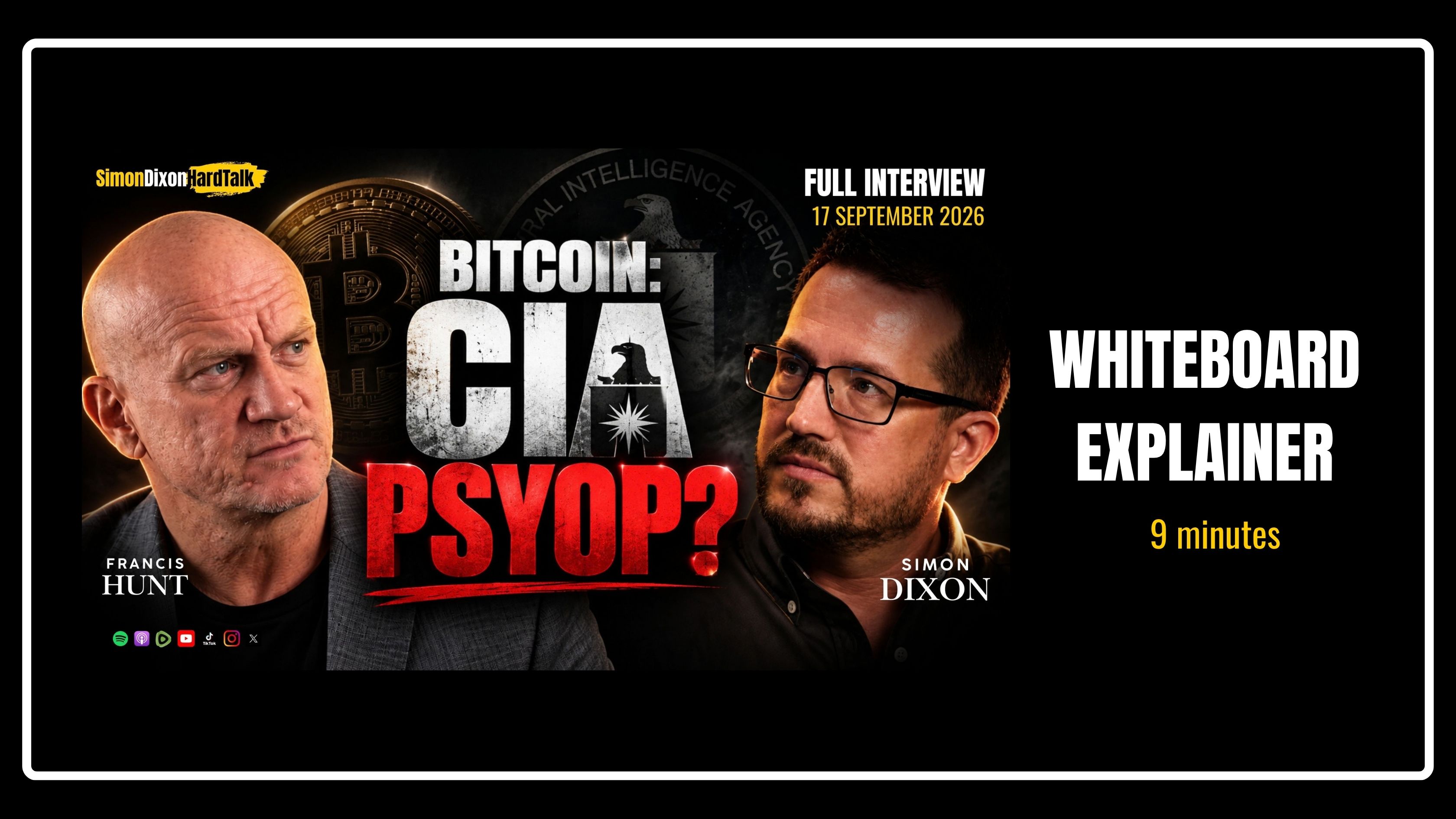
Sep 17, 2026On 17 September 2026, the YouTube channel CapitalCosm, hosted by Danny, featured a debate between Simon Dixon, an early Bitcoin investor and advocate, and Francis Hunt (known as "The Market Sniper"), a trader and skeptic regarding the nature of digital assets. The discussion centered on whether Bitcoin serves as a tool for individual sovereignty or a sophisticated psychological operation ("psyop") designed to transition the global population into a digital surveillance grid.
Executive Summary
The debate presents a fundamental clash between two perspectives on the "Great Reset" and the future of money. Francis Hunt argues that digitization is a comprehensive power grab by the Financial Industrial Complex (FIC), framing Bitcoin as "trainer wheels" intended to program the public for a future of Central Bank Digital Currencies (CBDCs) and total surveillance. Conversely, Simon Dixon acknowledges the existence of infiltration attempts by intelligence agencies and the FIC but maintains that the Bitcoin protocol’s decentralized architecture—specifically its node operators and open-source code—remains a viable breakaway project for individual sovereignty.
Critical takeaways include:
- The Infiltration Thesis: Both participants agree that the FIC and intelligence agencies have attempted to co-opt Bitcoin, specifically citing connections between early developers and figures like Jeffrey Epstein.
- The Nature of Privacy: Hunt views the blockchain as "footprints in wet concrete" that eliminate the right to be forgotten, while Dixon argues that privacy is achievable through technical mastery (running nodes/coin joins).
- Store of Value vs. Speculative Asset: Dixon views Bitcoin as a hard-money alternative to gold; Hunt classifies it as a high-beta speculative asset correlated to the Technical Industrial Complex (TIC).
High-Level Overview
The discussion frames Bitcoin not merely as a currency, but as a pivotal element in a broader geopolitical and financial transition. The central question is whether Bitcoin was "innocently" created by cypherpunks to bypass the banking cartel or if it was seeded by the state to destroy physical cash and usher in a digital slavery system. The debate encompasses historical analysis of Bitcoin's origins, the mechanics of protocol governance, and the role of institutional players like BlackRock and the IMF.
Key Arguments Made by Simon Dixon
Simon Dixon advocates for Bitcoin as a tool for "sovereign strategy," emphasizing the distinction between the protocol itself and the custodial services built atop it.
- Sovereign vs. Custodial Use: Dixon believes the primary trap is not Bitcoin itself, but the "financial industrial complex" (FIC) convincing people to hold Bitcoin via ETFs or custodians. He argues that "sovereign Bitcoin" (self-custody) allows for peer-to-peer transactions without government permission.
- The Decentralized Defense: Dixon claims the "block size wars" of 2017 and subsequent battles in 2024 prove that node operators can resist centralization attempts by miners and developers.
- Origin Theory (Len Sassaman/Hal Finney): In Dixon's opinion, it is more plausible that cypherpunks like Len Sassaman and Hal Finney were Satoshi Nakamoto. He suggests Satoshi left the project when the CIA/In-Q-Tel began showing interest.
- Infiltration Acknowledgment: Dixon admits that the FIC has attempted to infiltrate the ecosystem, specifically citing Blockstream’s alleged funding connections to Jeffrey Epstein and the presence of CIA-linked individuals in companies like MicroStrategy.
- The "Breakaway Project" Thesis: Dixon posits that while the state wanted to create CBDCs, Bitcoin was a "breakaway project" that utilized open-source code to create a fixed monetary policy (21 million cap) that the state cannot easily alter.
- Utility over History: He believes that even if the origins are murky, the current utility—owning your own key and verifying your own transactions—is the best available defense in a digital world.
Key Arguments Made by Francis Hunt (The Market Sniper)
Francis Hunt presents a skeptical view, arguing that the "freedom money" narrative is a lure into a trap.
- The Digital Surveillance Grid: Hunt argues that digitization is a "power grab" and that the "satanic acic forever financial record" of the blockchain destroys the inherent right to privacy and the "right to be forgotten."
- The "Trainer Wheels" Analogy: He views Bitcoin as a mechanism to program the masses to accept wallets and digital payments, easing the transition into a "grand surveillance grid slavery system."
- Origin Skepticism (The Adam Back Thesis): Allegedly, linguistic and mathematical analysis of the white paper points to Adam Back as the author. Hunt highlights Back’s presence on Epstein Island as evidence of the project's compromised nature.
- Asset Stripping and Tokenization: Hunt believes Bitcoin is part of an "asset stripping exercise" led by the World Economic Forum (WEF) and BlackRock to move humanity toward a "you own nothing" future.
- Failure as a Store of Value: He characterizes Bitcoin as a "high-beta" asset correlated to tech stocks. He argues it fails as a store of value because it "leaks like hell" during the rainy periods of economic contraction when liquidity is needed most.
- Physical Supremacy: Hunt advocates for "physical cash" and "physical gold/silver," arguing that physical assets cannot be "switched off" or remotely hacked in the same way digital assets can.
Points of Agreement
- The Adversary: Both agree the Financial Industrial Complex (FIC) and the "transnational banking cartel" are working to centralize power and eliminate individual sovereignty.
- The End of Privacy: Both acknowledge that traditional banking and CBDCs are designed for total surveillance and programmable control.
- Institutional Infiltration: Both discussed allegations and documented links involving intelligence agencies and figures associated with Jeffrey Epstein, while differing on what those connections imply for Bitcoin itself. (e.g., Blockstream, Blockchain Capital).
- The Debt-Based Collapse: Both see the current fiat system as being in a state of "debt-based collapse" and "monkey money" devaluation.
- Gold’s Role: Both hold gold as a legitimate store of value and a necessary part of a wealth preservation strategy.
Points of Disagreement
- The Identity of Satoshi: Hunt points to Adam Back (alleging a committee/intelligence link); Dixon points to Len Sassaman and the cypherpunks (arguing for a grassroots breakaway).
- The Viability of Privacy: Hunt believes digital footprints are permanent and inherently dangerous; Dixon believes technical tools (nodes, coin joins) can provide sufficient obfuscation.
- Bitcoin as an On-ramp: Hunt sees Bitcoin as the gateway to CBDCs; Dixon sees it as the only viable exit from CBDCs.
- Market Function: Hunt views Bitcoin as a speculative tech stock; Dixon views it as an emerging "digital gold" that will eventually outperform physical gold due to its fixed supply and portability.
Important Data, Claims, or References Mentioned
Historical and Institutional References
|
Entity/Person |
Reference/Claim |
|
Adam Back |
Alleged author of the white paper; allegedly visited Epstein Island with Austin Hill. |
|
Blockstream |
Allegedly received funding connected to Jeffrey Epstein; central figure in the "block size wars." |
|
Len Sassaman |
Prominent cypherpunk who died in July 2011, shortly after the period in which Gavin Andresen publicly disclosed his CIA presentation. No evidence establishes a causal connection. |
|
Gavin Andresen |
Early Bitcoin developer who gave a presentation at CIA headquarters in June 2011 during an emerging-technologies conference for the U.S. intelligence community. |
|
El Salvador |
El Salvador holds Bitcoin as part of its national reserves; the United States formally established a Strategic Bitcoin Reserve in March 2025. |
|
B.I.S. |
Bank for International Settlements; Basel framework limits commercial banks’ Group 2 cryptoasset exposure to generally 1% of Tier 1 capital, with an absolute 2% limit. |
|
MicroStrategy |
In the debate, Strategy Government Services was described as “CIA-linked”; this specific connection was not independently substantiated. |
Comparative Asset Performance (Claims)
|
Asset |
Francis Hunt's View |
Simon Dixon's View |
|
Cash |
Essential for localized, anonymous transactions. |
Useful for local spending, but a victim of debasement. |
|
Gold |
The ultimate "seinal wealth"; hard to confiscate if held physically. |
A 5,000-year history of success; hard to transport/verify at scale. |
|
Bitcoin |
High-beta speculative instrument; "exploration mining stock" behavior. |
Hardest form of money designed by math; potential to outperform gold. |
Notable Quotes or Framing
Simon Dixon
- "The devil's in the detail."
- "The rules of mining and how currency is issued is set in code by mass and code."
- "History doesn't tell us that... what they have done historically is the banksters tried to corner as much gold as possible and then they issue paper receipts against it."
- "Trying to figure out how to remain sovereign is actually the skill of the future."
Francis Hunt
- "Digitization is a power grab in all its forms."
- "The satanic acic forever financial record... our right to privacy is the great victim here."
- "Bitcoin is the trainer bicycle wheels that have brought everybody to cycle into a new realm."
- "You never get to have your own money; they will kill for that."
- "It's a bit like the raincoat that's always usable except when it rains—it leaks like hell."
Open Questions or Unresolved Issues
- The Nation-State Adoption: Why are major powers like Russia and China accumulating gold instead of Bitcoin? (Hunt suggests they know it is a surveillance trap; Dixon suggests it is due to gold's 5,000-year established history).
- The Protocol Integrity: Can the FIC simultaneously capture all miners, developers, and nodes to change the 21 million supply cap? Dixon says it’s highly unlikely; Hunt suggests they already control the narrative and major holders.
- The CBDC Connection: Is Bitcoin’s technical infrastructure being used to "beta test" the very systems that will eventually enslave the population via programmable money?
- Satoshi's True Identity: The debate over whether Satoshi was an individual, a committee, or an intelligence operation remains speculative and unresolved.
Call To Action
- Share this post. Share this blog post to expose the "divide and conquer" trap.
- Subscribe to the Simon Dixon YouTube channel. Get my weekly deep dives into geopolitics, macro, and Bitcoin. Subscribe to my YouTube channel.
- Find me on Rumble. This is my backup channel, safe from censorship. Follow me on Rumble.
- Follow me on X @SimonDixonTwitt. I post real-time updates and analysis on X and am highly active there. Follow me on X.
- Follow me on instagram. Usually short clips are posted here.
- Follow me on TikTok. Usually short clips are posted here.
- Follow me on NOSTR.
- SimonDixon.com This is my personal site and an archive of all my content, safe from de-platforming. Join the free membership portal.
Watch On YouTube
Prefer to Listen? Available on Apple Podcasts & Spotify
Read Other Related Blogs
The World Is Being Rewired | War, Programmable Money & Bitcoin | Simon Dixon Hard Talk LIVE
Want the faster version of this article?
If you don’t have time to read or watch the full discussion, you can access the AI Summary and Whiteboard Explainer for this post inside the Simon Dixon Hard Talk Membership Portal.
Already have your complimentary login? Simply sign in to access them.
Not a member yet? The portal is 100% complimentary to join and use.
You can also download a free PDF copy of Simon’s 2011 book and access the full archive of Simon Dixon Hard Talk LIVE episodes, interviews, long-form conversations, AI summaries and explainer videos.
Simon does not ask you to buy anything.
- No membership fees.
- No upsells.
- No sponsors.
- No ad revenue.
- No products being pushed.
The portal exists to build a sovereign community and independent archive that does not depend entirely on YouTube, X or any other social platform to stay connected.

Disclaimer: This blog post is provided solely for educational and informational commentary and reflects personal opinion. It does not constitute financial, investment, legal, or tax advice.