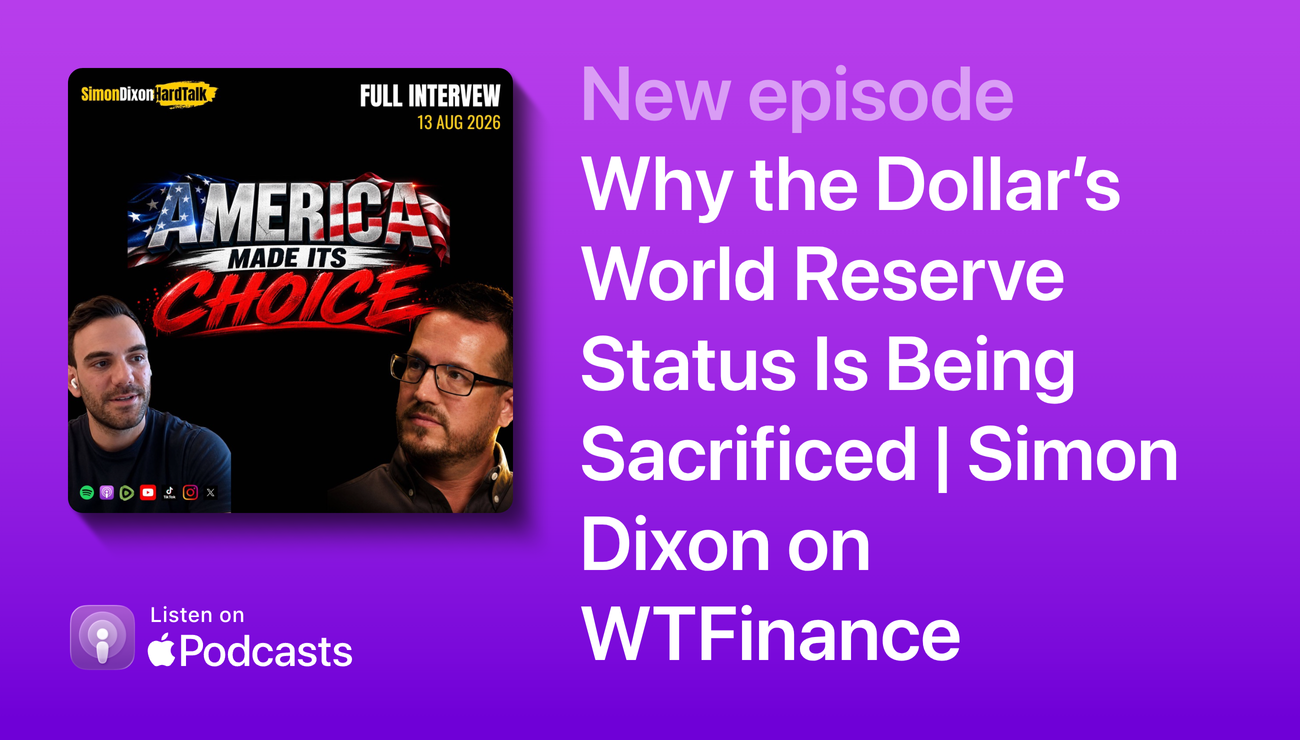
Why the Dollar’s World Reserve Status Is Being Sacrificed | Simon Dixon on WTFinance w/ Anthony Fatseas
Aug 13, 2026This briefing document synthesizes the key insights, arguments, and data points from the interview conducted on 13 August 2026 on the WTFinance podcast. The host, Anthony Fatseas, welcomed back guest Simon Dixon for their second interview to discuss the structural transition of the global financial system and the emerging geopolitical landscape. This document is intended for Simon Dixon’s use in preparing for his upcoming livestream.
Executive Summary
The central thesis of the discussion is that the US dollar system is undergoing a managed sacrifice to prevent a total collapse, moving instead toward a "K-shaped" economy. This transition is characterized by extreme wealth concentration for asset holders and the implementation of a global AI-driven surveillance and control grid for the rest of the population. Simon Dixon argues that we are shifting from a unipolar world dominated by the US to a multipolar world where China acts as the primary broker. To survive this transition, Dixon emphasizes the necessity of "sovereign assets"—specifically self-custodied Bitcoin, gold, and decentralized technology—to resist the "centralization vs. decentralization" battle that defines the current era.
High-Level Overview
The interview explores the terminal phase of the current monetary system, drawing historical parallels to the Dutch and British Empires. The conversation frames the current economic volatility not as a series of random crises, but as a "central bankers' game" coordinated via the Bank for International Settlements (BIS). The overarching narrative suggests that the dollar is being sacrificed as the world reserve currency to facilitate a transition into a tokenized, programmable economy where "you will own nothing and be happy."
Key Arguments Made by Simon Dixon
- The Sacrifice of the Dollar: Simon Dixon believes the current strategy is to sacrifice the dollar as the world reserve currency to avoid a total depression. This involves running the economy "hot," rolling over debt, and pumping liquidity into the stock market via AI narratives and ETF flows.
- The K-Shaped Economy and Control Grid: Dixon argues that the resulting extreme wealth polarization requires a "surveillance control grid." He suggests that as civil unrest grows due to wealth gaps, the state will implement Universal Basic Income (UBI) via CBDCs or stablecoins to maintain order and make money "programmable."
- Geopolitical Realignment:
- The Middle East as "West Asia": Dixon posits that the US is exiting the Middle East, leading to a "multipolar world" where China is the broker between Iran and Saudi Arabia.
- The Strait of Hormuz: He compares the symbolic importance of the Strait of Hormuz today to the Suez Canal's role in the decline of the British Empire.
- Israel’s Transition: Dixon observes that Israel is being turned into a "pariah state" while its state assets are simultaneously being privatized and acquired by transnational capital via IPOs.
- The "Genocide/Occupation as a Service" Model: Dixon claims that conflict zones like Ukraine, Gaza, and the West Bank have served as beta tests for AI drone integration and "occupation as a service" technologies that will eventually be used for domestic control.
- Centralization vs. Decentralization: In Dixon’s opinion, the "real war" is not between political parties or religions but between centralized control (CBDCs, digital ID, centralized AI) and decentralized sovereignty.
- The IMF/BIS Strategy: He believes the strategy involves distressing governments with debt (above 100% debt-to-GDP), implementing austerity, and then acquiring resources and assets at a discount—a model previously used by the Dutch and British Empires.
Key Arguments Made by Anthony Fatseas
- Alternative Support Mechanisms: Fatseas noted that central banks recently intervened to strengthen the Yen by selling Euros (without consulting the ECB) as a way to protect the system without selling US Dollars directly.
- Managed Property Crashes: Fatseas proposed a theory that authorities might seek to devalue property (as seen in the UK) to manage social instability. By making housing "affordable" while the stock market remains high, they might prevent revolution among those who do not own assets.
- Sustainability of the Chinese Model: Fatseas questioned the sustainability of the Chinese economic growth model over the last 20 years, wondering if it might require a "Plaza Accord 2.0" to rebalance global currencies.
Points of Agreement
- Multipolarity: Both participants agree the world is moving toward a multipolar financial system.
- Decoupling from Reality: There is a shared view that stock market performance no longer reflects economic reality but is driven by passive ETF flows and central bank interventions.
- AI as a Prop: Both recognize that AI is currently propping up economic growth narratives and driving massive investment (e.g., the Nvidia/Anthropic mentions).
Points of Disagreement
- Saudi-Iran Relations: Fatseas expressed skepticism regarding Iran and Saudi Arabia becoming true "allies" given their history. Dixon countered that it is not about being "allies" in the traditional sense, but a "realization of collaboration" and necessity driven by China’s influence and the desire to rebuild regional infrastructure.
Important Data, Claims, and References Mentioned
Financial and Market Data
|
Data Point |
Value/Reference |
Context |
|
10-Year Treasury Yield |
Above 4.5% |
Described by Dixon as a "distressed level." |
|
30-Year Treasury Yield |
Above 5.0% |
Level that triggers market manipulation/unwinding. |
|
Anthropic IPO |
$2 Trillion |
AI valuation propping up the growth narrative. |
|
Nvidia Sector Pump |
$0.5 Trillion |
Investment by big banks/asset managers to support the sector. |
|
Debt-to-GDP |
Above 100% |
Threshold used to distress governments for asset stripping. |
|
DXY (Dollar Index) |
100 - 102 range |
Tracking the dollar's strength/weakness relative to allies. |
Historical and Institutional References
- Dutch Disease: Reference to the Dutch Empire's economic decline.
- Suez Canal: Parallel used to describe the waning of the British Empire.
- BIS (Bank for International Settlements): Identified as the coordinator for global central bank policy.
- PBOC (People's Bank of China): Identified as the only truly "independent" central bank.
- BlackRock, State Street, Vanguard: Identified as the drivers of passive ETF flows and "institutional exemptions" from taxes.
Notable Quotes and Framing
- On the Global Agenda: "The World Economic Forum tells you you will own nothing and you will be happy... you either join our team... or you end up on a stable coin and in an AI control grid."
- On Conflict Beta-Testing: "...our AI drone integrated test that we did on Ukraine and our occupation as a service... and genocide as a service that they did in Gaza... they've got all the tools."
- On the Real Conflict: "The real battle is between centralization and decentralization... central banks, central intelligence, central digital currencies... versus decentralized money, decentralized data, decentralized identity."
- On Mental Submission: "They want you thinking it's World War III. That's submission mentally... you need to increase your time frame because that's how you escape."
Open Questions or Unresolved Issues
- The "DeepSeek" Moment: Can China trigger a valuation crash in Western AI companies (Anthropic, OpenAI, SpaceX) by providing cheaper robotics and AI infrastructure after the Western IPOs are finalized?
- The Timing of the "Deal": When will the "major deal" between the US and China be finalized to define their respective regional roles (e.g., China in the Eastern Hemisphere, US as a regional power in the West)?
- The Strait of Hormuz Resolution: Whether the passage will be controlled by Oman, Iran, or a covert/overt international agreement remains a pivotal uncertainty for global trade.
- The Sustainability of the "Silent Depression": How long can the "slow bleed" of the non-asset-owning class continue before civil unrest becomes unmanageable for the "control grid"?
Call To Action
- Share this post. Share this blog post to expose the "divide and conquer" trap.
- Subscribe to the Simon Dixon YouTube channel. Get my weekly deep dives into geopolitics, macro, and Bitcoin. Subscribe to my YouTube channel.
- Find me on Rumble. This is my backup channel, safe from censorship. Follow me on Rumble.
- Follow me on X @SimonDixonTwitt. I post real-time updates and analysis on X and am highly active there. Follow me on X.
- Follow me on instagram. Usually short clips are posted here.
- Follow me on TikTok. Usually short clips are posted here.
- SimonDixon.com This is my personal site and an archive of all my content, safe from de-platforming. Join the free membership portal.
Watch On YouTube

Prefer to Listen? Available on Apple Podcasts & Spotify
Read Other Related Blogs
FULL EPISODE: America Is Sacrificing the Reserve Currency| Simon Dixon Hard Talk LIVE
PART ONE: Bond Yields Blow Out — Bitcoin & Gold Break Higher