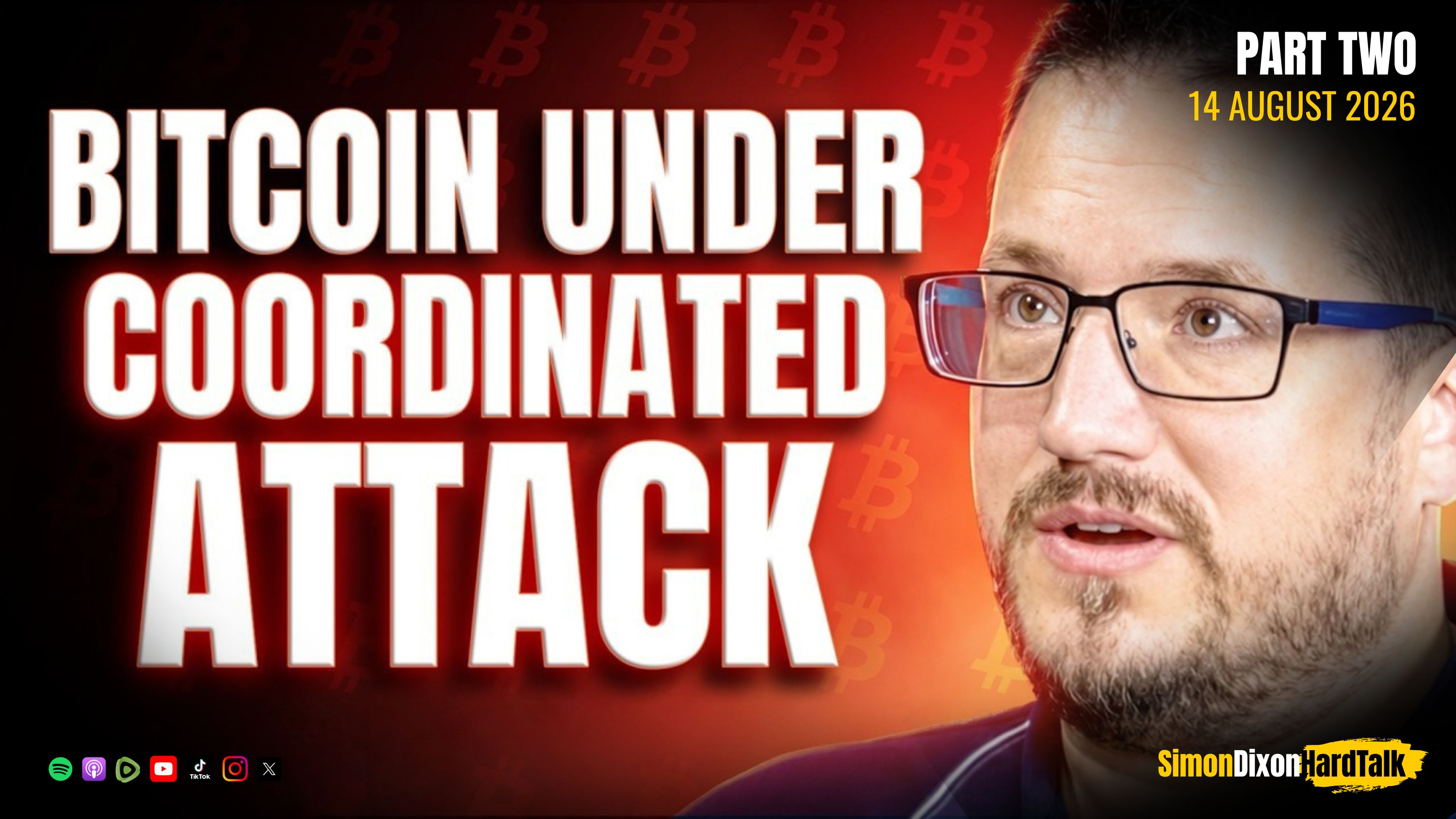
Exiting the Battle for Bitcoin Is Not an Option | Simon Dixon on BTC Sessions w/ Nathan Fitzsimmons (Part Two)
Aug 14, 2026Hey hey sovereign wealth builders,
Exiting the Battle for Bitcoin Is Not an Option. In this update, I connect the physical macro negotiations of our global transition with the technological war over the Bitcoin network. Before we head into my deep-dive postmortem with Nathan from BTC Sessions, we must address the intense pressure the financial industrial complex is mounting to centralise our digital citadel.
A few updates.
Tether has finally completed its financial audit with KPMG, confirming they are over-collateralised with gold and US Treasuries held at Cantor Fitzgerald—a milestone that links back to my work supporting Bitfinex hack victims in 2016.
Yet, there is a catch: you only get this regulatory stamp once you comply and integrate with the financial industrial complex. At the same time, the attempted institutional capture of Bitcoin is accelerating. BlackRock has slashed its ETF in-kind transfer threshold from $25M down to $1M via third party brokers to pull more self-custodied coins into Coinbase custody with more institutions in the middle, while Strategy MsTR claims to be the "central bank of Bitcoin" whilst tokenising its securities on Solana.
On the technical front, we must process the outcome of the Bitcoin civil war and the failed BIP-110 fork, which fell more than 700 blocks behind after 99.8% of Bitcoin’s hashpower stayed with the main chain.
While I supported the resistance by running a Bitcoin Knots node to see if node operators could influence mining pools, the fork's failure proved that consensus-level changes are incredibly hard to achieve. A faction of the BIP-110 community is now pushing for a proof-of-work change to create a new altcoin—this is my red line.
This civil war has coincided with coordinated attacks on the self-custody ecosystem. We've seen a tragic Cold Card entropy exploit draining approximately 2,000 coins, alongside a newly disclosed Trezor shipping provider data breach exposing sensitive order addresses from the last 90 days.
In my view, exiting this battle is simply not an option if we want to defend our individual sovereignty and move from subordinate to sovereign. I invite you to read my 13 lessons from this war, review my free self-custody course created with Andreas Antonopoulos, and stay tuned for the release of my upcoming book, The Game of Money.
To truly understand how we protect our sovereign wealth, rebuild stronger, and navigate these volatile times, we must closely analyze the battlefield. Below is the deep-dive postmortem of my session with Nathan Fitzsimmons on BTC Sessions. Together, we step into the messy reality of Bitcoin's 'open source boardroom' to unpack exactly how the power dynamics of this civil war flipped the script on the 2017 Blocksize Wars, why the BIP 110 node battle ultimately failed to pressure major mining pools, and what these infrastructure attacks mean for the future of self-custody.
This document provides a comprehensive synthesis of the interview between Simon Dixon and host Nathan Fitzsimmons on the show BTC Sessions, recorded on 10 August 2026. This interview is the second part of a two-part series. Part 1, titled "Everyone's Sleepwalking Through the Biggest Event of Our Lives," featured guest panelist Doomberg and lasted 1 hour and 50 minutes. This second part, titled "Exiting the Battle for Bitcoin Is Not an Option," has a duration of 46 minutes and focuses on the aftermath of recent Bitcoin infrastructure attacks and the conclusion of the BIP 110 fork. Both parts are interlinked and essential for a full understanding of the current state of the Bitcoin ecosystem.
Executive Summary
The primary focus of this discussion is the fallout from a "civil war" within the Bitcoin community regarding BIP 110 and a series of coordinated attacks on Bitcoin infrastructure. Simon Dixon argues that while the failed BIP 110 fork and recent security vulnerabilities have temporarily weakened the network's decentralization, they have served as a vital "intelligence" exercise for the community. Dixon maintains that the attacks on self-custody, nodes, and Layer 2 solutions are part of a coordinated "message" from centralizing forces intended to discourage personal sovereignty. The critical takeaway is that while the battle for Bitcoin has become more complex and dangerous, exiting the arena is not an option; instead, participants must "rebuild stronger," diversify their vendors, and embrace the ongoing "proof of work" required for self-sovereignty.
High-Level Overview
The interview frames the current period as one of the most volatile in Bitcoin's history. The discussion is structured around two central pillars:
- The BIP 110 Fork: A reflection on the failed attempt by a minority of node operators to force a consensus change against the will of major mining pools.
- Infrastructure Attacks: An analysis of the "most insane week" in Bitcoin, involving the Coldcard low-entropy vulnerability and cyber-attacks on BTC Pay Server, Zeus, Boltz, and the Lightning Network.
The discussion frames these events not as isolated incidents, but as a test of the "open source boardroom" that governs Bitcoin.
Key Arguments Made by Simon Dixon
Simon Dixon provides an analysis based on his history as a long-term Bitcoin investor and participant in the original Blocksize Wars. His arguments include:
- The Shift in Power Dynamics: Dixon observes that the current "civil war" reversed the roles seen in 2017. In the Blocksize War, miners/corporates tried to change the code while nodes resisted. In the case of BIP 110, node operators (the "resistance") tried to change the code back to a previous state, while miners stopped the change.
- BIP 110 as a Strategic Test: Dixon supported the BIP 110 movement not necessarily out of ideological agreement with the specific code, but to test if a minority of nodes (approximately 20%) could influence large mining pools like Foundry and F2Pool. The failure of BIP 110 proved that consensus-level changes remain incredibly difficult to achieve without total alignment.
- Rejection of "Shitcoins": Dixon states firmly that if a movement results in the creation of a new coin (like Bitcoin Cash or SV), he is "completely out." He believes the goal must be to influence the main Bitcoin chain, not to "die on the hill" of a separate asset.
- Guilty Until Proven Innocent: Regarding the recent wave of attacks, Dixon operates on a heuristic of assuming coordination by default. He finds it statistically improbable that nodes, self-custody tools, hardware wallets, merchant processors, and the Lightning Network would all face simultaneous attacks without a centralizing motive.
- The Nature of the Stolen Bitcoin: Dixon suggests that the $100 million+ stolen from Coldcard users may be part of a "compromise operation." He argues that because stolen Bitcoin is difficult to spend at scale without state-level intelligence protection, such hacks are often used to turn individuals into "assets" or to destroy trust in self-custody.
- Sovereignty as a Continuous Process: Dixon argues that Bitcoin is not a "set it and forget it" technology like gold. He believes personal sovereignty is a skill that carries risk and requires an ongoing "proof of work" through education and practice.
Key Arguments Made by Nathan Fitzsimmons
Nathan Fitzsimmons offers a perspective focused on the social and technical fallout of the recent controversies:
- Social Consequences of BIP 110: Fitzsimmons argues that the BIP 110 movement felt "unbelievably rushed" and moved forward without establishing the necessary social consensus among exchanges and a larger cohort of node operators.
- The Damage to Decentralization: In Nathan's opinion, the recent "fiasco" actually further centralized Bitcoin. He notes that the "Ocean" mining pool, which was leading the way in block template decentralization, took a hit to its hash rate.
- The Loss of Software Diversity: Fitzsimmons highlights the potential loss of Bitcoin Knots as a major blow. With Luke Dashjr moving toward a proof-of-work change, Knots is effectively gone as a competing implementation, leaving Bitcoin Core with near-total dominance.
- The "Best Among Us" Targeted: He notes that the attacks (such as the Coldcard vulnerability) specifically hit the "most hardened bitcoiners"—those who took security most seriously and followed the best available advice.
Points of Agreement
- Centralization is the Enemy: Both participants agree that the current trend is toward centralization and that this is the primary threat to Bitcoin's mission.
- The "Open Source Boardroom": They both view Bitcoin's governance as a messy, high-stakes boardroom where conflict is natural and "money for enemies" means dealing with hostile actors within the camp.
- The Call for Reconciliation: Both speakers emphasize the need for those who "clashed" during the BIP 110 debate to offer "olive branches" and return to the fold to continue the broader mission.
- Self-Custody Importance: Despite the risks highlighted by the Coldcard hack, both maintain that self-custody remains a main path to true financial sovereignty.
Points of Disagreement
- Support for BIP 110: While Dixon chose to "go up to the resistance" and support the BIP 110 experiment to see if nodes could exert pressure, Fitzsimmons remained more neutral and expressed significant concerns regarding the speed and lack of consensus behind the proposal.
Important Data, Claims, or References Mentioned
The following table summarizes the key data points and entities cited during the discussion:
|
Category |
Reference / Data Point |
Details Mentioned |
|
Statistics |
Coldcard Loss |
Over 2,000 coins stolen; estimated value exceeding $100 million. |
|
Statistics |
Node Adoption |
Bitcoin Knots adoption spiked from sub-1% to approximately 20% during the conflict. |
|
Entities |
Mining Pools |
Foundry, F2Pool (large pools); Ocean (decentralized pool led by Luke Dashjr). |
|
Infrastructure |
Vulnerabilities |
Coldcard low entropy; attacks on BTC Pay Server, Zeus, Boltz, and Lightning Network. |
|
Historical Events |
Blocksize War |
References to the 2017 conflict involving SegWit2x, Jihan Wu, and Barry Silbert. |
|
Software |
Implementations |
Bitcoin Core, Bitcoin Knots, Bitcoin ABC (historical), Bitcoin D, BTC. |
|
Historical References |
Bitfinex Hack |
Mentioned in context of the difficulty of spending stolen Bitcoin (120,000 BTC). |
Notable Quotes or Framing
- On the Current State: "I assume this attack and coordinated by default... This is guilty until proven innocent." — Simon Dixon
- On Bitcoin Governance: "Bitcoin has never been a company technology... this is the nature of an open source boardroom." — Simon Dixon
- On the Recent Attacks: "What is the message? Exiting the battle is not an option." — Simon Dixon
- On the Resilience of Users: "Sometimes the worst things are the best things that can happen to us... the community is a thousand times wiser than they were." — Simon Dixon
- On Personal Responsibility: "Key storage is your freedom in a world where everything's going digital... there's no alternative." — Simon Dixon
Open Questions or Unresolved Issues
- The Future of Software Diversity: With Bitcoin Knots potentially defunct, the question remains whether new implementations like the one being developed by Jimmy Song's team ("Production Ready") will gain enough traction to provide a check on Bitcoin Core.
- The Source of the Attacks: The participants left unresolved whether the series of infrastructure attacks were truly a coordinated state-level operation or a series of tragic coincidences, though Dixon strongly favors the former theory.
- The Recoverability of Funds: While Dixon speculates that some funds might eventually be returned through a "settlement" years from now, the immediate fate of the $100 million in stolen Bitcoin remains unknown.
- Node Power: The debate failed to resolve exactly how minority node operators can influence mining pools if a 20% adoption rate is insufficient to force a change.
Call To Action
- Share this post. Share this blog post to expose the "divide and conquer" trap.
- Subscribe to the Simon Dixon YouTube channel. Get my weekly deep dives into geopolitics, macro, and Bitcoin. Subscribe to my YouTube channel.
- Find me on Rumble. This is my backup channel, safe from censorship. Follow me on Rumble.
- Follow me on X @SimonDixonTwitt. I post real-time updates and analysis on X and am highly active there. Follow me on X.
- Follow me on instagram. Usually short clips are posted here.
- Follow me on TikTok. Usually short clips are posted here.
- SimonDixon.com This is my personal site and an archive of all my content, safe from de-platforming. Join the free membership portal.
Watch On YouTube
Prefer to Listen? Available on Apple Podcasts & Spotify
Read Other Related Blogs
PART ONE: Everyone's Sleepwalking Through the Biggest Event of Our Lives | Simon Dixon & Doomberg