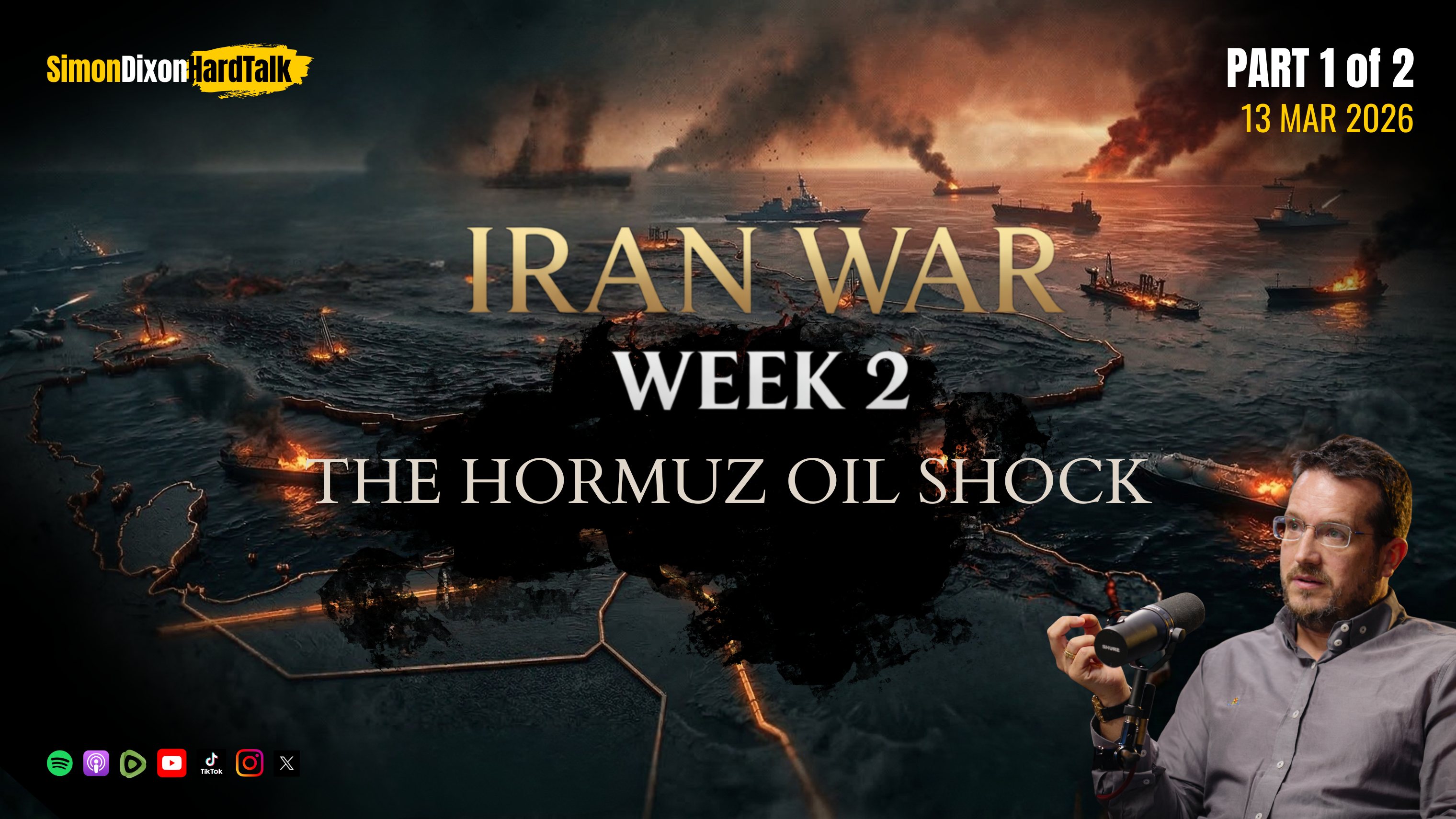
🇮🇷 🇺🇸 The Financial War Behind the Iran Conflict | BTC Sessions interviews Simon Dixon
Mar 13, 2026No time for the full 1h19m video? Watch the 25-minute AI-generated TL;DR Podcast Style Discussion instead. Or watch the 9-minute Ai generated Whiteboard Explainer Video.
Introduction: The Fog of War and the Sovereign Builder’s Lens
Hey hey Sovereign Wealth Builders,
We are currently witnessing a period of unprecedented geopolitical upheaval, and as I often say, you are alive at one of the most interesting times in financial history. On 11th March 2026, I sat down with Nathan from BTC Sessions for a deep-dive interview that spanned 1 hour and 20 minutes. This conversation, which aired across my YouTube and Rumble channels, was intended to peel back the layers of the current Iran conflict to reveal the underlying financial architecture that mainstream media outlets habitually ignore. The title of our discussion, "The Financial War Behind the Iran Conflict," reflects the necessity of looking beyond the surface-level narratives of religious fervor or nuclear brinkmanship to understand where the capital is actually flowing.
In this analysis, I aim to provide you with a framework to navigate the "fog of war." When we see conflicting reports about nuclear capabilities or naval blockades in the Strait of Hormuz, we must ask ourselves who stands to benefit from the chaos. Most people are conditioned to view these events through the lens of national pride or human emotion, but geopolitics is frequently the opposite of human emotion. It is a cold, calculated game played by transnational entities. My goal is to ensure that you stay on the right side of this change, avoiding the wreckage that typically follows for those who remain trapped in the legacy narratives.
The core of our discussion focused on the transition from a unipolar world, dominated by a single Western empire, to a multipolar world order managed by what I call transnational capital. This transition is not an accident; it is an interpretation of a managed global reset. By following the money, we can see how the Financial Industrial Complex is shifting its strategy away from the "forever war" model toward a "build back better" phase that requires regional stability in the Middle East (West Asia).
Understanding this shift is critical for any capital allocator or sovereign individual looking to protect their wealth during this period of fiscal dominance.
The Invisible Framework: The Three Complexes and the Proof of Weapons Network
To understand the current conflict, one must first recognize the existence of what I refer to as the "Proof of Weapons Network." Historically, the global financial system has operated on a mechanism where military force is used to subordinate nations, install Western-style central banks, and extract natural resources to prop up the US Dollar and the Treasury market. This system relies on three distinct but interconnected power structures: The Financial Industrial Complex (FIC), the Military Industrial Complex (MIC), and the Technical Industrial Complex (TIC). In my analysis, the real conflict is not between nations, but rather a struggle I call "MIC versus FIC"—the battle between the Military Industrial Complex and the Financial Industrial Complex.
The Military Industrial Complex, or "MIC," represents the legacy arm of this power structure, profiting from the production of defense hardware and the perpetuation of kinetic warfare. However, this arm is increasingly being disrupted by the Technical Industrial Complex. As we have seen in recent conflicts, high-cost legacy military assets like naval ships and traditional missiles can now be neutralized by relatively inexpensive drones and advanced cyber-warfare. The TIC uses AI and sophisticated algorithms to build out a global surveillance and police state, which serves as the modern enforcement mechanism for the financial system. This shift in technology has forced the traditional "Proof of Weapons" network to evolve into something more technocratic.
The Financial Industrial Complex, or "FIC," is the overarching entity in this hierarchy. It is transnational in nature and possesses no inherent loyalty to any single nation-state. Its primary objective is the management of global capital flows and the preservation of its assets under administration. While the MIC might desire "forever wars" for the sake of defense contracts, the FIC eventually requires a "build back better" phase to secure infrastructure, AI data centers, and energy flows. This suggests that the current conflict in the Middle East is an alleged attempt by the FIC to finalize the destruction phase so that it can transition into a period of high-return reconstruction and regional stability across West Asia. This cycle allows the FIC to profit twice: first by financing the destruction and second by financing its subsequent rebuilding.
The Great Pivot: From National Debt to Private Equities
A significant component of my analysis is the debunking of the "America First" narrative. While politicians often use nationalistic marketing to appeal to voters, their actions are frequently beholden to powerful transnational lobbies, including Big Tech, the military, and financial giants. In our interview, I alleged that there is no such thing as "America First" in the halls of power because the political leadership is effectively renting the US military to global financial interests. This "rented militia" model is the result of decades of financialization and securitization, which has transformed the US economy into a service-based system focused on financial speculation rather than manufacturing.
The vulnerability of this model is exposed by the fact that the US military-industrial base has been hollowed out. Because of globalization, the US is now allegedly dependent on China for the rare earth minerals and critical components required to build high-tech weaponry, such as the F-35 fighter jet. This dependency means the US can no longer sustain a large-scale conflict without the tacit cooperation of its primary economic rival. Furthermore, the shift in global leverage is most visible in the behavior of Gulf Sovereign Wealth Funds (SWFs). Historically, these funds were the primary purchasers of US Treasuries, effectively lending money to the US government to fund its deficits. However, there has been a massive pivot where these funds are now buying US equities instead of debt.
This transition has created a deep partnership between Gulf capital and the giants of Western finance. For instance, following an IPO of 2% of the company, the CEO of Saudi Aramco took a board seat at BlackRock. This gives transnational capital leverage over the US private sector and, by extension, its military strategy. When the largest shareholders of American corporations and asset managers like BlackRock, State Street, and Vanguard are Gulf-based SWFs, the definition of "national interest" becomes incredibly blurred. We also see this through entities like Jared Kushner’s Affinity Partners fund, which allegedly manages $5 billion of Gulf sovereign money, acting as a lobby that dwarfs traditional political influence groups.
Strategic Tension and the End of the Forever War Model
The history of the Middle East is a history of "Strategic Tension." My interpretation of global events suggests that the West has historically funded both sides of various conflicts to prevent any single regional power from unifying. Whether referencing the Iran-Contra affair—where the US and Israel allegedly worked together to sell weapons to Iran while simultaneously funding Iraq—or the alleged funding of various militia groups, the objective was to ensure that the region remained in a state of chaos. This chaos allowed the West to profiteer from war and ensure that energy resources continued to flow in a manner that supported the petrodollar system.
However, the "forever war" model favored by the Military Industrial Complex is now coming into conflict with the needs of the Financial Industrial Complex. The FIC now seeks regional stability to secure its long-term investments in AI data centers and energy corridors. To achieve this, they must eliminate the "agitators" on both sides who benefit from the status quo of conflict. This process of "cleaning house" allegedly involves removing hardliners within Iran’s Islamic Revolutionary Guard Corps (IRGC) who built a resistance economy, as well as radical elements in Israel whose political power is tied to perpetual military mobilization and the "greater Israel" project.
This "cleaning house" is a cold, analytical necessity for the global financial reset. The FIC requires a more pragmatic, reformist leadership in the region that is willing to normalize relations and participate in the new multipolar world order. We have seen signs of this through the alleged use of currency wars to create economic stress, followed by targeted operations to remove those who might derail a peace negotiation. I believe the goal is to move the US military out of its "attack mode" and into a "defense mode," allowing the Gulf countries and China to take the lead in regional diplomacy and economic development, effectively integrating West Asia into the global financial grid.
The Managed Transition: Off-Ramps and the April Resolution
The current conflict is being managed through what I described in the interview as a "Three-Way Off-Ramp." This strategy is designed to allow all major players to claim a form of victory while undergoing internal regime shifts. In this interpretation, Iran is permitted to look strong to its domestic audience by hitting US military bases and claiming it has humbled the "Great Satan." Simultaneously, the US government can claim it has achieved peace through strength and dismantled nuclear threats. Israel, meanwhile, can claim it has neutralized hostile militias, even as it undergoes an internal regime change to remove hardline figures like Benjamin Netanyahu, who may have already negotiated an exit to places like Argentina or Hungary to avoid prosecution.
A critical milestone in this managed transition is the predicted "China Summit" in April. I forecast that this summit will serve as the formal unveiling of the newly negotiated multipolar world order. China is increasingly acting as the lead diplomat in West Asia, and they have prepared for this transition with great foresight, allegedly building a strategic oil reserve of 1.2 billion barrels in anticipation of this conflict. While the US President is likely to take public credit for the peace deal, portraying it as a result of "strength," the actual terms have been dictated by the requirements of transnational capital and the diplomatic maneuvers of China.
These movements involve high-stakes operations in the "fog of war." For example, there was a recent horrific bombing of a school in Iran that killed 165 children. My analysis suggests this may have been an "off-plan" Israeli operation intended to derail peace negotiations, which the US is now deciding whether to cover up. We also see the use of financial weapons, such as the alleged currency operation conducted by Scott Bessent, designed to destroy the Iranian currency and create the economic stress necessary for an uprising. These are not accidental escalations but are part of a Global Reset where the Financial Industrial Complex ensures its continued relevance across the GCC and BRICS nations.
Macro-Economic Consequences: Fiscal Dominance and the Dollar’s Decline
From a macro-economic perspective, the conflict follows a predictable cycle. During the initial phases of the war, the US Dollar typically strengthens as capital seeks a safe haven, and oil prices spike due to supply concerns. This strengthens the dollar's position temporarily and allows the US to continue printing money to monetize its debt—a process known as "Fiscal Dominance." We are seeing this through the increase of the US military budget from $1 trillion to $1.5 trillion, which pumps liquidity into the markets while burdening the public with debt.
The endgame of fiscal dominance involves the managed devaluation of the currency. A key figure to watch is Kevin Warsh, who is expected to come into power in May. In my interpretation, Warsh will provide the "hawkish credibility" necessary to print money aggressively to finance military operations and debt monetization. The financial system allegedly intends to "dump" low-interest, long-term debt onto pensioners while the smart money transitions into productive assets. This creates a "K-shaped" economy where asset owners profit from the "Build Back Better" phase while the middle class is hollowed out by inflation.
In the post-conflict environment, once the "off-ramps" are executed, oil prices will likely crash and the US Dollar will enter its managed shrinking to a regional power. My analysis suggests that foreign markets, particularly those in West Asia and the East, will begin to outperform the US market. As the era of the US Dollar as the undisputed global reserve currency begins to unwind, it will be replaced by a more fragmented, technocratic global financial order. This is a slow process designed to prevent total systemic collapse while transferring wealth to those who control the new multipolar architecture.
Bitcoin: The Ultimate Resistance and the Self-Custody Endgame
Amidst this backdrop of managed transitions and technocratic surveillance, Bitcoin emerges as the ultimate resistance. There is a fundamental distinction between the "Proof of Weapons" network and Bitcoin’s "Proof of Work." While the legacy system relies on military force and the manipulation of debt to maintain power, Bitcoin relies on a transparent, immutable mathematical reality. It is the only financial system that offers a true hedge against the emerging technocratic surveillance state, which aims to utilize Central Bank Digital Currencies (CBDCs) to control individual behavior and financial flows.
The real "endgame" in this macro narrative is the "self-custody play." As the financial system becomes more unstable and more reliant on paper contracts and derivatives, the discrepancy between the "paper" supply of assets and the "physical" supply will become untenable. I believe that paper contracts for Bitcoin, as well as gold and silver, will eventually be exposed when investors realize there is not enough underlying commodity to satisfy the claims. We are already seeing the early signs of this as major asset managers like BlackRock enter the space; eventually, the derivatives complex will face a reckoning, making physical possession and cold-storage self-custody the only ways to truly verify ownership of your wealth.
For the sovereign individual, the goal during this period of volatility is to ignore the short-term noise and accumulate Bitcoin, Gold and other commodities. Whether it trades in correlation with the Nasdaq or as an "AI tech play" in the short term is irrelevant to its long-term purpose as a decentralized store of value. The managed transition to a multipolar world is designed to consolidate power among transnational entities, but Bitcoin provides an exit ramp from that system. By practicing self-custody, you remove your capital from the "Proof of Weapons" network and place it into a system governed by "Proof of Work," which is the only real defense against the Orwellian nightmare of a fully digital, state-controlled financial grid.
Call to Action
The information discussed here represents a significant departure from the narratives you will find in the mainstream press. To gain the full context of these insights and to see the data points I have laid out in their entirety, I highly encourage you to watch the complete 1 hour and 20 minute interview here or on the Simon Dixon YouTube or Rumble channels. These deep-dive sessions are designed to help you think like a strategist and act like a builder of sovereign wealth in an era of managed chaos.
If you value this type of macro-economic and geopolitical analysis, please take a moment to subscribe to the Simon Dixon YouTube channel for our weekly updates and feedback sessions where I break down the latest global trends and capital flows. For real-time analysis, commentary on breaking news, and to participate in our live Spaces, you should follow me on X, formerly known as Twitter. Finally, I ask that you share this blog post with other capital allocators and Sovereign Wealth Builders who are looking for clarity in these uncertain times. Together, we can navigate this transition and ensure we are on the right side of the changes coming to the global financial system.
- Share this post. Share this blog post to expose the "divide and conquer" trap.
- Subscribe to the Simon Dixon YouTube channel. Get my weekly deep dives into geopolitics, macro, and Bitcoin. Subscribe to my YouTube channel.
- Find me on Rumble. This is my backup channel, safe from censorship. Follow me on Rumble.
- Follow me on X @SimonDixonTwitt. I post real-time updates and analysis on X and am highly active there. Follow me on X.
- Follow me on instagram. Usually short clips are posted here.
- Follow me on TikTok. Usually short clips are posted here.
- SimonDixon.com. This is my personal site and an archive of all my content, safe from de-platforming. Join the free membership portal.
Watch on YouTube
Prefer to Listen? Available on Spotify & Apple Podcasts
Read other related blogs

Disclaimer
This content is for informational and educational purposes only and does not constitute financial, legal, or investment advice. Geopolitical and financial analysis involves significant risk; please consult with a professional advisor before making any investment decisions. The views expressed are interpretations of complex global events and include alleged activities of various entities, including governments, lobbies, and financial institutions. The accuracy of the "fog of war" information discussed cannot be guaranteed, and all claims regarding specific individuals or organizations should be viewed as analysis and interpretation rather than established fact.