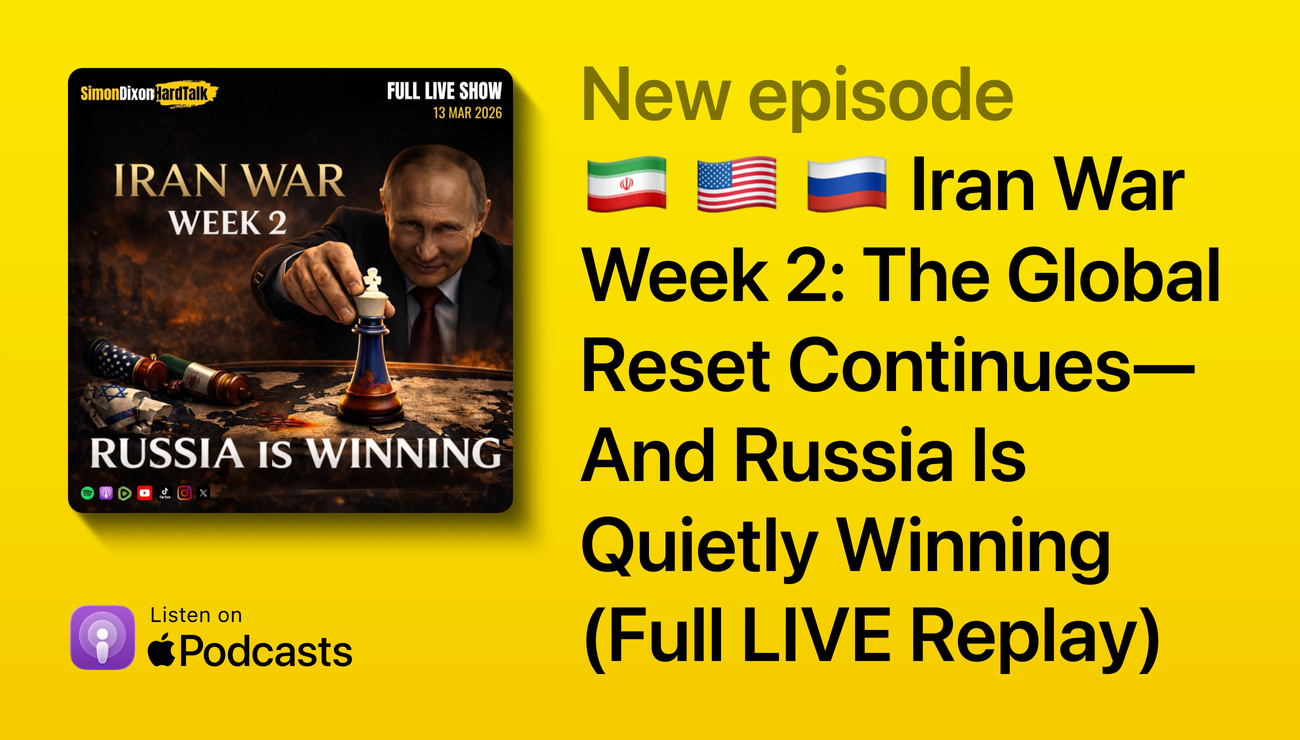
🇮🇷 🇺🇸 🇷🇺 Iran War Week 2: The Global Reset Continues—And Russia Is Quietly Winning | SimonDixonHardTalk LIVE
Mar 13, 2026No time for the full 3 hour video? Watch the 18-minute AI-generated TL;DR Podcast Style Discussion instead. Or watch the 8-minute Ai generated Whiteboard Explainer Video.


Introduction: The Managed Transition
Hey hey Sovereign Wealth Builders.
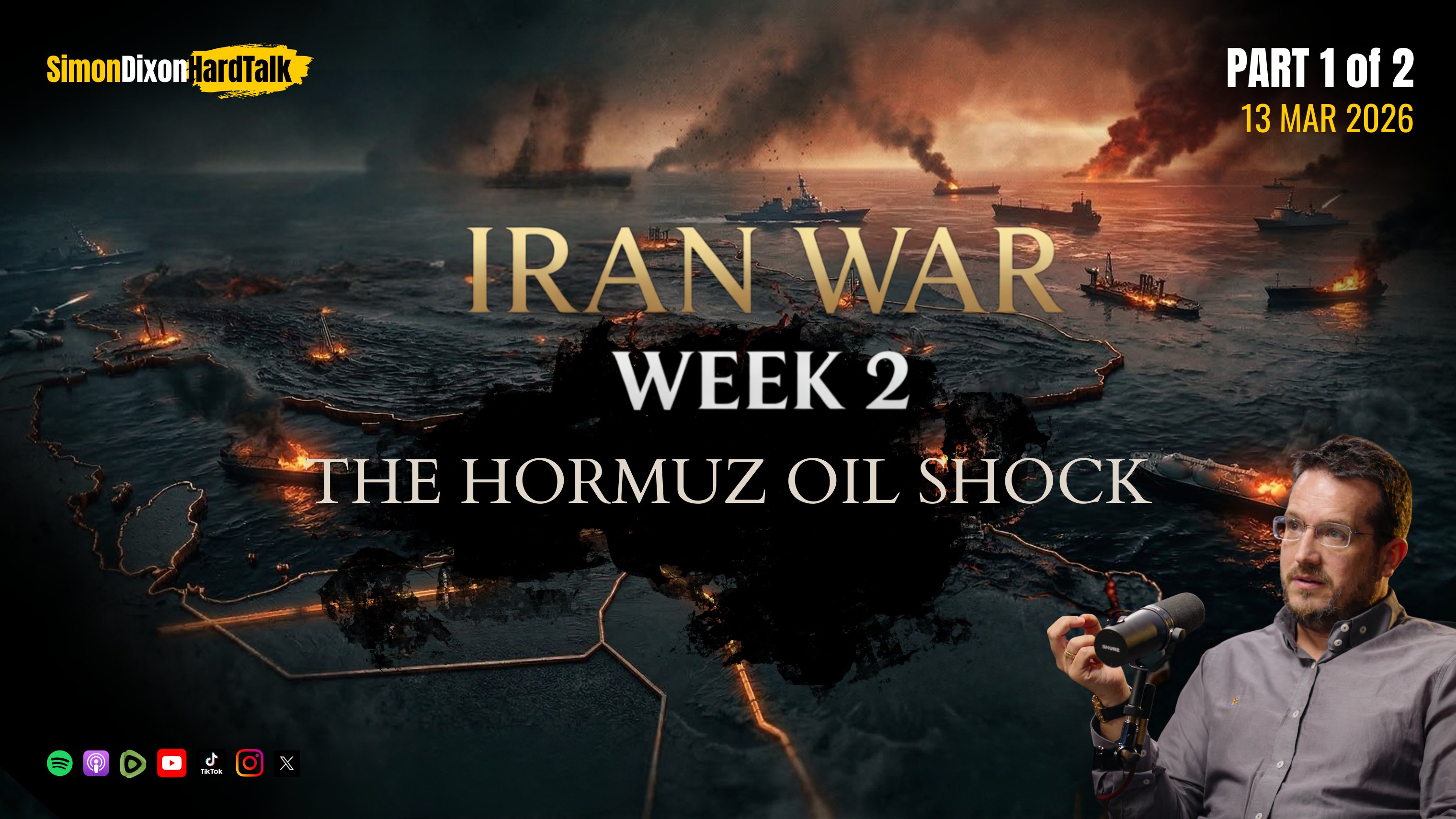
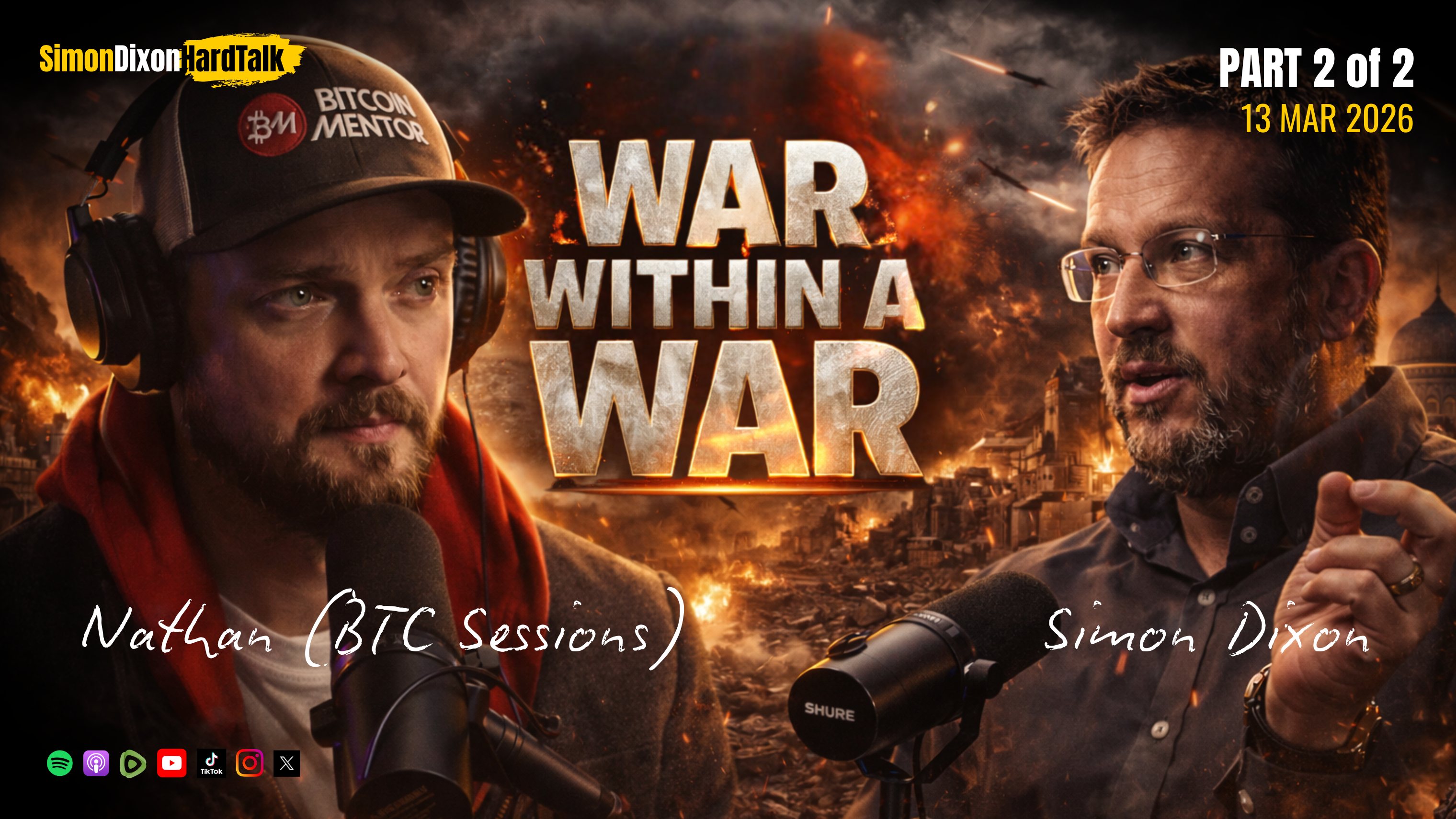
This analysis is based on the full livestream titled “🇮🇷🇺🇸🇷🇺 Iran War Week 2: The Global Reset Continues—And Russia Is Quietly Winning | SimonDixonHardTalk LIVE,” which aired on March 13th, 2026, with a total duration of 3 hours on YouTube, X, and Rumble. The discussion is meticulously broken down into Part 1, "Iran War Week 2: The Hormuz Oil Shock," and Part 2, "The Financial War Behind the Iran Conflict | BTC Sessions interviews Simon Dixon." While Week 1 was characterized by the initial shock and damage phase of a kinetic conflict, Week 2 has seen the markets begin to price the actual limits of this confrontation. I believe we are no longer merely discussing bombs and missiles; we are witnessing a "Theatrical War"—a managed transition and a renegotiated settlement of global energy and financial systems. This is an authoritative look at how capital allocators must interpret the move toward a multipolar world order, where the theatricality of victory serves to mask the hard economic reality of a global reset.
The Hormuz Oil Shock and the Market’s Hidden Ceiling
The second week of the conflict provided an incredible display of market intervention and volatility management as WTI oil spiked toward $115 before experiencing a historic $26 collapse to $89 within a seventy-two-hour window. This price action confirms the existence of a strategic "Oil Ceiling" between $110 and $120, a zone where the global system reaches a breaking point for inflation and political stability, triggering aggressive intervention. While mainstream narratives focus on a total blockade, savvy investors are following the money through bypass infrastructure like the Saudi East–West Pipeline. This 750-mile artery is currently pumping at its maximum theoretical capacity of 7 million barrels per day for the first time in history. When combined with the UAE ADCOP and Iraq–Turkey pipelines, the theoretical bypass capacity sits at 10 million barrels per day, though real-world port constraints limit this to an actual flow of 5 to 6 million. However, the true escalation ladder remains the Red Sea; if the Houthis successfully shut down the Bab el-Mandeb, the Saudi bypass network effectively collapses, as those Red Sea exports would have no safe passage, potentially sending oil back through the $115 ceiling.
The Insurance Chokepoint: War by Financial Infrastructure
The effective closure of the Strait of Hormuz has revealed that the Financial Industrial Complex (FIC) wields more power than any naval fleet. It is striking that while approximately 20,000 regional flights were cancelled, aviation insurers continued to provide coverage for carriers like Qatar Airways and Emirates, yet war-risk insurers for the shipping industry abruptly withdrew coverage. This coordinated financial withdrawal forced shipping premiums to an alleged 75% of total cargo value, effectively grounding the tanker fleet without a single confirmed direct missile strike on a vessel. This discrepancy suggests that the Strait was closed not by kinetic destruction, but by the invisible hand of financial infrastructure to facilitate a tactical pause. It is alleged that this chokepoint is being used as a lever to renegotiate long-term energy agreements while the FIC ensures the system remains just stable enough to prevent a total systemic meltdown.
Russia’s Quiet Victory and West Asia’s Realignment
Russia has emerged as the definitive economic victor of Week 2, capitalizing on a geopolitical landscape that Simon Dixon identifies as the return of "West Asia"—a rejection of colonial "Middle East" terminology. As oil prices moved from discounted levels of $35 to $40 up toward $100, Russian revenue has surged, providing the Kremlin with massive leverage. In a move of blatant energy diplomacy, Scott Bessent announced the removal of certain US sanctions on Russian oil already at sea to prevent a global supply catastrophe. This has resulted in a permanent splitting of the energy map: Europe is now trapped in a deeper, more expensive dependency on US LNG, while Asia pivots decisively toward the BRICS corridor and Russian energy. Russia is now using this windfall to bolster its reserves and solidify its position as the primary energy guarantor for a multipolar Asia, effectively winning the economic war while the West manages the theater of the kinetic one.
The Hidden Financial Reset: Private Credit and Force Majeure
The energy shock is currently being used as cover for a massive restructuring within Western private credit markets. Significant stress has emerged in non-bank lending, with major institutions like BlackRock allegedly restricting withdrawals from credit vehicles to prevent a wider contagion. These finance houses are reportedly invoking "Force Majeure" clauses—citing the war as an exceptional circumstance—to freeze redemptions and write down underperforming loans, specifically those tied to over-leveraged AI data centers that lack immediate revenue models. This stress coincides with the steady rise of 10, 20, and 30-year US Treasury yields, signaling the onset of "fiscal dominance." The appointment of Kevin Warsh in May is expected to provide the hawkish credibility necessary for the US to pivot toward aggressive money printing to devalue its debt. This "Big Print" will be the ultimate bailout for a financial system that is currently using the fog of war to clean its balance sheets at the expense of currency holders.
The Three Complexes: MIC, FIC, and TIC
To understand this transition, one must recognize the war between three rival power structures. The Military Industrial Complex (MIC), thrives on "forever wars" and the "Proof of Weapons Network," which uses military force to subordinate nations to the dollar. Opposing the MIC’s chaos is the Financial Industrial Complex (FIC), or the "Fick," which seeks regional stability to secure the flow of transnational capital and the "build back better" phase of global development. Joining them is the Technical Industrial Complex (TIC), which utilizes AI and algorithms to construct a technocratic surveillance state. The current conflict is an attempt by the Fick to use the US military as a "rented militia" to eliminate "agitators"—including alleged hardliners in the IRGC and radical elements in Israel—who profit from instability. The FIC’s ultimate goal is to secure the infrastructure for AI data centers and global capital flows, replacing regional chaos with a stable, multipolar investment environment.
The Three-Way Off-Ramp and the April China Summit
Drawing a historical parallel to the "12-Day War," the current conflict is moving toward a negotiated "Three-Way Off-Ramp" where all actors can claim a theatrical victory. The US will likely claim a Hollywood-style triumph by alleging the destruction of Iran’s nuclear program; Israel will claim the dismantling of proxy networks while undergoing an internal regime change to remove the alleged radicalism of the Netanyahu administration. Simultaneously, Iran is signaling a transition toward civilian control following the Pezeshkian speech on March 7th and the alleged installation of Mojtaba Khamenei as a reform-aligned Supreme Leader on March 8th. This orchestrated drama is set to culminate in the "China Summit" this April, where Xi Jinping and Donald Trump are expected to formalize a new world order. In this scenario, Trump will take public credit for a peace deal that was largely engineered by Chinese diplomacy and the economic necessity of the BRICS corridor.
The Sovereign Strategy: Bitcoin as the Ultimate Hedge
The market signals are currently bifurcated: Gold remains relatively flat while Bitcoin trends upward, indicating that the smart money is pricing an energy shock rather than a total systemic collapse—for now. However, Bitcoin remains the only viable "Proof of Work" resistance against the "Proof of Weapons" system and the TIC’s surveillance state. Simon Dixon warns of a massive "Paper Bitcoin" risk, where the derivatives complex—led by entities like Jane Street—may face catastrophic liquidations. In the event of a systemic freeze, "Force Majeure" will likely be called on paper contracts, leaving only those in self-custody with actual assets. The long-term strategy for a Sovereign Wealth Builder is the accumulation of real Bitcoin held in self-custody to survive the managed decline of the dollar and the inevitable "Big Print" required to paper over the cracks in the private credit market.
Conclusion and Call to Action
Week 2 has pulled back the curtain on the limits of kinetic warfare and revealed the acceleration of a multipolar reset. We are witnessing a global renegotiation of power, where energy flows are being rerouted and financial systems are being restructured under the cover of orchestrated volatility. To stay on the right side of this change, look past the media theater and follow the money.
- Share this post. Share this blog post to expose the "divide and conquer" trap.
- Subscribe to the Simon Dixon YouTube channel. Get my weekly deep dives into geopolitics, macro, and Bitcoin. Subscribe to my YouTube channel.
- Find me on Rumble. This is my backup channel, safe from censorship. Follow me on Rumble.
- Follow me on X @SimonDixonTwitt. I post real-time updates and analysis on X and am highly active there. Follow me on X.
- Follow me on instagram. Usually short clips are posted here.
- Follow me on TikTok. Usually short clips are posted here.
- SimonDixon.com. This is my personal site and an archive of all my content, safe from de-platforming. Join the free membership portal.
Watch on YouTube

Prefer to Listen? Available on Spotify & Apple Podcasts
Read other related blogs
Disclaimer
The content provided in this article is for informational and educational purposes only and does not constitute financial, legal, or investment advice. Macroeconomic and geopolitical commentary reflects the author’s analytical interpretation of available data and must be viewed as speculative analysis rather than statements of absolute fact. All claims regarding "managed transitions," the coordination of the Financial Industrial Complex, or the internal maneuvers of political figures such as Netanyahu or Mojtaba Khamenei are alleged and based on the author's "follow the money" methodology. Investing in private credit, energy markets, and digital assets involves extreme risk, including the risk of total loss. The potential use of "Force Majeure" clauses in paper contracts and the volatility of West Asian conflicts can lead to sudden market freezes. Consult with a qualified professional before making any financial decisions. The author is not responsible for any financial losses resulting from the use of this information.