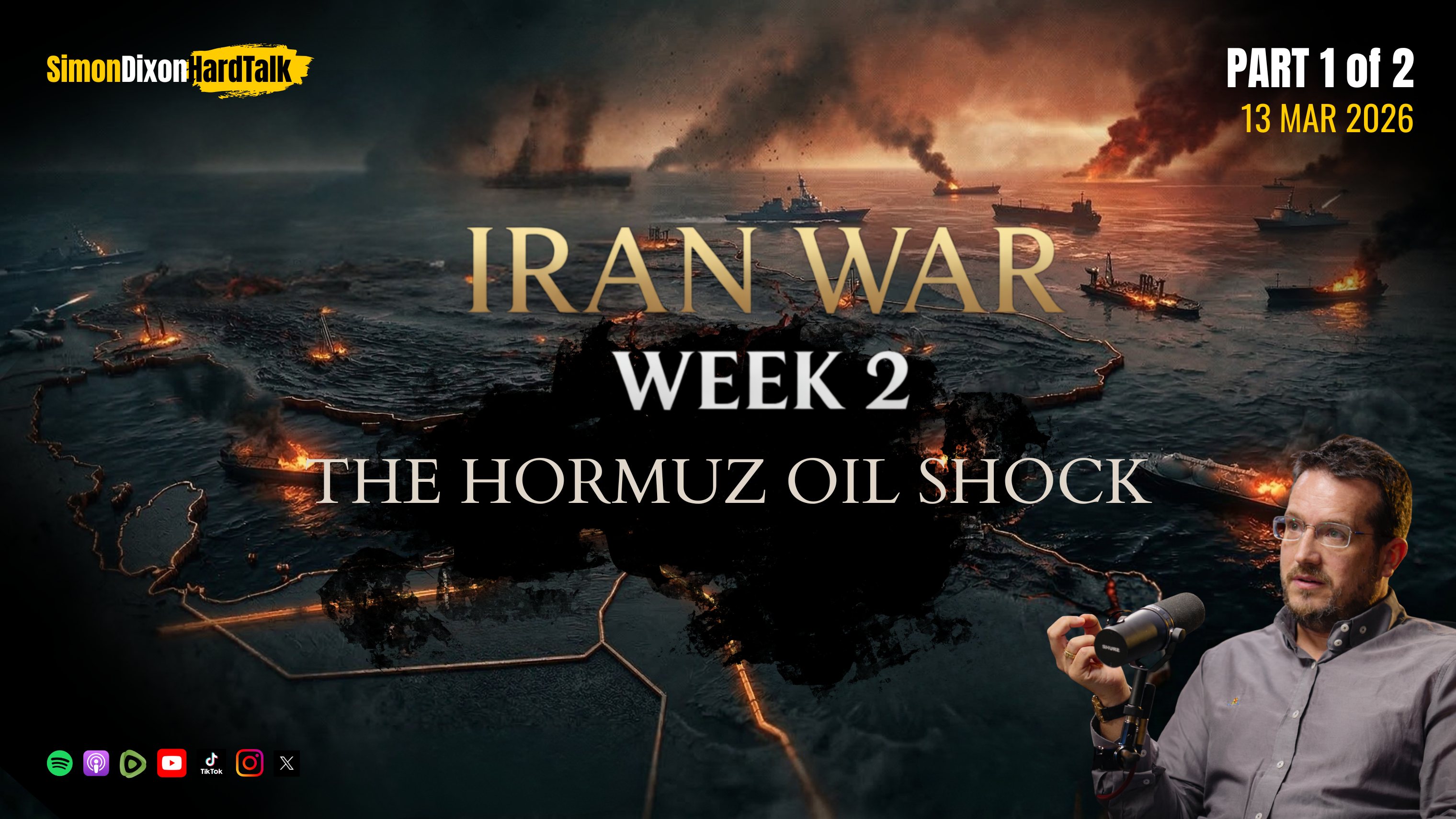
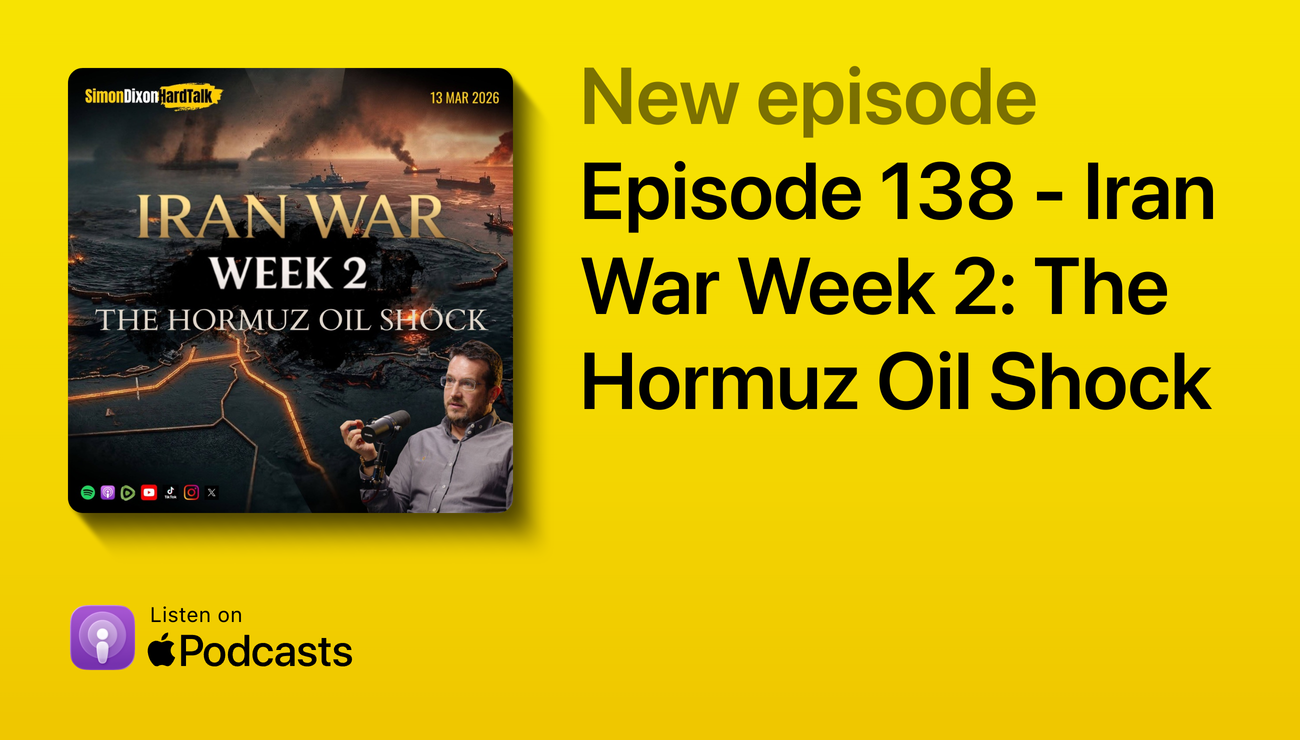
Iran War Week 2: The Hormuz Oil Shock
Mar 13, 2026No time for the full 1h40m video? Watch the 19-minute AI-generated TL;DR Podcast Style Discussion instead. Or watch the 8-minute Ai generated Whiteboard Explainer Video.
The Opening Salvo and Strategic Context
Hey hey Sovereign Wealth Builders.
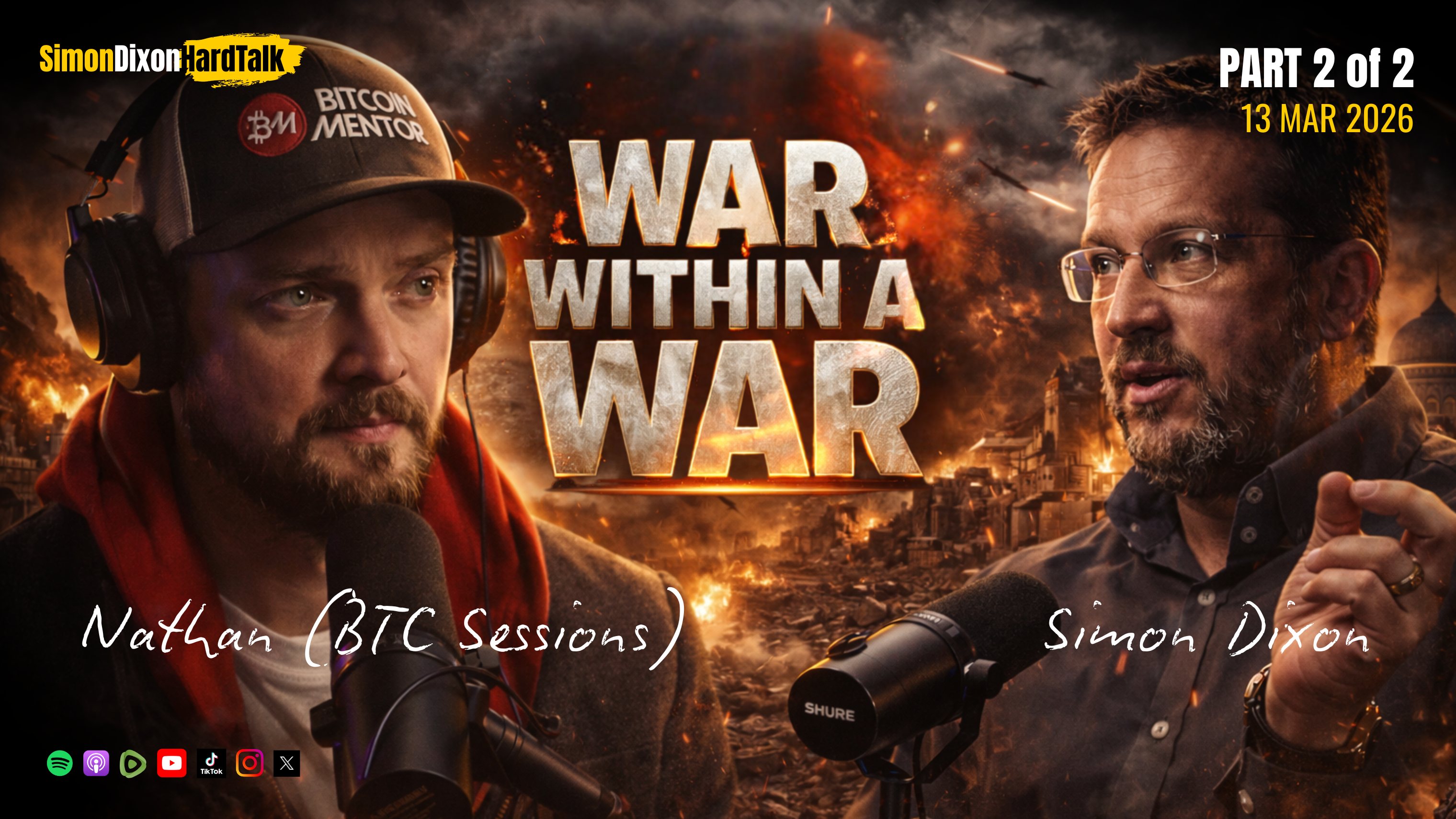
It is an honor to have you with us as we deconstruct the accelerating shifts in the global order. We are currently navigating the second week of the Iran conflict, a period that marks a profound transition from the kinetic "shock phase" of the initial outbreak to a more calculated phase of market pricing and structural realignment. This analysis is derived from our three-hour intensive session, “🇮🇷🇺🇸🇷🇺 Iran War Week 2: The Global Reset Continues—And Russia Is Quietly Winning | SimonDixonHardTalk LIVE,” which aired on 13th March 2026. The broadcast was meticulously divided into two segments: “Part 1: Iran War Week 2: The Hormuz Oil Shock” and “Part 2: The Financial War Behind the Iran Conflict | BTC Sessions interviews Simon Dixon.” While Week 1 was characterized by the immediate panic of missiles and theater, Week 2 is where the Financial Industrial Complex (FIC) begins to exert its dominance over the Military Industrial Complex (MIC), managing the volatility to facilitate a systemic reset. This article focuses on the first 100 minutes of that broadcast, analyzing how the global system is internalizing a new equilibrium in West Asia.
The Hormuz Oil Shock: Markets and Equilibrium
The market volatility of the past week has been historic, defining a clear "oil price ceiling" that the global financial system is currently unwilling to breach. We witnessed an extraordinary gap in WTI crude to a peak of $115, followed by a violent $26 collapse to $89 within just seventy-two hours. This represents the most significant price increase and decrease cycle in the history of oil markets, signaling that "real money" is actively testing the limits of this conflict. An equilibrium zone has established itself between $110 and $120; once prices enter this territory, the threat of systemic inflation, political backlash, and total demand destruction becomes a secondary war that the G7 cannot win. The Trump administration has attempted to manage these spikes through the "Taco Trade"—alleged optics-driven announcements on social media suggesting an imminent end to hostilities. However, much like the "Silver short squeeze" of the past, the effectiveness of these optical tools is waning. We are seeing a likely structural short position held by entities like the Treasury, where futures and options are used to suppress prices. If these suppression tactics fail and a liquidation cycle is triggered, the resulting price spike would be catastrophic, echoing the volatility seen when the Federal Reserve was forced to pivot from QT to QE during previous repo market distress.
The Invisible Infrastructure: Bypassing the Chokepoint
While the mainstream media obsesses over the potential physical closure of the Strait of Hormuz, a network of alternative infrastructure is providing a temporary cushion for the global economy. The Saudi East-West Pipeline is currently operating at its full capacity of 7 million barrels per day, a historic first for the 750-mile desert artery. When integrated with the UAE’s ADCOP pipeline to Fujairah, the alleged Goreh-Jask route in Iran, and the Iraq-Turkey corridor to the Mediterranean, the total theoretical bypass capacity reaches approximately 10 million barrels per day. However, real-world logistical bottlenecks and port limitations suggest a functional capacity closer to 5 or 6 million barrels per day. While this has prevented oil from instantly skyrocketing to $150, it leaves the global system precariously dependent on these bypasses. The next phase of the escalation ladder likely involves the Red Sea transit zones, where the Houthi-controlled threat zone could effectively nullify these alternative routes, removing millions more barrels from the market and forcing a total energy renegotiation.
The Insurance Chokepoint: A Financial Industrial Complex Operation
The functional paralysis of shipping in the Strait of Hormuz is not merely a military outcome; it is a sophisticated operation enforced by the Financial Industrial Complex. A glaring discrepancy exists between maritime shipping and aviation: while approximately 20,000 flights were impacted and jet fuel reached record highs, war-risk insurers allegedly continued to cover carriers like Emirates and Qatar Airways. Conversely, these same insurers allegedly withdrew coverage for tankers, causing premiums to explode to roughly 75% of total cargo value. This move effectively closed the Strait without the need for a full-scale naval engagement. The lack of confirmed direct tanker strikes, contrasted with the narrative of "interceptor debris" and "shrapnel," suggests a highly theatrical management of the conflict. The FIC appears to be using insurance and financial infrastructure as a chokepoint to force the renegotiation of long-term energy contracts, keeping the MIC occupied with managed kinetic displays while finance positions itself for the "Build Back" phase.
Russia as the Quiet Victor and the US LNG Pivot
Russia has emerged as the primary economic beneficiary of this conflict’s second week. By transitioning from selling oil at an alleged sanctioned discount of $35 to commanding near-market prices of $100, the Russian economy has secured a massive de-dollarized windfall. This windfall was ironically facilitated by the US government’s alleged temporary easing of sanctions to allow Russian oil shipments already at sea to stabilize the market—a desperate move to prevent a global price explosion. Simultaneously, we are witnessing the strategic "vassalization" of Europe. With Qatari LNG disrupted, European nations are being forced into a deep, long-term dependency on US LNG exports. This is splitting the energy map into a Western hemisphere subordinate to US private sector energy interests and an Eastern sphere where Asia aligns with Russian and Chinese corridors. The multipolar reality is further underscored by the fact that the US military-industrial base cannot even produce drones or F-35s without Chinese components, revealing a "weapons network" that makes an unmanaged global war nearly impossible.
The Hidden Financial Reset: Private Credit and Force Majeure
Beneath the fog of war, a hidden financial reset is unfolding within the private credit markets, which have driven much of the recent US growth in AI and data centers. Significant stress is appearing in these non-bank lending sectors as the Gulf sovereign wealth funds use their leverage to renegotiate investment terms. Major institutions, including BlackRock, JP Morgan, and Deutsche Bank, have allegedly implemented redemption freezes or restricted withdrawals in specific credit vehicles. This conflict provides the perfect "Force Majeure" cover, allowing these massive entities to write down losses and restructure unprofitable loans that were already failing due to AI disruption. While the dollar appears strong on the surface, US Treasury yields for 10, 20, and 30-year bonds are rising steadily. This increases the cost of financing the national debt, applying "vassal pressure" on the US government by its own bondholders and the FIC, who effectively treat the US military as a for-rent militia for transnational capital.
The Political Shift: Internal Power Transitions
We are observing a managed political transition in West Asia that mirrors historical resets like "Operation Ajax." In Iran, the alleged installation of Mojtaba Khamenei as Supreme Leader, following President Pezeshkian’s March 7th speech regarding civilian control over military assets, suggests an internal purge of hardliners who were not on board with the regional stability plans favored by China. This is a theatrical "Operation Ajax 2.0," designed to preserve the IRGC structure while pivoting toward a negotiated outcome. Simultaneously, in the US and Israel, we see the alleged marginalization of neocon "dinosaurs" like Lindsey Graham and Ted Cruz. The narrative is shifting toward a regime change within Israel itself, moving away from radicalized elements toward a structure more aligned with the 20-point stability plans favored by the Gulf sovereign wealth funds and the FIC.
The Endgame: The Final Act and the China Summit
The projected timeline for this conflict points toward a "Visual Victory" for the Trump administration, likely involving "Operation Midnight Hammer"—an alleged strike on a nuclear facility designed for narrative impact rather than total destruction. This "Hollywood moment" would allow for a declared victory and a ceasefire in March, leading directly into a high-stakes Xi-Trump summit in April to finalize the multipolar trade order. The financial markets are already pricing this off-ramp; the "Gold Signal" has remained relatively flat, suggesting that the most sophisticated capital does not expect a systemic World War III collapse. Instead, Bitcoin continues its upward trajectory as a high-beta trade on AI and liquidity, signaling that the markets expect a managed negotiation and a eventual massive "print" to devalue global debt.
Call to Action and Sovereign Wealth Conclusion
For the Sovereign Wealth Builder, the message is clear: the US footprint in West Asia is being reduced in favor of a multipolar energy and financial alignment. To understand the full depth of this macro analysis and how to protect your capital during this reset, watch the full livestream replay on YouTube, X, or Rumble. Subscribe to the Simon Dixon YouTube channel and Rumble channel, and follow me on X for real-time updates. Ensure you participate in the next SimonDixonHardTalk LIVE session to stay ahead of the transition.
- Share this post. Share this blog post to expose the "divide and conquer" trap.
- Subscribe to the Simon Dixon YouTube channel. Get my weekly deep dives into geopolitics, macro, and Bitcoin. Subscribe to my YouTube channel.
- Find me on Rumble. This is my backup channel, safe from censorship. Follow me on Rumble.
- Follow me on X @SimonDixonTwitt. I post real-time updates and analysis on X and am highly active there. Follow me on X.
- Follow me on instagram. Usually short clips are posted here.
- Follow me on TikTok. Usually short clips are posted here.
- SimonDixon.com. This is my personal site and an archive of all my content, safe from de-platforming. Join the free membership portal.
Watch on YouTube
Prefer to Listen? Available on Spotify & Apple Podcasts
Read other related blogs

Disclaimer
This document is provided for informational and educational purposes only and does not constitute financial, legal, investment, or tax advice. The macroeconomic and geopolitical commentary contained herein reflects a specialized analysis of global power dynamics, utilizing a "theatrical" framework to interpret conflict management rather than making absolute statements of fact. All mentions of institutional redemption freezes at entities such as BlackRock, JP Morgan, or Deutsche Bank, as well as political transitions involving Mojtaba Khamenei or other world leaders, are strictly "alleged" and represent the author's professional interpretation of market signals and transcript context. Investing in energy, commodities, and digital assets involves high risk. You should consult a qualified professional before making any financial decisions. The author is not responsible for any losses resulting from the interpretation of this strategic brief.